
A DWI arrest can turn an ordinary night into a week of panic. You may be worried about your job, your license, your family, and whether one bad stop now controls everything that comes next.
It doesn't.
An arrest is not a conviction. If you're searching for how to get a DWI dismissed in Texas, the most important thing to know is that dismissal usually comes from fast, disciplined legal work, not from hope, excuses, or waiting to see what happens. In many cases, the first few days after arrest shape what's still possible later.
A DWI Arrest Is Overwhelming but a Dismissal May Be Possible
Right after a DWI arrest, individuals often make one of two mistakes. They either assume the case is hopeless, or they assume it will “work itself out” because it's a first offense. Both reactions can weaken your defense.
Texas DWI cases can be dismissed, but usually for specific legal reasons. Weak stops. Weak arrests. Bad testing. Missing video. Sloppy procedure. A prosecutor rarely drops a case because someone is sorry. A prosecutor drops a case when the evidence has real problems.
A useful reality check comes from a 2024 compilation of results from the five largest Texas counties, which reported a 34.2% dismissal rate for first-time DWI cases, compared with 15.2% for second-offense cases and 6.17% for felony DWI cases. That matters because it shows dismissal is a real outcome, especially when prior history isn't working against you.

What a dismissal really means
A dismissal means the criminal charge is dropped. That is different from being found not guilty at trial. It is also different from pleading to a lesser offense.
If your goal is to protect your record, your license, and your future, the strategy has to start early. That's especially true in a first DWI in Texas, where the facts may still leave room to challenge the state's case before it hardens.
Practical rule: The best dismissal arguments are usually built before the prosecutor is fully comfortable with the file.
Key terms you should understand now
A few terms show up in almost every DWI case:
- BAC: Blood alcohol concentration. This is the alcohol level the state may try to prove through a breath or blood test.
- Implied consent: Texas drivers are considered to have consented to chemical testing rules tied to driving privileges, which is why a refusal can trigger a separate license issue.
- Field sobriety test: Roadside coordination and attention tests officers use to claim impairment.
- Administrative license suspension: A separate license process handled through the state, apart from the criminal court case.
If you want to fight a DWI in Texas, you need to think about both the courtroom case and the license case from day one.
Your First 15 Days The Critical Post-Arrest Checklist
The first deadline that matters isn't your trial date. It's your license deadline.
In Texas, there is a separate administrative case called the Administrative License Revocation hearing, often shortened to ALR hearing. This is not the same as your criminal DWI case. It deals with whether the Texas Department of Public Safety can suspend your license after the arrest.
A Texas DWI defense source discussing dismissal chances notes the 15-day deadline to request an ALR hearing after arrest. If you miss it, the license suspension can move forward automatically. That one deadline often decides whether your defense starts in control or starts behind.
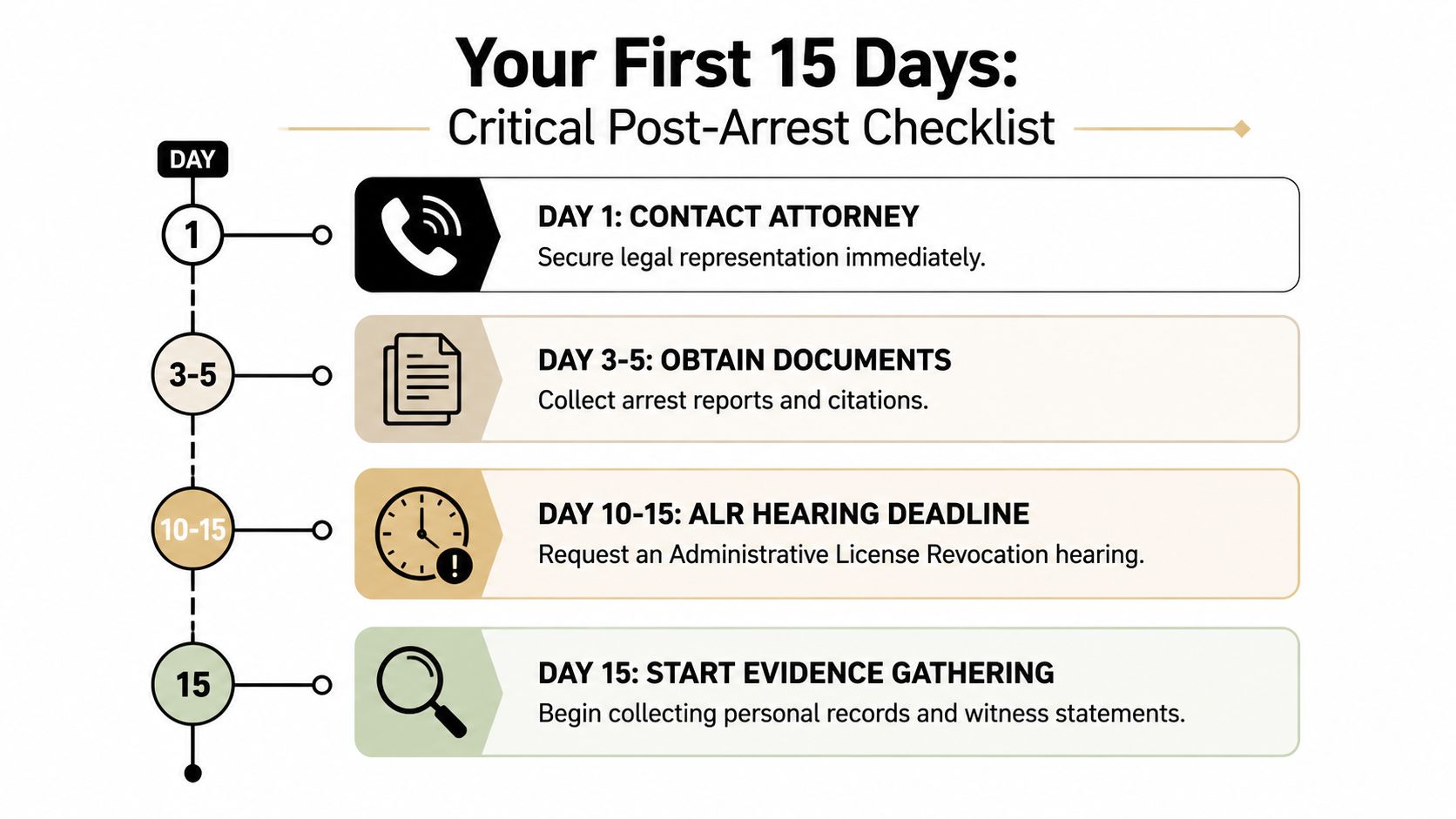
Your immediate checklist
If you were arrested recently, do these things now:
Hire a Texas DWI attorney quickly
Speed matters because video, call records, and officer notes may not stay easy to access forever. Early representation also helps keep you from making avoidable statements.Request the ALR hearing before the deadline
This protects your chance to contest the suspension and starts the evidence fight early.Save every document you received
Keep your citation, bond paperwork, temporary driving paperwork, towing information, and any notice about testing or refusal.Write your own timeline while it's fresh
Note where you were, why you were stopped, what the officer said, whether you were asked to do field tests, and whether you gave a breath or blood sample.Do not talk about the case casually
Don't explain it to police, don't post about it online, and don't guess about facts you aren't sure of.
For a more detailed action list, review this Texas DUI post-arrest checklist.
Why the ALR hearing matters so much
Many people treat the ALR hearing like paperwork. That's a mistake.
The ALR hearing can be one of the first chances to test the officer's reasons for the stop, the arrest decision, and the handling of any chemical test. In practice, it can also help your lawyer pin down testimony before the criminal case moves further.
Here's a short overview of the early process:
| Stage | What it affects | Why it matters |
|---|---|---|
| Arrest | Criminal charge and license exposure | Starts both tracks |
| ALR request | Driving privileges | Preserves your right to challenge suspension |
| Evidence requests | Criminal defense and negotiations | Helps identify weak points early |
| Court settings | Criminal case | Opens room for motions and negotiation |
This short video gives a helpful overview of the early post-arrest situation.
A simple example of what goes wrong
A person gets arrested on a Saturday, misses work on Monday, and spends the next week trying to “wait and see.” By the time they call a lawyer, the license deadline is close, their memory has faded, and they haven't saved key paperwork.
That doesn't ruin every case, but it reduces options. The first 15 days are where you protect your ability to drive and build the foundation for dismissal.
The strongest early defense work is often unglamorous. Deadlines, records, videos, and preserving facts. That's what creates leverage later.
Building Your Defense Investigating the DWI Arrest
A strong DWI defense starts with one basic question. Was the officer legally allowed to do each step that followed?
The state doesn't get to pull over any driver on a hunch. An officer needs reasonable suspicion to make the stop. That means specific facts suggesting a traffic violation or other lawful basis to detain you. To arrest you, the officer needs probable cause, which means enough facts to justify the arrest decision.
A Texas-focused defense guide explains that attacking the traffic stop and arrest sequence is one of the most valuable dismissal strategies. If the stop or arrest lacked proper legal support, evidence obtained afterward can be excluded through a suppression motion, and the case may collapse.
What the defense looks for
Practical case work matters more than slogans. A lawyer investigating how to get a DWI dismissed in Texas usually looks closely at:
The reason for the stop
Did the report describe a clear lane violation, speeding, or another actual offense? Does the video match that claim?The timing of the detention
Did the encounter escalate too quickly? Was the officer extending the stop without a solid basis?The arrest narrative
Did the officer rely on specific observations, or on vague statements that sound stronger on paper than on video?The record trail
Dashcam, bodycam, dispatch audio, 911 calls, and written reports often tell slightly different stories. Those differences matter.
The evidence that often makes the difference
A careful defense review usually includes:
- Dashcam and bodycam footage
- The officer's written report
- Dispatch or 911 records
- Testing records and maintenance logs where applicable
- Training records related to field sobriety testing
Sometimes the video is better for the defense than the report. Sometimes it's worse. Either way, you need to know early.
A prosecutor may trust an officer's report at first. That confidence changes when the video doesn't line up.
Suppression is often the pressure point
A motion to suppress asks the court to exclude evidence that was obtained unlawfully. In a DWI case, that can involve the stop, the detention, statements, field tests, or chemical test evidence.
If key evidence gets suppressed, the prosecutor may still try to proceed. But many cases become much harder to prove when the stop or arrest foundation is weak. That's where dismissals often become realistic, and where a Houston DWI lawyer or Texas DUI attorney earns real value by breaking the case into pieces instead of accepting the arrest report at face value.
Challenging the Evidence How to Fight Breath and Blood Tests
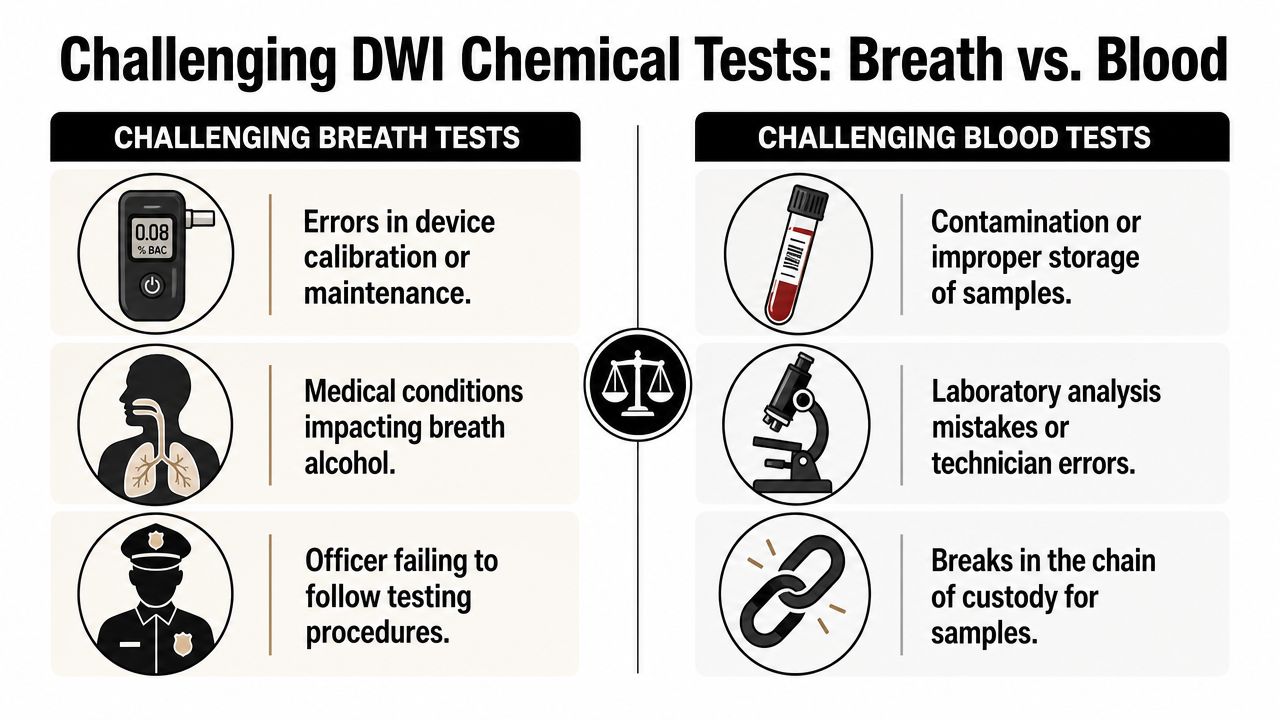
It is often assumed that a breath or blood result ends the case. It doesn't. Chemical testing can be powerful evidence, but it still has to be collected, handled, and interpreted correctly.
And even before the chemical test, the officer usually relies on field sobriety tests. These are roadside exercises used to support an intoxication claim. They are not magic. They depend heavily on instructions, conditions, and officer judgment.
Start with the field sobriety tests
The common roadside tests are often called standardized field sobriety tests. In plain terms, they are exercises the officer uses to claim you lost the normal use of your mental or physical faculties.
Problems show up in these tests all the time:
Bad instructions
If the officer gives rushed or unclear directions, the result may say more about confusion than impairment.Poor conditions
Gravel, sloped pavement, bad lighting, traffic noise, and weather can all affect performance.Physical limitations
Age, injuries, fatigue, balance issues, and medical conditions can make a sober person look unsteady.
When I review bodycam in these cases, one recurring issue is how fast officers move. A person is nervous, cars are passing, instructions are layered, and the report later reads like the test happened in a calm laboratory. It didn't.
Breath tests can be challenged too
A breath test is used to estimate BAC, or blood alcohol concentration. But the number only matters if the machine was working properly and the test was administered the right way.
Defense challenges often focus on:
- Device maintenance and calibration
- Whether testing procedures were followed
- Whether some outside factor affected the sample
This guide on breathalyzer calibration errors in Texas DWI defense is useful if your case involves a breath result.
Blood cases are more technical, not untouchable
Blood evidence often looks stronger because it seems more scientific. But blood cases still require proper collection, storage, transport, and analysis.
Common challenge points include:
| Evidence type | Common defense question | Why it matters |
|---|---|---|
| Breath test | Was the device properly maintained and used? | A flawed process weakens reliability |
| Blood sample | Was the sample handled and stored correctly? | Handling problems can affect trustworthiness |
| Lab analysis | Were procedures followed consistently? | Errors can undermine the reported result |
| Field sobriety tests | Were the tests administered fairly? | Poor administration can distort the officer's conclusions |
A good defense doesn't assume the state's science is wrong. It checks whether the science was applied correctly in your case.
Negotiating Your Case Dismissal Reduction or Diversion
Not every DWI case ends in a full dismissal. That's the truth, and a good lawyer should tell you that early.
But a smart defense is still about winning ground. Sometimes the right result is dismissal. Sometimes it's a reduction. Sometimes the best outcome is a structured resolution that protects your record, your driving, or your professional future better than a trial gamble would.
One of the biggest points of confusion is what people mean when they ask whether the case will “go away.” A Texas article discussing first-time DWI dismissal questions makes an important point: many people are really asking whether the event will disappear from their record, and dismissal, reduction, deferred adjudication, and record sealing are not the same thing.
The outcomes are not interchangeable
Here is the practical difference:
Dismissal
The charge is dropped. That is usually the cleanest criminal case outcome, but it does not automatically erase the arrest record.Reduction
The DWI charge is resolved as a lesser offense. This can still be a strong outcome when the evidence makes a total dismissal unlikely.Deferred adjudication or diversion
In some situations, the case may be handled through a program or court structure that avoids the same result as a straight conviction. Whether that's available depends on the charge, county practice, and case facts.Record clearing later
That is a separate question. It may involve expunction or sealing, and eligibility depends on the final result.
Texas DWI case outcomes compared
| Outcome | Impact on Criminal Record | Eligibility for Expunction/Sealing | Common Scenario |
|---|---|---|---|
| Dismissal | No DWI conviction, but arrest record may still exist | May be possible depending on the exact case outcome | Weak stop, bad testing, missing evidence, or procedural defect |
| Reduction | No dismissal. Case resolves as a lesser offense | Depends on the offense and final disposition | Mixed evidence, but defense has leverage for negotiation |
| Deferred adjudication | Avoids a final conviction in some situations, but still requires careful record analysis | Depends on the exact resolution and Texas law | Client prioritizes a non-conviction path if available |
| Diversion | Can provide an off-ramp from standard prosecution in some counties | Depends on program structure and completion | First-time or lower-risk case where the county offers an alternative track |
How prosecutors actually evaluate these cases
Negotiation usually turns on a few practical questions:
- Can the state prove the stop and arrest cleanly?
- Will the officer and video hold up under scrutiny?
- Is the chemical evidence solid, or vulnerable?
- Does the client have prior history that makes dismissal less realistic?
- Would a compromise resolution satisfy the county's policy concerns?
A defense lawyer isn't just arguing law here. The lawyer is also shaping risk. If the state sees real suppression issues, inconsistent evidence, or testing problems, the prosecutor may become more open to dismissal or a better negotiated outcome.
Good negotiation in a DWI case is built on pressure points, not personality.
What works and what usually doesn't
Some clients think being polite, employed, or embarrassed will be enough. Those facts can help at the margins, but they don't replace a legal defense.
What tends to work:
- Early factual investigation
- Targeted suppression issues
- A clean presentation of weaknesses in the state's proof
- A realistic strategy based on your goals
What usually doesn't work:
- Calling the prosecutor yourself
- Assuming a first offense guarantees leniency
- Treating the ALR case and criminal case as unrelated
- Waiting until trial settings to get serious
If you want to fight DWI Texas cases effectively, you need to know what outcome you're chasing. A “win” is not one-size-fits-all.
Your Next Steps After a Dismissal and How We Can Help
If your case gets dismissed, that is a major victory. But it may not be the final step.
A dismissed DWI doesn't automatically vanish from public view. Employers, licensing boards, and background check companies may still see the arrest unless you take separate action to clear the record where the law allows it. That's why case resolution and record cleanup should be part of the same plan.
Another critical point is your driving status. A Texas DWI guide discussing dismissal odds and ALR strategy notes that a defendant who requests the ALR hearing within 15 days can often keep driving until that matter is resolved, and success there can improve the odds of dismissal or a better outcome in the criminal case. That's one reason the first month matters so much. It affects both mobility and bargaining power.
What to do after the criminal case ends
Once the case is resolved, ask these questions right away:
What exactly was the final disposition?
The answer affects what comes next.Am I eligible to clear the record?
That depends on the result, not just on the fact that the case is over.Do I still have any license-related issues to fix?
Administrative consequences can outlast the courtroom case if they aren't addressed carefully.
If your case ended favorably, review the process for expunging a DWI in Texas. Expunction is separate from winning the criminal case. It's the step that may help remove the record itself when the law allows.
The practical bottom line
How to get a DWI dismissed in Texas usually comes down to speed, evidence, and pressure. The earlier your defense starts, the more options you tend to preserve. That is true whether you need a Houston DWI lawyer, a Texas DUI attorney, help with DWI license suspension issues, or a plan for a first DWI in Texas.
The Law Office of Bryan Fagan, PLLC handles Texas DWI defense, including ALR hearings, chemical test challenges, and record-clearing matters related to favorable outcomes.
If you were arrested for DWI, don't wait for the state to define your case for you. A careful defense can challenge the stop, test the evidence, protect your license, and pursue the best available outcome, including dismissal when the facts support it. Request a free consultation with Law Office of Bryan Fagan, PLLC to review your arrest, your deadlines, and your next steps.