
A DWI arrest can be overwhelming — but you don’t have to face it alone. If you’ve just been pulled over, your head is probably spinning with a million questions. But the one that matters most right now is often the simplest: "How long does alcohol stay on your breath?" The quick answer—that a breathalyzer can detect alcohol for up to 24 hours—is technically true, but it doesn't even begin to tell the whole story.
Understanding what that detection window really means is the first step in defending yourself against a DWI in Texas. At The Law Office of Bryan Fagan, PLLC, our goal is to protect your rights, explain Texas DWI laws in clear terms, and help you take the next step toward a strong legal defense.
What You Need to Know After a Texas DWI Stop
When an officer shines their flashlight into your car and asks you to take a breath test, it feels like everything is on the line. The result of that test can seem like a final verdict, but in our experience, it’s really just the beginning of your defense.
The truth is, how long alcohol stays on your breath isn't some fixed number. It’s a moving target, influenced by everything from your metabolism and body weight to what you ate for dinner and when you had that last drink. It’s in those variables that a strategic DWI defense often begins to take shape.
The Problem With the "24-Hour Rule"
While it’s true that alcohol is detectable for up to a day, that's not what the law cares about. The real question is how long it takes for your Blood Alcohol Concentration (BAC) to drop below the legal limit of 0.08%. For a commercial driver, the limit is 0.04%, and for drivers under 21, any detectable amount is illegal.
Take a look at how long it can take for your body to fully process alcohol.
Estimated Time to Zero BAC Based on Initial Level
This table gives a rough idea of how long it takes for the body to metabolize alcohol, which is why you can still be over the legal limit many hours after you stop drinking.
| Blood Alcohol Concentration (BAC) | Common Scenario | Estimated Time to Reach 0.00 BAC |
|---|---|---|
| 0.08% | Just at the legal limit after a few drinks. | Up to 6 hours |
| 0.15% | Well over the limit, often after a night out. | Up to 10 hours |
| 0.20% | Dangerously high, indicating heavy consumption. | 13 hours or more |
As you can see, the timeline is significant. It’s the reason so many people get arrested the morning after a night out. They feel sober, but their BAC tells a different story. This gap between feeling fine and being legally sober is a critical area a skilled DWI lawyer will investigate.
An arrest is not a conviction. The state has to prove its case beyond a reasonable doubt, and breath test results are often far less reliable than they appear. A confident, strategic defense can expose those weaknesses.
How This Affects Your DWI Case
The science behind how long alcohol stays on your breath is complicated, and that complexity can be a powerful tool for your defense. The officer's roadside breathalyzer is just one piece of evidence—and it’s one that can be challenged.
Things like improper test administration, faulty equipment, or even underlying medical conditions can throw off the results. This is why knowing your rights from the very start is so crucial. For example, understanding the consequences of a breath test refusal can completely change your defense strategy. Our team is here to help you make sense of these details and protect your rights every step of the way.
How a Breathalyzer Actually Works

To figure out how long alcohol stays on your breath, you first have to understand what a breathalyzer is really measuring. It isn't sniffing for the smell of beer or wine. Instead, it’s designed to capture air from deep inside your lungs to guess how much alcohol is flowing through your blood.
Think of your lungs as a complex network of tiny, blood-rich air sacs. As your heart pumps blood through them, a constant exchange happens: oxygen goes into your blood, and waste products like carbon dioxide come out. When you've been drinking, alcohol vapor hitches a ride out with that carbon dioxide.
A breathalyzer is built to grab a sample of this "deep lung" air, which is believed to be the most accurate reflection of your Blood Alcohol Concentration (BAC). The machine then runs a calculation and spits out a number—a number the state will try to use against you in a DWI case.
Two Types of Breathalyzers You May Encounter
It’s absolutely critical to know that not all breathalyzers are the same. The small gadget an officer uses on the side of the road is worlds apart from the bulky machine back at the police station. Understanding this difference can be a key part of building your defense.
- Portable Breath Test (PBT): This is the handheld screening device an officer might ask you to blow into during a traffic stop. PBTs are notoriously less accurate and are mainly used to give the officer probable cause to arrest you. In Texas, results from a PBT are generally not admissible in court as direct evidence of intoxication precisely because of these reliability issues.
- Evidentiary Breath Test Machine: If you are arrested, you'll be taken to the station and asked to blow into a much larger, more sophisticated machine like the Intoxilyzer 9000. These machines use infrared spectroscopy to measure alcohol concentration and are considered "evidentiary"—meaning their results are specifically intended to be used as the primary evidence against you at trial.
This distinction is crucial. An officer uses the PBT to justify an arrest, but the prosecutor's entire case will likely hinge on the number from the big machine at the station. A skilled Houston DWI lawyer knows exactly how to scrutinize the maintenance logs, calibration records, and operating procedures for both devices.
How the "Science" Can Be Challenged
The science behind breath testing sounds simple enough, but it’s built on a shaky foundation of assumptions that don't apply to everyone. For instance, every one of these machines uses a standard formula—a "partition ratio"—to convert the alcohol in your breath into an estimate of the alcohol in your blood.
The machine assumes that the amount of alcohol in 2,100 milliliters of your breath is equal to the amount in 1 milliliter of your blood. But this 2100:1 ratio isn't a universal biological law; it's just an average. The actual ratio varies from person to person depending on body temperature, medical conditions, and even how you breathe.
This means the machine's BAC reading might be completely wrong for you. If your personal partition ratio is different from the machine's pre-programmed average, the result it produces could be artificially inflated, making you seem far more intoxicated than you actually are.
This is just one of many potential weaknesses in the state's case. The truth is, the science of DWI testing is far from perfect, and a solid defense starts with understanding its flaws. You can learn more about the many factors that impact the accuracy and reliability in the science of DWI testing in our detailed guide. Challenging the state’s supposed "scientific" proof is often the most effective strategy for protecting your rights and fighting for a better outcome.
How to Fight a Breath Test Result
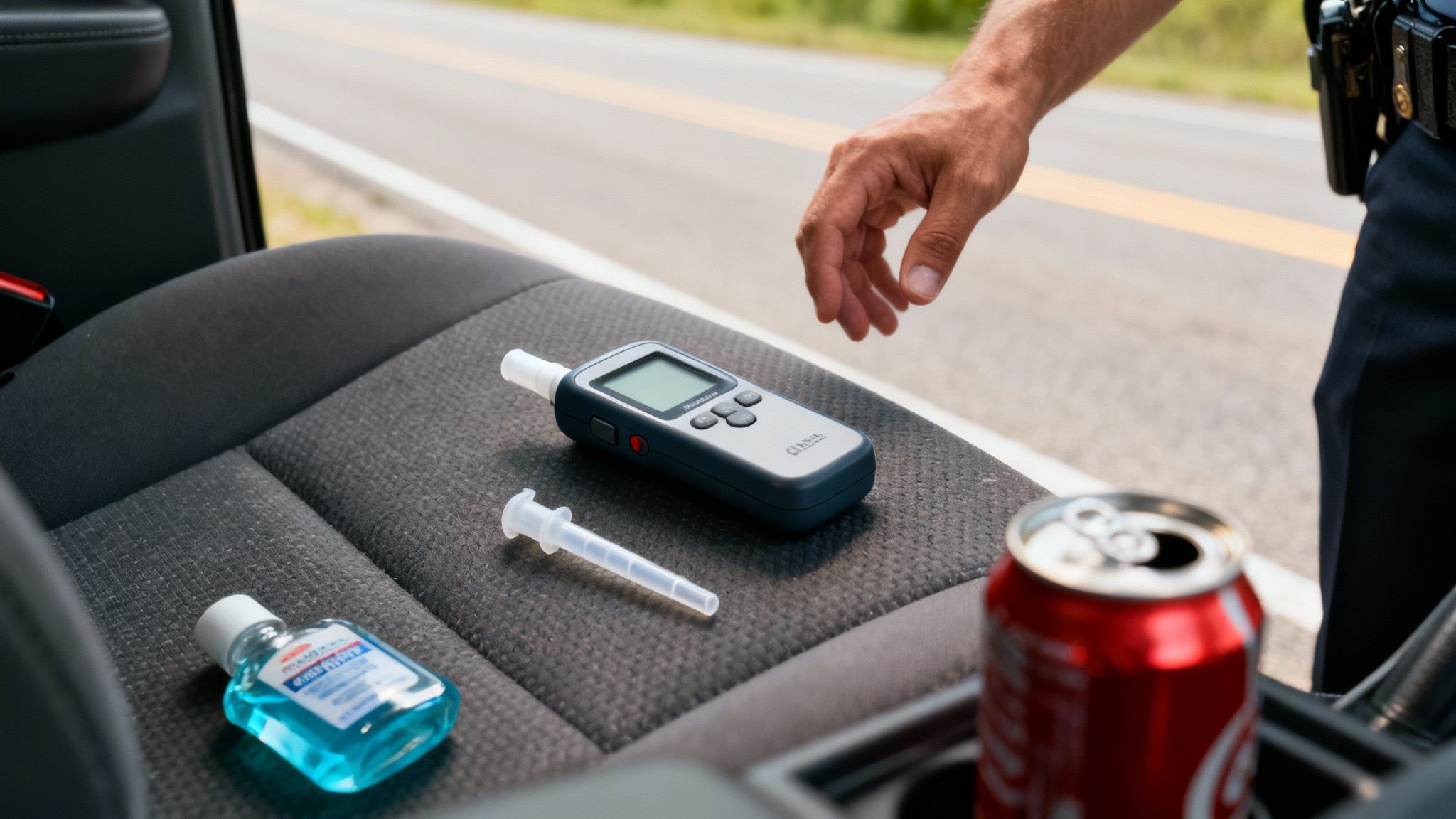
When a breathalyzer spits out a number over 0.08%, it can feel like the final word. Most people assume that number is a rock-solid piece of scientific evidence. But here's the truth an experienced DWI attorney knows well: it's often just the beginning of your defense.
These machines are far from perfect. In fact, they're prone to a surprising number of errors that can produce an unfairly high reading. The state wants you to see that number and give up. We see it as the first piece of evidence to question.
By digging into every detail—from the moment you were stopped to the maintenance logs of the machine itself—we can often expose the reasonable doubt needed to fight back.
The Problem of Mouth Alcohol Contamination
One of the biggest weaknesses in any breath test is something called "mouth alcohol." This is a huge deal. The breathalyzer is supposed to measure deep lung air, which gives an indirect reading of the alcohol in your bloodstream. But it can be easily fooled by alcohol that's still lingering in your mouth, throat, or even your stomach.
This isn't a small error. Residual alcohol in your mouth can dramatically inflate the reading, making it look like you're far more intoxicated than you actually are.
So, where does this mouth alcohol come from? It can be caused by surprisingly common things:
- A recent drink: Taking a sip of an alcoholic beverage just before getting pulled over is an obvious one.
- A simple burp: Medical conditions like acid reflux or GERD—or even just belching—can bring alcohol vapor up from your stomach right into the sample.
- Dental work: Things like dentures, bridges, and even food stuck in your teeth can trap alcohol and release it later, contaminating the test.
- Everyday products: Many common mouthwashes, breath sprays, and even some medications contain alcohol that can trigger a false positive.
This isn't just a theory; it's a known scientific flaw. Studies have shown that a breathalyzer’s ability to flag a sample contaminated by mouth alcohol is shockingly poor, with almost half of these bad samples going completely undetected. That means a BAC result over the legal limit could be based on junk science.
The Critical 15-Minute Observation Period
Because mouth alcohol is such a well-known problem, Texas law has a specific rule to prevent it: the 15-minute observation period.
Before police can give you an evidentiary breath test back at the station, they are required to watch you, continuously and without interruption, for at least 15 minutes. During this time, you cannot eat, drink, smoke, vomit, or put anything at all in your mouth.
The entire point of this 15-minute window is to give any residual alcohol in your mouth time to dissipate. This way, the machine is supposed to be measuring air from your lungs, and only your lungs.
If the officer failed to do this correctly—maybe they were busy with paperwork, stepped out of the room, or were distracted by their phone—the test is fundamentally unreliable. An experienced Houston DWI lawyer will immediately check the police report and any video footage to see if this rule was followed to the letter. Any slip-up is a major procedural error that can get the breath test thrown out of court.
Machine Errors and Improper Calibration
Breathalyzers are just machines. And like any machine, they can break, glitch, or simply be wrong if they aren't maintained perfectly. The Texas Department of Public Safety (DPS) has very strict rules for how these devices must be calibrated and serviced. If a police department gets sloppy with its records or misses a scheduled check, every single test from that machine becomes questionable.
Common machine-related problems that can sink the prosecution's case include:
- Improper Calibration: The machine wasn't correctly set against a known standard, meaning every reading it gives is likely off.
- Maintenance Gaps: Required inspections or repairs were missed, making the machine’s results legally untrustworthy.
- Software Glitches: These are basically computers, and like any computer, they can suffer from bugs that produce incorrect results.
- Interfering Substances: Some devices can be fooled by other chemicals. For instance, acetone on the breath of a person with diabetes can sometimes be misread as alcohol.
Challenging a DWI based on a breath test requires a deep understanding of these technical and procedural rules. The number on that little printout is never the end of the story. Our firm has spent years investigating these exact issues to find the weaknesses in the state's case. If you're worried about a false positive breathalyzer test, we can help you figure out the best way to fight it.
Personal Factors That Affect Your BAC Reading
Have you ever been out with a friend, had the exact same number of drinks, and felt completely different? One of you might feel fine, while the other is clearly intoxicated. It’s a common experience, and it highlights a simple truth: no two bodies are the same. But here’s the problem—a breathalyzer machine treats everyone as if they are. It applies a one-size-fits-all formula to guess your BAC, and this massive oversimplification is a major weakness that can be challenged in court.
The reality is that how long alcohol stays on your breath is entirely dependent on a unique cocktail of personal factors. These variables aren't just interesting trivia; they're critical pieces of evidence. For anyone facing a DWI charge in Texas, understanding these factors can introduce the reasonable doubt needed to dismantle the state’s case against you.
An experienced Texas DUI attorney knows that a BAC number isn't an absolute fact. It's an estimate—one that can be thrown way off by your individual biology.
Your Body Weight and Composition
One of the biggest players in how your body handles alcohol is your weight and body composition. Alcohol is water-soluble, which means it spreads out through all the water in your body. It makes sense, then, that a heavier person generally has more body water to dilute the alcohol.
Imagine adding a drop of red food coloring to two different glasses. One is a small shot glass, and the other is a tall pint glass full of water. That single drop will make the shot glass intensely red, but it will barely tint the water in the pint glass. In the same way, the same amount of alcohol will lead to a much higher BAC for a smaller person than a larger one.
But it gets even more complex. Body fat contains very little water, while muscle tissue is packed with it. This means two people who weigh the exact same can process alcohol differently. A 180-pound person with a high muscle mass has more water to dilute the alcohol than a 180-pound person with a higher body fat percentage, which can result in a lower BAC.
Gender and Metabolism
Biological differences between men and women also play a huge part in how alcohol is processed. On average, women tend to have a higher percentage of body fat and less body water than men of the same weight. This anatomical difference means alcohol becomes more concentrated in their system, and it happens faster.
There's another key difference happening on a chemical level. Women generally have lower levels of an enzyme called alcohol dehydrogenase (ADH), which gets to work breaking down alcohol in the stomach and liver. With less of this enzyme on the job, more pure alcohol makes its way into the bloodstream, leading to a higher BAC from the same number of drinks.
Your personal metabolism is like your body's internal furnace for burning off alcohol. A breathalyzer has no idea how hot your furnace runs—it just assumes everyone's is set to the same temperature. That assumption is a fundamental flaw that a skilled attorney can expose.
The Impact of Food
What you ate—and when you ate it—can dramatically change how your body absorbs alcohol. If you drink on an empty stomach, the alcohol passes almost immediately into the small intestine, where it’s absorbed rapidly into your bloodstream. This is why you feel the effects so quickly and why it causes a sharp spike in your BAC.
On the other hand, eating a meal before or during drinking, especially something high in protein, fat, and carbs, slows everything down. Food in your stomach acts like a roadblock, holding the alcohol back and preventing it from flooding your system all at once. It doesn't stop the alcohol from being absorbed, but it spreads it out over a much longer period, resulting in a lower peak BAC.
This is a critical point in many DWI defenses. If you were arrested hours after your last drink but right after eating a big dinner, your BAC could have still been rising when you were tested at the station. An attorney can use this to argue that your BAC was actually lower when you were driving. This powerful defense is known as the "rising BAC" defense.
Other things like your age, medications you're taking, and certain health conditions also alter how your body handles alcohol. Each one of these variables adds another layer of doubt to the reliability of a single breath test, making the state's job of proving its case that much harder.
Comparing Breath, Blood, and Urine DWI Tests in Texas
When an officer asks you to take a breath test during a DWI stop, it can feel like the end of the line. But that single moment is far from the final word. It’s critical to understand that a breathalyzer is just one tool police use, and honestly, it’s often the most scientifically questionable one.
In Texas, prosecutors can build their case using breath, blood, or urine tests. Each comes with its own set of rules, accuracy levels, and potential weaknesses that a skilled attorney knows how to find and exploit.
The Accuracy Debate: Breath vs. Blood
From a purely scientific standpoint, a blood test is considered the "gold standard" for measuring BAC. It directly analyzes the concentration of alcohol in your bloodstream, which leaves very little room for the kind of estimation errors that plague breath tests.
But that accuracy comes at a price—specifically, strict procedural safeguards. Unlike a breath test, an officer can't just force you to give a blood sample. They need a warrant signed by a judge unless you freely and voluntarily consent. A sharp Houston DWI lawyer will meticulously review every step of that process, from the warrant application to the blood draw itself, hunting for any violation of your constitutional rights.
Comparing DWI Chemical Tests in Texas
To make sense of it all, it helps to see how these tests stack up against each other. While police prefer the convenience of breath tests, their results are often the easiest to challenge. Blood and urine tests, on the other hand, have their own unique issues that can be just as problematic for the prosecution's case.
| Test Type | Detection Window | Accuracy | Key Defense Considerations |
|---|---|---|---|
| Breath Test | Immediate | Lowest. Highly susceptible to outside factors. | Mouth alcohol contamination, machine calibration errors, improper police procedure, medical conditions. |
| Blood Test | Up to 12 hours | Highest. Considered the "gold standard" for BAC. | Warrant validity, improper blood draw procedure, chain of custody errors, lab contamination, fermentation of the sample. |
| Urine Test | Up to 72 hours | Very Low. The least reliable for proving intoxication at the time of driving. | Only shows past consumption, not current impairment. High potential for false positives and contamination. |
As you can see, no single test is perfect. The state’s "strongest" evidence often has significant hidden weaknesses.
This is especially true when you consider all the personal factors that can throw off a test result.
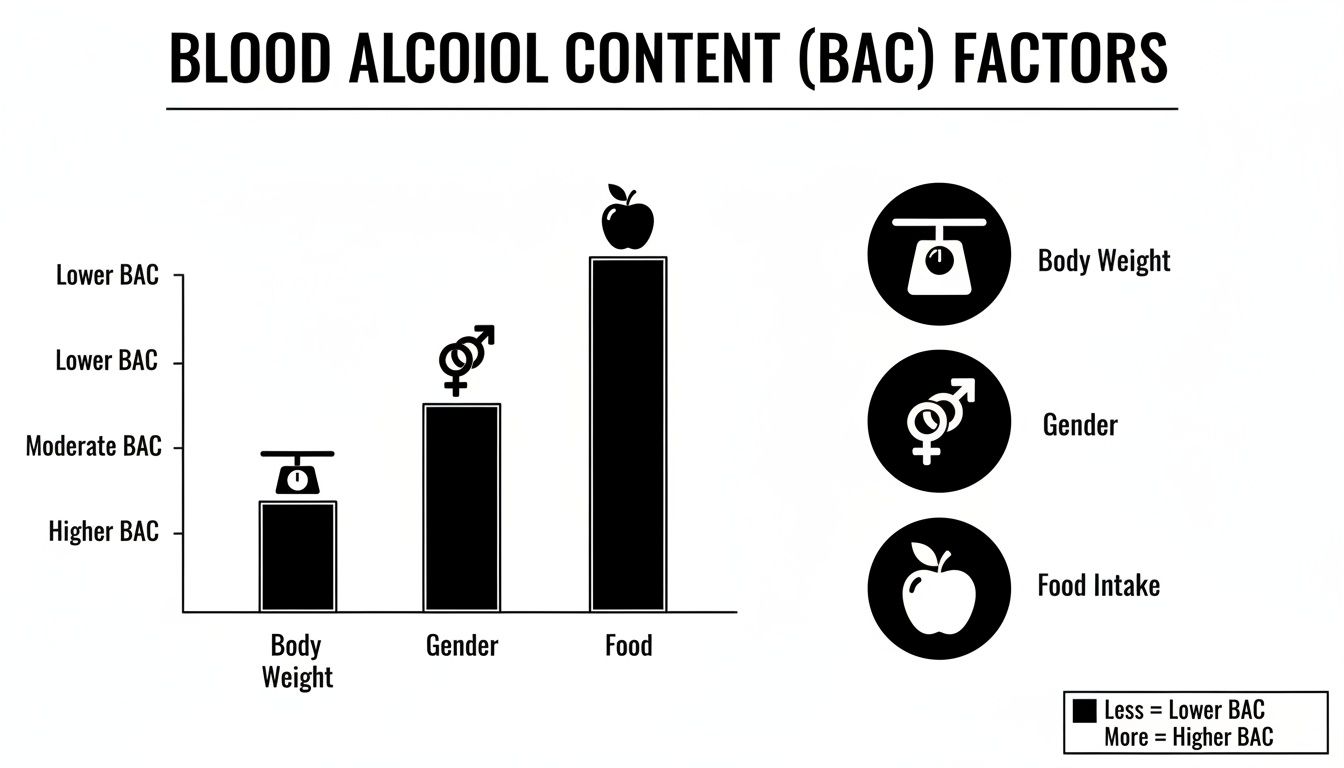
The chart above highlights just a few of the variables—like body weight, gender, and whether you’ve eaten—that can dramatically change how your body processes alcohol. This is why a single test result can be a deeply unreliable snapshot of your actual impairment.
Texas Implied Consent and Your Right to Refuse
Here’s something many Texans don’t realize: the moment you get a driver's license, you automatically agree to the state's "implied consent" law. In simple terms, this means you’ve already consented to provide a breath or blood sample if you are lawfully arrested for DWI.
But—and this is a big but—that consent isn’t absolute. You still have the right to refuse.
Refusing a chemical test isn't a get-out-of-jail-free card. It immediately triggers a civil penalty called an Administrative License Revocation (ALR), which is completely separate from your criminal DWI case. For a first-time refusal, this means an automatic 180-day license suspension.
While that’s a serious consequence, refusing also denies the prosecution what is often their strongest piece of evidence against you.
A refusal forces the prosecutor to prove their case using other evidence, like the officer’s testimony and dashcam footage—evidence that is often subjective and much easier to challenge in court.
Knowing the differences between these tests and your rights is the first step in building a strong defense. An experienced attorney uses these details to craft a strategy tailored to the specific facts of your case.
Navigating the Texas Legal System After a DWI Arrest
A DWI arrest can feel like the world is crashing down around you, but it's not the end of your story. The moment those handcuffs click is actually the beginning of a complex legal journey—one you can navigate with the right strategy and a strong advocate in your corner.
Most people don't realize that a DWI arrest immediately throws you into two separate legal battles at the same time. The first is the criminal case, where the State of Texas is trying to convict you of Driving While Intoxicated. The second is a civil case against your driver's license, a process called the Administrative License Revocation (ALR) hearing.
These two cases run on parallel tracks, and each comes with its own critical deadlines and unique rules. Getting a handle on this dual-track system is the first step toward protecting your rights and your future.
The Race to Save Your Driver's License: The ALR Hearing
Right out of the gate, you’re facing an urgent deadline for your Administrative License Revocation (ALR) hearing. From the date of your arrest, you have only 15 days to formally request this hearing. If you let that window close, the Texas Department of Public Safety (DPS) will automatically suspend your license, no questions asked. A DWI license suspension can impact your job, family, and daily life.
This ALR hearing is your first—and often best—shot at challenging the state’s evidence. It gives your attorney a chance to cross-examine the arresting officer under oath, dig into the reports, and fight to keep your driving privileges intact. But it’s more than just about keeping your license; it’s a crucial fact-finding mission that can uncover invaluable information for your criminal defense.
A DWI arrest triggers two separate legal battles: a criminal charge where your freedom is at stake, and an administrative case where your driving privileges are on the line. Acting quickly is essential to fighting both effectively.
An experienced Texas DUI attorney can handle the ALR request for you, making sure it’s filed correctly and on time. This is a critical first move to fight DWI Texas charges effectively.
What to Expect in Your Criminal DWI Case
While the ALR process moves at lightning speed, your criminal case unfolds on a more structured timeline. Knowing what’s coming can help dial down the anxiety and uncertainty you might be feeling.
A typical Texas DWI case moves through these steps:
- Arraignment: This is your first court appearance, where the charges are formally read. You'll enter a plea of "not guilty," and the judge will set the conditions of your bond.
- Pre-Trial Motions: Your attorney gets to work filing motions to challenge the evidence. This could mean trying to suppress the breath test results because of an improperly calibrated machine or arguing the officer had no legal reason to pull you over in the first place.
- Negotiations: Your lawyer will be in talks with the prosecutor. The goal is to get a dismissal, a reduction of the charges (like from a DWI to Obstruction of a Highway), or a plea deal that minimizes the consequences.
- Trial: If a fair agreement can't be reached, your case goes to trial. This is where the state has to prove its case against you beyond a reasonable doubt to a judge or jury.
Each of these steps is an opportunity to build your defense. Whether you're fighting a first DWI in Texas or facing a more serious felony charge, a strategic lawyer will guide you through every phase. With the right legal team on your side, you can face the system with confidence.
Texas DWI Penalties Explained
The potential penalties for a DWI in Texas are serious and escalate with each offense.
- First DWI in Texas (Class B Misdemeanor): Fines up to $2,000, 72 hours to 180 days in jail, and a driver's license suspension of up to one year.
- Second DWI (Class A Misdemeanor): Fines up to $4,000, 30 days to one year in jail, and a license suspension of up to two years.
- Third or Subsequent DWI (Third-Degree Felony): Fines up to $10,000, two to ten years in state prison, and a license suspension of up to two years.
These penalties can be enhanced if there are aggravating factors, such as having a child passenger in the car or a BAC of 0.15 or higher.
It's Time to Build Your Defense
If you're reading this, you've probably just been through one of the most stressful experiences of your life. The flashing lights, the field sobriety tests, the breathalyzer—it’s a lot to process. But here’s the most important thing to remember right now: an arrest is not a conviction.
You have rights. The "evidence" against you isn’t set in stone. This is the moment you stop worrying and start taking control.
We've just walked through how breathalyzers can be flat-out wrong and how dozens of tiny factors—from your health to what you ate for dinner—can throw off a test. Knowing how long alcohol might stay on your breath is just one small piece of a much larger, more complicated puzzle. An experienced Houston DWI lawyer knows exactly how to find all those pieces and fit them together to build a defense that tells your side of the story.
The complexities of breath testing and DWI law aren’t weaknesses in your case—they’re opportunities. A strategic defense can turn those scientific and procedural details into the reasonable doubt needed to fight for a dismissal or a reduced charge.
Your future is far too important to leave up to chance or to try and handle on your own. Let's talk. We offer a free, completely confidential consultation to go over the specifics of what happened. We’ll break down your options in plain English and start building a strategy to fight for the best possible outcome for you.
At The Law Office of Bryan Fagan, PLLC, our team is ready to stand with you from day one. We are confident in our ability to protect your rights and minimize the consequences you face. Don't wait and let the state build its case without a fight. Take the first step now by requesting your free case evaluation at our website.