
A Texas DWI case usually takes about 10 months to over a year to resolve, and many cases are measured in months, not weeks. The urgent part comes first: if your arrest triggered a license suspension, you may have only 15 days to act.
A DWI arrest can leave you staring at paperwork, bond conditions, and a court date you don't fully understand. The desire for a simple answer to one simple question is understandable: how long does a DWI case take in Texas? The honest answer is that your case is probably moving on two different tracks at the same time, and each one has its own pace, deadlines, and risks.
That distinction matters. Your license problem may need attention almost immediately, while your criminal case can keep moving for months. If you're worried about your job, your ability to drive, your family, and what happens next, that reaction is normal. The process is stressful, but it is manageable with a clear plan and fast action.
Your DWI Arrest Is Overwhelming But You Are Not Alone
The first day after a DWI arrest often feels worse than the arrest itself. You're replaying the stop, trying to remember what you said, wondering if your license is already suspended, and asking yourself whether this will drag on forever.
It might take time, but that doesn't mean you're powerless.
One Texas case-timeline review found an average closure time of 10 months, with 68% of cases closing in 6 to 17 months, and some stretching beyond 21 months. Another Texas DWI timeline states that the process can take "a few months to over a year." You can read that breakdown in this Texas DWI case timeline discussion.
Why the process feels confusing
Many individuals assume they have one case. In practice, they usually have two legal problems triggered by the same arrest:
- The license track deals with whether you can keep driving.
- The criminal track deals with the charge itself and any penalties.
Those tracks don't move together. One starts almost immediately. The other often unfolds much more slowly.
Practical rule: The first mistake many people make is waiting for the criminal court date before doing anything. In a Texas DWI case, waiting can cost you options.
Start with the first 24 hours
The best first move is simple. Get organized, preserve every document, and understand what happened right after booking and release. This guide to the first 24 hours after a Texas DWI arrest helps you focus on the decisions that matter most while the details are still fresh.
A DWI charge doesn't automatically define the outcome of your case. Good defense work starts early, especially when the timeline is already running.
The Two Timelines Every Texas DWI Case Follows
Think of a Texas DWI case as two trains leaving the same station. They start from the same arrest, but they go to different destinations and run on different schedules.
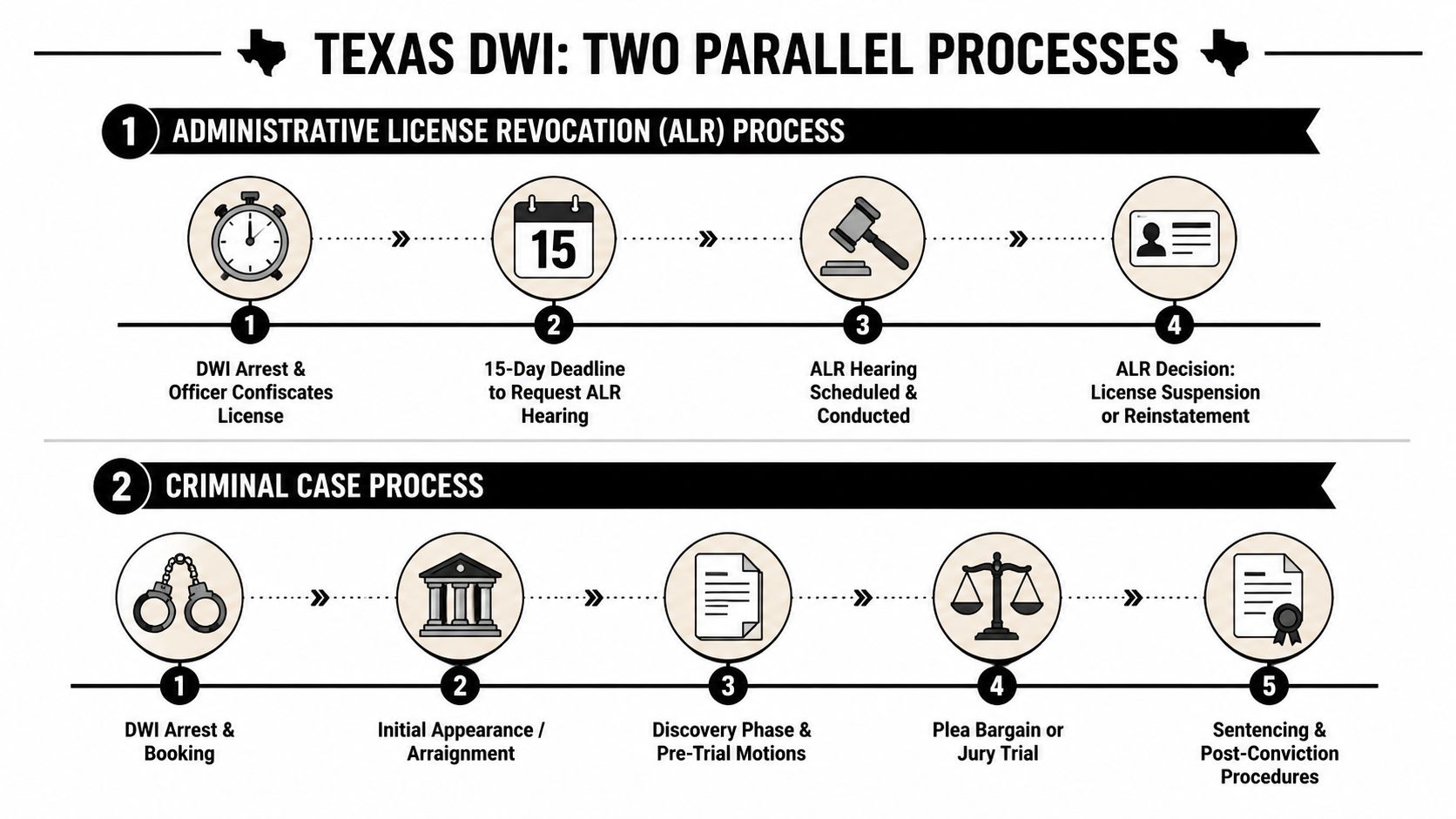
One train is the Administrative License Revocation, often shortened to ALR. The other is the criminal court case. If you don't separate those two in your mind, the entire process feels harder than it needs to be.
The ALR track moves fast
Administrative license suspension is the civil process that can affect your driving privileges after a DWI arrest. It is separate from the criminal charge.
A Texas DWI timeline focused on this gap explains that you must request an ALR hearing within 15 days of arrest, while magistration typically happens within 24 to 48 hours and a first court appearance is often 20 to 60 days later depending on the county. That timeline appears in this Texas DWI breakdown of the ALR and court process.
If you care about driving to work, taking your kids to school, or keeping a commercial position, this is often the first timeline that matters most.
The criminal track moves slower
The criminal case decides whether the State can prove you committed DWI and what consequences may follow. That process usually includes court settings, evidence review, negotiations, motions, and sometimes trial.
Here is the cleanest way to compare the two:
| Track | Main issue | Pace |
|---|---|---|
| ALR | Your driver's license | Fast and deadline-driven |
| Criminal court | Guilt, defenses, and punishment | Slower and often months long |
Why this distinction helps
Once you understand the split, the timeline starts to make sense. You stop asking one broad question and start asking better ones:
- Can I still drive right now
- When is my first court setting
- Has the prosecutor produced the evidence
- Is this case moving toward negotiation or trial
That shift matters because it leads to better decisions early. It also reduces panic. A delayed criminal setting doesn't necessarily mean your lawyer isn't doing anything. It may mean the defense is waiting for evidence, preparing motions, or using time strategically.
The biggest timeline mistake is treating the license issue like it can wait. It usually can't.
A Stage by Stage Breakdown of the Texas DWI Process
The process becomes easier to handle when you break it into stages. You don't need to know every courtroom detail on day one. You need to know what usually happens next.
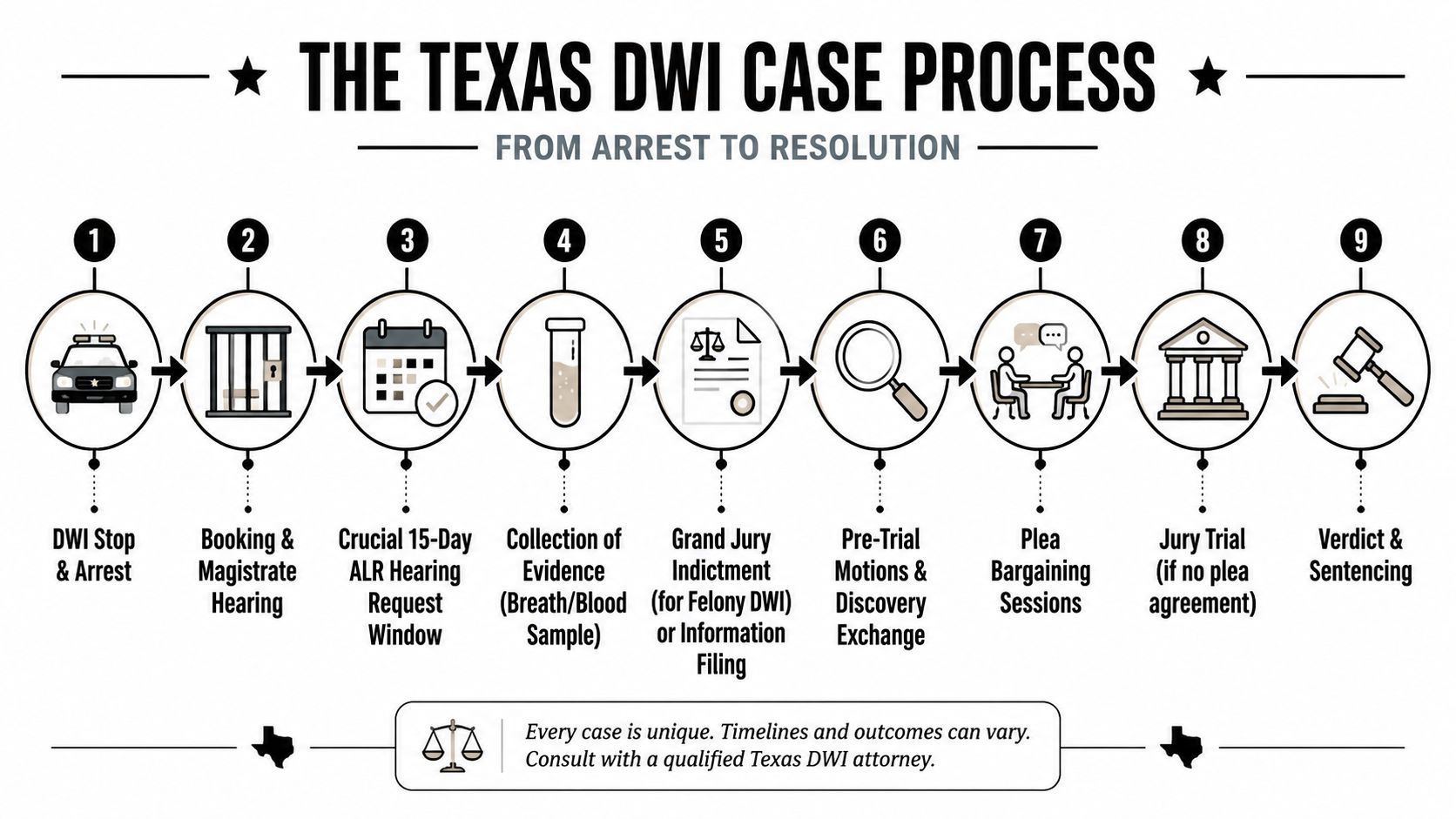
Early in the process, this visual helps in understanding the sequence.
Arrest, booking, and magistration
After the stop, the officer may conduct field sobriety tests, which are roadside balance and coordination exercises used as part of the investigation. If you're arrested, you are booked and taken before a magistrate for bond and release conditions.
You may also hear the term implied consent. In Texas, that means a driver who is lawfully arrested for DWI is deemed to have consented to certain chemical testing procedures under state law, subject to the specific rules and consequences that apply in that setting. You may also see BAC, which means blood alcohol concentration, a measurement used in alcohol-related driving cases.
The 15-day ALR decision window
This is the first major deadline. A Texas DWI court-process overview states that drivers generally have only 15 days from service of the suspension notice to request an ALR hearing. If no hearing is requested, the suspension can become effective on the 40th day after notice. The same source notes that the first court setting for a misdemeanor DWI is often about 20 to 40 days after arrest, while felony cases may take a few months to reach initial court dates. That explanation appears in this Texas DWI court process article.
That means your license issue can become urgent long before your criminal case gets moving in a serious way.
Evidence collection and review
The State begins building its case right away. Your lawyer begins testing it right away.
This often includes:
- Police reports that describe the stop, arrest, and officer observations
- Body camera or dash camera video showing the interaction
- Breath or blood evidence from chemical testing
- Witness information if anyone saw your driving or arrest
A field sobriety test result is not the same thing as a conviction. A breath result is not automatically unchallengeable either. Defense work often turns on whether the stop was lawful, whether the arrest had probable cause, whether testing was administered correctly, and whether the State can prove impairment.
To get a fuller picture of how these stages play out in real life, watch this short overview:
Court settings, motions, and negotiations
Most DWI cases don't resolve at the first setting. That setting is often procedural. It gives the court a chance to call the case, set expectations, and allow the sides to exchange information.
From there, several things may happen:
- Discovery review. The defense reviews reports, video, lab records, and other evidence.
- Legal challenges. The defense may file motions to suppress evidence or challenge how it was obtained.
- Negotiations. If the facts support it, the parties may discuss dismissal issues, reduced charges, or other negotiated outcomes.
- Trial preparation. If the offer isn't acceptable or the case is defensible, the case may be prepared for trial.
A long timeline isn't always bad. Sometimes more time gives the defense room to uncover weaknesses that weren't obvious at arrest.
Possible endpoints
A DWI case can end in several ways. It may resolve through negotiation. It may be dismissed if legal or factual problems develop. It may go to trial.
What doesn't work is rushing to a decision before you know the evidence. In many cases, the smartest move is to get the file, examine the stop, evaluate the testing, and make choices from a position of information instead of fear.
Key Factors That Influence Your DWI Case Timeline
No two DWI cases move at the exact same speed. Some cases are straightforward. Others slow down because the evidence isn't ready, the court is crowded, or the defense needs time to challenge what happened.
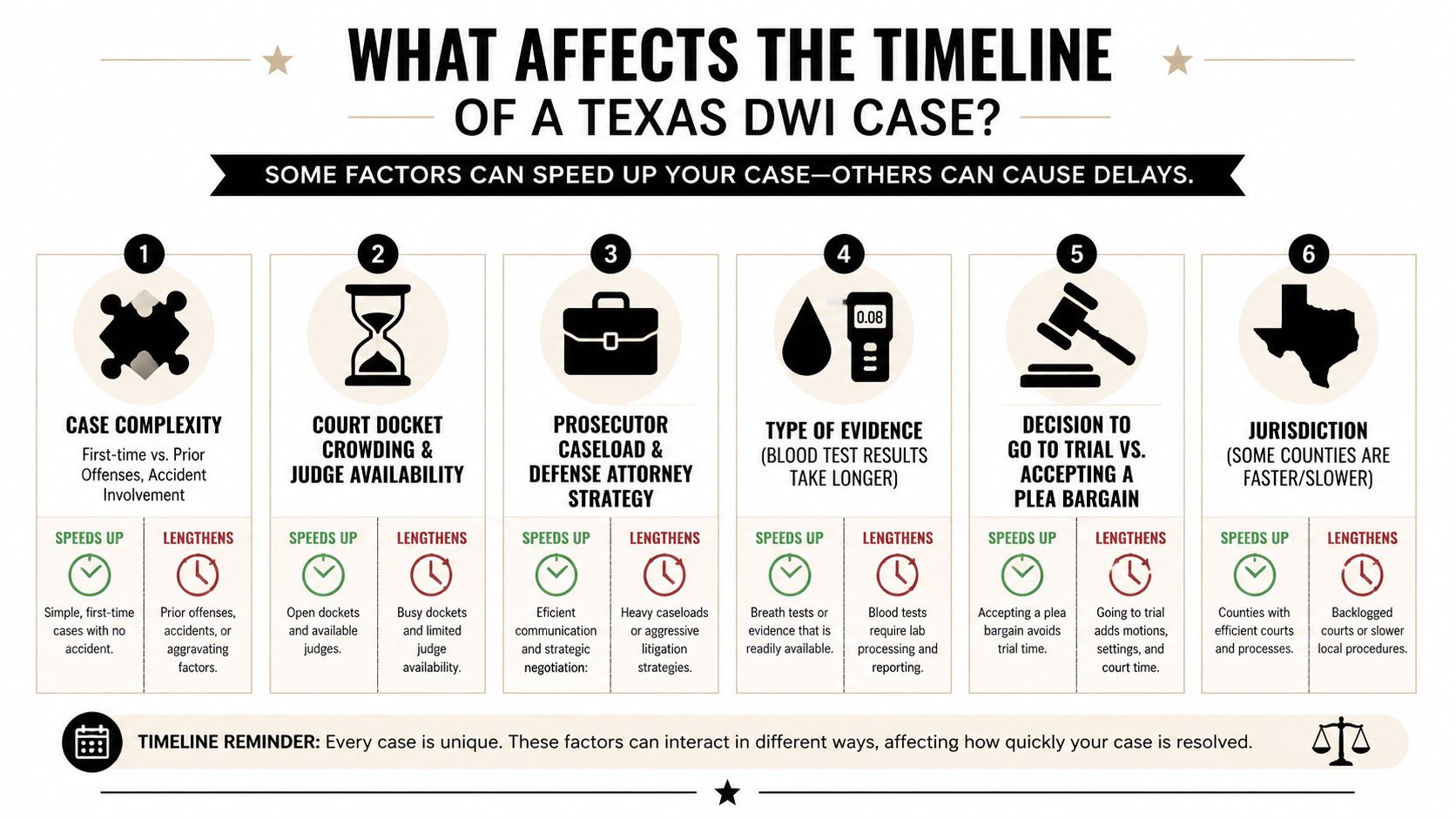
This graphic sums up the main pressure points.
Blood cases usually take longer
The biggest source of delay is often the evidence itself. Published Texas attorney case analyses report that toxicology results in DWI blood cases can take 3 to 6 months to return, and the same review reported an average closure time of about 10 months, with 68% of cases falling between 6 and 17 months. That timeline is discussed in this analysis of Texas DWI case duration and blood-test delays.
When a blood result hasn't come back yet, the prosecutor may not be ready to evaluate the case fully. The defense may also need that report before deciding whether to negotiate, challenge the science, or prepare for trial.
Charge level changes the pace
A first DWI in Texas is usually simpler than a felony allegation. Felony cases can involve more court procedures, more records, and more serious consequences. Cases with accidents, prior allegations, or added factual disputes also tend to take longer.
A few practical factors often shape the timeline:
- Court docket conditions. Some counties move faster than others.
- Evidence type. Breath cases may move differently from blood cases.
- Defense strategy. Filing and litigating motions takes time, but that time may be useful.
- Trial decision. Trial preparation usually extends the case.
For a closer look at the proof issues prosecutors focus on, review what evidence prosecutors use in Texas DWI cases.
Fast isn't always better
A quick resolution can sound appealing when you're under stress. But speed is only good if the result protects you.
If the State's evidence is weak, or if the stop and testing raise real legal issues, pressing pause and building the defense can be the wiser path. That's often the difference between finishing a case and fight DWI Texas in a way that protects your record, license, and future options.
Managing Delays and Protecting Your Rights
Delay frustrates people because it feels passive. In a good defense, it isn't passive at all.
A DWI lawyer should use time carefully. That may mean requesting the ALR hearing on time, securing records, reviewing video frame by frame, checking whether the officer had a lawful basis for the stop, and deciding whether a motion to suppress makes sense. It may also mean slowing down a case that shouldn't be rushed.
What works
Some delays help the defense. For example, additional time may allow your attorney to obtain missing footage, compare reports against video, or identify inconsistencies in the officer's version of events. In the right case, that alters the negotiating position.
Prompt action matters most at the beginning. One Texas DWI timeline states that if a driver refuses or fails the alcohol test, there are only 15 days from arrest to request an ALR hearing, and the first court appearance in misdemeanor cases typically comes 20 to 40 days after arrest. That timing appears in this Texas DUI case timeline guide.
What doesn't work
These choices usually hurt people:
- Ignoring the license deadline and assuming the court will handle it
- Talking too much about the facts of the case to police, friends, or online
- Missing court dates or bond conditions
- Pleading too early just to make the stress stop
When clients feel anxious, they often want the case over fast. The better question is whether ending it fast helps or hurts the result.
Your attorney's role during the waiting periods
A strategic Houston DWI lawyer or Texas DUI attorney doesn't just show up at court and ask for another setting. The job is to make every setting count.
That can include requesting records, challenging test procedures, evaluating witness issues, negotiating from a position of strength, and deciding whether trial risk makes sense. The Law Office of Bryan Fagan, PLLC handles both DWI defense and related license issues, which is important because the license track and criminal track often need separate attention at the same time.
Your Checklist The First Steps After a DWI Arrest
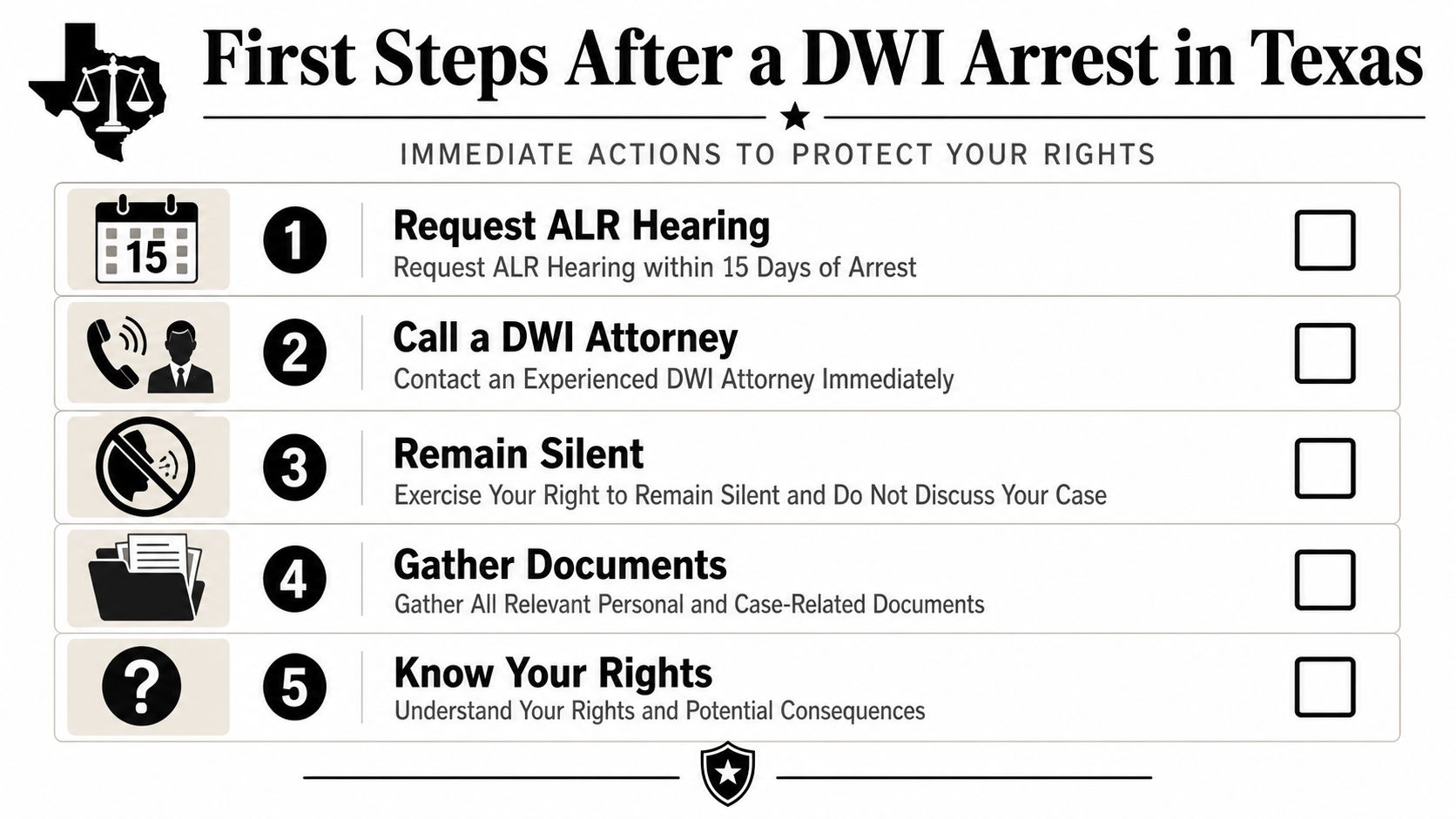
You need a short to-do list, not a long lecture. Start here.
In the first days, focus on control
- Save every paper. Keep bond documents, notice of suspension paperwork, tow information, and any court notices together.
- Write down the stop. Record where you were, what you drank if anything, what the officer asked, whether tests were given, and who saw what happened.
- Stop discussing the case. Use your right to remain silent. Don't try to explain your way out of it after the fact.
- Get legal advice quickly. Early review matters most when deadlines are short.
- Track the license issue. If your case involves a DWI license suspension, waiting can close off options.
Keep your checklist simple
If you're overwhelmed, use this order:
- Gather documents.
- Calendar every date.
- Request legal review.
- Preserve names, receipts, and witness details.
- Follow bond conditions carefully.
For a practical step-by-step reference, use this Texas DUI post-arrest checklist.
Texas DWI Timeline Frequently Asked Questions
How long does a first DWI in Texas usually take
There isn't one fixed answer. Some first-offense misdemeanor cases move more quickly than others, but many still take months. The exact pace depends on the evidence, the county, the prosecutor, the court's calendar, and whether the case is resolved by agreement or prepared for trial.
What is implied consent in a Texas DWI case
Implied consent means Texas law treats a driver as having agreed to certain chemical testing procedures after a lawful DWI arrest, subject to the legal rules that apply. It matters because a refusal can trigger a separate license consequence even before the criminal case ends.
What does BAC mean
BAC means blood alcohol concentration. It's one of the measurements that may appear in a DWI case involving alcohol. It is only one piece of the evidence, not the entire case.
What is an administrative license suspension
An administrative license suspension is the civil process that affects your driver's license after a DWI-related arrest. It is separate from the criminal prosecution. That is why someone can still be dealing with a license issue while the criminal case is far from finished.
Are field sobriety tests the same as a breath test
No. Field sobriety tests are physical and cognitive exercises used during the roadside investigation. A breath test is a chemical test. They raise different legal and factual issues, and each can be challenged in different ways.
Can a commercial driver or underage driver face different concerns
Yes. A CDL holder may face employment and licensing consequences that make immediate action even more important. An underage alcohol-related driving case can also involve different legal issues from a standard adult DWI case. In both situations, the timeline question is only part of the problem. The primary concern is how to protect driving privileges, record, and future opportunities.
Can I clear my record after the case ends
Possibly, depending on how the case ends and what relief Texas law allows in your situation. Some people may pursue record-related relief such as expunctions or sealing options, but eligibility depends on the final outcome and the facts of the case. That is a good question to raise early, because the way a case resolves can affect what options may exist later.
If you're asking how long does a DWI case take in Texas, you're probably also asking a more urgent question: what should I do right now? The answer is to act early, protect your license, and make sure your defense strategy fits both timelines instead of reacting to them one at a time.
A DWI arrest can feel isolating, but you don't have to sort through the ALR deadline, court settings, and defense strategy on your own. Law Office of Bryan Fagan, PLLC offers free consultations for Texans dealing with DWI and DUI charges, including first-time cases, license suspension issues, and more complex allegations. If you need clear answers from a team that understands how to protect your rights and future, request a confidential case evaluation today.