
A DWI arrest can be overwhelming — but you don’t have to face it alone. Being charged with a first DWI in Texas, typically a Class B Misdemeanor, is a serious matter, but it's a charge that can absolutely be challenged and defended. While the arrest itself is a jarring experience, it's crucial to remember one thing: an arrest is not a conviction. Understanding what happens next and knowing your rights is the first step toward protecting your future.
Your First Texas DWI Arrest: A Clear Path Forward

Facing a first DWI in Texas can leave you feeling disoriented, confused, and unsure of what’s coming next. From the flashing lights in your rearview mirror to the booking process at the station, the entire experience can feel like a blur. The most powerful thing you can do right now is gain clarity on the process. It's how you begin to take back control.
The journey starts the moment an officer pulls you over. From there, it follows a predictable path: roadside questioning, field sobriety tests, the arrest itself, and a trip to the station for booking and chemical testing (like a breath or blood test). After that, you'll need to arrange for bond to be released from jail.
We break down the critical details of what happens in those first hours in our guide on the immediate steps after a DUI arrest.
Two Separate Legal Battles
What most people don't realize is that a DWI arrest immediately triggers two separate legal proceedings. Each has its own timeline, its own rules, and its own consequences. You must fight both strategically to protect your freedom and your driver's license.
- The Criminal Case: This is the court case where the State of Texas must prove you are guilty of Driving While Intoxicated "beyond a reasonable doubt." This is where penalties like jail time, fines, and probation are determined.
- The Administrative License Revocation (ALR) Case: This is a separate civil process managed by the Texas Department of Public Safety (DPS). It focuses solely on your driving privileges. You have only 15 days from the date of your arrest to request an ALR hearing, or the state will automatically suspend your license.
Texas DWI Penalties Explained
So, what are you actually up against? For a standard first-time DWI, which is a Class B Misdemeanor, the penalties can seem harsh. But knowing what’s on the table is the first step in building a defense to avoid those consequences.
Here’s a clear overview of what a conviction could mean.
First-Time Texas DWI Penalties at a Glance
| Penalty | Standard Range | Important Notes |
|---|---|---|
| Jail Time | 3 to 180 days | Although the law requires a minimum of 72 hours, many first offenders can avoid jail entirely through probation or deferred adjudication. |
| Fines | Up to $2,000 | This does not include court costs or other administrative fees, which can add up quickly. |
| License Suspension | 90 days to 1 year | This is separate from the ALR suspension. An Occupational Driver's License may be an option. |
| Annual Surcharges | $1,000 to $2,000 for 3 years | These are fees paid to DPS just to keep your license valid after a conviction. |
| Ignition Interlock Device | May be required | Often ordered as a condition of bond or probation, this device requires a clean breath sample to start your car. |
| Community Service | 24 to 80 hours | Typically required as part of a probation sentence. |
| DWI Education Program | 12-hour class | Required for all DWI convictions. |
While these penalties look intimidating, remember that they represent the maximums. Judges have significant discretion and can consider alternatives like deferred adjudication or probation, which can help you avoid jail time and potentially keep the conviction off your public record.
The key takeaway is this: An arrest is just the beginning of the legal process, not the end. With a skilled Houston DWI lawyer on your side, you can build a strong defense aimed at minimizing these consequences and protecting your record.
Decoding the Language of a DWI Charge
After an arrest, the legal system throws a lot of confusing terms at you. It can feel overwhelming, but legal jargon shouldn't be a barrier to understanding your rights or building your defense. Let's clarify some of the most critical terms you'll encounter after a first DWI in Texas.
Getting a handle on these concepts is the first step toward having a meaningful, strategic conversation with your Houston DWI lawyer about your case.
What Is Legal Intoxication in Texas?
In Texas, the legal definition of "intoxication" is broader than most people realize. The law states you are intoxicated if you lack the normal use of your mental or physical faculties due to alcohol, a drug, a controlled substance, or any combination of those things.
However, the definition that comes up most often is tied to your Blood Alcohol Concentration (BAC).
- Blood Alcohol Concentration (BAC): This is a measurement of the amount of alcohol in your bloodstream. In Texas, the legal limit for adults (21 and over) is 0.08%. If your BAC is at or above that level, you are considered legally intoxicated, regardless of whether you felt fine to drive.
Understanding Implied Consent
When you were arrested, the officer likely requested a breath or blood sample. This request is backed by a legal rule called Implied Consent.
- Implied Consent: In exchange for the privilege of driving on Texas roads, you have automatically agreed to provide a breath or blood sample if you are lawfully arrested for DWI. You gave your consent the moment you got your driver's license. You can still refuse the test, but refusal has its own consequences—namely, an automatic driver's license suspension.
Refusing the test doesn't make the case disappear. While the prosecutor won't have a BAC number, they can tell the jury you refused. More immediately, a refusal triggers an automatic driver's license suspension through the ALR process.
The Role of Field Sobriety Tests
Before asking for a chemical test, the officer probably had you perform roadside exercises. These are the Standardized Field Sobriety Tests (FSTs), and they are not as simple as they appear.
- Field Sobriety Test (FST): These are a series of physical and mental tasks designed to help an officer determine if a driver is impaired. The three standardized tests approved by the National Highway Traffic Safety Administration (NHTSA) are:
- Horizontal Gaze Nystagmus (HGN): The officer watches for involuntary jerking in your eyes as you follow a stimulus, like a finger or a pen.
- Walk-and-Turn: You are instructed to take nine heel-to-toe steps along a line, turn, and take nine steps back.
- One-Leg Stand: You are told to stand on one foot, raise the other about six inches off the ground, and count aloud for 30 seconds.
These tests are designed to be "divided attention" tasks, but they are highly subjective. An officer’s opinion of your performance can be influenced by nerves, fatigue, a medical condition, or poor testing conditions (like an uneven road or flashing lights). This subjectivity is exactly why these tests are a prime target for a skilled DWI attorney to challenge in court and a key part of how we fight DWI Texas cases.
Navigating the Two Fronts: Your License and Your Record
When you’re arrested for a DWI in Texas, you're immediately thrown into a fight on two separate fronts. On one side, you have the criminal case—dealing with guilt, fines, and potential jail time. On the other, you have a completely separate civil case that will decide whether you get to keep your driver's license.
It is critical to understand that these two battles are independent. Winning one doesn't guarantee you'll win the other. This is why you need a strategic plan for both, starting from day one. The clock is already ticking on your right to drive, and a misstep now can lead to an automatic DWI license suspension, no matter what happens in your criminal case.
This visual guide breaks down the typical terms and flow you'll encounter, from the officer's initial suspicion to the tests used to build a case against you.
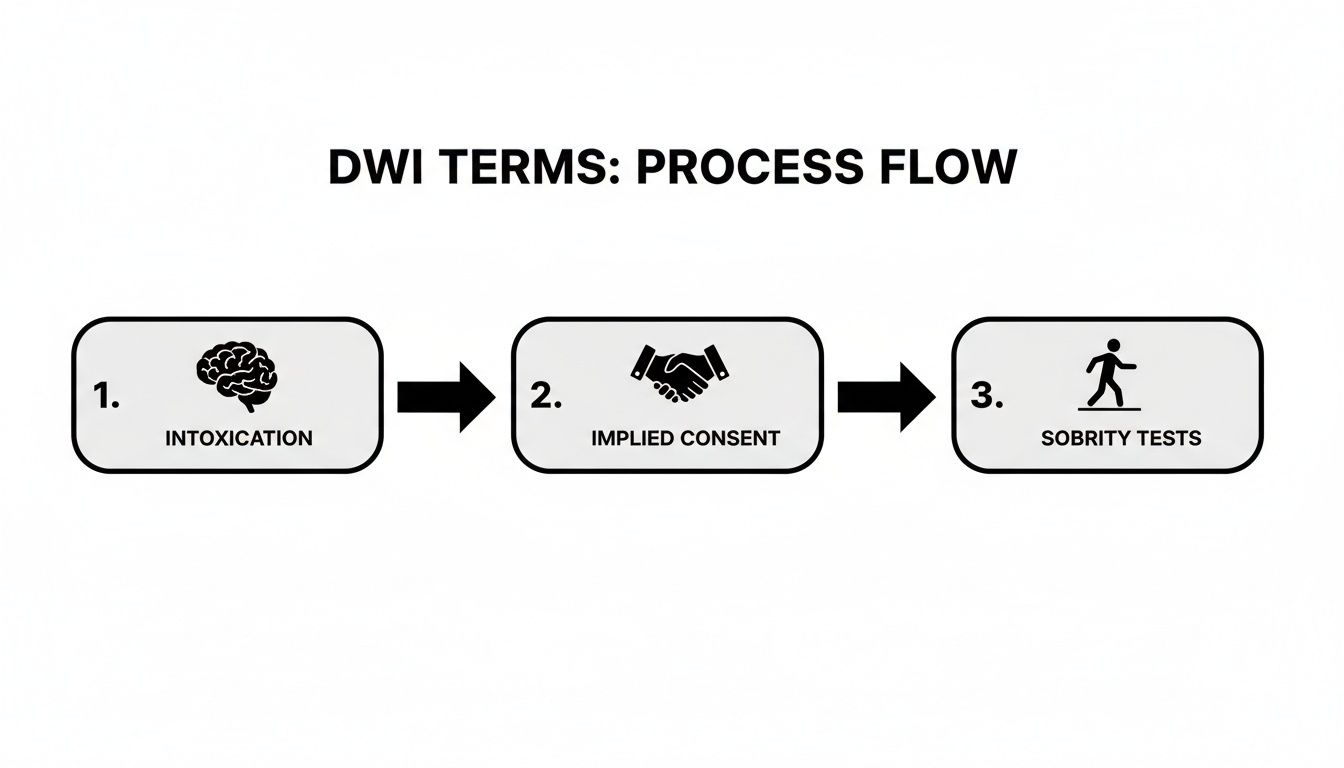
As you can see, the process moves from an officer's subjective opinion toward evidence that, while seemingly scientific, is often full of flaws we can challenge.
The Fight for Your License: The ALR Hearing
The first, most time-sensitive battle you’ll face is for your driver's license. This happens in an Administrative License Revocation (ALR) hearing, which is a civil proceeding run by the Texas Department of Public Safety (DPS), not the criminal court. Its only purpose is to determine if your license should be suspended because you either refused a chemical test or provided a sample over the 0.08% legal limit.
- Administrative License Suspension: This is a civil penalty separate from any criminal conviction.
You have a very short window to take action.
You must request an ALR hearing within 15 days of your arrest. If you miss this deadline, your license gets suspended automatically.
Requesting this hearing is one of the most important first steps. It puts your license suspension on hold until the hearing occurs. More importantly, it gives your lawyer a crucial opportunity: the chance to question the arresting officer under oath. This is like a "test run" for your criminal case, where your defense team can find weaknesses in the state’s story long before you ever see a criminal courtroom.
The Fight for Your Record: The Criminal Court Process
While the ALR process is underway, the criminal case moves along its own track. This is where a prosecutor will try to prove beyond a reasonable doubt that you are guilty of Driving While Intoxicated. The criminal process unfolds in a series of stages, each with its own challenges and opportunities for a strong defense.
Key Stages in a Texas DWI Criminal Case:
- Arraignment and Bond: This is your first official court appearance where the charges are read, and you enter a plea of "not guilty." The judge will also set your bond conditions, which might include installing an ignition interlock device on your vehicle.
- Discovery and Pre-Trial Motions: Your attorney goes on the offensive, requesting all evidence the state has against you (police reports, videos, test results). They will also file motions to suppress illegally obtained evidence, such as from an unlawful traffic stop.
- Plea Negotiations: Your lawyer will negotiate with the prosecutor to seek a favorable resolution, such as a case dismissal, a reduction to a lesser offense like reckless driving, or an agreement for a probated sentence.
- Trial: If a satisfactory agreement cannot be reached, your case goes to trial. You have the right to have your case decided by a jury of your peers or by a judge, who will determine guilt or innocence.
Even if you lose the ALR hearing and your license is suspended, you may still be eligible for an occupational license, which allows you to drive to essential places like work and school. You can learn more about how to get an occupational license to maintain stability while your case is pending.
Building a Strong Defense Against Your First DWI

After an arrest for a first DWI in Texas, it’s easy to feel like the case against you is unbeatable. That is rarely true. The state carries the entire burden of proving every element of its case beyond a reasonable doubt, and its evidence often has weaknesses a skilled Houston DWI lawyer can expose.
Building a powerful defense starts with a simple but crucial mindset: question everything.
Every part of the process—from the reason the officer pulled you over to the chemical test at the station—is an opportunity for a strategic challenge. We don't just accept the police report at face value; we dig into the details to find the openings that can lead to a dismissal, a reduced charge, or a "not guilty" verdict.
How to Fight a Breath Test Result
Chemical tests, like a breathalyzer or a blood draw, sound scientific and final. They're not. Both are vulnerable to procedural mistakes, machine malfunctions, and human error that can render the results inadmissible in court.
For a breath test, a skilled DWI attorney will investigate:
- Machine Maintenance and Calibration: Was the breathalyzer device properly calibrated and maintained according to state regulations? We can subpoena the machine’s maintenance logs to look for a history of errors.
- Operator Certification: Was the officer who administered the test certified to operate that specific device?
- Observation Period: Texas law requires the officer to watch you for 15 continuous minutes before the test to ensure you don’t do anything to contaminate the sample, like burping or putting something in your mouth. Did they follow this rule strictly?
Challenging the Initial Traffic Stop
The entire DWI case rests on the legality of the initial traffic stop. If the officer did not have a valid reason to pull you over, any evidence they gathered afterward could be thrown out of court. This is known as the "fruit of the poisonous tree" doctrine.
An officer needs reasonable suspicion—specific, observable facts suggesting you broke a traffic law. A vague hunch is not enough. Common reasons for a stop include:
- Speeding or other moving violations.
- Failure to signal a turn or lane change.
- Weaving or swerving.
- Equipment violations like a broken taillight.
A good defense attorney will immediately obtain the dashcam and bodycam footage. If the video shows you driving perfectly while the report claims you were swerving, we have a powerful argument to get the case dismissed.
Disputing Field Sobriety Test Results
As we've covered, Field Sobriety Tests (FSTs) are notoriously subjective. They are not pass/fail exams; they are tools designed to give an officer justification for an arrest. A defense lawyer can attack their validity from several angles.
An officer’s subjective opinion about your FST performance is not concrete proof of intoxication. External factors often play a larger role than alcohol, and our job is to bring those factors to the jury's attention.
We create doubt by questioning if the results were unreliable due to:
- Improper Instructions: Did the officer explain and demonstrate the test according to national standards? Often, they do not.
- Poor Conditions: Were you forced to perform these tests on an uneven surface, in bad weather, or with blinding patrol car lights in your eyes?
- Medical or Physical Factors: Do you have a medical condition, a past injury, or are you over a certain age or weight? Any of these can affect balance and make a sober person appear impaired.
By highlighting these issues, we can show a prosecutor or jury that the FSTs do not prove intoxication.
Texas DWI statistics show that while many cases end in a plea, a strategic defense makes a significant difference. According to one report, out of over 83,000 DWI charges filed in a recent year, only a small fraction resulted in a "not guilty" verdict at trial, highlighting the uphill battle without expert legal help. You can read more about Texas DWI case outcomes and why an aggressive defense is so critical.
Understanding the Potential Outcomes of Your Case
When you’re facing a first DWI in Texas, the uncertainty can be one of the most stressful parts of the process. You are likely asking, "What’s going to happen to me?" The good news is that a conviction is not the only possibility. An experienced Houston DWI lawyer works to find a resolution that protects your record and your future, and there are several favorable outcomes we fight to achieve.
Where your case lands depends heavily on the strength of the evidence and the skill of your defense. Our goal is always to aim for the best-case scenario first, protecting your rights at every turn.
The Best Outcome: Case Dismissal
A full dismissal is the absolute best result. It means the prosecutor has dropped the charges against you entirely. The case is over. A dismissal often happens when your attorney finds critical flaws in the state's evidence, such as an illegal traffic stop or unreliable test results, leaving the prosecutor with a case too weak to win at trial.
Getting the Charge Reduced
Sometimes, the evidence has enough holes to make a prosecutor nervous about a trial. In these situations, your attorney can negotiate to get the DWI charge reduced to a less serious, non-alcohol-related offense, like Obstruction of a Highway or Reckless Driving. This is a huge win, as these charges don’t carry the same stigma or the harsh automatic penalties of a DWI, such as an immediate license suspension.
While every case is unique, a strategic legal approach opens the door to multiple favorable outcomes. The key is to challenge the state's narrative and create leverage for negotiation or dismissal.
Deferred Adjudication: Keeping a Conviction Off Your Record
For many first-time offenders in Texas, deferred adjudication is an excellent outcome. It is a special form of probation that allows you to avoid a final conviction.
Here’s how it works: you plead "guilty" or "no contest," but the judge defers finding you guilty and places you on community supervision (probation). If you successfully complete all the terms—paying fines, attending classes, and using an ignition interlock device—the case is dismissed. The charge will not appear as a conviction on your public criminal record. After completing deferred adjudication for a first DWI, you may also be eligible to have your record sealed from public view through an order of non-disclosure.
What a Conviction Entails
If a dismissal, reduction, or deferred adjudication cannot be reached, the outcome is a conviction. A conviction for a first DWI means a permanent criminal record and the full range of penalties, including fines, probation, mandatory community service, and a DWI license suspension. This underscores why it is so critical to mount an aggressive defense from day one.
When a DWI Puts Your Career on the Line
A DWI arrest is a major disruption for anyone. But for professionals, it can be a direct threat to the career they’ve spent years building. When your job depends on a professional license or maintaining a clean record, the stakes of a first DWI in Texas are significantly higher.
A conviction isn't just about fines and classes; it's about potentially losing the livelihood that supports you and your family. For these individuals, you need a legal strategy laser-focused on protecting your license and your future.
Commercial Drivers (CDL Holders)
If you drive for a living with a Commercial Driver's License (CDL), you are held to a much higher standard. For a CDL holder operating a commercial vehicle, the legal BAC limit is just 0.04%. A DWI conviction, even if it occurred in your personal vehicle, triggers a one-year disqualification of your CDL for a first offense. A second offense results in a lifetime ban. Fighting the charge aggressively is essential to save your career.
Underage Drivers and Zero Tolerance
Texas has a “zero tolerance” policy for underage drinking and driving. For anyone under 21, it is illegal to operate a vehicle with any detectable amount of alcohol in their system. This charge is a Driving Under the Influence (DUI) offense. A conviction creates a criminal record that can complicate college applications, scholarships, and future job opportunities, making a strong defense crucial to protect a young person's future.
Licensed Professionals
Many careers require a state-issued license, and licensing boards have strict rules about character and fitness. A DWI conviction can put your professional license in jeopardy.
Professionals at risk include:
- Nurses and Doctors: A DWI can trigger an investigation by the Texas Board of Nursing or the Texas Medical Board.
- Pilots: The FAA has strict reporting rules, and a conviction can lead to the suspension or revocation of your pilot’s license.
- Lawyers and Real Estate Agents: State licensing bodies can impose sanctions, suspension, or other disciplinary actions.
For these professionals, the primary goal is to avoid a conviction that must be reported to a licensing board. If you're concerned about how a DWI could impact your job, our guide on navigating employment with a DWI record provides more detailed information.
Answering Your Urgent First DWI Questions
A first DWI in Texas arrest triggers a whirlwind of urgent questions. Getting clear answers is the first step toward building a solid defense and regaining a sense of control. Let’s tackle some of the most common concerns we hear from clients.
Do I Really Need a Lawyer for My First DWI in Texas?
Yes. While a first DWI is a misdemeanor, the consequences are serious and long-lasting. An experienced Houston DWI lawyer understands how to analyze the prosecution's evidence for weaknesses, negotiate effectively, and guide you through both the criminal and administrative legal battles. Going it alone means facing a prosecutor whose job is to secure a conviction. An attorney's goal is to find the best possible path forward, whether that’s a dismissal, a reduced charge, or a deferred adjudication that keeps a conviction off your record.
Will I Definitely Go to Jail for a First DWI?
Not necessarily. While a Class B Misdemeanor carries a potential jail sentence of up to 180 days, it is not a guaranteed outcome for first-time offenders. Outcomes like probation or deferred adjudication are common, especially with a strong defense. These alternatives allow you to serve your sentence in the community instead of behind bars. A skilled Texas DUI attorney will fight for these options to minimize the disruption to your life.
A DWI arrest can feel like a one-way ticket to a jail cell, but Texas law provides several alternatives to incarceration. The key is having an advocate in your corner who knows how to effectively argue for them on your behalf.
How Much Does a First DWI in Texas Cost?
The total cost of a first DWI often adds up to thousands of dollars. These expenses include court fines (up to $2,000), bond fees, attorney fees, monthly probation fees, mandatory DWI education classes, and a significant increase in your car insurance premiums. If an ignition interlock device is required, you'll also pay for installation and monthly monitoring. Investing in a qualified DWI attorney can pay for itself by fighting to lower fines, avoid costly requirements, or get the charges dismissed altogether, significantly reducing the overall financial burden.
A DWI arrest can feel isolating, but you don't have to face this challenge alone. At the Law Office of Bryan Fagan, PLLC, our team is dedicated to defending your rights and protecting your future. We offer a free, confidential case evaluation to help you understand your options and take the first step toward building a strong defense. Contact us 24/7 to get the strategic, reassuring guidance you need.