 Skip to content
A DWI arrest can be overwhelming—but you don’t have to face it alone. Being charged with a first-time Driving While Intoxicated (DWI) in Texas is serious, but it's crucial to remember that an arrest is not a conviction. This is the starting point, not the end of the road. With a strategic legal defense, you have the power to protect your rights and your future.
What Happens After a First DWI Arrest in Texas

The moments following a DWI arrest are confusing and stressful. From the flash of red and blue lights, you are suddenly facing two separate legal battles, each with its own strict deadlines and potential consequences. This is a challenge you should not face by yourself.
The first battle is the criminal case, where the State of Texas must prove beyond a reasonable doubt that you were operating a motor vehicle in a public place while intoxicated. The second is an administrative case that deals exclusively with the suspension of your driver's license.
Understanding the Two Legal Fronts
Navigating what comes next requires a strategic approach on two fronts. You will be defending against criminal charges that could lead to fines and jail time, while simultaneously fighting an administrative process to keep your driver's license.
- The Criminal Case: This is the formal DWI charge that proceeds through the court system. It involves arraignments, pre-trial motions, and potentially a trial. The goal here is to fight for a dismissal, a reduction of the charges, or a "not guilty" verdict.
- The Administrative License Revocation (ALR) Hearing: This is a civil proceeding entirely separate from your criminal case. It is automatically triggered if you refuse a breath or blood test, or if you provide a sample showing a Blood Alcohol Concentration (BAC) of 0.08% or higher. You have a very small window—just 15 days from the date of your arrest—to request this hearing. If you miss that deadline, your license will be automatically suspended.
A first-time DWI in Texas isn't just about the criminal charge; it's also an immediate threat to your ability to drive. An arrest is just the beginning of the process, not the final word. A proactive defense is the most powerful tool you have right now.
Your Immediate Next Steps Are Crucial
What you do in the hours and days after an arrest can significantly impact your case. The legal system moves quickly, and missing a deadline can mean losing important rights forever. The single most important thing you can do is understand the initial steps you must take after a DWI arrest to start protecting yourself.
This guide will walk you through what a first DWI in Texas truly means, cutting through the fear and confusion. We will explain the potential penalties, what to expect from the court process, and how a skilled Houston DWI lawyer can defend your rights. This is your first step toward regaining control and building the strongest defense possible.
What a First-Time DWI Charge Really Means in Texas
Facing a DWI arrest in Texas can feel like your world is shrinking. While the potential penalties are intimidating, an arrest is just the start of the legal process, not the final outcome. The punishments listed in the law books represent the maximums, not what is guaranteed to happen in your case. Our job as your defense team is to fight for the best possible result and minimize the consequences.
In Texas, a standard first-time DWI is charged as a Class B Misdemeanor. While this is a serious charge, a strategic legal approach can often help first-time offenders avoid the harshest penalties.
Class B vs. Class A: Why Your BAC Matters
One of the most significant factors determining the severity of a first DWI charge in Texas is your alleged Blood Alcohol Concentration (BAC). A standard first offense is a Class B Misdemeanor, but a high BAC reading can elevate the charge and increase the potential penalties.
- Class B Misdemeanor: This is the standard charge for a first-time DWI where your alleged BAC is below 0.15%.
- Class A Misdemeanor: If your BAC result is 0.15% or higher, the state automatically enhances the charge to a Class A Misdemeanor, which carries much more severe potential penalties.
It is critical not to accept a BAC number as indisputable fact. A skilled Texas DUI attorney will immediately begin to scrutinize every piece of evidence—from the reason for the traffic stop to the breathalyzer's calibration records—to challenge that result. A successful challenge can be the key to getting your charges reduced.
The Real-World Consequences of a First DWI
When facing a DWI, the "what ifs" can be overwhelming. For example, if you are pulled over after dinner with friends, you could be facing a Class B Misdemeanor. The law allows for a fine of up to $2,000, but that is just the beginning. Court costs and state-mandated fees can easily double or triple that amount, pushing your total cost well over $4,000.
Then there is the possibility of jail time, which can range from a mandatory 72 hours to 180 days. However, for many first-time offenders, judges often favor probation. Perhaps the most disruptive consequence, especially in a state like Texas, is the loss of your driver's license for 90 days to a full year. You can get more details on how we fight these outcomes in this overview of first-offense DWI consequences.
The specific details of your arrest are everything. A good DWI attorney knows how to take those facts, reframe the narrative, challenge the state's evidence, and fight for an outcome that doesn't ruin your future. For a first DWI in Texas, that often means securing probation instead of jail time.
To give you a clearer picture, here is a side-by-side comparison of the potential penalties.
First-Time DWI Penalties in Texas at a Glance
This table breaks down the difference between a standard first DWI and one with a high BAC, showing how much that one number can change everything.
| Penalty | Standard First DWI (Class B Misdemeanor) | First DWI with BAC ≥0.15 (Class A Misdemeanor) |
|---|---|---|
| Fine | Up to $3,000 | Up to $6,000 |
| Jail Time | 72 hours to 180 days | Up to 1 year |
| License Suspension | 90 days to 1 year | 90 days to 1 year |
| Probation | Up to 2 years of community supervision | Up to 2 years of community supervision |
| DWI Education | Mandatory 12-hour class | Mandatory 12-hour class |
| Ignition Interlock | Possible requirement during probation | Often a mandatory condition of bond or probation |
These are the penalties the state will pursue, but they are not set in stone. The quality of your defense can make a significant difference. We are here to analyze the specifics of your case and build the strongest possible strategy to protect your rights and your future.
The 15-Day Deadline To Save Your Driver's License
After a DWI arrest, a critical clock starts ticking. You have exactly 15 days from the date of your arrest to formally request an Administrative License Revocation (ALR) hearing. If you miss this non-negotiable deadline, the Texas Department of Public Safety (DPS) will automatically suspend your driver’s license.
This is the single most urgent step in protecting your freedom to drive. For anyone facing a first DWI in Texas, meeting this deadline is priority number one. It is your only opportunity to challenge the administrative license suspension and prevent a major disruption to your life.
This tight turnaround is due to Texas's implied consent law. By obtaining a Texas driver's license, you legally agree to provide a breath or blood sample if you are lawfully arrested for DWI. Refusing that test—or providing a sample with a BAC of 0.08% or higher—triggers this administrative penalty, which is entirely separate from your criminal case.
Understanding The ALR Process
The ALR hearing is a civil proceeding, not a criminal trial. Its sole purpose is to determine if the state has the right to suspend your license. While it is your chance to fight the suspension, it also serves a critical strategic purpose for your overall defense.
This hearing provides your attorney with the first opportunity to cross-examine the arresting officer under oath. It is an invaluable preview of the state's case. We can investigate every detail of the stop and arrest, asking about:
- The legal reason for the traffic stop (probable cause)
- How the field sobriety tests were administered
- Every statement you made during the encounter
- The officer’s specific observations about your behavior and appearance
That testimony is recorded and can become a powerful tool in your criminal case. It allows us to lock the officer into their story, uncovering inconsistencies, procedural errors, and weaknesses in the evidence long before a criminal trial. The ALR hearing is a strategic advantage that can significantly strengthen your defense.
The infographic below shows how quickly the stakes escalate in a Texas DWI case.
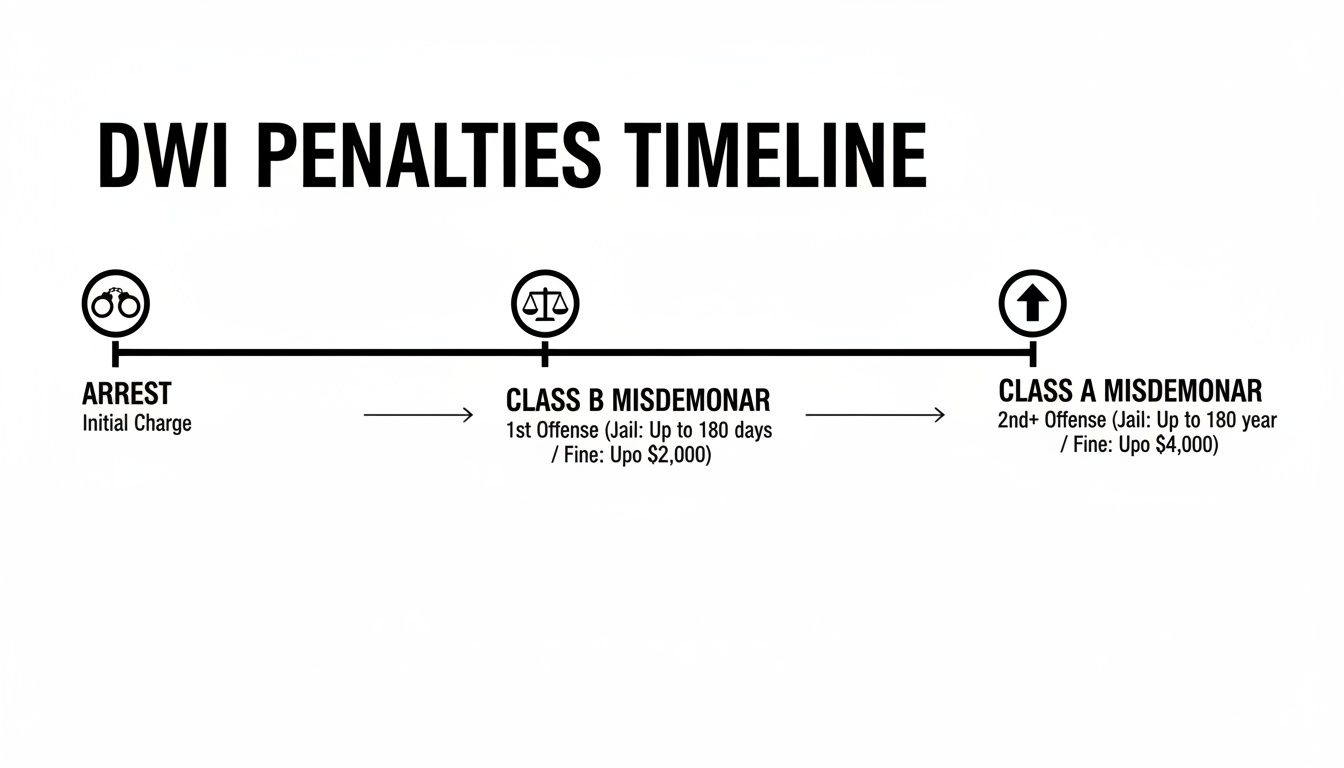
From the moment of arrest, the legal process moves swiftly toward harsher penalties. This timeline makes it clear why taking immediate action is so important.
What Happens If Your License Is Suspended?
If you miss the deadline to request the hearing or if you lose the hearing, your license will be suspended. The length of the suspension depends on what happened during your arrest.
For a first DWI offense, refusing a chemical test triggers an automatic 180-day license suspension. If you provided a sample that was over the legal limit, the suspension is typically 90 days.
Losing your license can make it difficult to get to work, take your children to school, or manage daily errands. However, even if your license is suspended, you are not necessarily stranded. An experienced Houston DWI lawyer can help you apply for an Occupational Driver's License (ODL).
An ODL, sometimes called an essential need license, is a restricted license that allows you to drive for essential purposes like work, school, and necessary household duties.
Obtaining an ODL involves filing a petition with the court and proving that you have an essential need to drive. You can learn more about the process in our guide on how to get an occupational license in Texas. While protecting your ability to drive begins with meeting that 15-day ALR deadline, it is reassuring to know that options like an ODL exist. Decisive action is the best way to fight a DWI in Texas and minimize its impact on your daily life.
Navigating The Texas DWI Court Process
A DWI arrest can feel like being dropped into a legal maze without a map. The journey from arrest to final resolution can be intimidating, but understanding the process is the first step toward regaining control. We are here to guide you through every stage, ensuring your rights are protected from start to finish.
The process begins the moment you are arrested. After being taken into custody, you will be booked, a formal procedure where your information is recorded. From there, your most immediate challenge is securing your release from jail.
The First Steps: Bond and Arraignment
To be released, you will need to post bond. A bond is a financial promise to the court that you will appear for all required court dates. This can be done with a cash bond or by working with a bail bond company.
Your first court appearance is the arraignment. At this formal hearing, the charges against you will be read, and you will enter an initial plea. This plea is almost always "not guilty." This is not about denying facts; it is a critical procedural step that preserves all your legal rights and gives your attorney the time needed to investigate your case.
A "not guilty" plea at your arraignment is a legal formality. It informs the court that you are exercising your constitutional right to require the state to prove its case against you beyond a reasonable doubt.
The Critical Pre-Trial Phase
After the arraignment, your case enters the pre-trial phase. This is where the real work of your defense begins. It involves intense investigation, strategic negotiation, and legal maneuvers designed to challenge the state’s evidence.
During this stage, your DWI lawyer will file for discovery. This is a legal demand that forces the prosecutor to provide every piece of evidence they have against you, including:
- Police Reports: The officer’s official account of the traffic stop and arrest.
- Dashcam and Bodycam Video: Objective footage that can either support or contradict the police report.
- Breath or Blood Test Results: The chemical evidence, along with all maintenance and calibration logs for the testing equipment.
- Witness Statements: Any accounts from others at the scene.
A meticulous review of this evidence is often where cases are won. We scrutinize every detail, searching for procedural errors, constitutional violations, or weaknesses in the prosecution's argument. For instance, did the officer have a legally sound reason—known as probable cause—to pull you over in the first place?
The numbers show why a strong defense is so important. In 2020, law enforcement agencies in Texas made 83,088 DWI arrests, and over 99% of them led to formal charges. In major counties like Harris and Dallas, first-time offenders make up the majority of these cases. While this sounds overwhelming, a skilled attorney knows that backlogged courts and flawed evidence can create opportunities for a dismissal. You can learn more about Texas DWI statistics and what they mean for your case.
Potential Paths and Outcomes
As the pre-trial phase progresses, several potential outcomes will emerge. Your attorney will explain the strengths and weaknesses of your case and help you decide on the best path forward. For a first DWI in Texas, the most common resolutions include:
- Dismissal: If your lawyer finds a critical flaw in the state's case—such as an illegal traffic stop or improperly handled evidence—they can file a motion to suppress it. If the motion is successful, it often dismantles the prosecutor's case, leading to a full dismissal.
- Plea Agreement: Sometimes, the best strategy is negotiation. Your attorney can often work with the prosecutor to secure a reduced charge or a more favorable sentence, like probation instead of jail. This approach avoids the risk and uncertainty of a trial.
- Trial: If a fair agreement cannot be reached, you have the absolute right to take your case to trial. A judge or jury will then hear the evidence and decide your guilt or innocence.
Understanding this roadmap helps demystify the legal journey ahead. With a strategic advocate in your corner, you can face each step with confidence, knowing your defense is in capable hands.
How A Skilled Lawyer Defends Your First DWI

Being arrested for a first DWI in Texas is a jarring experience, but it is critical to remember that an arrest is not a conviction. The state may present what seems like a solid case, but a skilled DWI attorney knows that the real story is often found beneath the surface. A powerful defense is not just about responding to the prosecutor; it is about proactively taking their case apart, piece by piece.
That process starts at the very beginning—the moment the police lights appeared in your rearview mirror. The officer needed a valid, legal reason, known as "reasonable suspicion," to pull you over. If they did not have one, any evidence collected afterward could be thrown out of court. We analyze police reports and review every second of dashcam footage to challenge the legitimacy of that initial stop.
Challenging The Evidence Against You
After examining the traffic stop, our focus shifts to the evidence the state plans to use against you. Prosecutors often rely on three things: field sobriety tests, breathalyzer results, and blood tests. However, each of these methods is prone to errors, and those errors can form the foundation of your defense.
A sharp attorney will start asking tough questions, such as:
- Were the Field Sobriety Tests administered correctly? The National Highway Traffic Safety Administration (NHTSA) has very strict protocols for how these tests must be performed. Even a small deviation can make the results completely unreliable.
- Was the breathalyzer machine functioning properly? These are complex devices that require constant maintenance and calibration. We subpoena the machine’s service logs to look for red flags, like a history of malfunctions or missed inspections.
- Was the blood sample handled according to procedure? The "chain of custody" for a blood sample must be flawless. If there is any break in that chain or if the sample was stored improperly, it can be contaminated, rendering the results invalid.
An experienced DWI attorney knows that mistakes in police work and procedure happen far more often than you would think. Finding these errors is often the key to getting evidence suppressed, charges reduced, or even having the case dismissed entirely.
Investigating The Arrest and Police Procedure
Beyond the physical evidence, your lawyer will launch a full-scale investigation into every detail of the arrest itself. This means obtaining all paperwork, videos, and reports to ensure your constitutional rights were upheld every step of the way.
This is not about searching for one magic bullet. It is about building a complete picture of what really happened and identifying every weak link in the prosecution's story. For instance, something as simple as a pre-existing medical condition or even the weather that day can significantly affect the outcome of a field sobriety test.
Common Defense Strategies For A First DWI
Every DWI case has a unique set of facts, but many of the strongest defenses are built on time-tested legal strategies. By dissecting your specific situation, a good lawyer can pinpoint the most effective way to move forward. The ultimate goal is always to protect your record and minimize the fallout.
Some of the most common and effective defense angles include:
- Challenging the Traffic Stop: Arguing that the officer lacked the legal justification to pull you over in the first place.
- Questioning Field Sobriety Test Results: Demonstrating that the tests were administered incorrectly or that external factors (like nerves or a physical ailment) impacted your performance.
- Attacking the Breath or Blood Test: Exposing issues with faulty equipment, improper handling of a blood sample, or a failure to follow testing protocols.
- Exposing Inconsistencies: Using the officer’s own reports and video footage to highlight contradictions in their story.
Building a solid defense requires a detailed and strategic game plan. You can learn more about the specific DWI defense strategies we employ for our Texas clients. Facing a first DWI in Texas is overwhelming, but with the right legal team fighting for you, you can challenge the charges with confidence and work toward the best possible outcome.
The Hidden Consequences Of A DWI Conviction
A DWI conviction in Texas creates ripples that extend far beyond fines and court dates. These hidden, long-term consequences can impact your professional reputation, financial stability, and personal freedom for years. Understanding these collateral effects is the first step in building a defense designed to protect your entire future, not just the outcome of your criminal case.
The most immediate financial shock often comes from your auto insurance provider. A single DWI conviction can cause your premiums to skyrocket, sometimes doubling or tripling overnight. This hike isn't temporary; it can last for years, costing you thousands of dollars long after you’ve paid off any court-ordered fines.
Lasting Professional And Financial Impacts
Beyond insurance, a DWI on your record can create serious hurdles in your career. Many employers run background checks, and a conviction can disqualify you from jobs in certain fields, especially those requiring a professional license (like nursing or aviation) or those that involve driving a company vehicle. It can even make it harder to rent an apartment or secure a loan.
The financial penalties have also gotten tougher over the years. Before 2019, Texas imposed heavy annual surcharges on top of court fines. While that specific system is gone, the penalties are now more direct and severe. Lawmakers replaced the old system with fines like $3,000 for a first offense within 36 months, which can climb even higher if your BAC was elevated. A conviction today still carries the risk of jail time, license suspension, and a permanent mark on your record that can impact employment for years to come, a topic you can learn more about in this breakdown of modern DWI penalties.
Protecting Your Record And Your Future
Facing these consequences can feel overwhelming, but it's important to remember that solutions exist. A proactive legal defense is your best tool to prevent these long-term issues before they ever start. Our goal isn't just to minimize the penalties—it's to fight for an outcome that avoids a final conviction altogether.
A DWI arrest does not have to result in a permanent criminal record. Strategic legal action can open pathways to protect your future, but the work must begin immediately.
One of the most effective tools for a first DWI in Texas is deferred adjudication. This is a special form of probation where you plead "guilty" or "no contest," but the judge actually defers a finding of guilt. If you successfully complete the probation period—following all the rules and staying out of trouble—the case is dismissed. No final conviction goes on your record.
Even better, successfully completing deferred adjudication may make you eligible to have the entire incident sealed from public view through an order of nondisclosure. This prevents most private employers from ever seeing the arrest, effectively giving you a clean slate. An aggressive defense from day one is the key to securing these kinds of outcomes and minimizing the hidden consequences of a DWI charge.
Common Questions After a First-Time DWI Arrest
If you’re facing your first DWI charge in Texas, your mind is probably racing with questions. It’s a stressful, confusing time, but getting clear answers is the first step toward regaining control. We hear the same worries from clients every day, and while every situation is different, these answers should help clear up some of the immediate uncertainty.
"Should I Have Refused the Breathalyzer?"
This is one of the most common "what if" questions we get, and there's no easy answer. It’s a split-second decision with major consequences either way.
Under Texas's "implied consent" law, just by driving on a public road, you've already agreed to provide a breath or blood sample if lawfully arrested for DWI. If you refuse, the state automatically suspends your driver's license for 180 days on a first offense. That happens right away, separate from the criminal case.
On the other hand, if you do provide a sample and it shows a Blood Alcohol Concentration (BAC) over the legal limit, you’ve just handed the prosecutor their strongest piece of evidence. A refusal makes their job harder, forcing them to prove intoxication through other, more subjective evidence. While the initial license suspension is longer for a refusal, it can sometimes strengthen your criminal defense. No matter what you chose to do at that moment, a skilled Houston DWI lawyer knows how to build a defense around it.
"Can My First DWI Be Dismissed?"
Yes, getting a first-time DWI charge dismissed in Texas is absolutely possible. In fact, it's our primary goal in every single case we take on.
A dismissal isn't about getting lucky; it's about finding critical weaknesses in the prosecution's case and exploiting them. This often comes down to police error. For instance, did the officer have a legitimate reason to pull you over in the first place? If not, the entire case can be thrown out.
We dig into every detail to dismantle the state's argument. Was the breathalyzer calibrated correctly? Did the officer follow the exact, standardized procedure for field sobriety tests? Finding these flaws is how we get cases dismissed.
Ultimately, the chance of dismissal comes down to the specific facts of your arrest and the thoroughness of your legal defense.
"How Much Will a DWI Lawyer Cost?"
The cost of hiring a good DWI lawyer can vary quite a bit, depending on how complex your case is, the lawyer's experience, and whether the case needs to go to trial. It’s a significant investment, but you have to weigh it against the catastrophic financial fallout of a conviction.
A DWI conviction comes with thousands of dollars in fines, court costs, and state-mandated surcharges. Your insurance premiums will skyrocket for years, and you could even lose your job or professional license.
Most reputable DWI firms, including ours, offer a free consultation to go over the details of your case and give you a clear, upfront understanding of the legal fees. We believe in being transparent about costs because we want you to understand the incredible value a strong, dedicated defense provides.
A DWI arrest is disorienting and frightening, but you do not have to navigate this alone. The dedicated attorneys at The Law Office of Bryan Fagan, PLLC are here to protect your rights, challenge the evidence, and fight for the best possible outcome for your case. Contact us today for a free, confidential case evaluation to understand your options and start building your defense. Visit us at https://texasduilawfirm.com to take the first step.

