 Skip to content
A DWI arrest in Texas can be overwhelming — but you don’t have to face it alone. From the moment you see flashing lights in your rearview mirror, you are fighting a battle on two separate fronts. While a first-time DWI is typically charged as a Class B Misdemeanor—a serious charge with potential jail time and fines—an arrest is not a conviction. Your most immediate priorities are to understand the two parallel legal processes that just kicked into gear: the criminal charge and the administrative attempt to suspend your driver's license.
What to Do Immediately After a Texas DWI Arrest
The minutes and hours after a DWI arrest can feel like a blur. It's confusing, overwhelming, and easy to feel paralyzed. But the actions you take in the first few days are absolutely critical for protecting your rights and your future. Think of it like this: you're facing two distinct legal challenges at the same time, and each one has its own unforgiving clock. How you handle this initial period can set the tone for your entire case.
The first challenge is the one everyone thinks about: the criminal charge. For a first DWI in Texas, this is usually that Class B Misdemeanor. This is the part that involves court dates, negotiations with prosecutors, and the potential for a trial.
The second challenge is more urgent and often overlooked: the Administrative License Revocation (ALR) process. This isn't a criminal case; it's a civil matter handled by the Texas Department of Public Safety (DPS), and its only goal is to take away your driving privileges.
Your Two Most Urgent Priorities
You cannot afford to ignore either side of this fight. If you focus only on the criminal case and let the administrative side slide, you could face an automatic license suspension, no matter what happens in court.
- The Criminal Case: This is the legal battle where the state must prove, beyond a reasonable doubt, that you were driving while intoxicated. Our goal here is to fight that charge—to get it dismissed, reduced, or secure another outcome that protects your record.
- The ALR Hearing: This is a separate, administrative hearing to decide if your license gets suspended. Here's the critical part: you have a non-negotiable 15-day window from the date of your arrest to request this hearing. If you miss that deadline, your license is almost certain to be suspended automatically.
The infographic below breaks down the immediate timeline you’re up against.
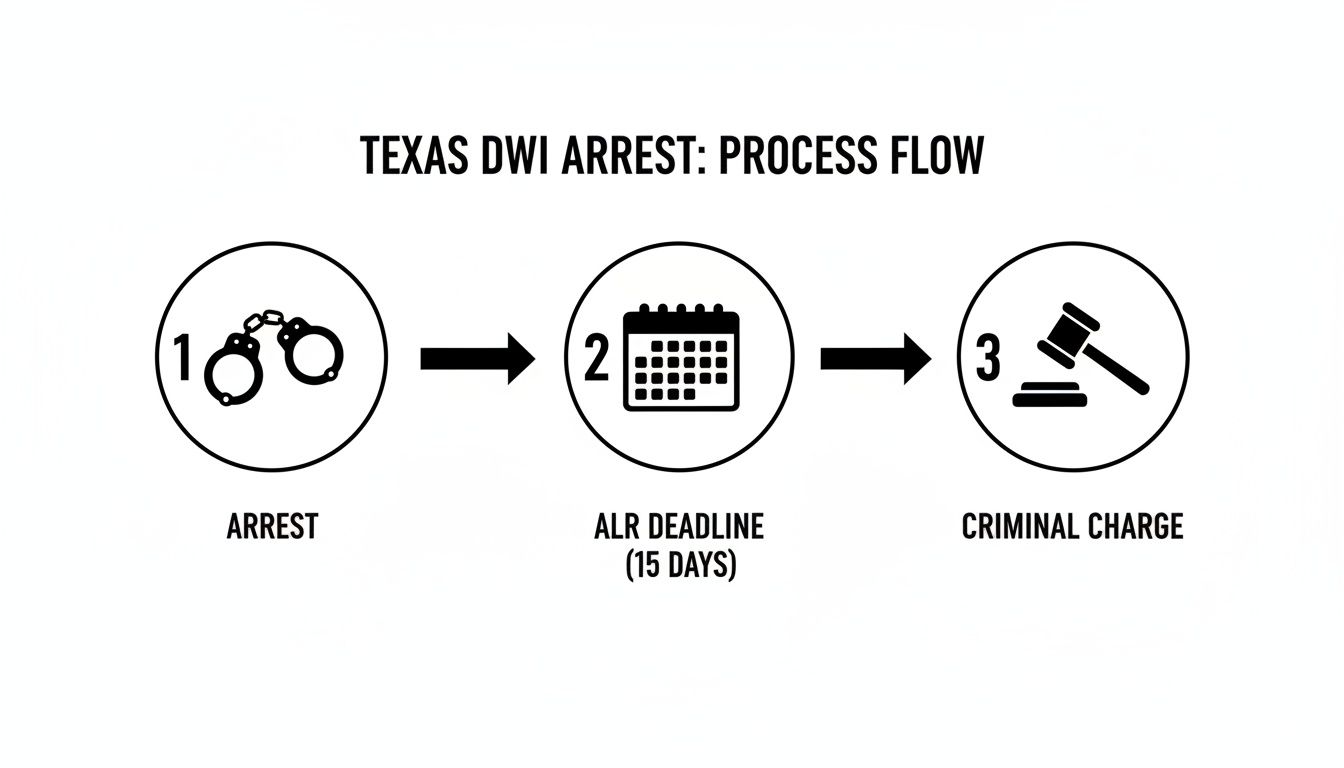
As you can see, the clock starts ticking the moment you're arrested. Swift, informed action isn't just a good idea—it's essential.
To help clarify these parallel tracks, here's a simple breakdown of your immediate priorities.
| Immediate Priorities After a First DWI Arrest in Texas | |||
|---|---|---|---|
| Legal Process | What It Is | Critical Deadline | Primary Goal |
| Administrative License Revocation (ALR) | A civil process to suspend your driver's license. It's separate from the criminal court case. | 15 days from your arrest to request a hearing. This is a hard deadline. | To challenge the suspension and keep your driver's license. |
| Criminal Charge (Class B Misdemeanor) | The formal court process where the state tries to convict you of driving while intoxicated. | Varies by court, but your first court date will be set soon after arrest. | To fight the DWI charge, aiming for a dismissal, reduction, or acquittal. |
This table highlights why you need a two-pronged strategy from day one. Addressing the ALR hearing buys you time and protects your ability to drive while we build a defense for the criminal case.
The Financial and Personal Stakes
The consequences of a DWI conviction go far beyond the courtroom walls. The true financial toll for a first offense can skyrocket, often landing somewhere between $5,000 and $24,000 in out-of-pocket costs when you factor in fines, fees, and surcharges. On top of that, you face a potential license suspension that could last up to two years. At The Law Office of Bryan Fagan, PLLC, our attorneys dig into every detail—from the initial traffic stop to the breath or blood test—to build a defense designed to dismantle the state's case.
Facing this alone can feel like an impossible task. Knowing what to do after a DWI arrest is the first step toward taking back control. A strategic, aggressive defense can protect your job, your family, and your future. From the moment you call us for a free consultation, we are ready to help you navigate this complex process and fight for the best possible outcome.
Texas DWI Penalties Explained

When you're facing a first DWI in Texas, the potential penalties can feel crushing. A quick search online paints a grim picture, full of worst-case scenarios that can keep you up at night. But here's the most important thing to remember: an arrest is not a conviction.
The initial charge is just the starting line of a long legal race. The penalties listed in the law are the absolute maximums, not what you will automatically receive. With a strong defense, there's often plenty of room to fight for a much better outcome.
For most people, a first-time DWI is charged as a Class B Misdemeanor. While that sounds serious—and it is—breaking down what it really means can take away some of the fear.
Standard Penalties for a First DWI
The Texas Penal Code lays out the official punishment range for a standard first-offense DWI. Think of these as the ceiling—the highest possible consequences the state can pursue.
- Fines: The court can order a fine up to $2,000.
- Jail Time: A conviction could mean anywhere from 72 hours to 180 days in county jail.
- Driver’s License Suspension: You could lose your license for 90 days to one year.
These numbers represent the upper limits, not the reality for most cases. That 72-hour minimum jail sentence, for example, can often be satisfied with probation, meaning you might not spend another minute in jail after your initial arrest. A skilled Houston DWI lawyer knows how to argue for outcomes at the lowest end of this spectrum—or better yet, for a complete dismissal.
When Penalties Are Increased to a Class A Misdemeanor
Some situations can instantly elevate a first-time DWI from a Class B to a more severe Class A Misdemeanor. This is called an "enhancement," and it dramatically raises the stakes. The most common trigger for this upgrade is a high Blood Alcohol Concentration (BAC).
Blood Alcohol Concentration (BAC) is a measurement of the percentage of alcohol in a person's bloodstream. In Texas, the legal limit for most drivers is 0.08%.
If your BAC comes back at 0.15 or higher—that's nearly double the legal limit—the charge gets automatically bumped up. The state sees this higher level of intoxication as a greater danger to the public, and the penalties reflect that.
A Class A Misdemeanor conviction brings much harsher potential punishments:
- Fines: The maximum fine doubles to $4,000.
- Jail Time: The potential jail sentence skyrockets to a range of 30 days to one year.
Even if you're facing an enhanced charge, don't lose hope. The state still has to prove its case beyond a reasonable doubt, and that includes proving the BAC test was accurate and reliable. A sharp Texas DUI attorney will dig into everything from the breathalyzer's maintenance logs to the officer's training records to challenge the validity of that 0.15 reading.
The key takeaway is this: these penalties are not set in stone. With a strategic legal defense, outcomes like probation, deferred adjudication, or even getting the charge reduced to a non-alcohol-related offense are often on the table. These resolutions are designed to keep you out of jail, protect your permanent record, and help you get your life back on track. Your case has a story, and our job is to make sure the court hears it.
Navigating the Administrative License Revocation Process

When you're facing a first DWI in Texas, the criminal charge feels massive. But for most people, the single most urgent problem is the risk of losing their driver’s license. Suddenly, the ability to get to work, pick up your kids, or make it to a doctor's appointment is on the line.
This is where the Administrative License Revocation (ALR) process kicks in. It's a separate, civil proceeding that runs alongside your criminal DWI case, and it’s focused entirely on your driving privileges.
Understanding how the ALR process works is absolutely critical because it moves incredibly fast. From the moment you are arrested, you have just 15 days to request a formal ALR hearing. If you miss this deadline, the Texas Department of Public Safety (DPS) will automatically suspend your license.
That’s not a suggestion; it's a hard and fast rule. Missing that window means you give up your single best shot at saving your license.
What is Implied Consent in Texas?
The entire ALR system is built on a legal concept known as "implied consent." It’s pretty straightforward: in Texas, the moment you get a driver's license and operate a vehicle on public roads, you have legally agreed to provide a breath or blood sample if a police officer has probable cause to suspect you're intoxicated.
You still have the right to refuse that chemical test. However, refusing triggers its own automatic consequence—a DWI license suspension. It's the state's way of encouraging cooperation during DWI stops.
The length of the suspension for a refusal depends on your record:
- 180-Day Suspension: This is the penalty for a first-time refusal.
- Two-Year Suspension: If you have any prior alcohol-related driving contacts on your record within the last 10 years, the suspension jumps to two full years.
It’s crucial to understand that this suspension can happen even if your criminal DWI charge is later dismissed. That’s why acting within the 15-day ALR window is priority number one.
The Critical 15-Day Deadline to Save Your License
After a DWI arrest, the officer likely handed you a piece of paper titled "Notice of Suspension." This document isn't just a receipt; it acts as your temporary driving permit and, more importantly, it spells out your deadline for requesting an ALR hearing.
You have exactly 15 calendar days from the date of your arrest to file a formal request for an ALR hearing with DPS. This isn’t a postmark deadline—the request has to be in their hands within that timeframe. Fail to do so, and your license will be automatically suspended 40 days after your arrest.
This deadline is unforgiving. The smartest move you can make is to hire a Houston DWI lawyer immediately. We handle filing the request for you, ensuring it’s done correctly and on time. This single step stops the automatic suspension in its tracks and prepares us for the next phase of your defense.
Why the ALR Hearing is a Strategic Advantage
The ALR hearing is about much more than just keeping your license. It’s a powerful strategic tool that can give us a huge advantage in your criminal DWI defense. Think of it as a preview of the prosecution's case.
At the hearing, a DPS attorney has to prove two things:
- The officer had reasonable suspicion to pull you over in the first place.
- The officer then developed probable cause to arrest you for DWI.
This is often our first—and sometimes only—opportunity to question the arresting officer under oath before the criminal trial. We can lock them into their story, expose inconsistencies between their testimony and their police report, and challenge the very foundation of the traffic stop or the arrest. To dig deeper into this, our firm has written extensively about the ALR hearing burden of proof in Texas.
The information we uncover during the ALR hearing is invaluable. It helps us build a much stronger strategy to fight DWI Texas charges on the criminal side, often leading to reduced charges or, in some cases, a complete dismissal.
How to Fight a First DWI Charge
An arrest for a first DWI in Texas can make you feel like the story is already written. It’s a common feeling, but nothing could be further from the truth. An arrest is just the beginning of the legal process, not the end. This is the moment we shift from simply reacting to the state’s accusations to proactively building a powerful defense designed to dismantle their case, piece by piece.

The prosecution's evidence might seem solid at first glance, but it's often full of procedural errors, subjective judgments, and scientific inaccuracies. Our job as your Texas DUI attorney is to find and exploit every single one of those weaknesses. At The Law Office of Bryan Fagan, PLLC, we don't just accept the state's version of events; we challenge it at every single turn.
This process starts by scrutinizing the very first interaction you had with law enforcement.
Challenging the Initial Traffic Stop
Every DWI case starts with a traffic stop. But an officer can't just pull you over on a hunch. They must have reasonable suspicion that you have actually violated a law—a crucial constitutional protection.
If the officer’s reason for the stop was flimsy or flat-out unlawful—think a vague claim of "weaving within your lane" without any real traffic violation—then any evidence gathered afterward could be thrown out. That includes the field sobriety tests, anything you said, and even the breath or blood test results.
We meticulously review dashcam and bodycam footage to see if the officer’s story matches what actually happened. A successful challenge at this first stage can cause the entire case against you to collapse before it ever gets started.
Dissecting Field Sobriety and Chemical Tests
The heart of the state's case usually relies on two types of evidence: Standardized Field Sobriety Tests (SFSTs) and chemical tests (breath or blood). Both are far from perfect and provide fertile ground for a strong legal defense.
Field Sobriety Tests are a set of physical and mental exercises (like the walk-and-turn or one-leg stand) administered roadside to help an officer determine if a driver is impaired. They are notoriously subjective and difficult to perform even when sober.
Many factors other than alcohol can cause a person to "fail" these tests. Nervousness, fatigue, physical limitations, medical conditions, or even the officer’s poor instructions can lead to an inaccurate assessment. We highlight these issues to show a judge or jury that these tests are not reliable indicators of intoxication.
Chemical tests might seem more scientific, but they are also vulnerable to attack. A skilled Texas DWI attorney knows exactly where to look for errors that can get the results thrown out of court.
Common Defenses Against Breath and Blood Tests:
- Improper Machine Calibration: Breathalyzer machines need regular maintenance and calibration to work right. We subpoena the device’s service records to look for a history of errors or missed inspections.
- Operator Error: The officer running the test must be certified and follow a strict protocol. Any deviation can compromise the sample and its result.
- Chain of Custody Issues: For a blood test, the sample has to be properly drawn, stored, and transported. We investigate every step in this "chain of custody" to make sure the sample wasn't contaminated or mishandled.
- Lab Errors: Even accredited labs make mistakes. We can bring in an independent expert to review the lab's procedures and findings, hunting for potential errors that could have skewed your BAC result.
Building a defense is like deconstructing a building brick by brick. By questioning the stop, the sobriety tests, and the chemical evidence, we systematically weaken the foundation of the prosecutor's case. Large urban areas like Harris County may process over 10,000 DWI arrests annually, but this high volume often means courts are overloaded and prosecutors are more willing to negotiate when faced with a well-prepared defense. It's also worth knowing that it is unlikely you will face significant jail time for a first DWI in Texas, and challenges to testing procedures frequently sway case outcomes. You can explore more about these trends and statistics to understand Texas DWI data.
Exploring the Potential Outcomes for Your Case
Uncertainty is one of the heaviest burdens that comes with a first DWI in Texas. The fear of the unknown—what’s going to happen to my job, my license, my future—can feel absolutely overwhelming. But it’s critical to remember this: an arrest is not a conviction. The charge you’re facing right now is just the starting line.
Think of it less like a one-way street to the worst-case scenario and more like a roadmap with several possible destinations. An experienced DWI attorney is your navigator, working to steer your case toward the best possible resolution and away from the harshest penalties. Let's walk through some of the paths your case could take.
The Best-Case Scenario: Dismissal of Charges
The ultimate goal in any criminal defense is to get the charges dismissed entirely. This means the prosecutor drops the case, and you are no longer facing a DWI charge. A dismissal isn't just a stroke of luck; it's earned through a meticulous and aggressive legal strategy.
We can secure a dismissal by successfully challenging the key pieces of the state's evidence. For instance, if we can prove the initial traffic stop was unlawful or that the breath or blood test results are unreliable because of procedural errors, the prosecutor's case can start to crumble. When their evidence gets thrown out, the state often has no choice but to dismiss.
Reducing the Charge to a Non-Alcohol Offense
Another highly favorable outcome is getting the DWI charge reduced to a lesser, non-alcohol-related offense, like reckless driving or obstruction of a highway. This is a huge win for a few important reasons.
- Avoids a DWI on Your Record: A conviction for reckless driving doesn't carry the same long-term stigma or consequences as a DWI.
- Lesser Penalties: The fines, fees, and potential probation terms are typically far less severe.
- Protects Your Future: It prevents a DWI conviction from torpedoing future employment, professional licenses, and insurance rates.
This outcome is often achieved through skilled negotiation. Your attorney highlights the weaknesses in the prosecution's case and convinces them that a plea to a lesser charge is a fair resolution for everyone involved.
Facing a first DWI in Texas can feel isolating, but it’s crucial to remember that a strong defense can dramatically alter the outcome. The goal is always to protect your record and minimize the impact on your life, and there are multiple avenues to achieve that.
Deferred Adjudication: A Second Chance
For many first-time offenders, deferred adjudication is an excellent option that offers a clear path to keeping a conviction off your permanent record. It’s not a conviction; think of it as a special kind of probation.
Here’s how it works: You enter a plea of "guilty" or "no contest," but the judge defers finding you guilty. Instead, you're placed on community supervision (probation) for a set period. During this time, you'll have to complete specific requirements, which might include:
- Completing a DWI education class
- Paying all fines and court costs
- Performing community service
- Installing an ignition interlock device on your vehicle
If you successfully complete every single term of your probation, the judge dismisses the case. Most importantly, this makes you eligible to file a petition for non-disclosure down the road, which seals the record from the public. This is a powerful tool for protecting your future opportunities.
Protecting Your Record and Future After a DWI Charge
A DWI charge doesn't just end when the court case does. Long after the fines are paid and the classes are completed, a mark on your record can create roadblocks for years, popping up during background checks for jobs, apartments, and even professional licenses.
The good news is that a single mistake doesn't have to define your future. Texas law offers powerful tools to help you move on with a clean slate, but you have to be proactive to use them.
The two main ways to handle a past DWI arrest are expunction and an order of non-disclosure. They might sound similar, but they do very different things and apply to completely different outcomes.
Expunction: The Power to Erase an Arrest
An expunction is the most powerful way to clear your name. Think of it as a legal process that completely destroys all public records of your arrest. Once a judge grants an expunction, it’s as if the arrest never happened. You can legally deny you were ever arrested for that offense.
This is the gold standard for clearing your record, but it's typically reserved for cases that end in your favor.
You might be eligible for an expunction if:
- Your DWI case was flat-out dismissed by the prosecutor.
- You went to trial and were found not guilty (acquitted) by a judge or jury.
- You successfully finished a Pre-Trial Intervention (PTI) or diversion program.
An expunction forces law enforcement, courts, and prosecutors to physically destroy their files related to your arrest. It's the ultimate clean slate after a wrongful or dismissed charge.
A huge misconception is that a dismissed case just vanishes. It doesn’t. The arrest record stays public unless you take the legal step to get it expunged.
Orders of Non-Disclosure: Sealing Your Record from Public View
So what happens if your case wasn't dismissed, but you successfully completed deferred adjudication? That’s where an order of non-disclosure comes into play. Instead of destroying the records, a non-disclosure order seals them from the public.
This means that private companies—like potential employers, landlords, and anyone else running a background check—won't be able to see the arrest or the case. Law enforcement and certain state agencies can still access the information if they need to, but it’s hidden from prying eyes.
Getting an order of non-disclosure is the key benefit of completing deferred adjudication. Once you finish your probation and the case is officially dismissed, you can petition the court to seal the record. This lets you move forward without constantly worrying that a past mistake will hold you back. Our firm provides detailed guidance on how you can get your record expunged in Texas or sealed.
Facing a first DWI in Texas is about more than just the immediate court battle; it’s about protecting your entire future. By understanding these long-term strategies from the start, you and your attorney can build a defense that not only fights the current charge but also sets you up for a clean record down the road.
Your Top Questions About a First Texas DWI
A DWI arrest triggers a flood of questions, and the legal jargon can feel overwhelming. Getting clear, straightforward answers is the first step toward regaining control. We've gathered some of the most common questions we hear from clients facing a first DWI in Texas to give you the clarity you need.
Is Jail Time Automatic for a First DWI?
No, not at all. While the law says a Class B Misdemeanor carries a potential sentence of 72 hours to 180 days in jail, that’s the maximum range—not a mandatory sentence. It's the worst-case scenario, not the starting point.
In reality, many people facing a first offense can resolve their case with outcomes like probation or deferred adjudication. These paths often let you avoid serving any more jail time beyond what you experienced during the initial arrest. A sharp Houston DWI lawyer knows how to negotiate for alternatives that protect your freedom and keep you out of a jail cell.
Can My First DWI Charge Actually Be Dismissed?
Yes, getting a first DWI charge dismissed is absolutely a realistic goal. A dismissal isn't just luck; it's earned by building a defense that systematically pokes holes in the prosecutor's case until it can no longer stand up in court.
Some of the most common paths to dismissal include:
- A Bad Stop: If the police officer didn't have a legitimate, legal reason to pull you over in the first place, any evidence they gathered afterward can be thrown out. This can cripple the entire case.
- Botched Field Sobriety Tests: These tests have strict protocols. If an officer administered them incorrectly or in a poor environment (like on a sloped road or in bad weather), the results become unreliable and can be challenged.
- Unreliable Breathalyzer: A breathalyzer machine is just that—a machine. If it hasn't been properly calibrated or maintained, its readings are questionable. We can often expose these maintenance failures to get the results thrown out.
What’s the Difference Between Probation and Deferred Adjudication?
This is a critical distinction that can change your entire future. While both options are designed to keep you out of jail, they have one massive difference in the long run.
"Straight probation" comes after a conviction. You plead guilty, are found guilty, and the DWI becomes a permanent stain on your criminal record.
Deferred adjudication, however, is a game-changer. It’s a special kind of probation where the judge agrees to defer or postpone a finding of guilt. You complete all the court's requirements—classes, community service, staying out of trouble—and once you're done, the case is formally dismissed. This is huge, because it means you were never technically "convicted," making you eligible to later have the record sealed from public view.
An arrest for a first DWI in Texas feels like your world is ending. But it's really the start of a legal process with many potential paths forward, including positive ones. The key is to act fast and make smart, strategic moves from day one.
How Long Will a DWI Stick to My Record?
A DWI conviction in Texas is a permanent mark on your criminal record—unless you take legal action to get it off. This is precisely why fighting the charge from the outset is so vital.
If your case ends in a dismissal or you successfully complete deferred adjudication, you open the door to options like an expunction or an order of non-disclosure. These are legal tools that can clear or seal the arrest and charge from your record. Without taking these steps, that one mistake can follow you for the rest of your life, impacting everything from job applications to housing.
A DWI arrest is a heavy burden, but you don’t have to carry it by yourself. The experienced Texas DWI attorneys at The Law Office of Bryan Fagan, PLLC are ready to build a strategic defense aimed at protecting your rights, your license, and your future. Let us help you understand your options and take the next step with confidence. Contact us today for a free, confidential case evaluation.

