
A DWI arrest can be overwhelming, but you don't have to face it alone.
If you're reading this after getting out of jail, calling a family member for bond money, or staring at paperwork that says felony, your mind is probably racing. You're worried about prison, your job, your license, and what your family will think. That's normal. It also doesn't mean your case is over.
A felony DWI case in Texas is serious, but serious doesn't mean hopeless. Charges can be challenged. Evidence can be tested. Prior convictions can be examined instead of accepted. That last point matters more than is generally recognized, especially if the State is trying to turn your current case into a felony based on an old DWI from another state.
A Felony DWI Charge Can Feel Overwhelming But You Have Options
A lot of people walk into this situation believing one bad night has already decided the outcome. That's the wrong way to look at it. An arrest is the start of a legal process, not the finish line.
You may have been stopped late at night, asked to step out of the car, put through a field sobriety test, and then arrested after a breath or blood request. A field sobriety test is a set of roadside tasks officers use to claim they saw signs of intoxication. These tests are subjective. They are not magic, and they are not beyond challenge.
You may also be hearing terms you haven't dealt with before:
- BAC means blood alcohol concentration. It's the measurement the State uses to argue a driver was intoxicated.
- Implied consent means that by driving on Texas roads, you are considered to have agreed to provide a breath or blood sample in certain DWI situations. That doesn't erase your rights, but it does trigger separate consequences if you refuse.
- Administrative license suspension means the State can try to suspend your driver's license through a separate process from the criminal case. That's why a DWI license suspension fight starts quickly.
A felony filing changes the stakes, but it doesn't erase your defenses.
What you need right now is a plan. First, protect your license. Second, protect yourself in the criminal case. Third, don't assume the prosecutor's version of your record is accurate, especially if they are counting an out-of-state conviction to claim this is a felony DWI Texas case.
If this is your first DWI in Texas, but there was a prior conviction somewhere else, the State may still try to use that history against you later. For those seeking a Houston DWI lawyer or Texas DUI attorney, focus on one thing above all else. You need someone who knows how enhancement works and who treats the prior conviction itself as a target, not a fixed fact.
Understanding the Thresholds for a Felony DWI Charge
You may have gone to bed thinking this was a standard DWI arrest and woken up to hear the word "felony." That shock is common. It also leads people to make a bad mistake. They assume the charge is fixed. It is not.
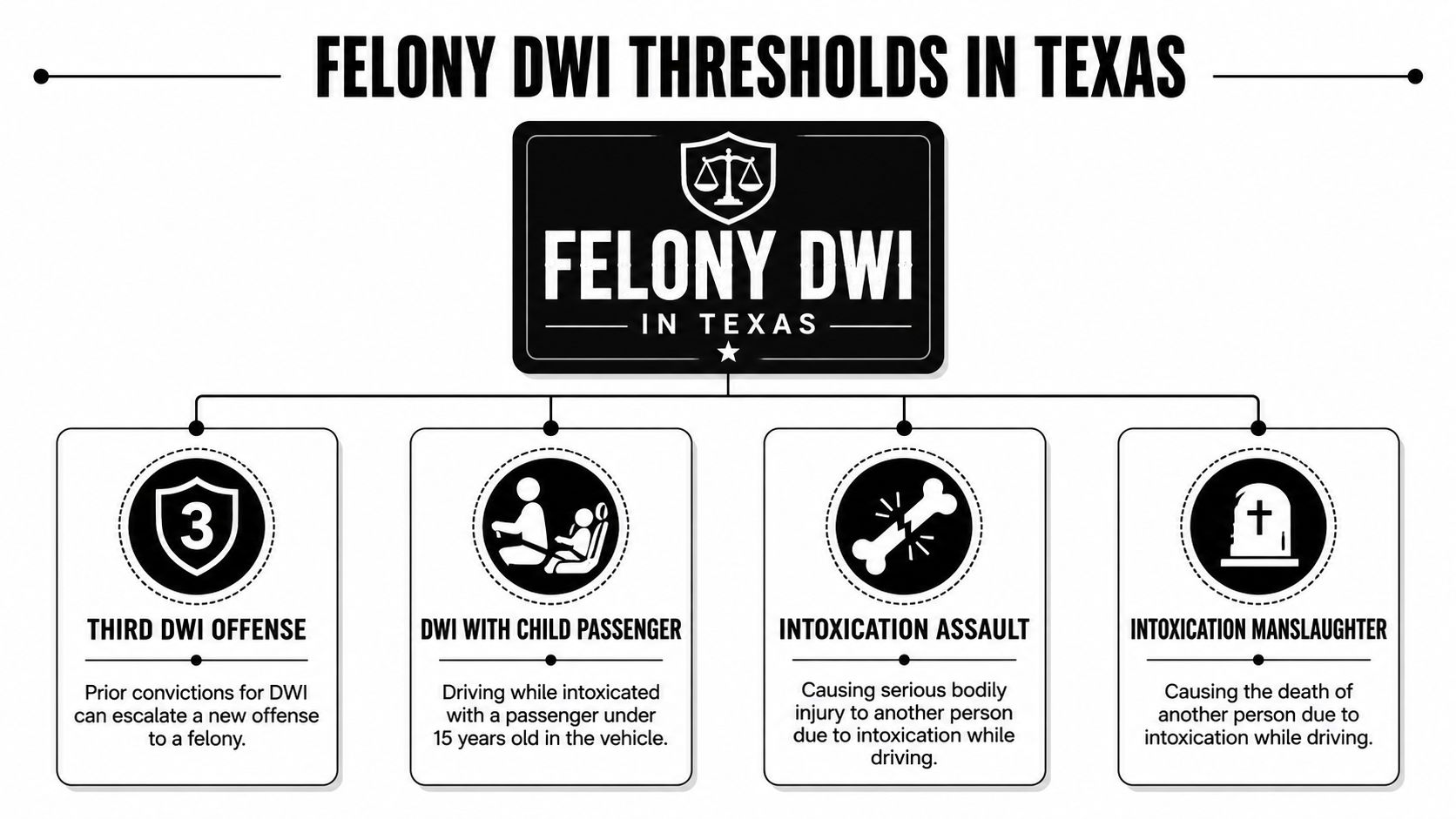
Four main ways a DWI becomes a felony
Texas law does not treat every DWI as a felony. The charge usually turns on one of four paths recognized under the Texas Penal Code: a third or subsequent DWI, DWI with a child passenger under 15, intoxication assault, or intoxication manslaughter. The Texas Department of Transportation outlines those felony categories in its summary of Texas DWI penalties and offense levels.
Here is the practical breakdown:
- Third DWI offense. A third or subsequent DWI is charged as a third-degree felony.
- Child passenger under 15. If a child younger than 15 is in the vehicle, the case can become a state jail felony, even if this is your first DWI arrest.
- Intoxication assault. If the State claims intoxicated driving caused serious bodily injury, the case becomes a felony.
- Intoxication manslaughter. If the State claims intoxicated driving caused a death, the case becomes a felony.
If you want a plain-language explanation of when a DWI becomes a felony in Texas, start there. Then look at the charging documents in your own case. The prosecutor's chosen theory matters because each path raises different proof problems and different defense opportunities.
The detail most people miss
The overlooked issue is not just how many prior DWIs you have. It is whether the State can legally use every prior it claims to have found.
That problem shows up often with out-of-state convictions. A person may have one old DUI from another state and assume a new Texas arrest is still a misdemeanor. Prosecutors may see it differently and try to use that prior to push the case into felony territory. Felony DWI in Texas: Third Offense and Child Passenger gives a good starting point on how that enhancement issue comes up.
Practical rule: If you have any prior DWI, DUI, or alcohol-related driving conviction from another state, expect the prosecutor to try to count it unless your lawyer blocks it.
That is often the most important battlefield in the case. Out-of-state priors are not automatic enhancements. Your attorney should examine the foreign statute, the judgment paperwork, the date of conviction, whether the offense lines up closely enough with Texas law, and whether the State can prove you are the same person named in that prior case.
This defense strategy gets missed far too often. A felony filing may look strong on paper, but if the enhancement prior fails, the entire charge level can change. That is why you should treat the prior conviction itself as a target for attack, not as a settled fact.
Penalties for a Texas Felony DWI Conviction
If you are facing a felony DWI, the fear is real. Clients usually worry about jail first. They should. But the conviction itself can keep hurting you long after sentencing, especially if the State is trying to turn the case into a felony by counting an old out-of-state DUI or DWI.
That point matters here. The punishment range depends on what kind of felony the prosecutor can prove, and enhancement priors are often the part of the case that deserves the hardest attack.
The penalty ranges you need to understand
A third DWI in Texas is generally charged as a third-degree felony. That exposes you to 2 to 10 years in prison and a fine of up to $10,000, as explained in this guide to third-offense felony DWI penalties.
A DWI with a child passenger under 15 is a state jail felony. The punishment range is 180 days to 2 years in a state jail facility and a fine of up to $10,000, based on the Texas Penal Code provisions for intoxication and alcoholic beverage offenses.
Intoxication assault is also a felony, usually a third-degree felony, with a punishment range of 2 to 10 years and a fine of up to $10,000 under the same Texas code section.
A felony DWI conviction can also trigger a driver's license suspension. The exact period depends on the charge, your record, and the facts the State proves. If the case is indicted, you should understand what happens after a grand jury indictment in a Texas felony case because the pressure usually increases at that stage.
Texas Felony DWI Penalty Comparison
| Felony Type | Potential Prison Time | Maximum Fine | License Suspension |
|---|---|---|---|
| State jail felony for DWI with child passenger under 15 | 180 days to 2 years | Up to $10,000 | Possible suspension |
| Third-degree felony for third DWI | 2 to 10 years | Up to $10,000 | Possible suspension |
| Third-degree felony for intoxication assault | 2 to 10 years | Up to $10,000 | Possible suspension |
Why the enhancement issue changes everything
The prosecutor may present the felony level as settled. It often is not.
If the State is using prior convictions to raise the case to a felony, your lawyer should test every piece of that enhancement evidence. That includes old Texas judgments and, just as important, DUI or DWI convictions from other states. Those priors can be vulnerable. The foreign statute may not match Texas law closely enough. The paperwork may be incomplete. The State may also have proof problems tying that old case to you.
That is not a technical sideshow. If an enhancement prior fails, the punishment range can change dramatically.
The hidden damage after sentencing
The sentence is only part of the problem. A felony record can block jobs, professional licenses, housing applications, firearm rights, and immigration options. It can also become a serious issue in family court if custody or visitation is disputed.
High-BAC cases deserve attention too. Texas can charge a first DWI with an alleged BAC of 0.15% or higher as a Class A misdemeanor, with steeper punishment than a standard first offense, as explained in this overview of Texas DWI laws and penalties. That kind of case is not a felony by itself, but it becomes much more dangerous if the State claims prior convictions in the background.
The right way to assess felony DWI penalties is simple. Start with the charge level, then challenge every prior conviction the State wants to use to keep that felony in place.
Navigating the Legal Process After a Felony DWI Arrest
After arrest, your case usually splits into two fights at once. One is the criminal case. The other is the driver's license case.
The license side often surprises people. Texas uses an Administrative License Revocation process, commonly called an ALR hearing, to decide whether your license should be suspended after a DWI arrest. If you're dealing with a possible DWI license suspension, speed matters.
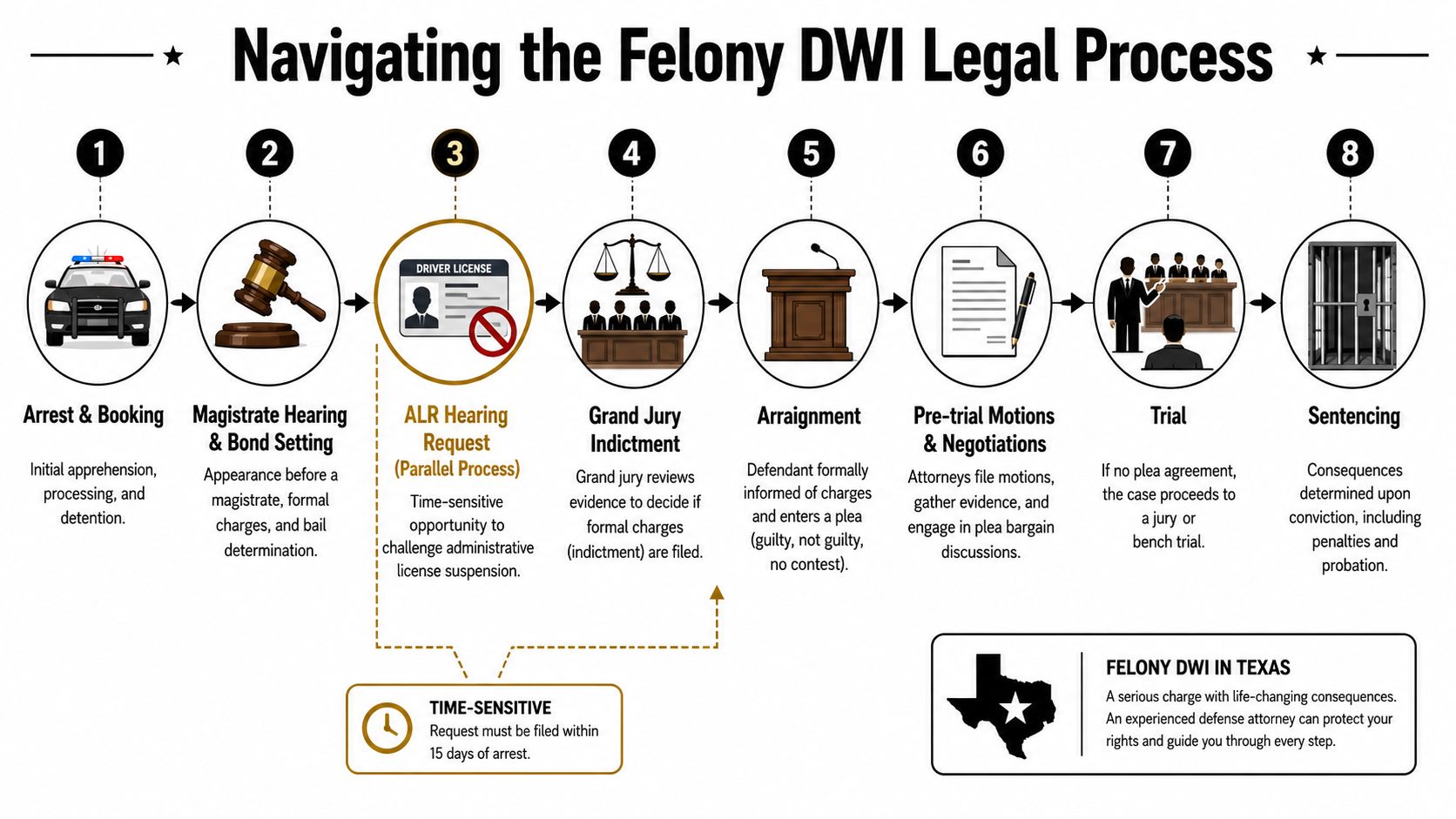
The first days after arrest
Expect the process to move like this:
- Arrest and booking. Officers process you, take fingerprints, and hold you until release or bond.
- Magistrate hearing and bond setting. A judge or magistrate reviews the accusation and sets bond conditions.
- ALR hearing request. This is the separate license fight. If you want to challenge the suspension, action has to happen quickly.
- Grand jury review. In a felony case, prosecutors usually seek an indictment.
- Arraignment. You hear the formal charge and enter a plea.
- Pretrial motions and negotiations. Many strong defenses are built during this stage.
- Trial if needed. If the case doesn't resolve, it goes to court.
- Sentencing if convicted. The court imposes punishment only after conviction or plea.
For readers trying to understand one major step in that sequence, this page explains what happens after a grand jury indictment.
Terms that matter right away
Here are the definitions that shape early decisions:
- Implied consent. Texas says drivers have already agreed to provide a breath or blood sample under certain circumstances by using public roads.
- Administrative license suspension. This is the separate civil-style process that can suspend your license even while the criminal case is still pending.
- Field sobriety test. These are roadside exercises officers use to support probable cause and later testimony.
A quick visual explanation can help if the paperwork feels confusing:
What you should do immediately
Don't talk your way into more evidence. Don't post about the arrest. Don't assume the blood result, breath result, or prior record is unbeatable.
Do this instead:
- Request help fast. The license issue moves early, and delay makes your position weaker.
- Save paperwork. Bond conditions, notice forms, and charging documents matter.
- Write down details. Stop location, officer statements, medical issues, and what you consumed can all matter later.
How a Skilled DWI Attorney Can Fight Your Charges
If you were arrested for felony DWI, you are probably worried about jail, your license, your job, and what this charge does to your future. That reaction is normal. It is also why you need a defense plan based on evidence, procedure, and the State's weak points, not panic.
A skilled DWI attorney does more than ask for a plea offer. Good defense work starts with one question: can the prosecutor prove this felony case the way it was filed? In many cases, the answer is no, or not without problems the defense can use.
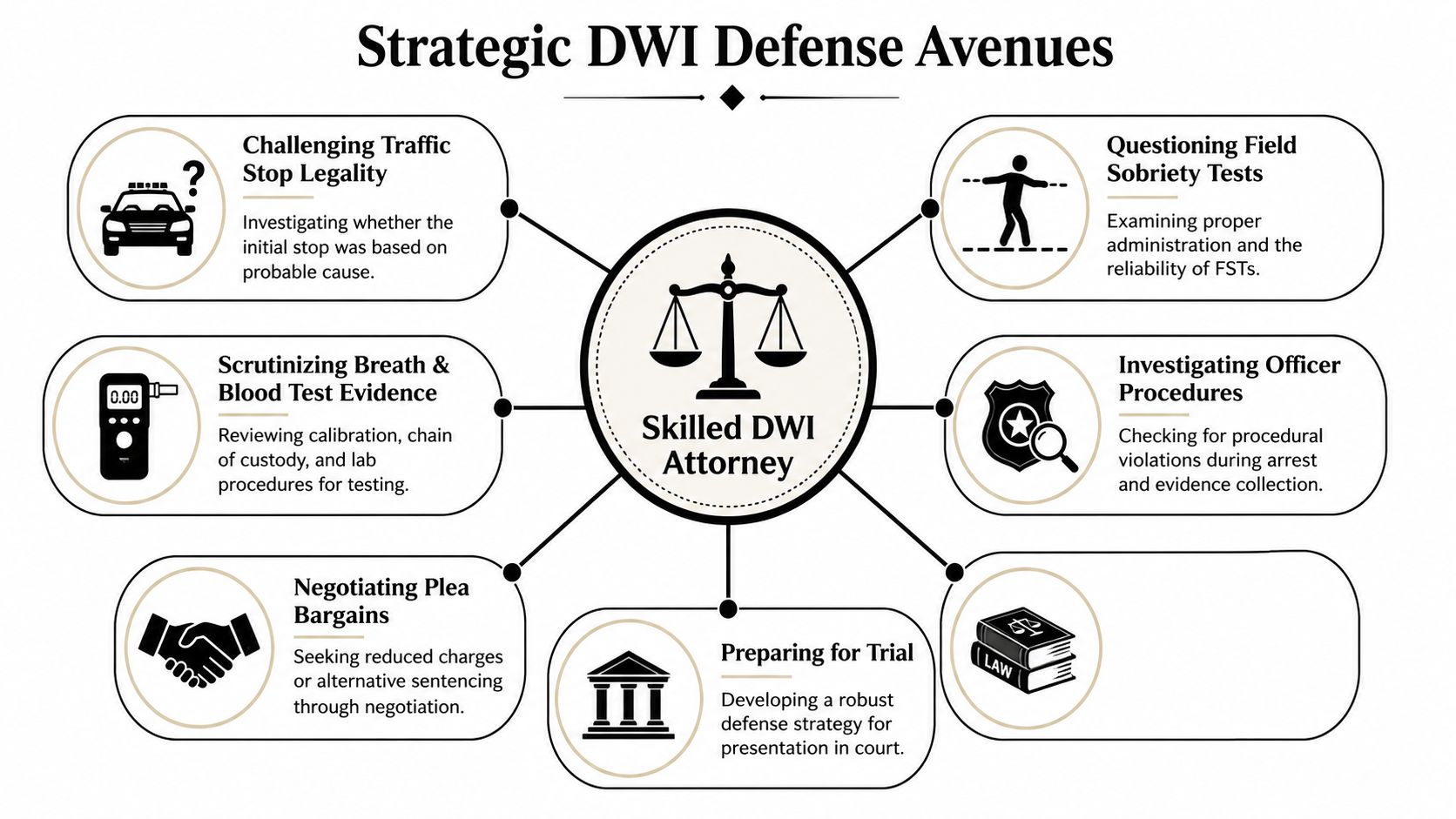
Start with the State's proof, not the accusation
The charging document is only the beginning. The case still depends on whether the officer had a valid reason to stop you, whether the investigation was handled correctly, and whether the chemical evidence will hold up under scrutiny.
An attorney should examine issues like:
- The traffic stop. No lawful basis for the stop can put later evidence at risk.
- Field sobriety tests. These tests are affected by medical conditions, fatigue, footwear, weather, surface conditions, and poor instructions.
- Breath or blood evidence. Machine maintenance, chain of custody, lab handling, and warrant problems can all matter.
- Officer conduct and paperwork. Reports, body camera video, missing timestamps, and inconsistent statements often reveal useful defenses.
For a closer look at common defense methods, see this guide on how lawyers beat DWI cases in Texas.
In felony cases, the prior convictions often decide the fight
This point gets missed too often. If the State is using prior DWI convictions to make the current case a felony, your lawyer should challenge those priors aggressively instead of treating them as automatic.
That matters even more with out-of-state convictions. Texas prosecutors often rely on older convictions from other states to file a felony DWI. Sometimes that enhancement is valid. Sometimes it is not. A prior from another state may involve a different statute, different elements, a defective judgment, or weak proof that the conviction belongs to you.
Texas courts have addressed how prior convictions are used in enhancement cases, and out-of-state priors can become a serious litigation issue, as discussed in this explanation of out-of-state prior DWI enhancement issues in Texas.
A defense lawyer should ask hard questions:
- Was the prior conviction final?
- Does the out-of-state offense match what Texas law requires for enhancement?
- Is the judgment facially valid?
- Can the State properly prove identity, not just produce a record with a similar name?
- Were constitutional problems built into the older case?
Some felony DWI cases turn on the stop, the blood test, or the officer's testimony. Others turn on whether the State can legally prove the priors needed to keep the case charged as a felony. That second category is where careful defense work can change the direction of the entire case.
The Law Office of Bryan Fagan, PLLC handles DWI defense matters involving ALR hearings, chemical test issues, repeat-offense allegations, and felony filings. That kind of full-case review matters because felony DWI defense is rarely about one issue alone.
Special Circumstances That Complicate DWI Cases
Some cases carry extra risk from the start. Those cases need more focused planning, not generic advice.
Commercial drivers and lower BAC rules
If you hold a commercial driver's license, Texas applies a lower legal BAC threshold. Commercial drivers operating in Texas are legally intoxicated at 0.04% BAC, according to this overview of Texas DWI law for commercial drivers. For many CDL holders, the case isn't only about court. It's about whether they can keep earning a living.
Old priors still count
Texas doesn't give you a clean slate just because time passed. A third or subsequent DWI can be treated as a third-degree felony regardless of how long ago the earlier cases happened, with no statutory time limit, as explained in this summary of Texas felony DWI enhancement rules.
If you have convictions from decades ago, don't assume they are irrelevant. Review them early. Don't wait for the indictment to learn what the State is planning.
Injury cases get more complex fast
When a DWI case involves a crash, serious injury, or death, the defense becomes more technical. The case may involve accident reconstruction, medical evidence, causation disputes, and multiple witnesses. If your arrest involved a collision, this page on DWI involving an accident or injury in Texas gives a factual overview of how an accident escalates the stakes of a Texas DWI charge.
Take the First Step to Protect Your Future and Your Freedom
The worst move in a felony DWI case is passivity. Waiting makes the license problem harder. Waiting gives the prosecutor time to build the enhancement case. Waiting also makes it easier to lose details that could help your defense.
You need to act like your future depends on early decisions, because it does. When seeking a Houston DWI lawyer, a Texas DUI attorney, or attempting to figure out how to fight DWI Texas, start with a clear review of the stop, the testing, the charging documents, and any prior convictions the State wants to use.
If your case involves an old out-of-state DUI or DWI, bring every record you can find. That issue may decide whether you're facing a misdemeanor or a felony. If your case involves a child passenger, a crash, a blood draw, or a CDL, say that in the first call. Those details change the defense plan.
You are not stuck with the State's first version of your case. You have rights. You may have defenses. You may have opportunities to challenge the stop, the testing, the enhancement, or all three.
The right first step is simple. Get the case reviewed immediately, before deadlines pass and before assumptions harden into outcomes.
If you're facing a felony DWI charge, request a free consultation with Law Office of Bryan Fagan, PLLC. A confidential case evaluation can help you understand the charge, protect your license, and build a strategy for your next move in Houston and across Texas.