
A DWI arrest can be overwhelming, but you don't have to face it alone.
If you were just arrested for a third DWI, you're probably dealing with several problems at once. You may be trying to get out of jail, figure out what happens to your license, explain the arrest to your family, and decide whether prison is now unavoidable. That reaction is normal. A felony arrest in Texas changes the stakes fast.
What matters right now is this. A third DWI is serious, but it is not hopeless. In many cases, the early decisions matter more than people realize. What you say, whether you request a license hearing on time, how your lawyer reviews the stop, and how your defense is presented can all shape the outcome. If your goal is to protect your freedom, your license, and your future, you need a clear plan.
A Third DWI Arrest Can Be Overwhelming But You Have Options
Individuals in this position feel like the case is already decided. They hear the word “felony,” they remember the prior cases, and they assume the court will treat them like there's nothing left to argue. That's usually the worst place to start.
A felony DWI case is not won or lost just because the charge sounds severe. It turns on evidence, procedure, timing, and strategy. I've seen people come in convinced they were headed straight to prison, only to learn that their fight had barely started. The officer may have made a weak stop. The field sobriety testing may have been sloppy. The blood or breath evidence may not be as clean as the police report makes it sound.
Practical rule: Your case is most vulnerable in the first days after arrest, but that is also when a strong defense can do the most good.
You also need to understand that there are really two fights happening. One is the criminal case. The other is the driver's license case with the Texas Department of Public Safety. If you focus only on court and ignore your license deadline, you can lose driving privileges automatically even while the criminal case is still developing.
Right now, your job is simple:
- Protect your rights: Don't try to explain the case away to police or investigators.
- Move quickly: Deadlines start running immediately after arrest.
- Get the file reviewed: A seasoned Houston DWI lawyer or Texas DUI attorney should start examining the stop, testing, and prior convictions right away.
If you're searching for answers about a felony DWI Texas third offense, the key point is that you still have options. Some outcomes are much better than others, and they usually come from disciplined, early defense work rather than panic.
What Makes a Third DWI a Felony in Texas
After a third arrest, one of the first questions clients ask is simple: why is this suddenly a felony? In Texas, the answer usually turns on your record, not just what allegedly happened this time.
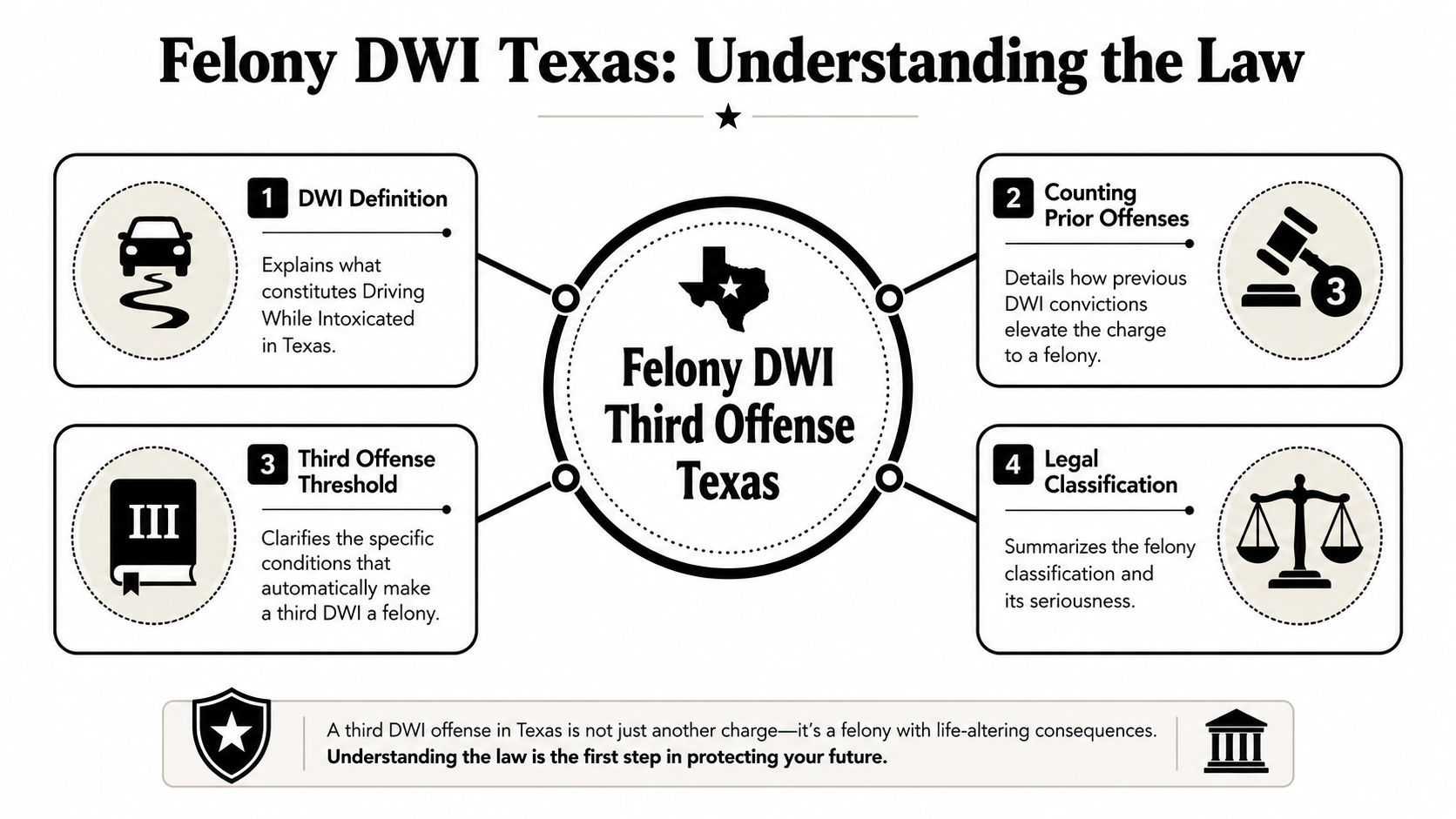
A new DWI charge becomes a third-degree felony if the State can prove two prior DWI convictions under Texas Penal Code §49.09(b)(2). Texas also allows old DWI convictions to count. There is no expiration date that wipes them out for enhancement purposes. That catches people off guard, especially if the earlier cases were years apart or came from different counties.
The felony issue often turns on more than intoxication
The prosecutor still has to prove the current DWI case. But in a third-offense filing, the State also has to prove that the prior convictions legally belong to you and qualify for enhancement. That creates more places to challenge the case than many people realize.
In practice, the defense usually examines at least four pressure points:
| Issue | Legal Implication |
|---|---|
| Prior conviction records | The State must connect those judgments and fingerprints to you with admissible proof |
| The traffic stop | A bad stop can lead to suppression of statements, testing, or other evidence |
| Proof of operation | The State must show you were operating a motor vehicle, not just present at the scene |
| Proof of intoxication | The prosecutor still has to prove intoxication under Texas law, with reliable evidence |
That matters because a felony DWI case is not always headed in one direction. If the priors are weak, the stop was unlawful, or the testing is vulnerable, the defense may have room to reduce the damage and, in some cases, improve the chances of community supervision instead of prison.
Key terms that affect how the case is fought
BAC means blood alcohol concentration. Prosecutors often rely on breath or blood results, but they can also try to prove intoxication through driving facts, officer observations, and field sobriety tests.
Field sobriety test refers to the roadside exercises officers use during a DWI investigation. These are not scientific lab tests. They depend heavily on instructions, conditions, and officer scoring, which gives the defense real issues to examine.
Implied consent means Texas treats licensed drivers as having agreed to provide a breath or blood specimen after a lawful DWI arrest. A refusal can trigger a separate license suspension issue, even before the criminal case is resolved.
“Operating a motor vehicle” and “intoxication” are often the most disputed facts in the file. I routinely look at whether the officer observed driving, whether a parked-car situation was misread, whether medical conditions affected performance, and whether fatigue, weather, footwear, or poor instructions distorted the field testing.
For a broader explanation of when a DWI becomes a felony in Texas, that overview is a useful starting point. For related escalation issues, Felony DWI in Texas: Third Offense and Child Passenger discusses another way a Texas DWI can be charged as a felony.
Criminal Penalties and Long-Term Consequences
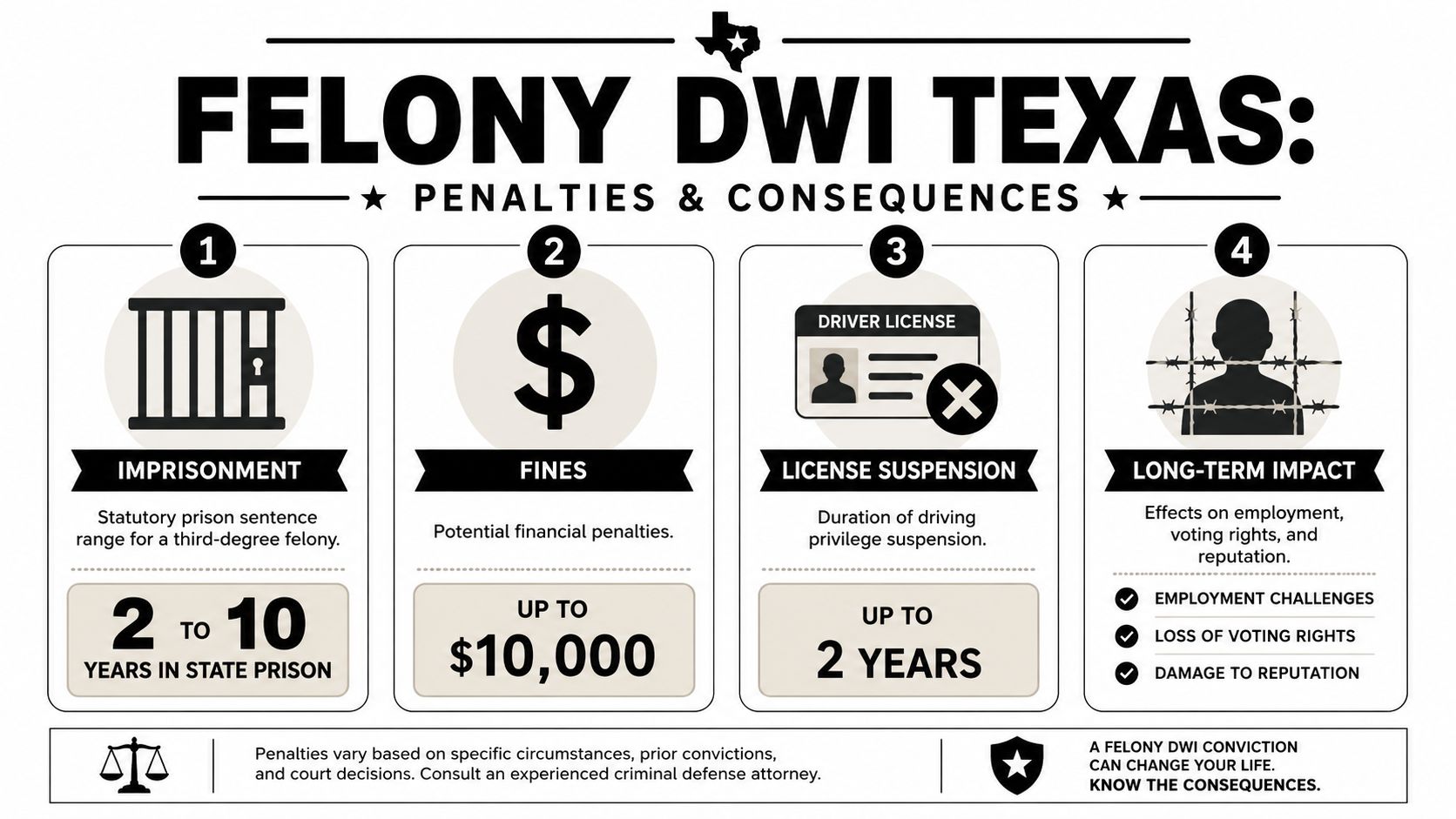
After a third DWI arrest, many people fixate on the prison range first. That concern is real. In Texas, a third DWI is charged as a third-degree felony, which puts prison, a felony record, and years of court supervision conditions on the table.
The sentence range is only part of the problem
The statutory punishment range matters. So does the part many articles skip. A felony DWI case does not always end in prison.
For the right client, under the right facts, community supervision may be a realistic goal. That does not mean the case is easy or the terms are light. Felony probation in a DWI case usually comes with strict conditions, substantial cost, reporting requirements, treatment, monitoring, and jail time as a condition in some cases. The point is simple. A third DWI charge calls for a strategy built around outcomes, not panic.
I tell clients this early because it changes how we approach the case. The difference between prison and a probation-eligible result can turn on details that seem small at first, such as the stop, the blood draw, your prior convictions, your background, and how quickly the defense starts working.
What a felony conviction can affect
A felony conviction follows you long after the court date. In most cases, it remains visible on background checks and continues to affect everyday decisions made by employers, licensing boards, landlords, and insurers.
That record has immediate effects on:
- Employment: Hiring decisions often change once a felony appears in a background check.
- Professional licensing: Boards may review the conviction itself, the underlying facts, and whether alcohol abuse treatment or monitoring was ordered.
- Housing: Landlords regularly screen for felony history.
- Civil rights: A felony conviction can affect firearm rights and other legal privileges.
Those consequences matter in plea negotiations and sentencing. A defense plan should account for more than jail exposure. It should also protect your ability to work, keep a license or credential, and support your family.
A third DWI case can threaten your freedom and your future at the same time. Good defense work addresses both.
The financial burden can keep growing
Court fines are only one part of the cost. A felony DWI case often brings court costs, supervision fees, treatment expenses, ignition interlock costs, insurance increases, missed work, and the practical cost of restrictions that make daily life harder.
That financial pressure creates real trade-offs. Some clients want to resolve the case fast. In some situations, speed helps. In others, a quick plea can cost far more over time if it closes off a path to community supervision or leaves damaging facts unchallenged.
Treat a felony DWI third offense like a full-scale threat to your freedom, record, income, and reputation. Stay calm, get the facts under control, and build a defense aimed at the result that protects the most ground.
The Administrative License Revocation Process
The criminal case is not the only problem that starts after a third DWI arrest. Your driver's license can be at risk almost immediately, and that process runs on its own track through the Texas Department of Public Safety.
That separate case is called Administrative License Revocation, or ALR. It is civil, not criminal. Even so, it matters a great deal because losing the ability to drive can affect work, treatment, court appearances, and your ability to keep daily life from falling apart while the felony case is pending.
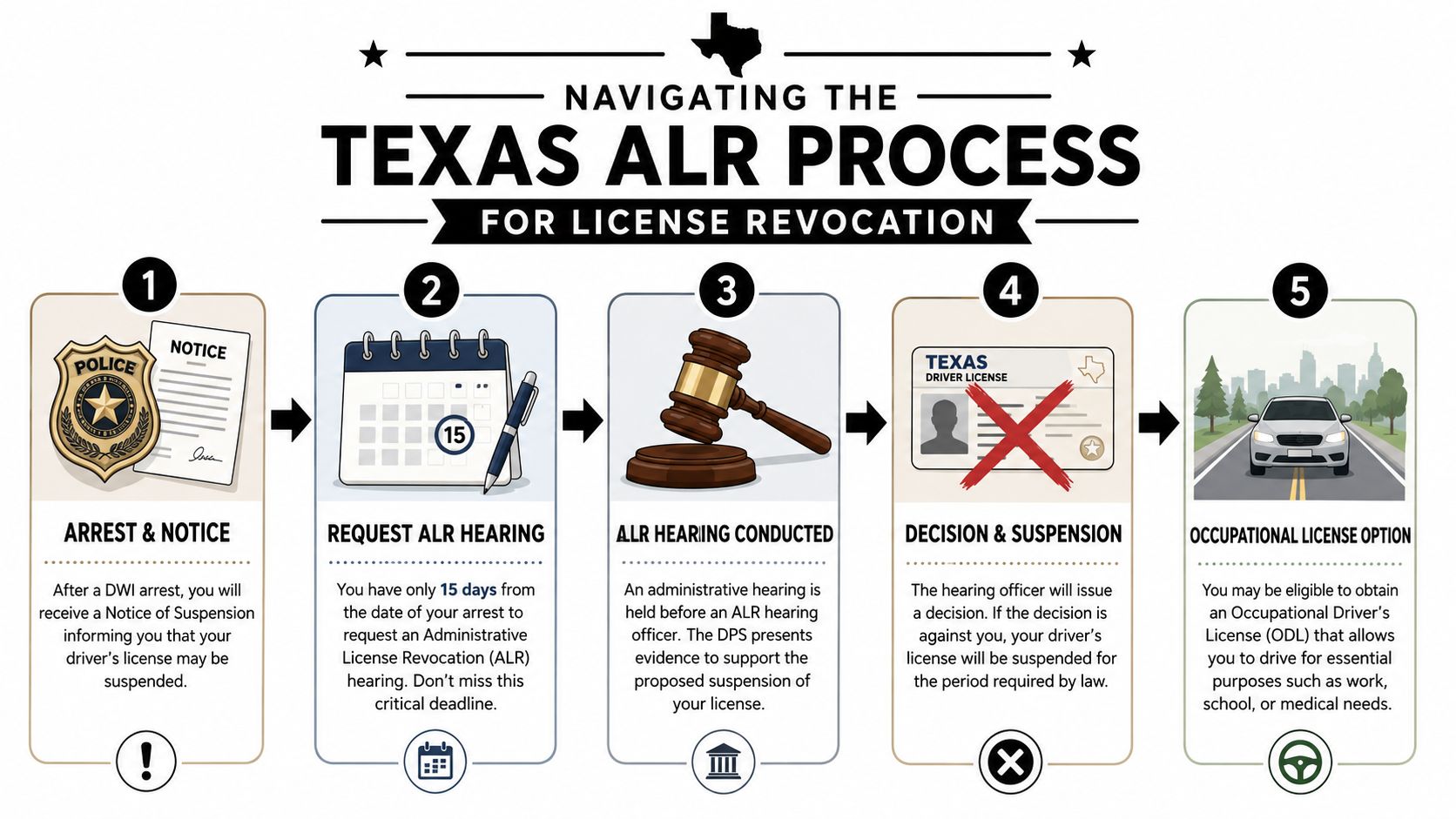
Here is the process at a glance.
What implied consent means in practice
Texas implied consent law means that after a lawful DWI arrest, the State can seek license consequences if a driver refuses testing or provides a result over the legal limit. It does not give police a free pass to ignore procedure, and it does not decide the criminal case for them.
That distinction matters. A person can lose the ALR hearing and still have good defenses in the felony prosecution. A person can also win the ALR hearing and still have to fight the criminal charge. They are connected by facts, but they are not the same case.
The first steps after arrest
Time matters here. If you do not act quickly, the suspension can take effect by default before your defense has a real chance to challenge it.
Use this as a practical checklist:
Review the paperwork right away
The notice given after arrest usually starts the deadline to request a hearing.Request the ALR hearing on time
Missing that window can waive your chance to contest the suspension.Use the hearing as an evidence opportunity
In many cases, this is the first chance to lock the officer into testimony, examine the basis for the stop, and identify problems that may later help in the felony case.
A good primer on the deadlines and hearing procedure is this Texas ALR hearing process guide.
After that, many drivers want to know whether limited driving is still possible while the case is pending. This overview is helpful background:
Why the ALR hearing can matter more than people expect
Clients sometimes treat the license case as secondary because the felony charge feels more urgent. I understand that reaction, but it can be a mistake. The ALR hearing can produce sworn testimony, reveal weaknesses in the officer's timeline, and preserve facts before stories harden.
It can also shape the practical side of the case. If keeping lawful driving privileges is possible, that stability can make it easier to keep a job, comply with bond conditions, attend counseling, and stay in a stronger position if we are pushing for community supervision instead of prison.
What getting back on the road can require
If a suspension takes effect, reinstatement is rarely automatic. A driver may need to complete required steps, pay fees, and in some cases use an ignition interlock device.
An Ignition Interlock Device (IID) is installed in the vehicle and requires an approved breath sample before the car will start. In a third DWI case, interlock requirements often become part of daily life, whether through bond conditions, occupational driving privileges, probation terms, or license reinstatement.
The short version is simple. Handle the license case early. A fast, disciplined response can protect your ability to drive and sometimes give the defense valuable testimony before the felony case gets much further.
Strategic Defenses for a Felony DWI Charge
The prosecution doesn't win because an officer wrote “intoxicated” in a report. The State still has to prove its case with reliable evidence, and that evidence can be challenged from several angles. That's where a real defense begins.

Start with the stop
A lawful stop matters in every DWI case, but it matters even more in a felony case because so much evidence flows from that first decision by the officer. If the officer lacked reasonable suspicion, the defense may be able to challenge everything that came after.
That review usually includes:
- Driving facts: Did the dashcam show a traffic violation or suspicious driving?
- Officer narrative: Does the written report match the video?
- Timing issues: Did the officer expand the stop without legal justification?
If the stop was unlawful, the next step may involve a motion to suppress evidence in a Texas DWI case.
Field sobriety tests are not as simple as police reports suggest
A field sobriety test is often presented as if it were a clean scientific measure. It isn't. These roadside tests depend on proper instructions, proper demonstration, proper scoring, and conditions that don't interfere with performance.
Common problems include:
- Poor roadside conditions: Sloped pavement, bad lighting, traffic, or weather
- Physical limitations: Injury, age, balance issues, or footwear
- Officer error: Incorrect instructions or miscounted clues
A person can look unsteady for reasons that have nothing to do with intoxication. Jurors often understand that once it's explained clearly and tied to the video.
Defense insight: In many DWI cases, the video tells a more accurate story than the report.
Breath and blood evidence can also be attacked
Chemical testing is powerful evidence, but it is not untouchable. A defense attorney will review whether the machine was maintained, whether the operator followed required steps, and whether the sample handling was reliable.
Potential issues may include:
| Area of review | Why it matters |
|---|---|
| Breath machine maintenance | Poor maintenance can affect reliability |
| Observation period problems | Breath test procedure matters |
| Blood draw handling | Collection and storage can affect sample integrity |
| Chain of custody | The State must show the sample remained properly identified and handled |
Some defenses come from the client's own history and condition
Not every defense is purely technical. Medical conditions, fatigue, anxiety, speech patterns, or lawful medications can affect how a person appears during a DWI investigation. That doesn't automatically defeat the case, but it can explain observations the officer interpreted as intoxication.
A strong fight DWI Texas strategy is rarely built on one issue alone. It usually comes from combining several weaknesses in the State's proof. For some clients, that means pushing for suppression. For others, it means building an advantage for negotiation or preparing the case for trial. A Houston DWI lawyer, a Texas DUI attorney, or another defense lawyer handling felony DWI work should be looking at the case from all of those angles, not just advising you to plead early.
In practical terms, firms such as Law Office of Bryan Fagan, PLLC handle both the criminal side of a DWI case and related license issues, including review of field sobriety tests, chemical testing, and ALR proceedings.
Possible Outcomes and the Path to Avoiding Prison
You may be sitting in a jail cell, or back home on bond, assuming a third DWI means prison is already decided. In Texas, that is not always true. A felony DWI case can still leave room to fight the charge, improve the outcome, and in some cases pursue community supervision instead of prison.
That is the part many people miss. Penalties matter, but strategy matters too.
The full range of outcomes
A third-offense DWI can end in several different ways, depending on the evidence, the prior convictions, your history, and what happens after the arrest.
Possible outcomes include:
- Dismissal: If key evidence is thrown out, a witness is unavailable, or the State cannot prove the case properly, dismissal can happen.
- Negotiated plea: Sometimes the best result comes from exposing problems in the State's case and using that pressure to reach a better resolution.
- Trial: If the prosecutor will not offer a reasonable result and the evidence can be challenged, trial may be the right call.
- Community supervision: In the right case, a judge or jury may place a person on felony probation instead of sending them to prison.
For many clients, that last option changes the entire conversation.
Deferred adjudication is different from community supervision
For a third DWI, deferred adjudication is not available. Community supervision can still be available in some felony DWI cases.
That distinction matters because people often hear “no deferred” and assume probation is off the table. It is not. Texas law treats those options differently.
Here is the short version:
| Option | Available for a third DWI |
|---|---|
| Deferred adjudication | No |
| Community supervision or probation | Yes, in some cases |
A good defense lawyer should be assessing that possibility early, not after the case has already drifted toward a prison sentence.
Probation is possible, but the case has to be prepared for it
Probation in a felony DWI case is never automatic. Courts want to see more than a request for leniency. They want a record that supports supervision as a realistic and safe alternative.
A strong probation argument is built from multiple components:
- Early treatment efforts: Starting counseling, evaluation, or recovery work before the court orders it can help show the problem is being taken seriously.
- Bond compliance: Clean drug and alcohol testing, attendance at required settings, and no new arrests matter.
- Useful mitigation: Work history, family support, military service, treatment progress, and community ties can all help if they are documented well.
- A case the State has to respect: Prosecutors make different decisions when they know the defense is prepared to challenge the stop, testing, priors, and other proof issues.
I tell clients this often. Conduct after the arrest can help or hurt just as much as the facts of the stop.
What hurts the effort to stay out of prison
Some clients want to plead guilty quickly and ask for mercy. In a felony DWI, that can be a costly mistake. A fast plea can give up arguments you may have had about the stop, the blood or breath evidence, or the way the prior convictions are being used.
Other problems show up often:
- Waiting too long to start treatment
- Violating bond conditions
- Talking freely about the case to friends, family, or on social media
- Treating a third DWI like a routine misdemeanor case
A third DWI is a felony case with much higher stakes. It has to be handled that way from the start.
How the path away from prison is usually built
In practice, the defense usually works on two tracks at the same time.
One track is legal. That means challenging the State's evidence, filing motions, testing whether the prior convictions were properly charged, and preparing for trial if necessary.
The other track is practical. That means building a record that shows why community supervision is a fair and workable result. Treatment, compliance, support letters, stable employment, and a concrete plan for supervision can all matter.
Those two tracks often work together. A case with pressure points in the evidence gives the defense negotiating power. A client who takes the case seriously gives the court a reason to consider something other than prison.
A third DWI arrest is serious. Prison is a real risk. But it is not the only possible outcome, and it should not be treated as inevitable.
Frequently Asked Questions About a Third DWI in Texas
After a third DWI arrest, the questions usually get very practical very fast. Can I keep my job. Will I lose my license. Is prison automatic. Those are the right questions, and the answers often depend on details that need to be reviewed early, not guessed at from general advice online.
Will a third DWI affect my CDL
Yes, it can affect far more than your personal driving privileges. A felony DWI can put your commercial driving status, your current job, and future employment at risk because employers, insurers, and licensing agencies look closely at alcohol-related driving history.
If you hold a CDL, the case has to be evaluated with your livelihood in mind from the start.
What if one of my prior DWIs happened in another state
An out-of-state conviction can still be used to raise a new Texas DWI to a felony, but it should never be accepted at face value. The State still has to prove the prior conviction, prove you are the person tied to that record, and show that the prior offense qualifies under Texas law.
That review matters. I have seen cases where the paperwork, the offense language, or the identification evidence deserved much closer examination than the prosecution expected.
Can a third DWI be removed from my record
A conviction for a third DWI generally stays on your record. That is one reason the early defense work matters so much in a felony case.
If the case does not end in conviction, the analysis can be different. Expunction and nondisclosure depend on how the case was resolved, so this is not an area to handle based on internet summaries or advice from friends.
Do I have to report the arrest to my professional licensing board
Maybe. The answer depends on the rules for your profession and the timing requirements that apply to your license. Some boards care about arrests. Others focus on convictions, probation terms, or related conduct.
Doctors, nurses, teachers, commercial drivers, real estate professionals, and other licensed workers should check that issue early. A missed reporting deadline can create a separate licensing problem that has nothing to do with whether the criminal case can be defended.
Is this handled the same way as a first DWI in Texas
No. A third-offense case is prosecuted and negotiated very differently because it is a felony, its severity is greater, and the court will look more closely at punishment issues from the beginning.
That does not mean prison is automatic. It means the defense has to be built with more care, with attention to both the legal weaknesses in the State's case and the practical work that can support a probation outcome when the facts allow it.
Do I need a lawyer for the ALR hearing and the criminal case
In a felony DWI case, that is usually the smart move. The ALR hearing affects your ability to drive, but it can also give the defense an early chance to question the officer under oath and learn more about the stop, the investigation, and the testing issues.
The criminal case is separate. It carries bigger consequences. Treating the license case and the felony case as one coordinated defense effort often gives you more useful information and better strategic options.
If you have been arrested for a third DWI, do not assume the only path ends in prison. Many clients are surprised to learn there may be room to challenge the stop, the testing, the prior convictions, and, in the right case, to build a record that supports community supervision instead of incarceration.
The attorneys at Law Office of Bryan Fagan, PLLC represent Texans facing repeat DWI allegations across Houston and throughout the state. If you need clear advice about the felony charge, the ALR case, and the practical steps that can protect your future, request a consultation or case evaluation today.