
A DWI arrest can be overwhelming, but you don't have to face it alone.
If you've recently been arrested, you're probably asking the same question many Texans ask right away. Can a DWI be reduced to reckless driving in Texas? In some cases, yes. But it's not automatic, and it isn't just a paperwork change. It's a strategic legal outcome that can significantly change your exposure to jail, fines, insurance fallout, and the way your case follows you into the future.
Information about a DWI reduced to reckless driving in Texas often tells only half the story. They hear about lighter penalties, but not about the arrest record issues that can remain even after a reduction. That missing detail matters.
Introduction
The hours after a DWI arrest are often a blur. You may have been booked, bonded out, handed paperwork you barely had time to read, and warned about deadlines that can affect your driver's license. At the same time, you're trying to figure out what happens to your job, your insurance, and your record.
In Texas, a DWI and reckless driving are not the same offense. A DWI is an intoxication offense under Texas Penal Code § 49.04. Reckless driving is a different offense under Texas Transportation Code § 545.401, based on driving in wilful disregard for the safety of persons or property. That distinction matters because a reduction changes the legal character of the case.
A strong defense starts with facts, not panic. You need to understand what a reduction means, who may qualify, how prosecutors make that decision, and what trade-offs come with taking a plea instead of continuing to fight for dismissal.
Practical rule: A reduction to reckless driving can be a very good result, but it's still a conviction. You should understand the full long-term impact before accepting any deal.
What a DWI Reduction to Reckless Driving Means in Texas
A reduction from DWI to reckless driving changes the legal label of the case, but it does not erase the arrest. That distinction matters. Many clients focus on avoiding a DWI conviction, and that is often the right first goal. The smarter decision comes from understanding both sides of the result. What you gain in court, and what still follows you afterward.
A DWI charge alleges that you operated a motor vehicle in a public place while intoxicated. In Texas, intoxication usually means either loss of the normal use of mental or physical faculties because of alcohol or drugs, or a BAC, meaning blood alcohol concentration, at or above the legal limit.
Reckless driving is a different offense. It turns on how the vehicle was driven, not whether the state can prove intoxication. Texas Transportation Code § 545.401 defines reckless driving as driving in wilful disregard for the safety of persons or property. That makes it a separate offense with a different set of consequences.
Why the reduction matters
For the right case, this can be a strong resolution. A reckless driving conviction usually carries less stigma than a DWI conviction, and in many situations it puts you in a better position with employers, professional licensing boards, and insurance carriers. It can also reduce exposure to some of the penalties and conditions that often come with DWI cases, including Ignition Interlock Devices in Texas DWI Cases.
The practical benefit is straightforward. You avoid a conviction for an intoxication offense. That can matter when a background check is reviewed by a hiring manager who may not understand the details but will recognize the letters DWI immediately.
If you have heard the phrase wet reckless charge in Texas, that is usually what people mean. The case started as a DWI and ended with a reckless driving disposition instead.
What the reduction does, and does not, change
A reduction changes the offense of conviction. It does not rewrite the underlying history. The arrest, the booking, the breath or blood request, and the license suspension issue may still exist in the record even if the final plea is to reckless driving.
That is where clients can get caught off guard. They accept a deal expecting the case to disappear from public view, then later learn that the court result and the arrest record are two separate problems. A good plea offer can still be the right move, but it should be evaluated with that permanent-record issue in mind.
Terms you need to know early
A few terms come up in almost every Texas DWI case:
- Implied consent means that by driving on Texas roads, you are treated as having agreed to provide a breath or blood specimen if an officer lawfully requests one after a DWI arrest. A refusal can trigger a separate driver's license problem.
- Field sobriety test refers to the roadside balance and divided-attention tests officers use to support an intoxication allegation. These tests are often open to challenge.
- Administrative license suspension is the separate process that can affect your driving privileges after an arrest or refusal. In Texas, that usually means an ALR hearing. You can learn more about ALR hearings and license defense.
Key Factors That Make a Charge Reduction Possible
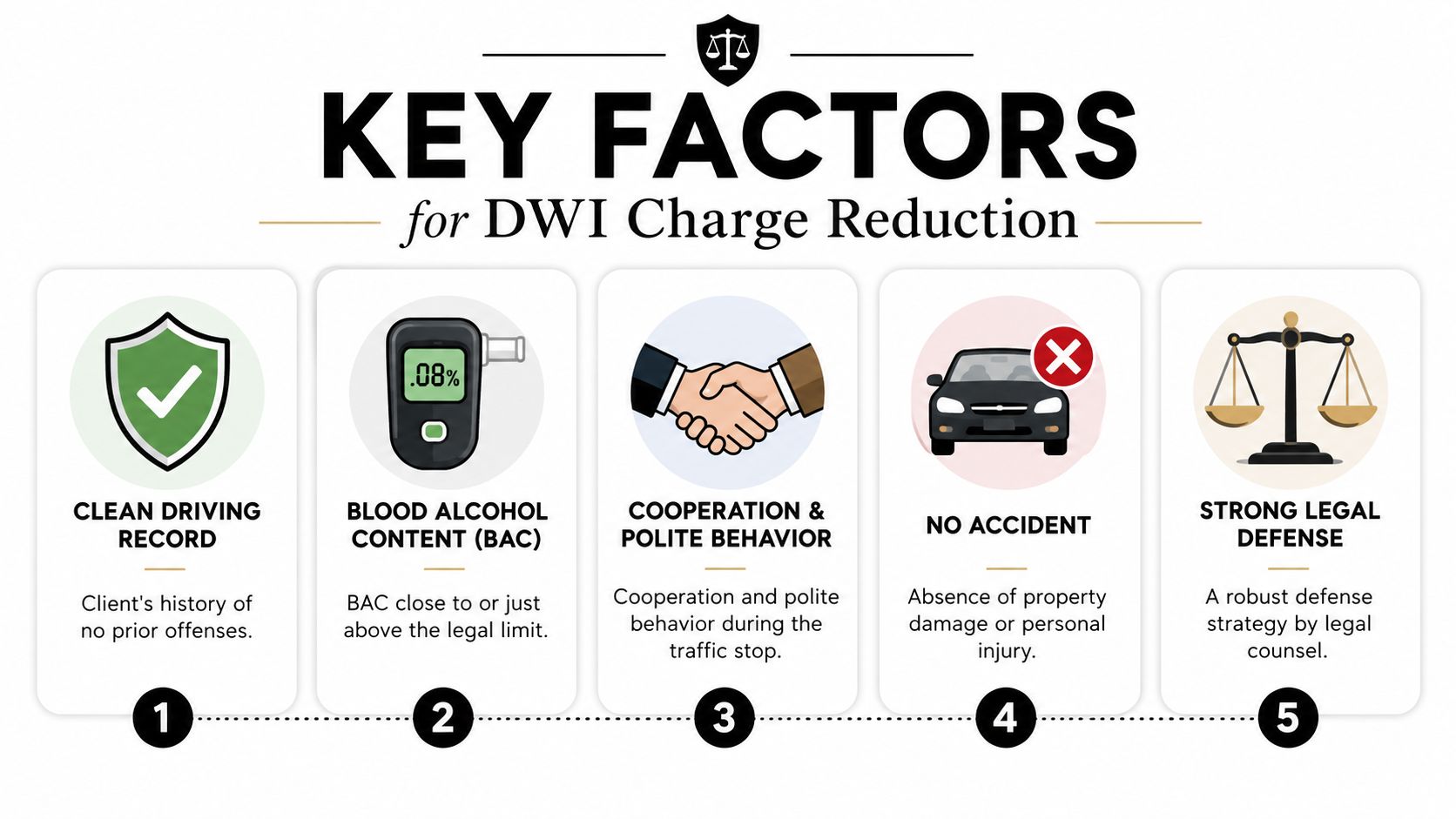
A reduction usually becomes realistic when the prosecutor sees real trial risk, real proof problems, or a defendant worth resolving the case for without a DWI conviction. That decision is practical. It turns on how strong the file is, how aggravating the facts are, and what the prosecutor believes a jury would do with the evidence.
BAC level and charge severity
The alcohol test result often sets the tone early. A reported BAC of 0.15 or higher makes the case harder to reduce because it raises the charge level and gives the state a cleaner story to tell. A borderline result, an incomplete result, or no chemical test at all creates more room to argue.
The number alone never decides the case. I look at how the sample was obtained, whether the machine was working properly, whether the blood draw followed procedure, and whether the result matches the officer's observations. When those pieces do not line up, the state has a problem.
The facts of the arrest matter
Prosecutors also judge the person and the context, not just the offense label. A first arrest with no crash, no injuries, and no ugly facts is easier to resolve than a case involving property damage, a child passenger, an open container, or allegations that suggest obvious impairment.
Several details can push a case toward or away from a reduction:
- Prior history: A clean criminal and driving record helps. Repeated alcohol-related contacts do not.
- Driving facts: Minor lane issues are different from high-speed driving, near collisions, or dangerous conduct caught on video.
- Stop behavior: Cooperation helps credibility in negotiations. Resistance, threats, or combative conduct make resolution harder.
- Accident involvement: Cases with a collision often draw more scrutiny. If your arrest involved a crash, review how DWI involving an accident can change the stakes.
Those facts matter for another reason clients often miss. If a DWI is reduced, the arrest record still reflects the original event. A prosecutor may agree to reckless driving, but the underlying police narrative can still follow you unless the record issue is addressed separately.
Weak proof gives the defense room to work
The best reduction candidates usually have identifiable weaknesses in the state's evidence. Common pressure points include a thin basis for the traffic stop, poor roadside test conditions, body camera footage that undercuts the report, missing maintenance records, chain-of-custody issues, or an officer who overstates what the video shows.
That is where preparation changes the value of a case. A prosecutor is far more likely to offer reckless driving when the defense can point to specific problems and explain how those problems would play in a suppression hearing or at trial.
A good file for negotiation is rarely perfect for the defense. It is often a case with enough uncertainty that the state has to weigh its risk against the benefit of closing the case. That is the practical window where charge reductions happen.
The Negotiation Process How a DWI Becomes Reckless Driving
You hire counsel, hoping the case can be reduced. The next question is the right one. Not whether a reduction is possible in the abstract, but what would make a prosecutor agree to it in your specific file.

In Texas, reckless driving replaces a DWI only through a negotiated plea agreement. A judge cannot relabel the charge on request. The prosecutor has to decide that resolving the case under Texas Transportation Code § 545.401 makes more sense than trying to prove intoxication beyond a reasonable doubt. One helpful overview of that process appears in this overview of DWI charge reductions in Texas.
How the negotiation usually develops
Good negotiations start long before anyone talks about a plea. Defense counsel reviews the full file, not just the offense report. That includes body camera footage, dash cam video, dispatch logs, witness accounts, lab records, maintenance records, and the timeline from stop to arrest to testing.
The goal is simple. Identify the points that create risk for the state and use them in a way a prosecutor takes seriously.
Common pressure points include:
The legal basis for the stop
If the officer did not have a valid reason to pull you over, the defense may have grounds to challenge what came after the stop.How the roadside investigation was handled
Field sobriety tests are only persuasive when they are administered correctly and under fair conditions. Instructions, lighting, footwear, medical limitations, weather, and video quality all matter.Breath or blood evidence
Testing problems can change the value of a case fast. Machine issues, missing records, collection errors, and chain-of-custody gaps can all weaken the prosecution's position.Timing and parallel proceedings
The criminal case and the license case often affect strategy. Deadlines, hearing testimony, and agency records can give the defense useful material or lock in the officer's version early.
For a practical look at how lawyers approach these discussions, see this page on Texas DWI plea deals and negotiated reductions.
What actually gets a prosecutor to move
Prosecutors do not reduce DWI charges as a favor. They do it when the file presents trial risk, proof problems, witness issues, or fairness concerns they would rather resolve than defend in court.
I tell clients the same thing at the start. Personal hardship matters, but it rarely drives the offer by itself. Saying you need to protect your job, your license, or your reputation does not usually change the outcome unless the defense can back it up with legal and factual weaknesses in the case.
That is why an early guilty plea is often a mistake. Once you give up the chance to test the evidence, you also give up much of your bargaining power.
The record issue clients often miss during plea talks
A reduced charge can be a smart result. It is not the same as erasing the arrest.
During negotiations, the defense should look at two tracks at once. One is the conviction you may be able to reduce. The other is the public record created by the arrest, the charging documents, and the police narrative. Even if the prosecutor agrees to reckless driving, those records can still appear in background searches unless they are addressed separately through the proper record-clearing process, if you qualify.
That is a strategic point many articles skip. A plea deal may improve the outcome in court while leaving a lasting paper trail outside the courthouse. Good advice accounts for both.
Comparing the Consequences DWI vs Reckless Driving
A reduction matters because the consequences are different in ways that affect your daily life for years.
Texas DWI vs. Reckless Driving Penalties at a Glance
| Consequence | First-Offense DWI (Class B Misdemeanor) | Reckless Driving (Class C Misdemeanor) |
|---|---|---|
| Criminal classification | Class B misdemeanor | Class C misdemeanor |
| Potential jail time | 3 to 180 days | Up to 30 days |
| Fine | Up to $3,000 | Up to $200 |
| Alcohol-related stigma | Yes | No DWI conviction |
| Insurance impact | Often more severe | Average 73% increase in premiums |
| Professional fallout | Can be harsher for CDL holders and licensed professionals | Often less damaging than a DWI |
A reckless driving conviction triggers an average 73% increase in automobile insurance premiums, while a first-time DWI can carry a maximum fine of $3,000 and reckless driving tops out at $200, according to this Texas reckless driving penalty overview.
What the table doesn't show
A DWI conviction often creates bigger problems outside the courthouse. Commercial drivers can face serious employment issues. Nurses, teachers, real estate professionals, and other licensed workers may have to report the case to a board or employer. A first DWI in Texas can also put future charges in a worse position if there's another arrest later.
By contrast, reckless driving is still serious, but it usually carries fewer collateral consequences than an alcohol conviction. That's why people often want a DWI reduced to reckless driving in Texas when the evidence supports a negotiated result.
The common myth about a wet reckless
Many people think a reduction means the case is basically erased. That's the part many articles get wrong.
A reduced conviction can be far better than a DWI conviction. But better is not the same as invisible. If your goal is to fully clean up your record, you need to understand what remains after the plea and what doesn't.
The Hard Truth About Your Permanent Record After a Reduction
This is the issue most clients don't hear about until late in the case. A reduced charge does not automatically mean a clean slate.
Texas law explicitly states that if a DWI arrest results in a conviction for any offense, including a reduced reckless driving charge, the original DWI arrest is ineligible for expungement. The conviction changes, but the arrest record remains permanently visible unless the case was dismissed entirely, as explained in this discussion of clearing a DWI record in Texas.

What stays on your record
The key distinction is between the conviction and the arrest.
If the DWI is reduced, your final conviction may say reckless driving instead of DWI. That is helpful. But the underlying arrest can still appear in records tied to the original event. For employment screening, licensing review, or professional disclosure, that difference can matter a lot.
This is why I tell clients to think about three separate goals, not one:
- Avoid a DWI conviction
- Protect your license and livelihood
- Preserve the best possible record outcome
Those goals overlap, but they aren't identical.
Why this changes plea strategy
A reduction may still be the right move. In many cases, it absolutely is. But if the evidence problems are strong enough to support a full dismissal fight, you should know what's at stake before giving that up.
That's also why record-cleaning questions should start early, not after the plea is signed. If you want to learn more about what may and may not come off your history, review whether you can get a DWI off your record in Texas.
A good plea deal protects you from some consequences. A dismissal can protect you from many more. Knowing the difference helps you make a smart decision.
The practical takeaway
When clients hear “wet reckless,” they often assume it means the case disappears. It doesn't. It means the conviction may be reduced to a less damaging offense, while the arrest history can still remain.
That's not a reason to give up on a reduction. It's a reason to negotiate with clear eyes. If you're facing a first arrest, dealing with a Houston DWI lawyer early can make a real difference because the strongest defenses are often built before evidence disappears, memories fade, or deadlines pass.
If your situation also raises questions about future sealing or cleanup options, the attorneys at Law Office of Bryan Fagan, PLLC handle DWI defense and related record issues in Texas courts.
Conclusion Take Control of Your Case Today
A DWI arrest is serious, but it is not the same thing as a conviction. In the right case, a reduction to reckless driving can lower the penalties, reduce the alcohol-related stigma, and put you in a better position for work, insurance, and future stability.
What matters is strategy. You need a defense that examines the stop, the field sobriety tests, the chemical evidence, the ALR timeline, and the prosecutor's likely pressure points. You also need honest advice about the trade-offs, including the part many people miss. A reduced charge can help a lot, but it usually doesn't erase the original arrest record.
If you want to fight DWI Texas charges the right way, act early. Preserve evidence. Protect your license. Don't assume the officer's version of events is the final word.
The next step is simple. Talk with an experienced Texas DUI attorney about the facts of your case, your goals, and whether a reduction, dismissal, or trial strategy makes the most sense for you.
If you're dealing with a DWI arrest and want clear answers about your options, contact Law Office of Bryan Fagan, PLLC for a free consultation. An experienced Houston DWI lawyer can review your arrest, explain your license risks, assess whether a reckless driving reduction is realistic, and help you take the next step with confidence.