
A DWI arrest can be overwhelming, but you don't have to face it alone.
If you're reading this after a late-night stop in San Antonio, you may be worried about your license, your job, your record, and what happens next in Bexar County. That reaction is normal. Many are unaware that a DWI case starts moving on two separate tracks almost immediately, and one of them has a deadline that comes fast.
A DWI arrest is not a conviction. You still have rights. You still have options. And the steps you take in the first days can affect both your driver's license and the criminal case that follows.
This guide is meant to give you a practical roadmap. It explains what a DWI lawyer in San Antonio does, what the ALR hearing is, how Texas treats BAC, implied consent, and field sobriety tests, and how a lawyer can start protecting your position early. If you've also searched for a Houston DWI lawyer or a Texas DUI attorney, the core Texas rules are statewide, even though local court practices can differ from county to county.
Facing a DWI Arrest in San Antonio You Are Not Alone
You get home after a late-night stop in San Antonio, set your bond papers on the counter, and start reading words that feel half familiar and half confusing. License notice. Court date. Suspension. Testing. By morning, the question is usually the same for everyone. What happened, and what needs attention first?
Start there. A DWI arrest puts you into two systems at once. One is statewide and tied to your driver's license through the Texas Department of Public Safety. The other is local and tied to the criminal case that may be filed in Bexar County. That split is where a lot of the confusion begins, because people often expect one court process when they are dealing with two.
What a DWI charge really means
In Texas, DWI means Driving While Intoxicated. BAC means blood alcohol concentration. For many adults, people focus on the 0.08% number because that is the level commonly associated with intoxication. But a San Antonio DWI case is not always built around a single breath or blood result. Prosecutors may also rely on an officer's claim that alcohol or drugs affected your normal mental or physical use.
A good way to understand it is to picture a toolbox instead of a single test result. The state may try to use several tools at once, including driving observations, statements, body camera video, roadside exercises, and chemical testing. Some of that evidence is stronger than it first appears. Some of it is much weaker.
That matters because people often ask, “My BAC was below what I expected, so shouldn't the case go away?” Sometimes the answer is no. In other cases, the stop, the arrest decision, the testing process, or the officer's observations create real defense issues.
A field sobriety test usually refers to roadside exercises such as following an object with your eyes, walking heel to toe, or standing on one leg. These tests are often presented as scientific, but they are still interpreted by an officer in real-world conditions like poor lighting, traffic, nerves, fatigue, uneven pavement, or medical limitations.
An administrative license suspension is separate from the criminal accusation. It deals with your driving privileges, while the criminal case deals with the DWI charge itself. In San Antonio, that means your case is not just about what may happen in court later. It is also about what needs to be done early to protect your ability to drive and to gather information that may help your defense.
What to focus on right now
The first goal is not to solve the whole case in one sitting. It is to get organized and avoid mistakes.
- Keep every paper you received, including bond forms, any notice related to suspension, and testing paperwork.
- Write down what happened while your memory is still fresh. Include where the stop occurred, what the officer said, whether tests were requested, and whether you gave a breath or blood sample.
- Do not explain the arrest publicly to friends, coworkers, or on social media.
- Get legal advice quickly so someone can evaluate both the statewide license process and the local Bexar County criminal process.
To effectively fight a DWI case in Texas, the first step is usually simple and practical. Get clear on the timeline, protect your rights early, and treat the arrest as the start of a process that can be challenged, not as the final outcome.
Your First 15 Days The Most Critical Window After a DWI Arrest
The most urgent part of a Texas DWI case often isn't the first court date. It's the license deadline that starts right after arrest.
A DWI arrest in Texas triggers an automatic Administrative License Revocation, often called an ALR case, with the Texas Department of Public Safety. To stop an immediate suspension from taking effect, you must request a formal ALR hearing within 15 calendar days from the date of arrest, as explained in this overview of the San Antonio ALR deadline. If you miss that deadline, the suspension becomes mandatory, and you also lose the chance to depose the arresting officer.
Here's the timeline many people need to see right away:
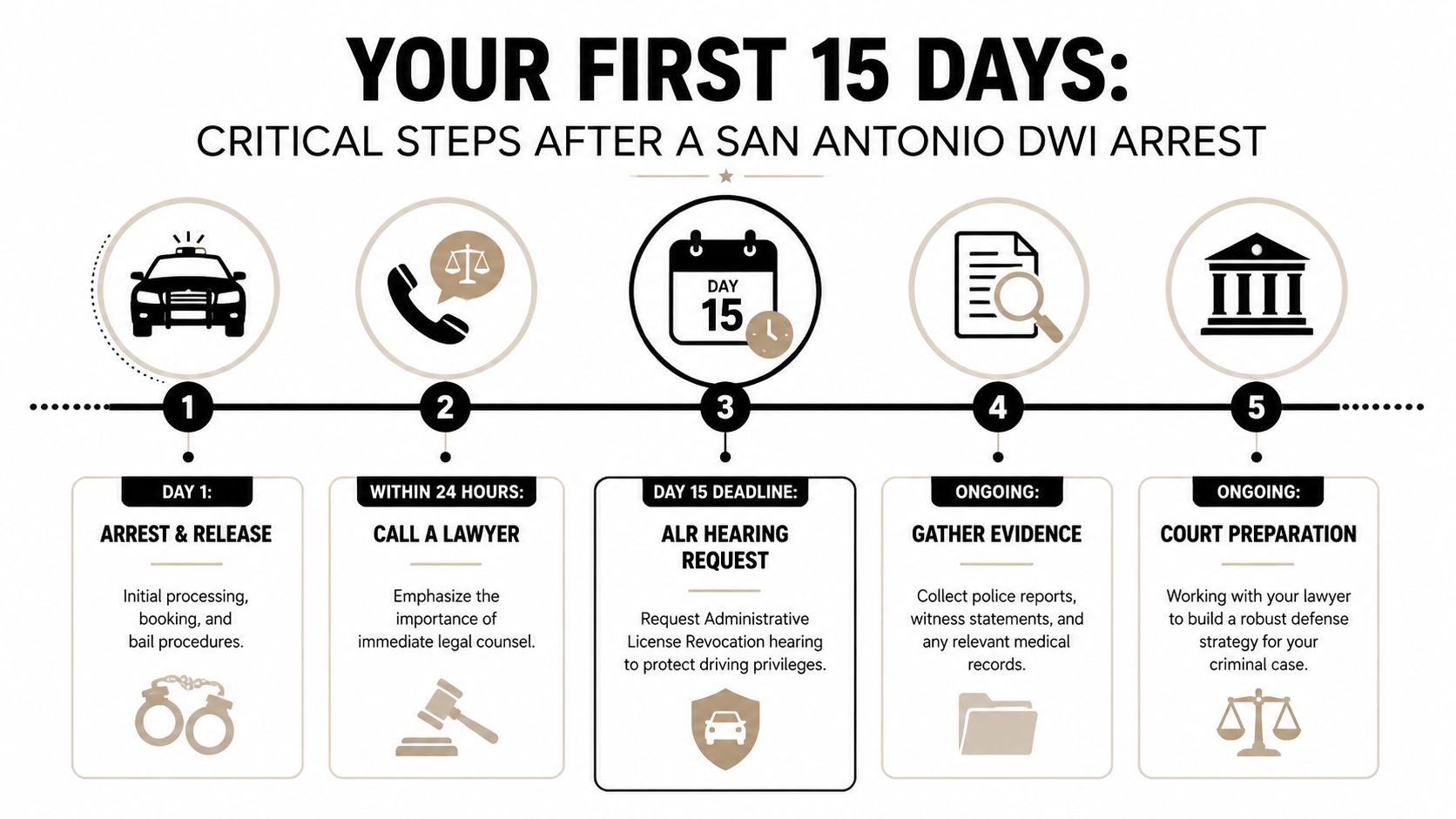
What the ALR hearing is
The ALR hearing is a civil proceeding, not the criminal trial. It's handled through the State Office of Administrative Hearings. The issue is your license, not whether you should be convicted of DWI in criminal court.
That distinction matters because people often think, “I'll deal with the license later when my court date arrives.” In many cases, later is too late.
For a plain-language explanation of how the civil license case differs from the criminal case, see What Is an ALR Hearing in Texas?.
What to do in those first days
Use the first two weeks strategically.
Read the paperwork carefully
Look for any notice tied to license suspension or a request deadline. Don't assume the bond paperwork covers it.Call a lawyer quickly
A DWI lawyer in San Antonio can request the hearing, track the deadline, and start preserving evidence before it disappears.Write down your memory
Record what happened before the stop, what the officer said, whether you were asked to perform field sobriety tests, and whether you were asked for a breath or blood sample.Save anything relevant
Keep receipts, rideshare records, medical information, and names of any witnesses who saw your condition before driving.
A timely hearing request can also place a stay on the suspension, keeping your license valid while the case is pending, as described in this explanation of the Texas implied consent timeline.
Later in the process, many clients find it helpful to hear the basics in video form:
Why this step matters beyond your license
The hearing isn't only about driving privileges. It can also give your lawyer a valuable chance to question the officer under oath. That testimony can reveal mistakes, weak observations, or inconsistencies that matter later in the criminal case.
Missing the ALR deadline doesn't just risk a suspension. It can also shut down an early evidence-gathering opportunity that may never come back.
If this is your first DWI in Texas, the instinct to wait and see is common. It's also risky. Fast action gives your defense more room to work.
Navigating the Two Fronts The ALR Hearing and the Criminal Case
A San Antonio DWI often feels confusing because you're not dealing with one case. You're dealing with two.
Think of it as a two-front battle. One front involves your driver's license. The other involves the criminal accusation. They overlap in facts, but they don't ask the same question and they don't end the same way.
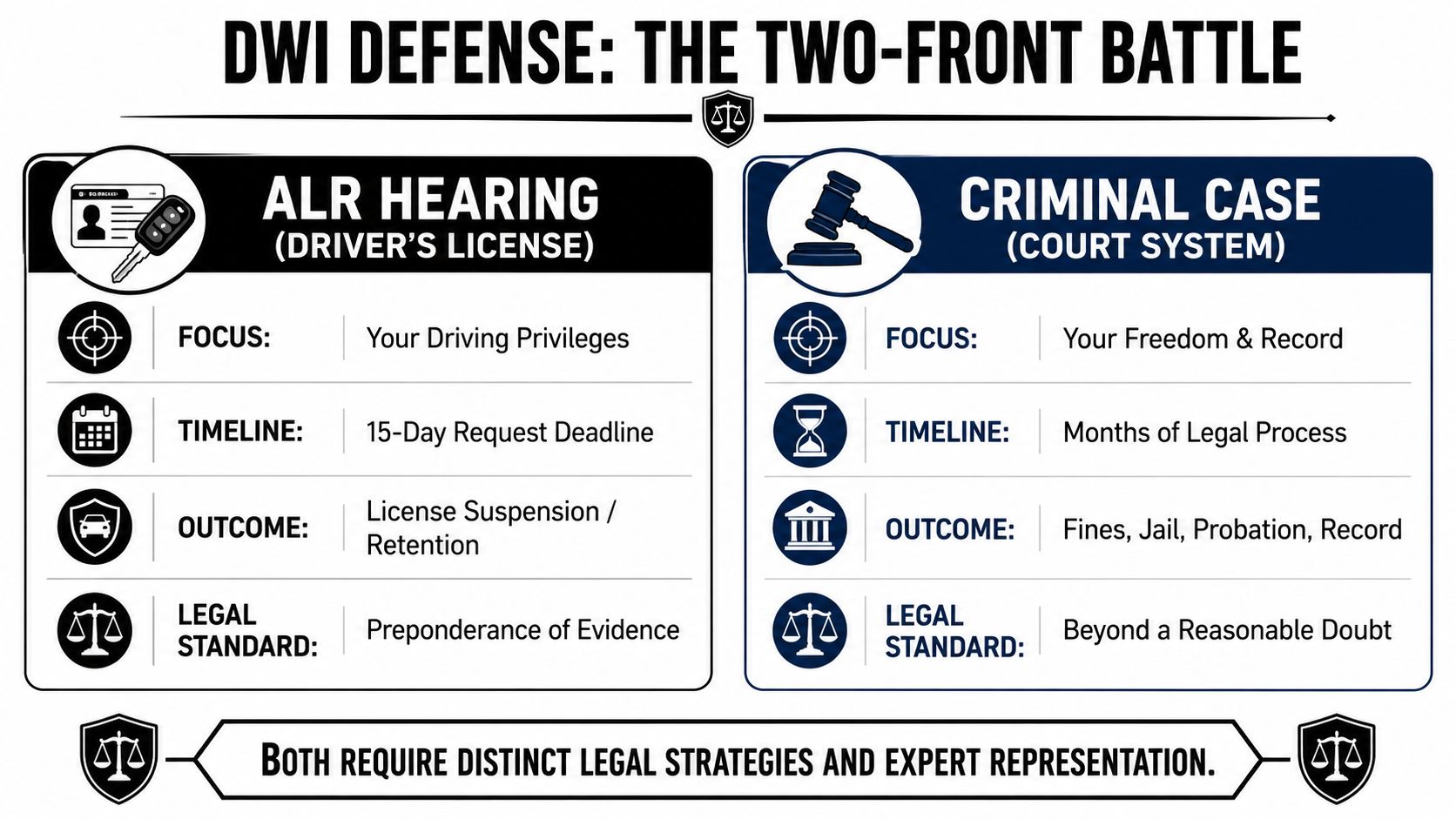
How the two tracks differ
Here is the cleanest way to separate them:
| Process | Main issue | Possible result |
|---|---|---|
| ALR hearing | Your driving privileges | License suspension or retention |
| Criminal case | Your guilt, freedom, and record | Dismissal, reduction, plea, probation, or trial outcome |
In the ALR case, the state focuses on whether the officer had a basis for the arrest and whether the testing or refusal issue supports suspension. In criminal court, the prosecution tries to prove the DWI charge itself.
That means mixed results are possible. A person can keep a license in the administrative case and still face a criminal conviction later. The reverse can happen too.
Where implied consent fits in
Implied consent is another term that causes confusion. In Texas, implied consent applies only after a lawful DWI arrest, not the moment you start driving or the moment an officer first stops you. If you refuse a breath or blood test after the warning, your license will be suspended for 180 days for a first refusal, compared to 90 days if you fail the test on a first offense, as explained in this discussion of Texas implied consent and refusals.
That doesn't mean refusal automatically decides the criminal case. It means refusal creates a separate license consequence and becomes part of the evidence picture.
Why strategy has to match each front
A lawyer may challenge probable cause in the ALR hearing while also attacking the state's proof in the criminal case. Those are related efforts, but they're not identical.
For a side-by-side look at how these processes differ, this guide on ALR hearing vs criminal case in Texas is a useful reference.
Winning a DWI case often means doing two jobs at once. Protecting your license and protecting your record require different arguments, different timing, and careful coordination.
That's one reason a Texas DUI attorney needs to think beyond the first court setting. A smart defense starts by identifying which front needs immediate action and which issues may create an advantage later.
Understanding Texas DWI Penalties in Bexar County
Many people in San Antonio reach this point in the process and ask the same question: what am I facing in Bexar County court?
That is the right question, but it helps to answer it in layers. Texas law sets the charge range and the possible punishment. Local Bexar County procedure affects how the case is filed, set, negotiated, and resolved. In other words, the statute gives the outer boundaries, and the local court process shapes how the case moves inside those boundaries.
The basic penalty ranges
For many first arrests, the starting charge is a Class B misdemeanor. Texas law generally allows 3 to 180 days in jail and a fine of up to $2,000 for that level of offense.
If the state alleges a BAC of 0.15% or higher, the charge is usually filed as a Class A misdemeanor. That raises the possible jail exposure to up to one year and the maximum fine to $4,000.
A second DWI can bring a longer jail range and a longer period where your driving privileges are at risk. A third DWI is much more serious because it is usually charged as a third-degree felony, with 2 to 10 years in prison and fines up to $10,000, as outlined in this San Antonio DWI penalty overview.
Texas DWI penalties at a glance 2026
| Offense | Jail Time | Maximum Fine | License Consequences |
|---|---|---|---|
| First DWI in Texas | 3 to 180 days | Up to $2,000 | Suspension exposure can apply |
| First DWI with alleged BAC of 0.15% or higher | Up to one year | Up to $4,000 | Suspension exposure can apply |
| Second DWI | 1 month to 1 year | Up to $4,000 | Longer suspension exposure can apply |
| Third DWI | 2 to 10 years in prison | Up to $10,000 | More severe driving and felony consequences apply |
Extra consequences people overlook
The charge itself is only part of the picture. Some cases carry added consequences that change the stakes quickly.
A child passenger allegation can lead to a separate felony-level accusation. Courts also often require classes, monitoring conditions, testing, ignition interlock requirements, or other bond conditions while the case is still pending. Those are not always final punishment, but they still affect daily life.
Texas also ties some education requirements and license-related consequences to DWI cases through state law and administrative rules, as noted in the Texas Impaired Driving Task Force summary of DWI laws.
These ranges show what is possible under the law. They do not tell you what result your case will reach in Bexar County.
That distinction matters. Two people charged under the same statute can have very different outcomes based on the video, the stop, the testing record, prior history, and how early the defense identifies weaknesses. That is why a lawyer does more than read the punishment chart. A lawyer studies how the evidence was built and where it may break down. For examples of the kinds of arguments that can reduce or defeat charges, see this guide on how lawyers beat DWI cases in Texas.
What this means in Bexar County
In practice, penalty exposure is only one piece of your roadmap. A Bexar County case may involve magistrate settings, bond conditions, county court scheduling, prosecutor review, and decisions about whether the case stays at the charged level, is reduced, or is challenged through motions and trial preparation.
If your license is at risk of suspension due to a DWI, or you are facing a misdemeanor or repeat allegation, the goal is to work from a timeline, not from fear. First identify the charge level. Then examine the evidence behind it. Then line that up with what the Bexar County court will require at each stage. That is how you protect your rights and make informed decisions instead of reacting to the worst-case scenario.
How a DWI Lawyer Builds Your Defense Strategy
You are pulled over on Loop 410, answer a few questions, try the roadside tests, and later read the officer's report. On paper, it can look settled. In practice, a defense lawyer treats that report as one version of events and starts testing it against video, records, timelines, and local court procedure in Bexar County.
A defense strategy is built the same way a contractor checks a foundation before repairing a house. You do not start with guesses about the ending. You start by checking each layer to see where the case is solid and where it may crack under review.
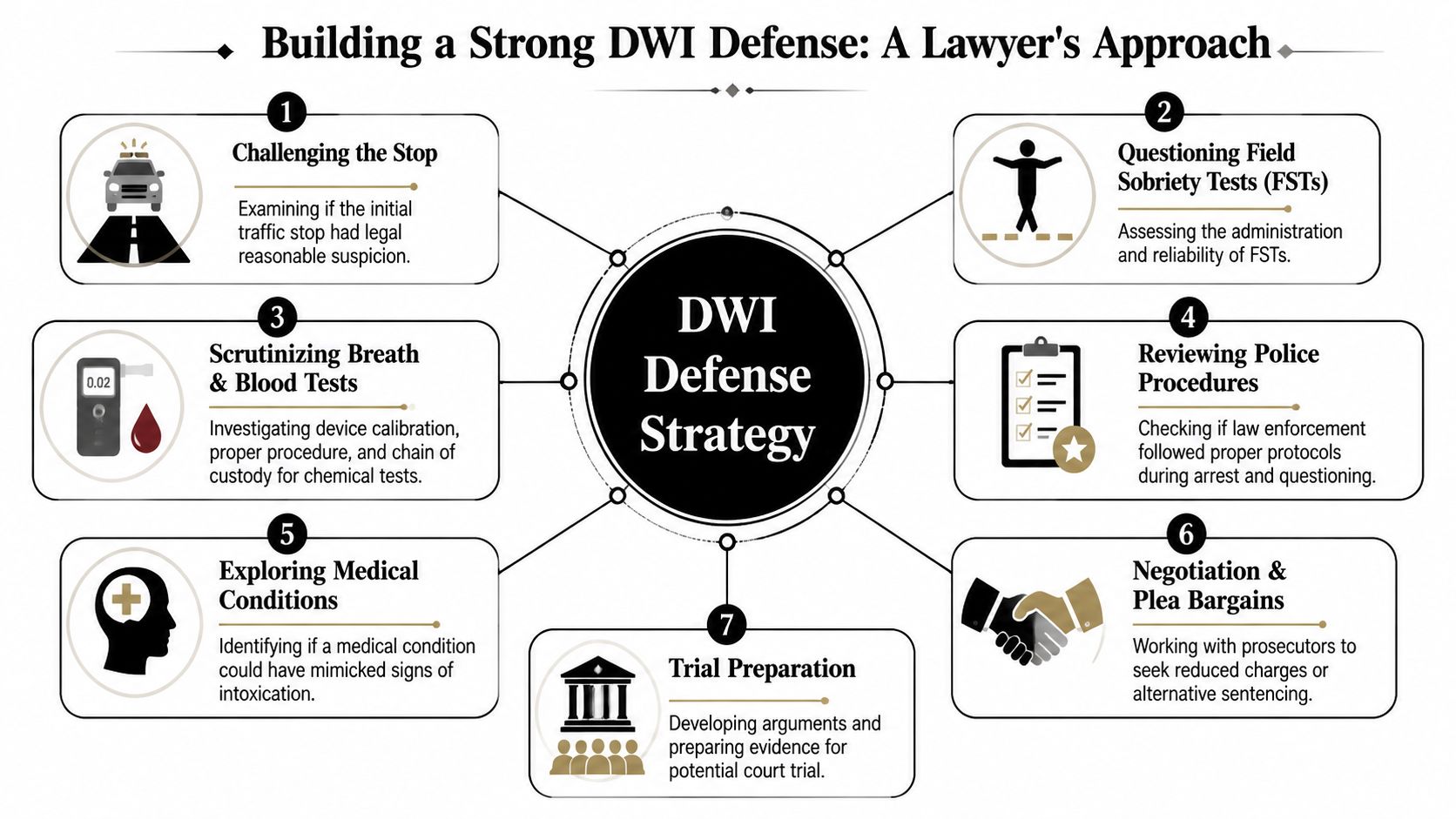
Challenging the stop and roadside investigation
The first job is to reconstruct the stop from the beginning. What did the officer say justified pulling you over? Does the dash cam support that reason? Did the encounter stay within legal bounds, or did it expand without a clear basis?
Then the roadside investigation gets its own review. Field sobriety tests are often presented as if they measure impairment cleanly, but they are affected by ordinary human factors. Bad knees, back pain, nerves, poor lighting, traffic noise, uneven pavement, and confusing instructions can all change how a person performs. A careful lawyer compares the written report to the body cam frame by frame, because small differences can matter.
In San Antonio cases, this step is not abstract. It can shape what motions are filed in the criminal case, what is developed for the ALR hearing record, and how early the defense can identify weak spots before the case gains momentum.
Examining breath and blood evidence
Chemical testing matters, but it does not decide every case by itself.
A lawyer looks at how the sample was obtained, handled, and documented. With breath testing, the questions often include whether procedures were followed and whether the machine records support the reported result. With blood evidence, the review may focus on the draw, storage, transport, and chain of custody. If one link in that chain is weak, the reliability of the result may become a real issue.
Timing matters too. The state must still connect a test result back to the time of driving. That sounds technical, but the idea is simple. A test taken later is not a snapshot from the exact moment you were behind the wheel. Your lawyer may examine whether the state can reliably make that connection.
Medical issues can also complicate the picture. Some conditions affect balance, speech, appearance, or even test results in ways that can be mistaken for intoxication.
Turning facts into a defense plan
Good defense work is not a canned checklist. It is a sequence of decisions based on your facts, your deadlines, and the way the case is unfolding in Bexar County.
One client may need an aggressive suppression strategy because the stop itself looks questionable. Another may have a stronger challenge to the breath or blood evidence. In another case, the best path may be preparing early for trial while also using the ALR process to question the officer under oath and preserve testimony. That is where the statewide license process and the local criminal case start to connect in a practical way.
For a closer look at common defense methods, see how lawyers beat DWI cases in Texas. If this is your first time dealing with the system, a practical resource for a first DWI offense in Texas can also help you understand which issues usually deserve immediate attention.
One option clients may consider for representation and educational resources is Law Office of Bryan Fagan, PLLC, a Texas criminal defense firm that handles ALR hearings, chemical test challenges, and DWI cases at multiple stages.
How to Choose the Right DWI Lawyer in San Antonio
Hiring a lawyer is a strategic decision. You're not only choosing someone to appear in court. You're choosing who will evaluate deadlines, challenge evidence, communicate with prosecutors, and help you make decisions that affect your record and license.
Some people search broadly for a Houston DWI lawyer or a statewide Texas DUI attorney, then realize local court experience also matters. In San Antonio, familiarity with Bexar County practice can help a lawyer move more efficiently and spot local procedural issues sooner.
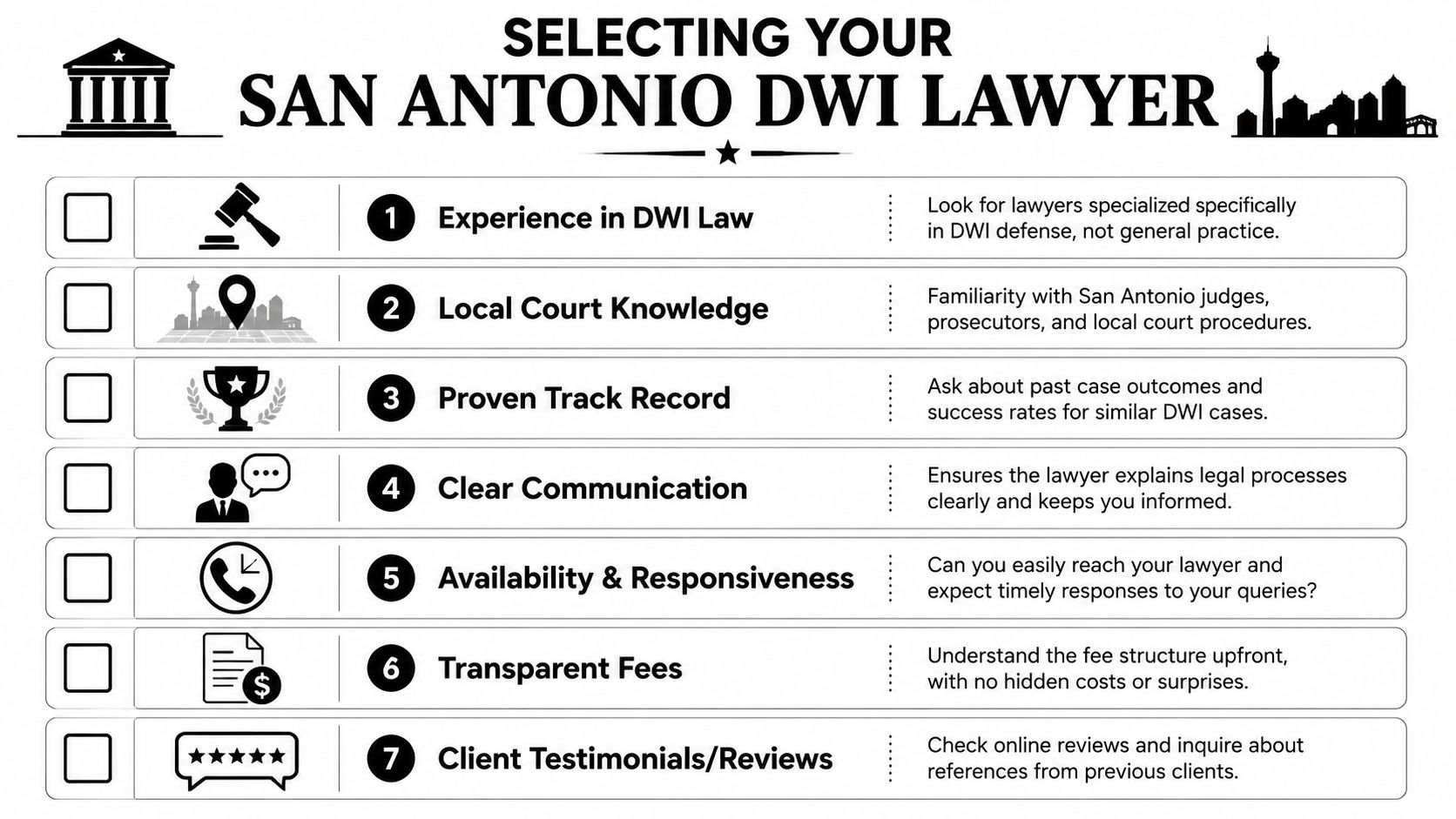
Questions worth asking in a consultation
Bring a short list and listen for direct answers.
- How do you handle the ALR side of the case? You want to know whether the lawyer treats the license issue as a core part of the defense.
- Have you handled DWI cases in Bexar County before? Local familiarity can matter in scheduling, negotiation, and expectations.
- What evidence would you want first? A thoughtful lawyer usually mentions reports, video, test records, and witness information.
- How will you communicate with me? You should know who will return calls and how updates are delivered.
A useful local-focused reference is this guide to choosing a DWI attorney in San Antonio.
Red flags to watch for
A few warning signs should make you pause.
Be careful with any lawyer who guarantees dismissal, promises a specific outcome, or brushes off the license deadline as unimportant.
You should also be cautious if the consultation feels rushed, if questions about process get vague answers, or if no one can explain the difference between the ALR hearing and the criminal case in plain language.
Good legal help should make the process clearer, not harder to understand. The right lawyer won't tell you only what you want to hear. They'll tell you what the case requires, what the risks are, and what steps can still protect you.
Frequently Asked Questions About San Antonio DWI Cases
A lot of clients reach this stage with the same concern. The arrest happened, the paperwork is confusing, and now every question feels urgent.
The good news is that confusion usually drops once you break the case into parts. In San Antonio, you are dealing with a statewide administrative process tied to your driving privileges and a local criminal case that will move through the Bexar County system. The questions below focus on what people usually want to know right away.
Will I definitely go to jail for a first-time DWI offense in Texas
Jail is one possible outcome, but it is not automatic. What happens in a Bexar County case depends on the facts of the stop, the testing, your background, and whether there are weaknesses in the State's evidence.
A charge is not the same thing as a final result. Police reports often tell only one side of the story. Video, witness accounts, medical issues, testing problems, and procedural mistakes can all change how a case is evaluated.
That is why early case review matters.
What does implied consent mean in plain English
It means Texas treats driving as an activity tied to certain testing rules after a lawful DWI arrest. If a person refuses a requested specimen or gives a sample that allegedly shows intoxication, the State can try to suspend that person's license through the administrative process.
A lot of people hear "implied consent" and assume they gave up every right the moment they started the car. That is not how it works. You still have legal protections, and the officer still has rules to follow.
In practical terms, this issue matters most during the license suspension from a DWI process, which usually starts much faster than the criminal case in court.
Can a DWI ever come off my record
Sometimes, yes, but the answer depends on how the case ends.
Record clearing is a lot like sorting keys. The result of the case determines which doors may still open later. A dismissal, a reduction, a no-bill, a not guilty result, or a conviction can each lead to very different options.
That is why it is smart to ask about record consequences before accepting any plea agreement, not after. If your job, professional licensing, housing, or future applications may be affected, bring that up at the start so your lawyer can factor it into the strategy.
How much is a DWI really going to cost me
The cost is usually broader than the court fine alone. People often focus on the criminal charge and overlook towing, bond expenses, time away from work, higher insurance costs, ignition interlock requirements in some cases, and the financial strain that can come from a restricted ability to drive.
In Bexar County, the local court process may also involve repeated appearances, classes, supervision fees, or other case-related expenses depending on the outcome. The total impact often feels more like a chain reaction than a single bill.
That is one reason many people choose to address the case early and carefully instead of treating it like a routine traffic matter.
Should I wait until my first court date to hire a lawyer
Usually, no.
The first days after an arrest are often the best time to protect evidence and make decisions that affect both sides of the case. A lawyer may be able to request the ALR hearing in time, obtain video before it disappears, review testing records, identify witnesses, and start examining whether the stop and arrest were handled correctly.
If your goal is to effectively challenge DWI charges in Texas, waiting until the first court date can mean losing time that cannot be recovered.
What should I expect next in San Antonio
Most clients want a timeline more than a definition. That makes sense.
After the arrest, the first major deadline usually involves the administrative hearing request tied to your license. After that, the criminal case begins moving through the Bexar County courts on its own track. Those two tracks connect, but they do not move at the same speed and they do not decide the same issues.
A helpful way to view the process is this: the ALR side focuses on your ability to drive, while the criminal case focuses on whether the State can prove the charge in court. Knowing which track you are dealing with helps you ask better questions and avoid costly assumptions.
If you are facing a San Antonio DWI, a prompt legal review can help you protect your license, understand your options, and build a strategy for the criminal case. The Law Office of Bryan Fagan, PLLC offers free consultations for Texas DWI defense matters, including ALR issues, first-time charges, and cases that may later involve record concerns such as expunctions. You can reach out for a case evaluation and get clear guidance on the next step.