
A DWI arrest can be overwhelming, but you don't have to face it alone. If you were stopped on a Killeen road, asked confusing questions, put through field tests, handcuffed, and taken to a Bell County facility, the paperwork afterward can feel just as stressful as the arrest itself. The important point is that your case has a sequence, and the license deadline comes first.
A focused response starts with preserving your driving privileges, protecting evidence, and understanding the criminal charge. Whether you searched for a DWI lawyer Killeen TX, a Houston DWI lawyer, or a Texas DUI attorney because you live elsewhere, act quickly and avoid discussing the facts with anyone except your lawyer.
A DWI Arrest in Killeen and What Comes Next
You may still remember the flashing lights, the officer's questions, and the moment the roadside investigation changed into handcuffs. After the ride to a Bell County facility, you may have received bond paperwork, learned that your vehicle was impounded, and been given documents affecting your driver's license. That sequence is upsetting, but it isn't random.
Once you're released, review every document before putting it aside. Your paperwork may include a citation, bond conditions, a temporary driving document, and information about a future court appearance. The Texas Peace Officer's Notice of Suspension, commonly called a DIC-24 or DIC-25-related notice depending on the documents issued, can be especially important because it may start the separate administrative license process.
Your first 48 hours
Do these things before trying to explain the entire event to friends, coworkers, or anyone posting online:
- Secure every document: Keep the citation, release paperwork, temporary license materials, and testing information together.
- Record the timeline: Write down where the stop occurred, when you were arrested, what tests were requested, and when you were released.
- Preserve your memory: Note road conditions, lighting, weather, medical symptoms, food, medication, and the timing of any drinks.
- Avoid public discussion: Social media posts, text messages, and casual explanations can become evidence or create inconsistencies.
- Call counsel promptly: A lawyer can identify the license deadline before attention shifts to the criminal court case.
Practical rule: Don't wait for the first court date to seek advice. The administrative case may require action before the criminal case meaningfully develops.
The criminal case may proceed through a county court or, in more serious circumstances, a district court. Your lawyer will examine the stop, arrest, testing, and paperwork before deciding whether to negotiate, file motions, or prepare for trial.
Key Texas DWI Terms You Should Know Before Anything Else
A DWI case can split into two tracks before you ever see a jury. Learn these terms first, then treat the license issue and criminal charge as separate problems requiring separate decisions.
BAC
BAC, or blood alcohol concentration, measures alcohol in a person's blood. A breath test estimates that concentration rather than measuring blood directly. The result matters only if collection, device operation, calibration, analysis, and interpretation were reliable.
Texas also recognizes impairment without relying on a specific BAC result. An officer may allege that alcohol, drugs, or both affected your normal mental or physical faculties. Your lawyer should review the number and the evidence describing your driving, speech, coordination, and conduct.
Implied consent
Implied consent refers to the legal concept that driving on Texas roads carries an agreement to provide a specimen in circumstances authorized by law. That concept does not make every test request valid or remove your constitutional rights.
A refusal or failed test can create a separate administrative license issue. Counsel should examine the request, the notice provided, whether officers obtained a warrant, and whether the required procedures were followed. Do not assume the criminal accusation answers those questions.
Field sobriety test
A field sobriety test, or FST, is a roadside exercise used to assess possible impairment. The three standardized tests are Horizontal Gaze Nystagmus, Walk and Turn, and One Leg Stand, as described in the NHTSA standardized field sobriety test manual.
These exercises are not medical examinations. Footwear, pavement, fatigue, injuries, inner-ear problems, anxiety, and unclear instructions can affect performance. A report that says you performed poorly still requires a close review of what the officer asked you to do and how the test was conducted.
Administrative license suspension and ALR
An administrative license suspension affects your driving privilege outside the criminal courtroom. Texas calls that process Administrative License Revocation, or ALR. An administrative law judge, not a jury, decides whether the suspension should remain in place under the applicable evidence and procedures.
The ALR case is separate from the DWI prosecution. A result in one case does not automatically decide the other. Put the license deadline first, preserve the documents, and then build the criminal-case strategy with the full record in hand.
Texas DWI Penalties Explained From First Offense Through Felony
A first DWI in Texas generally begins as a Class B misdemeanor when the BAC is under 0.15%. The baseline includes at least 72 hours in jail, exposure of up to 180 days, a fine of up to $2,000, and a driver's license suspension from 90 days to 1 year, according to this overview of Texas DWI laws.
A conviction may also bring a separate state fine of $3,000 within 36 months, or $6,000 if the evidence shows a BAC of 0.15 or higher, as summarized in this Texas first DWI guide. An open container in the vehicle raises the minimum jail term to 6 days under the baseline framework.
Texas DWI Penalties at a Glance
| Offense Tier | Minimum Penalty | Maximum Penalty |
|---|---|---|
| First DWI, BAC under 0.15% | 72 hours in jail, fine up to $2,000, license suspension from 90 days to 1 year | 180 days in jail, fine up to $2,000, plus applicable state fine |
| First DWI with BAC at or above 0.15% | Class A treatment may apply, with enhanced financial and criminal exposure | Up to the applicable Class A misdemeanor jail and fine limits |
| Repeat DWI | Increased punishment based on prior convictions | Felony exposure may apply depending on the record |
| Third or higher DWI | Felony prosecution | Significant prison and license consequences |
| Intoxication assault or manslaughter | Felony prosecution | Serious felony punishment, with exposure shaped by injury or death allegations |
Review this Texas DWI penalties guide for the full range of offense levels. The charge turns on prior convictions, BAC allegations, a child passenger, an open container, injuries, or a death.
Prior convictions can move a case into a higher punishment tier, so the record must be checked before anyone evaluates a plea offer. In Bell County, the prosecutor's position, the assigned court, the alleged facts, and the defendant's record can shape sentencing discussions. Early counsel can identify the correct tier and challenge unsupported enhancements before negotiations harden.
Under-21 cases require separate attention because Texas DPS treats an under-21 alcohol-related DWI conviction as a one-year license suspension offense. Your age, prior history, vehicle facts, and precise accusation can change the legal exposure before negotiations begin.
The ALR Hearing and Your 15-Day License Deadline
You leave a DWI arrest facing two separate tracks. Handle the driver's license deadline first, then build the criminal case. After Texas DPS serves a suspension notice, you have 15 days to request an ALR hearing. If you miss that deadline, the suspension generally begins on day 40, according to the Texas DPS ALR program.
The ALR hearing is civil and separate from the criminal DWI case. An administrative law judge examines issues such as the legality of the stop, the basis for the arrest, and whether the officer properly requested a specimen. The officer may be subpoenaed to testify. You may present evidence and challenge the state's account through questioning. A clearer explanation appears in this guide to the Texas ALR hearing process.
Follow the deadline sequence
- Find the service date: Use the date you received the suspension notice, not the date you later spoke with a lawyer.
- Request the hearing within 15 days: This preserves your opportunity to contest the administrative suspension. Missing the deadline can eliminate that opportunity.
- Prepare the evidence: Counsel can seek the arresting officer's testimony and examine the stop, arrest, test request, and specimen procedures.
- Track the criminal case separately: An ALR hearing does not replace the court process. After protecting your license position, address the criminal allegations and evidence.
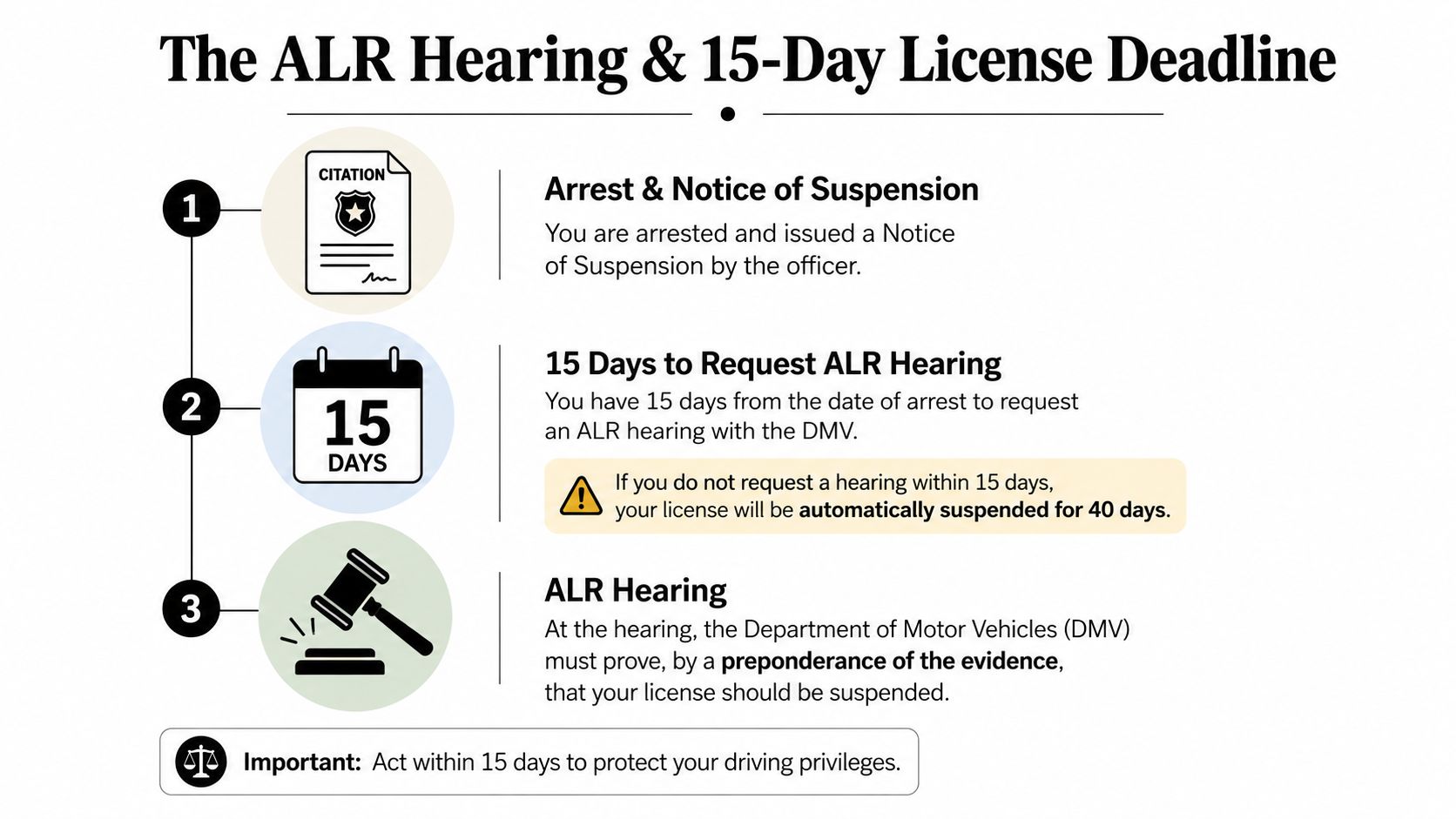
A lawyer may subpoena the arresting officer and, when appropriate, seek additional time within the administrative process. That may help preserve a valid license while the challenge proceeds, but no attorney should promise a particular result. Read The 15-Day ALR Deadline: Save Your License After a DWI Arrest for a focused explanation. If the arrest occurred near Fort Cavazos or elsewhere in Killeen, act on the notice date immediately.
Common DWI Defenses a Killeen Lawyer Can Use
A DWI arrest does not establish guilt. The prosecution must prove that the stop, investigation, arrest, and evidence satisfy Texas law and remain persuasive in court. Your lawyer should test each stage instead of treating the officer's report as the final word.
Where the investigation can break down
A Killeen defense lawyer should examine whether:
- The stop lacked reasonable suspicion: The officer needed a lawful basis to stop you.
- The FSTs were administered improperly: Instructions, demonstrations, footwear, surface, lighting, and physical limitations can affect the observations.
- Medical conditions affected observations: GERD, diabetes, tinnitus, inner-ear disorders, injuries, and fatigue may resemble signs officers associate with impairment.
- The breath test has technical weaknesses: Calibration, operator certification, testing protocol, radio-frequency interference, and machine records deserve review.
- The observation period was incomplete: Records and video may conflict with the state's account of the required deprivation period.
- BAC timing is disputed: The timing of your last drink and the test can affect how the result is interpreted.
- The arrest procedure was unlawful: A motion to suppress may be appropriate if officers violated constitutional or statutory requirements.
Roadside conditions matter. Uneven pavement, poor weather, unclear instructions, fatigue, and health conditions can affect field-test performance. Those facts do not decide the case by themselves, but they give counsel specific issues to investigate and present.
Texas appellate authority treats breath-test reliability as a scientific-foundation issue. Evidence that undermines reliability may affect the weight of the result, while admissibility still depends on Texas rules and DPS certification requirements, as discussed in State v. Mechler, 153 S.W.3d 435 (Tex. Crim. App. 2005).
| Defense Angle | Evidence or Motion Required |
|---|---|
| Unlawful stop | Dashcam, bodycam, dispatch audio, and a suppression motion |
| Weak field tests | Video, officer notes, medical records, and cross-examination |
| Breath-test reliability | Calibration logs, certification records, maintenance history, and testing protocol |
| Specimen handling | Collection records, chain-of-custody documents, and laboratory materials |
| Inconsistent timeline | Receipts, messages, witnesses, and location evidence |
Your attorney should connect each defense to evidence that can be obtained, tested, and used in court. Review these Texas DWI defense strategies with that standard in mind. Depending on the final outcome and your eligibility, you may also need to determine whether a Texas DWI can be removed or sealed.
Your First Consultation With a Killeen DWI Lawyer
A free consultation should be a working meeting, not a sales speech. Bring the documents that show what happened procedurally, then give the lawyer a clean account of the stop without guessing or minimizing details.
Bring the complete file
Place these materials in one folder:
- Notice of suspension: Bring the Texas Peace Officer's Notice of Suspension, including the DC-70 if that form was issued.
- Temporary driving document: Include any temporary license or permit.
- Criminal paperwork: Bring the citation, bond conditions, release paperwork, and any scheduled court information.
- Personal evidence: Add photographs, witness names, medical records, and your written recollection.
- Testing details: Include anything identifying a breath or blood test, including paperwork provided after the arrest.
The lawyer should ask about the location, reason for the stop, officer statements, field tests, chemical testing, medical conditions, and prior record. Don't be embarrassed by facts that seem unfavorable. A defense plan is only as accurate as the information you provide.
Questions that deserve direct answers
Ask how the attorney will handle the ALR hearing, what outcome range the known facts support, and whether the case belongs in a Bell County Court at Law or a higher court. Ask for an estimated total cost, including whether expert or testing fees are separate, and ask how often the firm will update you.
Counsel should review the offense report, identify possible suppression issues, and determine whether diversion or pretrial intervention may be available for a first-time offender in Bell County. The meeting should end with a written fee agreement and a clear next-action list, not vague reassurance.
How to Choose the Right DWI Attorney in Killeen
Choose a DWI lawyer by the work they will personally handle, not website promises. A DWI case runs on two parallel tracks, the administrative license case and the criminal charge, and the first has a hard deadline. Hire counsel who regularly handles Texas DWI defense, ALR hearings, breath and blood evidence, negotiations, and trials in Bell County courts.
Evaluate the lawyer's method
Ask the lawyer to explain how they will review:
- The arrest report and video: Confirm that dashcam and body-camera footage will be requested and examined.
- Chemical-test records: Ask how breath or blood documentation, calibration materials, and certification records will affect the analysis.
- Driving history: Prior convictions and license history can shape both criminal and administrative strategy.
- Local procedure: Killeen and Bell County experience helps counsel work within the local court setting, but it cannot guarantee a result.
- Fees and communication: Get a written agreement stating what the fee covers, when other costs may arise, and how updates will be provided.
The Law Office of Bryan Fagan, PLLC handles DWI and ALR matters through stated services that include reviewing probable cause, challenging field sobriety and chemical evidence, conducting administrative license hearings, and preparing cases for court.
Ask basic questions without hesitation. A capable lawyer will answer directly, identify the license deadline, explain the defense plan in plain language, and say what evidence remains missing. Before hiring anyone, confirm who will attend the ALR hearing, who will appear in court, and who will return your calls.
Your Next Steps and How to Reach Our Office
After an arrest in Killeen, the order of your response matters. Handle the license deadline first, then build the criminal defense with counsel. Write down the arrest date, court date, release conditions, and every deadline shown on your paperwork. If the Texas Department of Public Safety served a suspension notice, request the ALR hearing within 15 calendar days.
Put the record in order
- Separate the license case: Treat the ALR proceeding and criminal charge as different matters with different consequences.
- Preserve evidence: Save photographs, vehicle information, medical records, messages, witness names, and breath or blood testing documents.
- Protect communications: Do not post about the stop, delete relevant messages, or miss a court or license obligation.
- Prepare for counsel: Bring the arrest citation, ALR notice, driver's-license information, bond conditions, and available test details to the consultation.
- Follow the written plan: Track each instruction from your lawyer and keep copies of documents you submit.
Early action gives counsel time to obtain video, test records, dispatch information, and officer materials. It also keeps the license proceeding from being overlooked while attention shifts to the criminal case.
The Law Office of Bryan Fagan, PLLC offers consultations for DWI matters, and you can request a case evaluation through the office website with your Killeen or Bell County paperwork ready.