
A DWI arrest can be overwhelming, but you don't have to face it alone.
If you were arrested in Fort Worth, you're probably dealing with two pressures at once. You want to know what happens next, and you want to stop this from disrupting your license, your job, and your record more than it already has. That instinct is right. Early action matters.
The first mistake many people make is treating a DWI like a single case with a single deadline. It isn't. In Texas, you usually have two separate tracks moving at the same time. One is the criminal case in court. The other is the fight over your driver's license through the administrative license suspension process. A strong Fort Worth strategy has to handle both.
For many people, hiring a DWI lawyer in Fort Worth isn't really about making the problem disappear overnight. It's about making smart decisions quickly, protecting your options, and avoiding avoidable damage.
You've Been Arrested for a DWI in Fort Worth, Here's What Matters Now
You get out of jail late, sit in your car or your living room, and start sorting through the papers from the officer. One page talks about your license. Another mentions court. Your phone is buzzing with advice from people who do not have to deal with the consequences. That first stretch after a Fort Worth DWI arrest feels chaotic, but the right response is simple. Get organized, protect your deadlines, and treat this as two problems that need attention at the same time.
A DWI arrest can reach well beyond a courtroom. It can affect your ability to drive, the cost of your insurance, your work, and how much room your lawyer has to negotiate later. Early decisions matter because they shape both the criminal case and the license case before either one is fully underway.
Two tracks start immediately
In Fort Worth, a DWI arrest usually puts you on two separate paths.
- The criminal case, where the state tries to prove you were driving while intoxicated
- The administrative license case, where the state tries to suspend your driving privileges
Those paths are connected, but they are not the same case. They have different rules, different goals, and different pressure points. A good defense strategy accounts for both from day one. If a lawyer looks only at your court date and ignores the license side, that leaves a major part of the problem exposed.
That is why I tell people to stop asking only, "When is my court date?" The better question is, "What has already started, and what can we still protect?"
What to do in the first hours after release
The first job is preserving information. Small details that seem forgettable that night can become useful later, especially in cases involving the traffic stop, field sobriety testing, breath testing, or the officer's report.
| Helpful move | Unhelpful move |
|---|---|
| Keeping every paper the officer gave you | Misplacing the notice of suspension or bond paperwork |
| Writing down the timeline of the stop, arrest, and testing | Relying on memory weeks later |
| Taking the license issue seriously right away | Assuming everything starts at the first court setting |
| Getting legal advice before speaking casually about the case | Explaining your arrest to coworkers, friends, or on social media |
If you want a clear checklist, this guide on what to do after a DWI arrest in Texas immediately is a useful starting point.
An arrest does not mean the state's case is strong. In many Fort Worth DWI cases, the critical work starts with examining whether the stop was legal, whether the officer had grounds to arrest, whether the testing process was handled correctly, and whether the paperwork matches what occurred. The sooner that review starts, the more options you usually have.
Your First 15 Days The Most Critical Window After a DWI Arrest
You get out of jail, look at the paperwork, and assume the next date that matters is your court setting. In Fort Worth, that mistake can cost you your license before you ever step into a courtroom.
The first 15 days after a DWI arrest usually decide whether you still have a real chance to fight the license suspension through the ALR process. At the same time, your criminal case is already taking shape. Those are two separate tracks, and a smart defense starts working on both immediately.
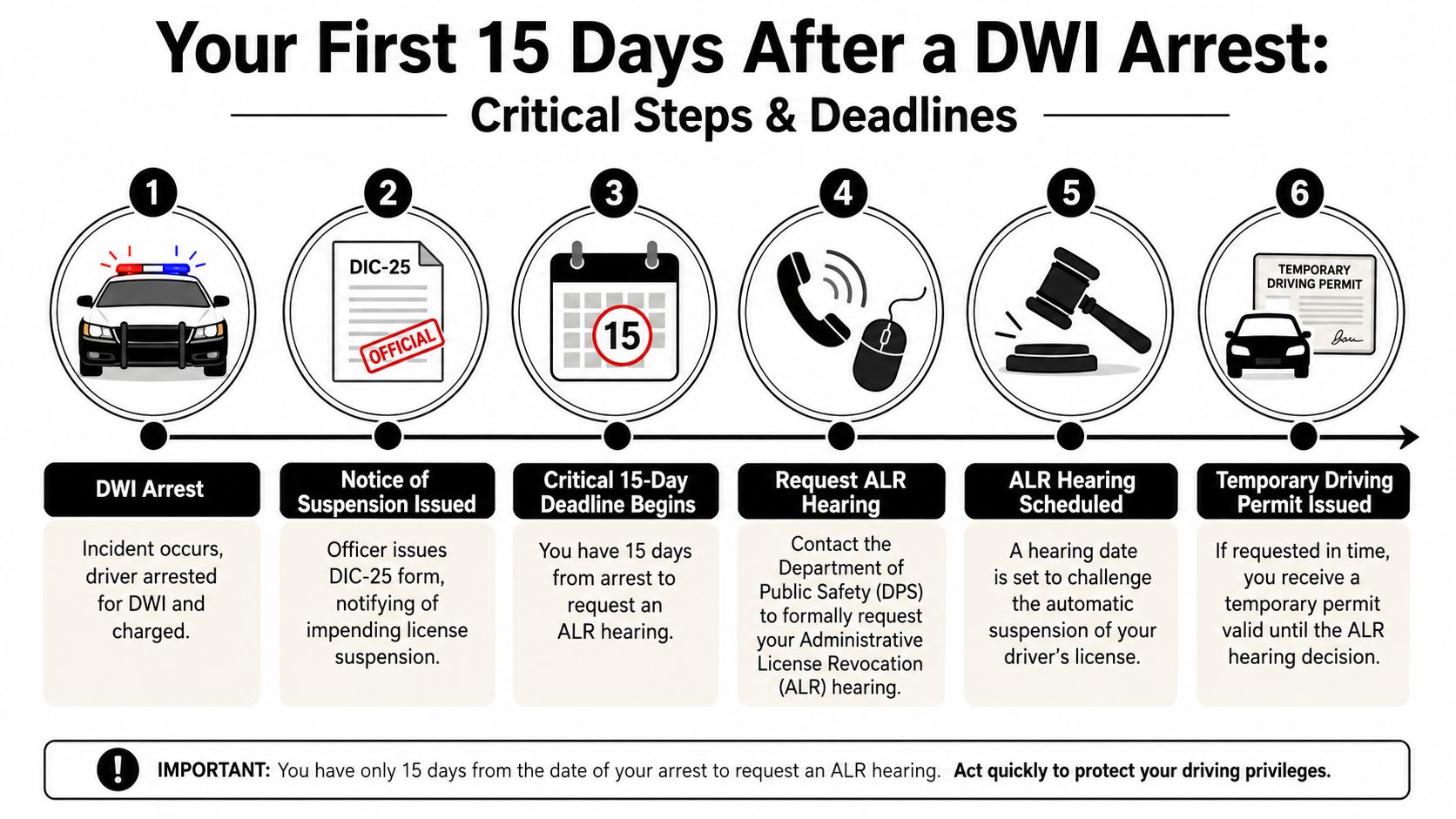
What an ALR hearing actually is
An ALR hearing is the civil case over your driver's license. It is separate from the criminal DWI charge pending in court. You can have a strong argument in one and a weak position in the other.
That distinction matters in real life. The criminal case deals with guilt, suppression issues, plea offers, and trial strategy. The ALR case focuses on whether the state can suspend your license based on the arrest, an alleged test refusal, or a blood or breath result over the legal limit.
If you were recently arrested for DWI in Texas, this is usually the first point where people realize the case is bigger than one court date.
Why the 15-day deadline matters so much
If no hearing is requested in time, the suspension process can move forward by default. That gives up a chance to contest the license action and also gives up an early opportunity to examine the officer under oath.
I treat that hearing request as more than paperwork. In many cases, it is the first chance to pin down the state's version of the stop, the arrest, and the testing timeline. Sometimes the officer's testimony at the ALR hearing helps the criminal defense later. Sometimes it exposes gaps. Sometimes it confirms where the main fight will be.
For a clear breakdown of the timeline, read The 15-Day ALR Deadline: Save Your License After a DWI Arrest.
Implied consent in plain English
Texas uses an implied consent law. If an officer lawfully arrests you for DWI, the state treats you as having agreed to provide a breath or blood specimen under certain conditions.
That does not mean every request was lawful or every test result is reliable. It does mean a refusal can trigger a license suspension issue separate from whether the criminal charge can be proven.
A few terms matter right away:
- BAC means blood alcohol concentration. It is the alcohol level measured in breath or blood.
- Field sobriety tests are roadside tests officers use to look for signs of impairment. They are subjective and often worth challenging.
- Administrative license suspension refers to the state's effort to suspend your driving privileges through the ALR process.
What to do during this 15-day window
Use this period carefully. Small mistakes here create bigger problems later.
- Keep every document you received at release, including the notice tied to your license.
- Confirm the deadline based on the date you were served with the notice, not the date you finally had time to read it.
- Request the ALR hearing quickly or have a lawyer do it for you.
- Write down the timeline of the stop, arrest, testing, medical issues, and anything you ate, drank, or said.
- Preserve evidence such as receipts, texts, ride plans, witness names, and any video that may disappear.
- Start reviewing both tracks of the case. One track is your license. The other is the criminal prosecution in Tarrant County.
That last point is where people lose ground. They focus on the court case and ignore the license problem, or they rush to save the license and never build a defense to the charge itself. A seasoned Fort Worth DWI lawyer handles both at once.
Why CDL and professional drivers need immediate planning
Commercial drivers usually have less room for error. The license issue can affect income fast, and generic advice often ignores the special consequences tied to a CDL or a job that depends on driving.
The same is true for nurses, pilots, teachers, and anyone with a professional license or employer reporting requirement. The right strategy is not just “fight the case.” It is deciding early what has to be protected first, what hearing needs to be requested now, and what evidence needs to be secured before it disappears.
How to Choose the Right Fort Worth DWI Lawyer
Not every criminal defense lawyer handles DWI cases the same way. If your goal is to fight the case intelligently, protect your license, and avoid blind spots, you need to ask sharper questions than “How much do you charge?” or “Can you get this dismissed?”
Start with local experience. A lawyer who regularly handles DWI cases in Tarrant County will usually have a more realistic sense of local procedure, prosecutor habits, courtroom expectations, and the kinds of issues that move cases.

Questions that reveal real experience
A useful consultation should sound specific, not canned. Ask questions like:
- How often do you handle DWI cases in Tarrant County? You're looking for regular, current experience, not occasional exposure.
- How do you approach the ALR hearing and the criminal case together? A good answer should address both tracks, not just court.
- What issues do you usually investigate first? Listen for discussion of the stop, video, field sobriety testing, chemical testing, and paperwork.
- How do you handle CDL cases or professional-license concerns? Special consequences require targeted planning.
- Who will work on my file? You should know whether the attorney you meet is the one driving strategy.
A practical checklist like how to find a good DUI attorney can help you compare lawyers based on substance instead of marketing.
Red flags to watch for
Some warning signs are easy to miss when you're stressed.
| Green flag | Red flag |
|---|---|
| Explains the difference between ALR and criminal court | Talks as if everything happens in one case |
| Discusses evidence review in detail | Promises a result before seeing records |
| Asks about deadlines, testing, and your job | Focuses only on a fast plea |
| Gives a strategy for your facts | Uses the same speech for every caller |
A reliable lawyer usually talks about process, evidence, and options. An unreliable one often talks only about guarantees.
What a serious defense conversation should include
If the consultation is useful, you should leave understanding at least these points:
- What happened procedurally after your arrest
- What the immediate deadline is
- What records need to be gathered
- Whether there are signs of a stop issue, testing issue, or timing issue
- What the next court setting likely means
This video gives a general explanation of what people should look for when evaluating defense help in a DWI case.
One option for handling both tracks
Some firms are set up specifically to address both the license and court side of a DWI matter. The Law Office of Bryan Fagan, PLLC handles ALR hearings, field sobriety and chemical test challenges, and criminal court defense across Texas, including Dallas-Fort Worth. That kind of scope matters when your case has more than one moving part.
The right Fort Worth DWI lawyer should make the process clearer, not foggier. After one meeting, you should have a plan, a timeline, and a better sense of where the state's case may be vulnerable.
Common DWI Defense Strategies Your Attorney Will Explore
A DWI arrest is only the starting point. To convict, the state still has to prove its case with admissible evidence. That's where defense work happens.
A skilled Texas DUI attorney doesn't just ask whether you blew over a number. Key questions are whether the stop was lawful, whether officers followed procedure, whether the tests were administered correctly, and whether the evidence proves impairment at the time of driving.

Challenging the stop
Police need a lawful basis to stop a vehicle. That usually means reasonable suspicion for the stop, and later probable cause for an arrest.
If an officer stopped you without a valid reason, your lawyer may challenge what happened after that point. Sometimes the most important issue in a DWI case isn't the breath result. It's whether the officer had legal grounds to pull you over at all.
Examples your attorney may scrutinize include:
- Driving facts such as weaving, speed changes, or lane use
- The video compared against the written report
- Timing problems in the officer's narrative
Field sobriety tests are not simple pass-fail tools
A field sobriety test is a set of roadside exercises officers use to look for signs of intoxication. Common examples include walking a line, standing on one leg, or tracking an object with your eyes.
These tests are often treated like hard proof, but they're highly dependent on conditions and interpretation. Surface conditions, footwear, weather, fatigue, injury, anxiety, and the officer's instructions can all matter.
Many people look worse on camera than they felt in the moment. That doesn't automatically prove intoxication.
A defense lawyer will usually compare the report, body camera, dash camera, and the actual testing instructions to see whether the officer followed standardized methods.
Breath and blood test challenges
BAC means blood alcohol concentration. In court, the number itself is only part of the analysis. The prosecution still needs reliable testing and proper procedure.
Defense review may focus on issues such as:
- Machine reliability and whether equipment records raise concerns
- Sample handling and whether blood evidence was collected and tracked properly
- Medical explanations that may affect results or appearance
- Timing between driving and testing
One defense theory that sometimes matters is rising BAC. In plain terms, alcohol can continue absorbing after driving stops. A later test result may not perfectly reflect your level at the earlier time the state must prove.
Lack of impairment and procedural errors
Some cases turn on whether the state can show loss of normal mental or physical faculties. Others turn on officer mistakes.
Your attorney may examine:
| Issue | Why it matters |
|---|---|
| Arrest paperwork | Inconsistencies can weaken the state's timeline |
| Officer instructions | Poorly given directions can undermine test results |
| Video evidence | It may contradict claims in the report |
| Search and seizure issues | Illegally obtained evidence may be challenged |
A strong defense doesn't rely on one magic argument. It's usually a methodical review of every step, from the first observation to the final lab result, to decide how to fight DWI Texas cases effectively.
Navigating the Fort Worth Court Process and Potential Penalties
After an arrest in Fort Worth, many people expect one court date and one decision. That is not how DWI cases usually work in Tarrant County. You are dealing with a criminal case that moves through the county court system, and at the same time, the license suspension issue can keep moving on its own timeline.
That two-track pressure matters. A good defense strategy does not wait for the first courtroom appearance to start making decisions.
What the court process usually looks like
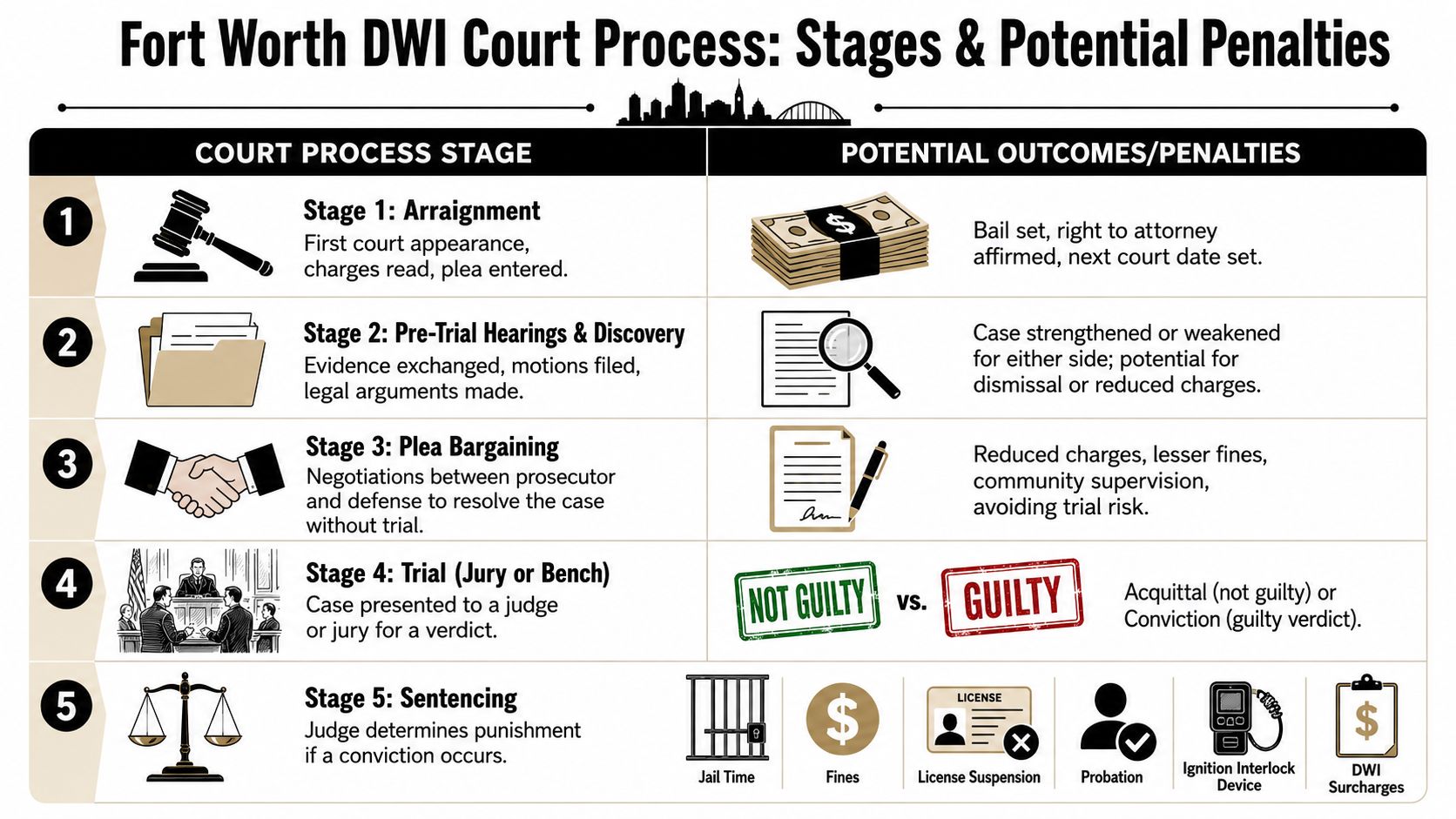
On the criminal side, a DWI case usually moves through several stages:
First court setting
The court addresses the charge and sets the next dates. In many cases, this is more about case management than final outcomes.Discovery and case review
The defense gathers police reports, body camera footage, dash camera video, breath or blood records, and other evidence. This stage often shapes the rest of the case.Motions and legal challenges
If the stop, arrest, testing, or evidence handling was flawed, your lawyer may raise those issues before trial.Negotiation
Some cases are resolved through plea discussions. Others should not be, especially when the facts, testing, or officer observations are open to challenge.Trial and sentencing, if needed
If the case does not resolve, the state has to prove the charge beyond a reasonable doubt. A conviction leads to sentencing based on the offense level and the facts involved.
Texas DWI penalties explained
For a first offense, the charge is often a Class B misdemeanor. Texas law generally sets a minimum of 72 hours in jail, a maximum of 180 days, and a fine up to $2,000. A separate driver's license suspension can also follow. As noted earlier in this guide, that license issue has its own process and deadlines.
A BAC of 0.15 or higher raises the charge to a Class A misdemeanor. That increases the exposure to up to one year in jail and a fine up to $4,000. For a concise explanation of how Texas treats high BAC allegations, see this discussion of Texas BAC over 0.15 charges. For general BAC thresholds under Texas law, Neal Davis's Texas BAC limit guide provides a useful overview.
A simple comparison
| Charge level | Classification | Jail range | Fine range | License consequence |
|---|---|---|---|---|
| Standard first DWI | Class B misdemeanor | Minimum 72 hours, up to 180 days | Up to $2,000 | Possible suspension through a separate process |
| BAC 0.15 or higher | Class A misdemeanor | Minimum 72 hours, up to 1 year | Up to $4,000 | Possible suspension, often with higher stakes |
Why early strategy affects the result
In practice, the strongest work often happens before trial. That includes getting the videos early, comparing the report to the footage, reviewing blood or breath records, and deciding whether the case should be challenged aggressively or resolved on terms that protect your job, license, and record as much as possible.
I tell clients the same thing every week. Court dates matter, but timing matters more. If your lawyer is only reacting to the next setting, valuable options can disappear. If your lawyer is handling both the criminal case and the license case from the start, you have a better chance to protect your ability to drive, your negotiating position, and your trial posture at the same time.
Take the First Step to Protect Your Future
If you've been arrested, you don't need to solve everything tonight. You do need to act in the right order.
Start with the deadline that can hurt you fastest. Deal with the ALR hearing request promptly. Then choose a Fort Worth DWI lawyer who can explain both the license case and the criminal case in clear terms. After that, focus on evidence, not assumptions. A DWI charge may look straightforward on paper and still have serious weaknesses underneath.
You also don't need fear-based advice right now. You need practical direction. That means understanding terms like implied consent, BAC, field sobriety test, and administrative license suspension in plain English, and making decisions before the state's timeline boxes you in.
If you hold a CDL, work in a licensed profession, or cannot afford a long interruption to driving, getting specific legal advice quickly matters even more. A generic plea-first approach often ignores the practical consequences outside the courtroom.
Fort Worth DWI cases can be defended. Some are fought through legal motions. Some turn on test reliability. Some turn on the stop itself. Some are managed through smart negotiation. What works depends on the facts, the timing, and whether your lawyer starts early enough to protect the best options.
If you need answers about your next step, request a free consultation with Law Office of Bryan Fagan, PLLC. You can get a case evaluation focused on your arrest, your deadlines, and your options in Fort Worth, with clear guidance on the criminal case and the license suspension process.