
A DWI arrest in Euless can put your license at risk fast. If you refused testing, a first refusal can trigger a 180-day suspension, and if you failed with a BAC of 0.08% or higher in a non-commercial vehicle, a first test failure can trigger a 90-day suspension.
A DWI arrest can be overwhelming, but you don't have to face it alone. If you're reading this after getting out of the Euless Police Department jail, the Tarrant County jail, or after a late-night release on bond, focus on the most urgent deadline first. You may have only 15 days to request the hearing that protects your right to challenge the pending license suspension. Miss that window, and the suspension can move forward by default.
If you're searching for a DWI lawyer in Euless TX, you probably want straight answers, not recycled warnings. Here's mine. Treat this like two cases from day one, not one. Your criminal charge matters, but your driver's license, your job, and your long-term record often need attention even sooner.
What to Do in the First 24 Hours After a DWI Arrest in Euless
You've been released. Your phone is full of missed calls. You're embarrassed, angry, and trying to decide whether to “wait and see.” Don't. The first day after a DWI arrest is when good cases are protected and bad mistakes get locked in.
Start with the deadline that can hurt you first
Your first job is simple. Find every paper you were given and look for the license paperwork. In Texas, the administrative process moves on its own schedule, and several Texas legal summaries state that you generally have 15 days from arrest to request the hearing or the suspension can move forward by default, as explained in this discussion of the first 24 hours after a DWI arrest in Texas and in a Texas legal summary discussing the ALR deadline (Round Rock Criminal Defense Lawyer on refusing a breathalyzer).
If you can't find the paperwork, that's a reason to call a lawyer today, not next week.
Lock down your facts before memory fades
Write down everything you remember while it's still fresh:
- Where the stop started: the road, intersection, parking lot, or highway ramp.
- What the officer said first: why you were pulled over, whether they claimed speeding, weaving, or something else.
- What you drank and when: not a guess. Your best honest timeline.
- How the tests happened: roadside conditions, lighting, shoes, traffic, weather, and whether you were tired, sick, or injured.
- Who saw you before the arrest: passengers, coworkers, restaurant staff, friends, or family.
Those details matter because DWI defense often turns on timing, observations, and whether the officer's report matches the video.
Practical rule: Don't “explain” your case to friends, coworkers, or family in text messages. Those messages can become evidence.
Protect evidence instead of talking
People hurt their own cases by trying to talk their way out of them after the fact. Stop doing that. Don't call the arresting officer. Don't post online. Don't answer questions from anyone except your lawyer.
Take these steps instead:
- Save your phone data. Keep call logs, ride receipts, map history, and timestamped photos.
- Preserve vehicle video. If your car has dashcam footage, download it now before it overwrites.
- Note nearby cameras. Gas stations, bars, apartment gates, and businesses may have useful footage, but not for long.
- Review bond conditions. If your release includes alcohol testing, travel limits, or ignition interlock terms, follow them exactly.
If you weren't promptly released, ask your lawyer whether a bond review makes sense. Early action changes outcomes. Delay usually helps the State, not you.
Understanding Texas DWI Laws and the Dual-Track System
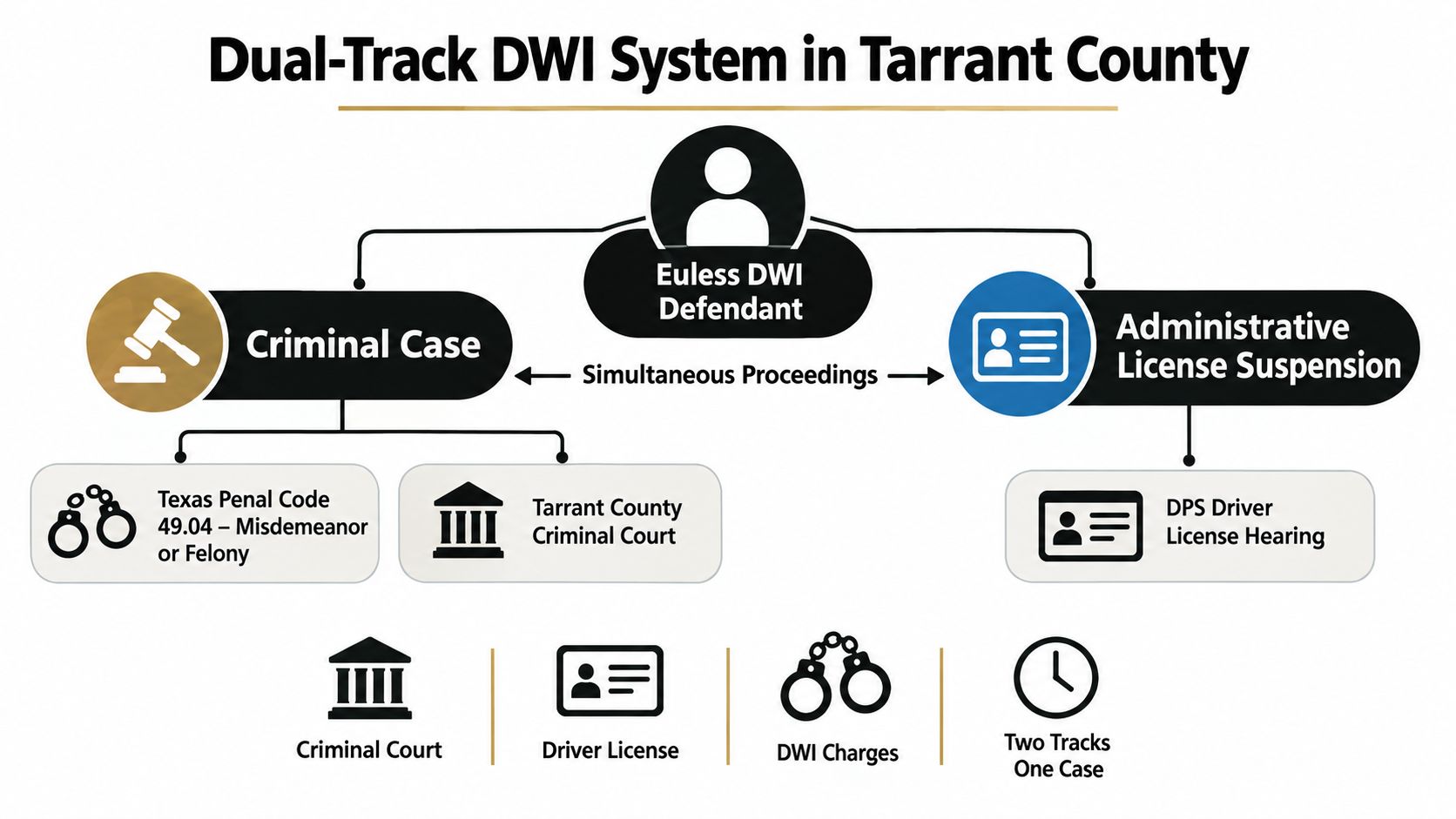
You leave the Euless jail thinking you have one case to deal with. You usually have two. One is the criminal DWI case that will move through Tarrant County court. The other is the license case, and it can start hurting you long before the criminal charge is resolved.
Two tracks start from the same arrest
After a stop by Euless police, the State can pursue a criminal prosecution and a separate administrative action against your license at the same time. They are connected by the same arrest, but they do different jobs.
The criminal case asks whether the State can prove DWI. The license case asks whether Texas can suspend your driving privileges based on the arrest, the testing issue, and the paperwork the officer submitted. Those cases run on different timelines, in different settings, and under different rules. If you treat them like one file, you give up options.
That split matters even more now because record relief after 2025 depends heavily on whether your case ends as an arrest without conviction or as a conviction. Many local pages blur that line. They should not. An arrest can create one long-term strategy. A conviction creates a very different one.
Know what each track is really about
The criminal track is the case filed in Tarrant County. That is where your lawyer challenges the stop, the officer's observations, the testing, and whether the State can prove intoxication.
The license track is commonly called ALR, short for Administrative License Revocation. It is a civil proceeding. Texas handles it separately from the criminal prosecution, and the deadlines come fast. If you want a plain-English comparison, read this breakdown of the ALR hearing versus the criminal DWI case in Texas.
Do not wait for a court date before taking the license side seriously. That is a mistake I see all the time.
The terms that actually matter
- BAC means blood alcohol concentration. It is the measurement the State uses when it claims your alcohol level was at or above the legal limit.
- Implied consent means Texas law treats driving on a public road as consent to breath or blood testing after a lawful DWI arrest. Refusal can trigger license consequences under the Transportation Code, as explained in Texas Transportation Code Chapter 724.
- Administrative license suspension means the State can move to suspend your license before the criminal case is finished.
- Field sobriety tests are the roadside tests officers use to build probable cause for arrest.
Here is the practical point. You can beat the criminal case and still have a license problem if the ALR side is ignored. You can also use the license case to get useful testimony and documents early, which can help the criminal defense.
Euless drivers need to think in timelines, not labels
In a Tarrant County DWI case, timing drives strategy. The stop may happen in Euless. The paperwork goes one direction. The court case goes another. Your record strategy depends on where each track ends.
That is why I tell clients to stop asking only, “Will this get dismissed?” Ask better questions. Was there a refusal allegation? Was a specimen taken? Was the officer's report accurate? If the case ends without a conviction, what record relief will be available later? Those answers shape the defense from day one, not after the fact.
Texas DWI Penalties Explained From First Offense to Felony
If you want to fight DWI Texas charges intelligently, you need to know what's at stake. Too many people either panic and assume the worst or relax because it's “just a first offense.” Both reactions are dangerous.
First-offense exposure is serious
Texas Department of Transportation states that a first DWI conviction can bring up to a $2,000 fine, up to 180 days in jail with three mandatory days of confinement, and a driver's license loss of up to one year (TxDOT impaired driving penalties).
That's enough by itself to justify a real defense plan. For many Euless residents, the damage doesn't stop at court. A conviction can affect work applications, housing, insurance rates, and professional licensing.
A first DWI in Texas is not a paperwork problem. It's a record problem, a license problem, and often an employment problem.
Higher exposure means higher urgency
Some cases are charged more aggressively based on the allegations and prior history. A repeat case, a child passenger allegation, or facts pushing the charge into felony territory change the risk completely.
I also tell clients to think beyond jail and fines. Judges may impose conditions like ignition interlock, and many drivers end up dealing with proof-of-insurance issues such as SR-22 requirements. If you work around DFW Airport, hold a professional license, or drive for a living, those practical consequences can hit harder than the courtroom penalty.
Texas DWI Penalty Tiers at a Glance
| Offense Level | Fine Range | Jail Time | License Suspension | Annual Surcharge |
|---|---|---|---|---|
| First DWI conviction | Up to $2,000 | Up to 180 days, with 3 mandatory days of confinement | Up to 1 year | Not addressed here |
| Higher-level DWI allegations | Can increase | Can increase | Can increase | Not addressed here |
| Felony-level DWI allegations | Can increase substantially | Can increase substantially | Can increase | Not addressed here |
A word of caution about penalty charts online. Many pages mix current law, old surcharge language, and generic summaries without explaining the source. If the page doesn't match your charging documents, your county, and your actual facts, it won't help you make decisions.
What Texas tracks and why that matters
Texas treats DWI enforcement as a public-safety issue with long-term consequences. The Texas Department of Public Safety reports quarterly DWI publications that track arrests, convictions, prior offenses, and recidivism, and the Texas Department of Transportation says impaired driving contributed to 14,389 traffic fatalities in Texas from 2014 to 2023, which is more than 37% of all traffic fatalities in that decade (Texas DPS crime records and DWI reporting).
That scale explains why prosecutors push these cases hard. It also explains why your defense needs to focus on evidence, procedure, and long-term damage control from the beginning.
How a DWI Lawyer Challenges Field Sobriety and Breath Tests
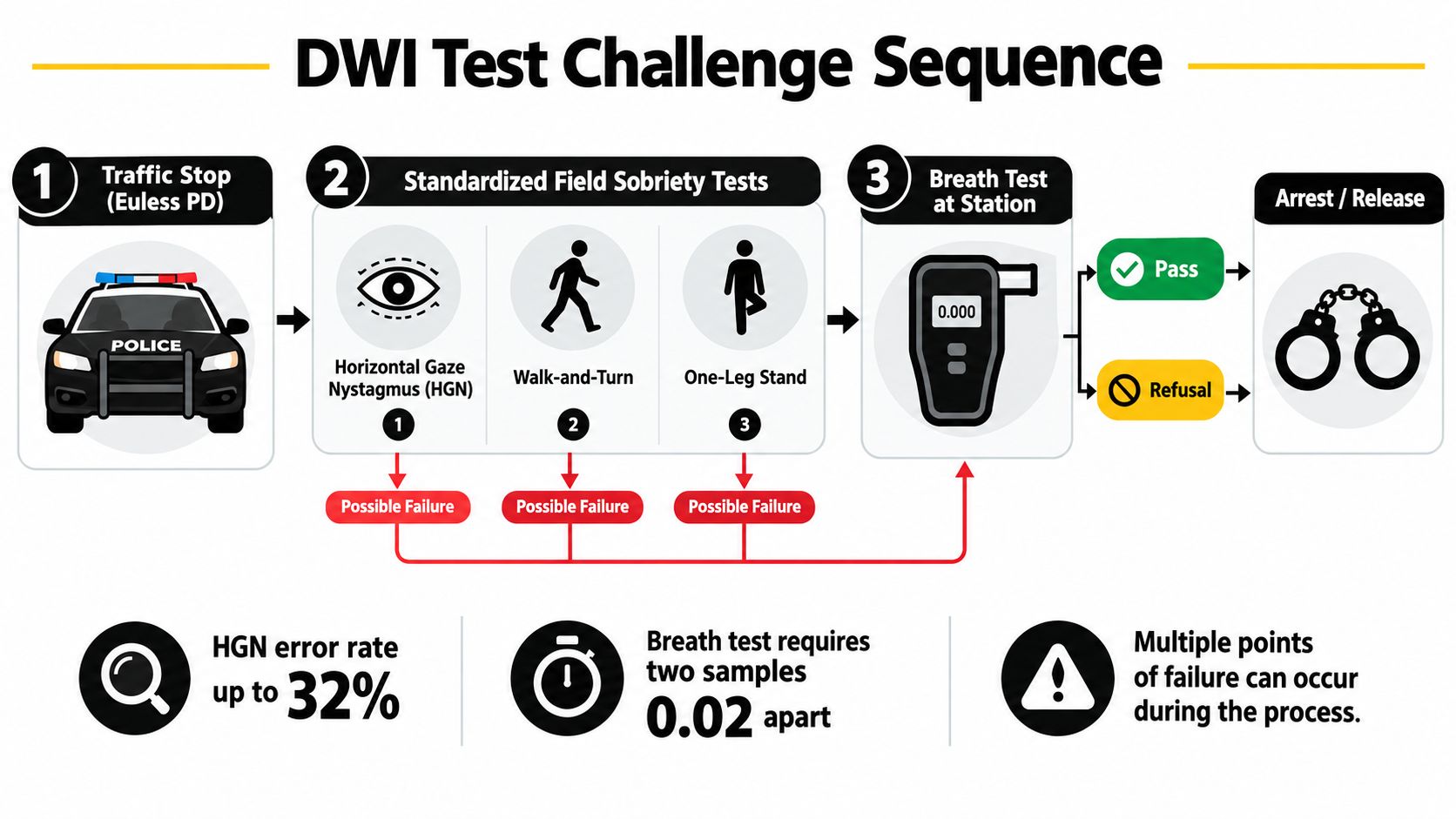
A DWI case is rarely won by outrage. It's won by details. Officers in Texas commonly use three standardized field sobriety tests approved by NHTSA: horizontal gaze nystagmus, walk-and-turn, and one-leg stand. Those tests help officers build probable cause, and they involve specific mechanics such as the nine-step heel-to-toe walk and the 30-second one-leg balance, as summarized here by Round Rock Criminal Defense Lawyer on field sobriety tests.
Field sobriety tests are not clean science in the real world
These tests happen on roadsides, parking lots, shoulders, and uneven pavement. That matters. Bad lighting, traffic distraction, fatigue, anxiety, injuries, age, and medical conditions can all make a sober person look unsteady.
A smart defense doesn't just say, “My client did fine.” It asks better questions:
- Was the stop lawful in the first place?
- Did the officer give the instructions correctly?
- Did bodycam video match the report?
- Was the surface level and safe for testing?
- Did the officer account for medical issues or footwear?
Breath and blood evidence can be attacked too
Breath-test evidence is not self-validating under Texas law. Courts have held that the State must show the result accurately reflects alcohol concentration at the time of the offense, and the Texas Court of Criminal Appeals has characterized retrograde extrapolation as unreliable when used to estimate intoxication at the time of driving. Timing, observation period, sample integrity, and machine handling all matter, as discussed in this Texas case summary on FindLaw's Texas court opinion page.
Defense focus: Don't ask only whether a number exists. Ask whether the State can reliably tie that number to the time you were actually driving.
That's where a DWI lawyer in Euless TX earns their keep. They subpoena video, inspect reports, request maintenance and testing records, and compare every step of the officer's process against what the law requires. If you want a practical look at machine-based challenges, this page on breathalyzer accuracy in Texas is a useful starting point.
Inside the Tarrant County Courthouse Process for Euless Drivers
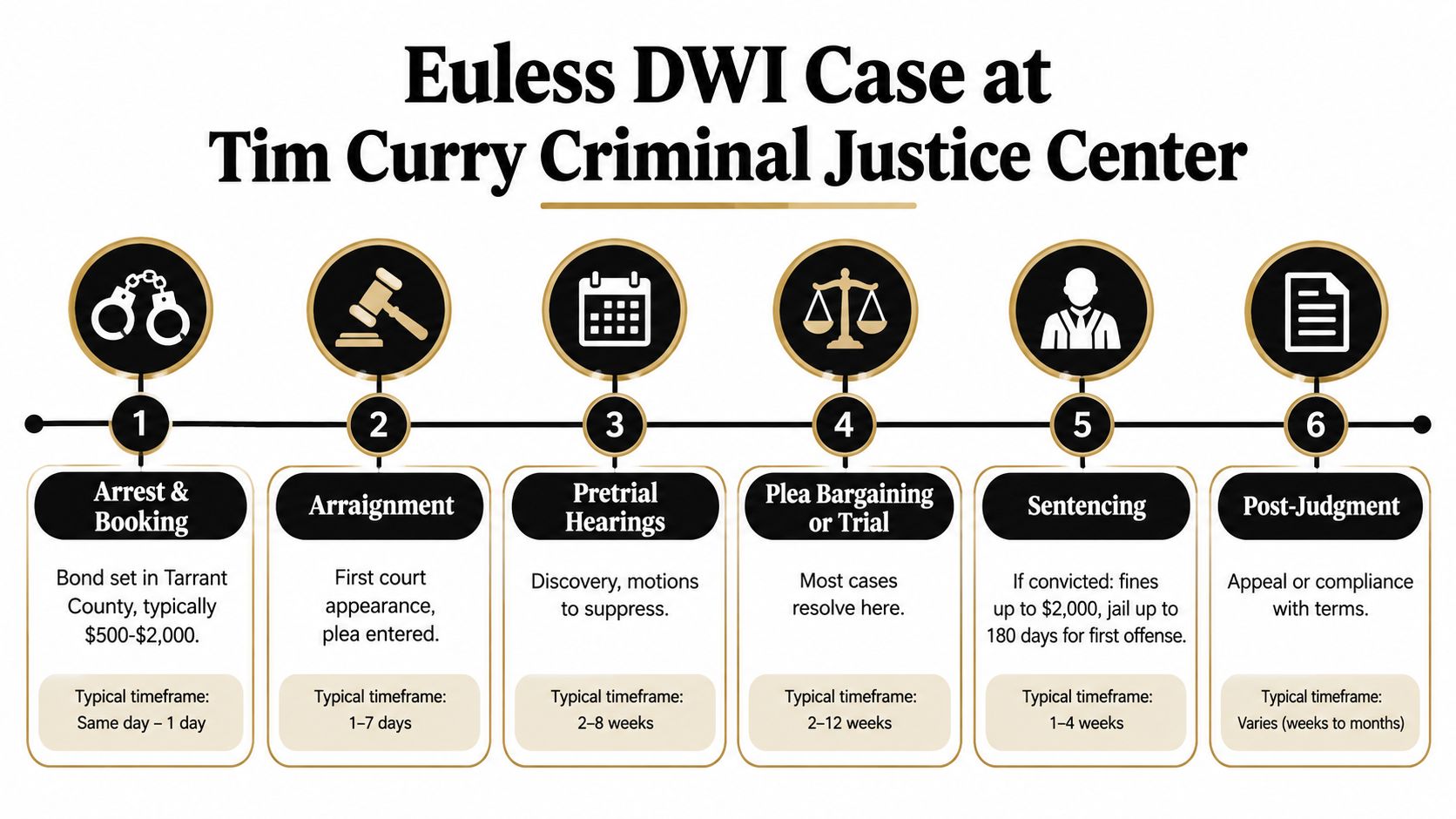
You get stopped by Euless PD, spend hours dealing with booking and bond, then wake up wondering where your case goes and what happens first. For many drivers, the answer is Fort Worth, not Euless. Your criminal case often lands in the Tarrant County system, while your license problem runs on a separate clock from the day of arrest.
That split matters.
A lot of local pages blur everything together and leave people with the wrong idea. The courthouse case is one track. The ALR case over your driver's license is another. They can affect each other, but they do not move on the same schedule, and you do not fix one by ignoring the other.
What usually happens after an Euless arrest
For many Euless drivers, the criminal case proceeds through the Tim Curry Criminal Justice Center in Fort Worth. The first setting is often brief, but it is still important. Show up early, dress conservatively, and expect security screening and waiting time before your case is called.
Your first dates in court are usually about control, not storytelling. The judge is not looking for your full explanation of what happened on the roadside. Your lawyer should be handling the practical work that shapes the rest of the case:
First appearance or arraignment
The court confirms the charge, addresses representation, and sets the basic posture of the case.Bond conditions
The court may review alcohol testing, ignition interlock, travel limits, reporting rules, or no-alcohol conditions.Pretrial settings
The defense pushes for police reports, bodycam and dashcam video, lab records, witness information, and any issue worth litigating early.
If the charge is filed as a misdemeanor, it usually stays on the misdemeanor court track unless it resolves first. If the allegation is more serious, grand jury review may become part of the process.
Here's a short video that helps demystify the court process:
What good lawyers do early in Tarrant County
Early settings are not throwaway dates. They are where cases start getting stronger or weaker.
A prepared lawyer uses those settings to lock down evidence before it disappears, pin the State to a theory, and deal with conditions that make daily life harder than they need to be. That includes checking whether Euless police video was preserved, whether blood records are complete, whether witnesses need to be contacted, and whether the license case deadline was handled on time.
Ask direct questions before you hire anyone. Will they request discovery right away? Will they treat the criminal case and ALR case as one coordinated defense problem? Will they talk with you about the long-term record issue too, including the difference between what can happen after a DWI arrest versus after a conviction under current Texas law?
The Law Office of Bryan Fagan, PLLC handles DWI matters through both the criminal and administrative stages. That is the right way to approach a case that starts with an Euless stop and then moves into the Tarrant County courthouse system.
CDL Holders and Commercial Drivers Facing DWI Charges
You get stopped by Euless police after dinner, you are driving your personal pickup, and by the next morning your biggest problem is not only the court date. It is your paycheck. CDL cases turn ordinary DWI problems into employment emergencies fast.
Commercial drivers need a different defense plan from day one because a DWI can hit two parts of your life at once. It can threaten your regular license and your ability to keep a commercial license. That risk does not disappear just because the arrest happened off duty or in a non-commercial vehicle.
The rules are stricter for CDL holders
For a CDL holder, the alcohol limit tied to commercial driving is lower than it is for a standard driver. Texas also treats DWI convictions harshly for commercial licensing purposes, including disqualification consequences that can put a driver out of work. The Texas DWI Site discussion of DWI and CDL consequences gives a useful summary of how those problems can follow a driver even when the stop happened in a personal vehicle.
That is the point many Euless drivers miss. They focus on the misdemeanor case in Tarrant County and do not realize the CDL problem may be the crisis.
Standard driver versus CDL holder
DWI Consequences for CDL Holders vs. Standard Drivers
| Factor | Standard Driver | CDL Holder |
|---|---|---|
| Alcohol threshold issue | General DWI standard applies in an ordinary vehicle | Lower alcohol threshold applies in commercial driving settings |
| License impact focus | Personal driving privileges | Personal privileges plus CDL disqualification risk |
| Employment fallout | Serious, but depends on the job | Often immediate because driving is the job |
| Off-duty arrest concerns | Important | Can still damage CDL status and employability |
If driving pays your bills, your lawyer should treat the CDL issue as a first-priority problem, not a side issue.
A good defense here is practical. Get the stop video. Get the dispatch and arrest reports. Confirm exactly what license status action is in play. Look closely at whether the allegation involves intoxication, test refusal, or both. Then build the case with your long-term record options in mind, because after 2025 the difference between a DWI arrest that gets cleared and a DWI conviction that stays on your record matters even more for commercial drivers who live through background checks.
CDL holders do not need panic. They need speed, accuracy, and a lawyer who understands how an Euless arrest can turn into a Tarrant County court case and a career problem at the same time.
Expunction and Long-Term Record Strategy After a DWI
Many people asking about a DWI in Euless want to know one question almost immediately. “Can this come off my record?” The answer depends on a line that many lawyers still explain poorly.
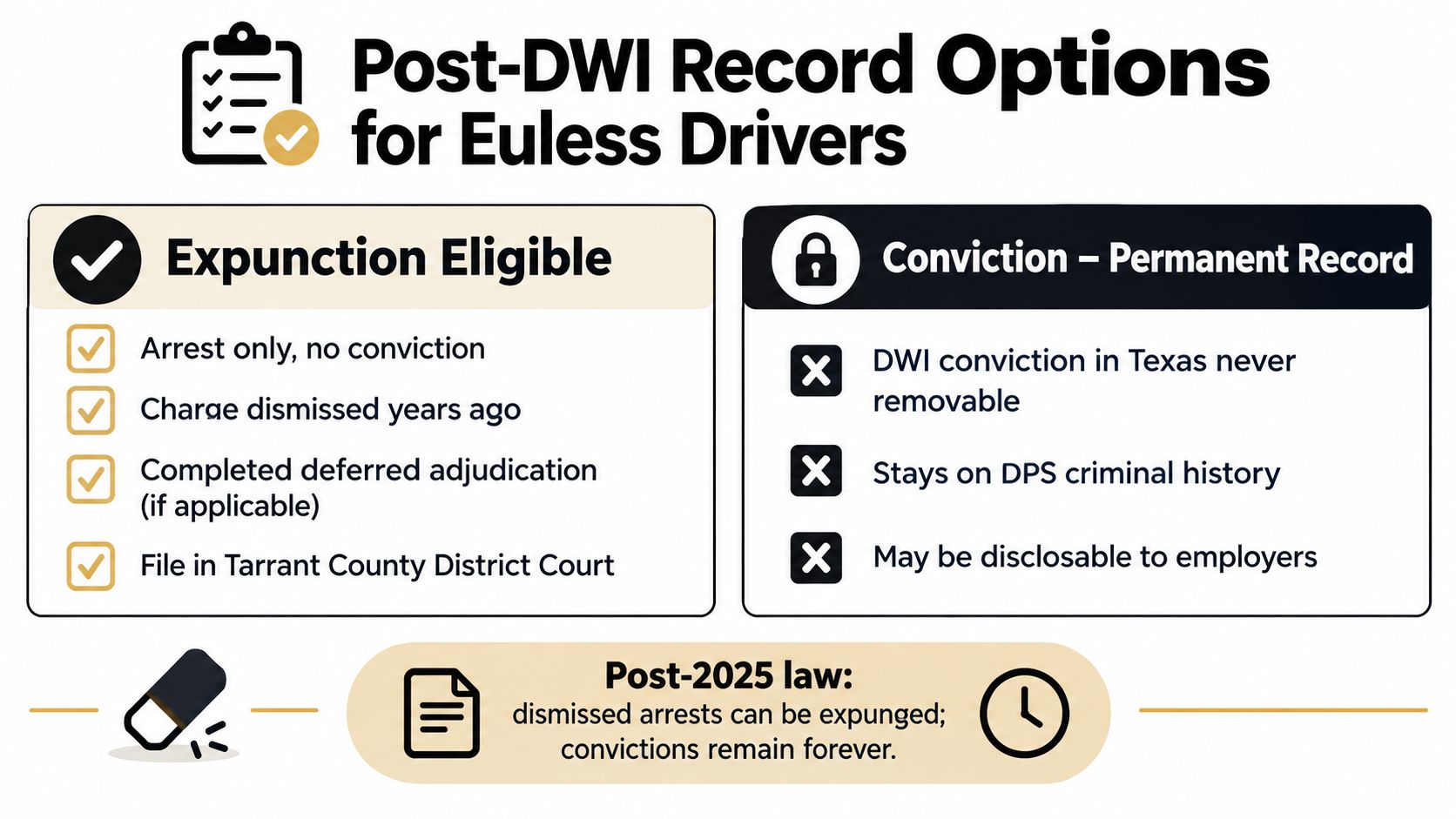
A dismissed arrest and a conviction are not the same thing
Texas law now makes expunction available for DWI dismissals or acquittals under Chapter 55A, while a DWI conviction cannot be expunged. That post-2025 split matters for job screening, licensing, and long-term planning, as explained in this discussion of Texas expunction and non-disclosure after DWI.
That means your case strategy should begin with the end in mind. If your lawyer sees a strong dismissal path, they should also be thinking ahead about record cleanup. If the case ends in conviction, the conversation changes completely because removal is off the table.
Build a record strategy, not just a courtroom strategy
Your record can live in more than one place, including local arrest records, county case records, and state-level reporting systems. That's why long-term planning matters.
A practical checklist looks like this:
- Track the final case outcome carefully. Dismissal language matters.
- Keep certified paperwork. Don't assume you can retrieve it easily years later.
- Check your driving and criminal-history records periodically. Errors happen.
- Address employment disclosures truthfully. A bad explanation can hurt more than the record itself.
- Ask about expunction timing early. Don't wait until a job offer is in trouble.
For readers who specifically want to understand whether an old arrest can be cleared, our page on Texas expunctions after a DWI matter can help frame the issue in plain language.
The best time to plan for record relief is before the criminal case ends, not after the paperwork is buried in a drawer.
Many “Houston DWI lawyer” and “Texas DUI attorney” pages fail readers. They talk about beating the case, but they don't clearly separate a removable arrest from a permanent conviction. You need that distinction before you decide how to resolve anything.
Get a Free Case Evaluation From a DWI Lawyer in Euless TX
You get out of jail at 3 a.m., your car is gone, your phone is full of messages, and you have work in a few hours. That is when people make bad decisions. They wait, they talk too much, or they assume the court date on the paperwork is the only deadline that matters. It is not.
Call a lawyer the same day.
A good case evaluation for a Euless DWI should focus on three things right away. What happened during the stop, what happens next in Tarrant County, and whether this case could leave you with a removable arrest record or a permanent conviction record. That last point matters more after 2025, because the answer depends heavily on how the case ends.
Bring the facts you have
Do not spend all day trying to organize the file perfectly before you call. Bring what you have, and bring it fast:
- Arrest papers, including the citation, bond paperwork, and any temporary driving paperwork
- A simple timeline of where the stop happened in Euless, when you were arrested, and where breath or blood testing took place
- Officer and agency details if you have names, badge numbers, or report references
- Helpful evidence such as photos, receipts, ride history, text timestamps, and witness names
If you remember something small, mention it. The exact location of the stop, what the officer said before roadside tests, or how long you sat before testing can matter.
What your consultation should cover
A serious consultation is not a pep talk. It should give you a short action plan.
Ask the lawyer to address:
- The license deadline, including whether an ALR request still needs to be filed
- Your bond conditions, especially travel, alcohol-monitoring, or testing requirements
- The criminal case track in Tarrant County, including the first setting and what usually happens there
- The evidence issues, including video, field sobriety testing, breath testing, or blood draw procedure
- The record outcome, meaning whether the goal is a dismissal path that may support expunction later or damage control if conviction risk is high
Ask one more direct question. Who will handle the case? Some firms hand the intake call to a salesperson and the court setting to whoever is free that morning. That is a bad sign.
My recommendation for Euless drivers
If the arrest happened after a stop by Euless PD, near Highway 183, 121, or on the way back from DFW, do not treat it like a generic Texas DWI. Local procedure matters. Tarrant County settings move on their own schedule, and the license case starts running before the criminal case is resolved. You need advice from someone who works those cases regularly and understands both tracks from day one.
You also need a lawyer who will talk about the endgame. Some cases can be positioned toward dismissal and later record clearing. A conviction changes that analysis completely. If a lawyer blurs those two outcomes, keep looking.
The Law Office of Bryan Fagan, PLLC offers free consultations for Texas drivers dealing with DWI charges, including Euless and Tarrant County cases involving license suspension, first-offense defense, CDL consequences, and record strategy. If you need clear next steps today, request a case evaluation and get answers before a missed deadline makes your case harder.