
A DWI arrest can be overwhelming, but you don't have to face it alone.
If you were arrested in Dallas last night, you're probably dealing with the same questions I hear every day. Will I lose my license? Do I have to go to jail? What happens at court? Can this be reduced or dismissed? Those are the right questions, and the right time to ask them is now.
Texas treats DWI cases seriously, but an arrest is not a conviction. A strong response starts with understanding what the State has to prove, where the weak points usually are, and which deadlines matter most. In Texas, you're legally intoxicated if your Blood Alcohol Content (BAC) is 0.08% or higher, which is the threshold for a standard first-offense DWI classified as a Class B misdemeanor with penalties of up to 180 days in jail and fines up to $2,000 under Texas BAC and first-offense DWI rules.
You need a plan, not panic. When facing a DWI charge in Dallas, the goal isn't just to react. It's to protect your license, challenge weak evidence, and keep this case from defining your future. The same kind of strategic thinking matters whether you're looking for a Dallas defense attorney, a Houston DWI lawyer, or a Texas DUI attorney anywhere in the state.
Arrested for a DWI in Dallas You Are Not Alone
The first few hours after an arrest are usually a blur. You were stopped, questioned, tested, booked, and released with paperwork that may not make much sense yet. That doesn't mean your case is hopeless. It means you need to slow down and start making smart decisions.
A DWI charge in Dallas usually involves two separate problems. One is your criminal case. The other is the threat to your driver's license. Many people focus only on the court date and miss the license issue until it's too late.
Know the key terms early
Here are the terms that matter right away:
- BAC means Blood Alcohol Content. It's the alcohol concentration measured through breath or blood testing.
- Implied consent means that by driving on Texas roads, you consent to chemical testing rules that can trigger license consequences if you refuse after arrest.
- Field sobriety test means the roadside balance and coordination exercises officers use to build probable cause.
- Administrative license suspension means the State can try to suspend your license through a separate process, even before your criminal case is resolved.
Practical rule: Your case gets easier to defend when you act early. Memories fade, video can disappear, and deadlines don't move.
You also need to understand what the State is really building. Prosecutors usually rely on a mix of the officer's observations, field sobriety testing, breath or blood results, and statements you made during the stop. Each part can be challenged. That's why a good defense starts with a close review of the stop itself, not just the test number on a report.
What you should do today
Start with the basics:
- Save every document you were given at release.
- Write down the timeline while it's still fresh.
- Don't talk about the case with friends, coworkers, or on social media.
- Get legal help quickly so the license issue is addressed before the deadline passes.
If this is your first DWI in Texas, that matters. If you're a commercial driver, out-of-state visitor, or licensed professional, it matters even more because the practical fallout can spread far beyond court.
The Clock Is Ticking What Happens to Your License
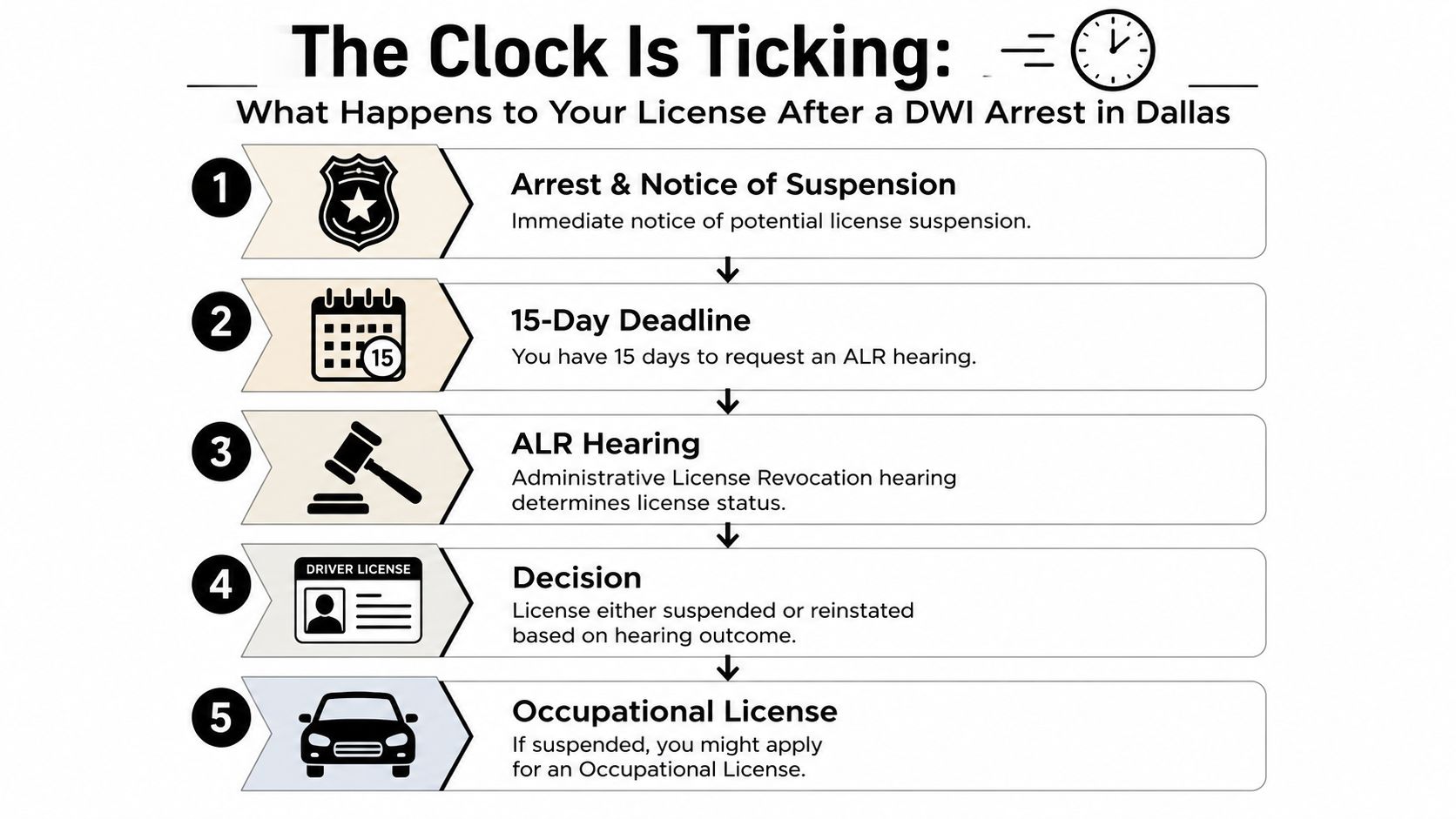
The most urgent problem after a DWI arrest is usually your driver's license. This part of the case doesn't wait for the criminal court process, and it doesn't care whether you think the arrest was unfair. If you don't act fast, the suspension process moves forward on its own.
What implied consent actually means
Implied consent is the rule that ties driving in Texas to chemical testing consequences. It doesn't mean police can do anything they want. It means that after a lawful DWI arrest, refusing or failing a qualifying test can trigger a separate license case with the Texas Department of Public Safety.
That separate case is called an Administrative License Revocation hearing, often shortened to ALR hearing. If you want a plain-language explanation of how the civil license case differs from the criminal DWI case, What Is an ALR Hearing in Texas? lays out that distinction clearly.
The deadline that can't be missed
In Texas DWI cases, the ALR hearing must be requested within exactly 15 days of arrest, and missing that deadline triggers an automatic 180-day license suspension for test refusals or a 90-day suspension for BAC at or above 0.08, independent of the criminal case, under Texas ALR hearing rules.
That is the first real fork in the road.
If you request the hearing in time, your lawyer gets a chance to challenge the basis for the suspension. If you miss it, the State moves ahead without giving you that early opportunity to fight.
Your criminal charge and your DWI license suspension are not the same case. You can still be dealing with one even if the other changes.
What a lawyer looks for at the ALR stage
The ALR process isn't just paperwork. It's your first chance to attack the State's version of events. A defense lawyer may examine:
- Probable cause for the stop so the State has to justify why the officer pulled you over in the first place
- Chain of custody if blood evidence was collected and handled in a way that raises questions
- Testing compliance with required procedures for field and chemical testing
- Officer documentation for contradictions between reports, videos, and testimony
If your license is suspended, there may still be options for limited driving privileges and later reinstatement. For that issue, Texas license reinstatement after a DWI is worth reviewing.
For anyone trying to fight DWI Texas cases effectively, this is the first strategic move. Don't wait for the court date and hope the license problem fixes itself. It won't.
Texas DWI Penalties Explained From Fines to Jail Time
The night of the arrest is over. Now the State starts putting a price on it. Your job is to understand the exposure without panicking, because the charge on paper is only the starting point.
First-offense DWI
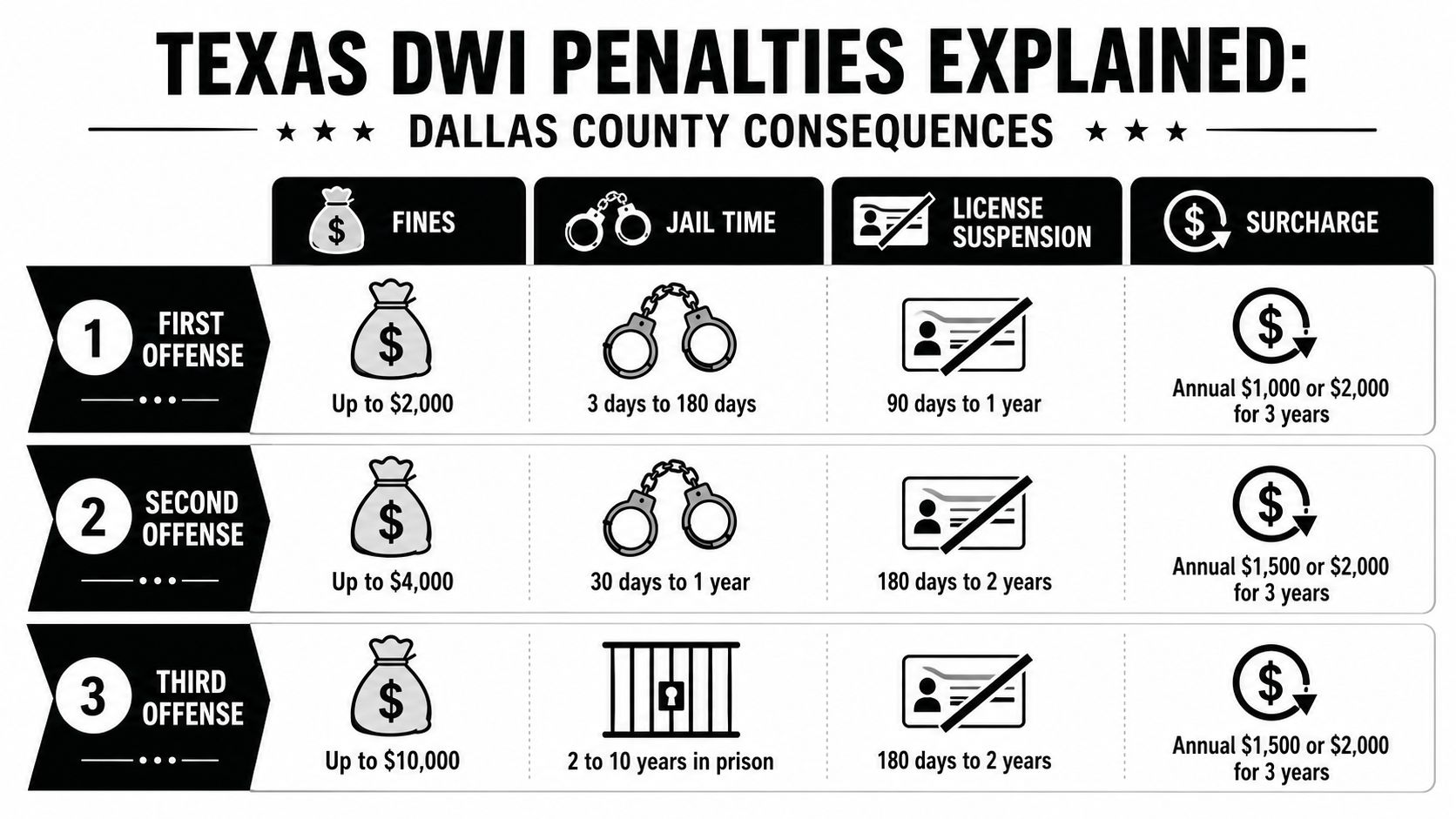
A first DWI in Texas is usually filed as a Class B misdemeanor. That means the court can impose jail time, fines, probation conditions, alcohol education classes, and restrictions that follow you long after the case ends. For many people, the most damaging part is not a short jail sentence. It is the record, the cost, the court supervision, and the effect on work, insurance, and professional licenses.
Texas law raises the stakes fast if the facts get worse. A first conviction can carry up to 180 days in jail and a fine of up to $2,000 under the Texas DWI penalties statute. Courts may also order community supervision, alcohol treatment, and ignition interlock in the right case.
If this is your first arrest, focus on reducing the charge, protecting your record, and avoiding terms that make daily life harder. A good defense plan is built around that goal. For a practical look at how attorneys attack these cases, review how lawyers beat DWI cases in Texas.
High BAC cases
If the State claims your BAC was 0.15 or higher, a first DWI can be charged as a Class A misdemeanor instead of a Class B misdemeanor. That increases the possible punishment to up to one year in jail and a fine of up to $4,000 under the same Texas Penal Code DWI provisions.
High BAC allegations matter because prosecutors treat them as proof that the case is more serious. Defense lawyers treat them as a testing problem first. Blood and breath results can be challenged for machine error, collection mistakes, contamination, poor maintenance records, and gaps between the time of driving and the time of testing.
When a DWI becomes a felony
A DWI stops being a misdemeanor and becomes a felony in several common situations. The biggest ones are prior DWI convictions, an accident involving serious injury or death, or driving while intoxicated with a child passenger.
That changes the risk immediately. A third DWI is generally a third-degree felony in Texas, and intoxication assault or intoxication manslaughter carry even harsher punishment ranges under Texas Penal Code Chapter 49. Prison exposure is real. So are long probation terms, heavy fines, felony supervision rules, and permanent record consequences that can affect housing and employment for years.
| Charge level | What it usually means |
|---|---|
| Class B misdemeanor | Standard first DWI allegation |
| Class A misdemeanor | Often tied to a high BAC allegation |
| Felony DWI | Usually based on prior history or aggravating facts |
Here is the point clients need to hear early. Penalty ranges tell you what the State wants available. They do not decide what happens to you. Strategy does.
Building Your Defense Strategy
You got arrested. You were scared, frustrated, and probably embarrassed. Now the job is to slow this case down, examine every step the police took, and attack the weak points before the State turns a single night into a permanent problem.

A strong DWI defense in Dallas follows a sequence. Start at the beginning and work forward. That is how you protect your license, your record, and your advantage in court.
Start with the stop
The first question is whether the officer had a legal reason to pull you over.
Police need specific facts that justify the stop. A vague hunch is not enough. If the stop was illegal, your lawyer can ask the court to suppress the evidence that came after it, including observations, field tests, statements, and sometimes the arrest itself.
That issue can decide the whole case.
Examine the officer's observations
Next, look at what the officer claims to have seen. Swerving, an odor of alcohol, red eyes, slurred speech, and balance problems sound persuasive in a report. They are often less convincing on video.
Body camera and dash camera footage matter here. The video may show normal speech, steady movement, clear answers, and a roadside setting that made any test harder than the report suggests. Reports are written to support the arrest. Video is harder to shape.
Challenge the field sobriety tests
Field sobriety tests are judgment calls. They are not precise measurements.
The officer has to give the instructions correctly, demonstrate the tests correctly, and score them correctly. The surface matters. Your shoes matter. Weather matters. Age, weight, nerves, fatigue, old injuries, and medical conditions matter too. A careful defense does not accept "failed the tests" as the end of the discussion. It checks whether the tests were fair in the first place.
Put the chemical test under pressure
Breath and blood results look powerful because they come with numbers. Numbers still depend on people, machines, and procedure.
Your lawyer should request maintenance records, calibration records, lab documents, collection records, and chain of custody materials. If the process broke down at any point, the result becomes less reliable. If you want a practical explanation of the pressure points good defense lawyers use, read how lawyers beat DWI cases in Texas.
Timing also matters. A test taken later does not automatically prove what your alcohol concentration was when you were driving. Alcohol absorption takes time. In some cases, that gap supports a rising BAC defense without relying on the State's timeline.
Review your statements and the arrest procedure
Clients often hurt their own cases by assuming every answer they gave was harmless. It usually was not. Your lawyer needs to review what you said, when you said it, whether you were in custody, and whether officers followed the rules before questioning you.
The same goes for the arrest itself. If the officer lacked probable cause, skipped required procedures, or mishandled the evidence, those mistakes can become negotiation pressure or motion practice.
Here are the defense lanes that usually matter most:
- Illegal stop: The officer lacked a valid reason to pull you over.
- Weak observations: The video does not match the report.
- Poor field testing: Instructions, conditions, or scoring were flawed.
- Unreliable chemical evidence: The machine, sample, or lab process has problems.
- Bad timing for BAC proof: The test result does not clearly show intoxication at the time of driving.
- Problematic statements or arrest procedure: Police may have overstepped during questioning or arrest.
The right strategy is not to throw every argument at the wall. It is to choose the arguments that fit your facts, support them with records and video, and use them to get a dismissal, a reduction, or a result that does the least damage to your future.
What to Expect in the Criminal Court Process
You get out of jail, check your phone, and see court dates, bond terms, and a case number you do not fully understand. That is the moment to get organized. A Dallas DWI case is won by handling each stage on time and with purpose.
The criminal case usually starts with an arraignment or other early setting. The court confirms the charge, makes sure you have counsel, and sets the case on its track. Treat every setting seriously. Missing one can create a new problem that has nothing to do with whether the DWI charge is weak.
Many Dallas DWI cases are heard at the Frank Crowley Courts Building. Local procedure matters there. A lawyer who regularly handles cases in that courthouse can often spot issues faster, set the right expectations, and make better use of each court date. If you want to see how that process works in practice, review this Dallas DWI defense attorney overview.
After the first settings, the actual work begins.
Your lawyer gets the police reports, videos, test records, witness materials, and any lab paperwork the State plans to use. Then the defense builds pressure in the right places. Sometimes that means filing motions to suppress evidence. Sometimes it means exposing gaps in the State's timeline or showing that the officer's report says more than the video supports. Sometimes it means pushing for a result that protects your record and your job.
Expect the process to move in steps:
- Initial court settings: The court addresses scheduling, representation, and basic case status.
- Discovery review: Your lawyer examines the evidence for weaknesses, inconsistencies, and missing pieces.
- Motions and hearings: The defense challenges bad stops, improper questioning, unreliable testing, or other legal problems.
- Negotiations: If the facts support it, your lawyer presses for a reduction, a dismissal, or another outcome that limits long-term damage.
- Trial preparation: Even if the case may settle, strong preparation changes how prosecutors value the case.
Some cases resolve early. Others take months because the defense needs records, hearings, expert review, or time to force the State to show its proof. That delay is not always bad. Time often gives the defense room to test the evidence and improve your position.
Trial is only one possible end point, but trial readiness matters in every case. Prosecutors make better offers when they know the defense is prepared to challenge officers under oath, attack the breath or blood evidence, and make the State prove each element to a jury.
Stay focused on the sequence. Show up. Follow bond conditions. Help your lawyer get documents, names, and timeline details quickly. The court process feels slow to clients, but a smart defense uses each stage to protect your license, your record, and your future.
If the case ends in a dismissal or acquittal, ask about clearing the record. That step can matter almost as much as the case result itself.
How to Choose the Right Dallas DWI Attorney
The lawyer you hire after a Dallas DWI arrest will shape what happens next. This decision affects your license, your record, your job, and the pressure you face in court. Pick someone who treats your case like a problem to solve, not a file to process.

What to look for first
Start with focus. A lawyer who regularly handles DWI cases will usually spot issues that a general criminal practitioner may miss, especially in breath testing, blood draws, field sobriety testing, and license suspension hearings.
You also want clarity. A good Dallas DWI attorney should be able to tell you, in plain language, what the State must prove, what the weak points may be, what deadlines matter first, and what the defense plan looks like over the next several weeks.
Fee quotes matter, but they are not the main question. A lower fee does not help if the lawyer skips motions, does not prepare for hearings, or pushes you to plead before the evidence is fully reviewed. Ask what the representation includes.
Ask these questions in the consultation
Use the consultation to test judgment.
- How much of your practice is DWI defense? You want regular DWI case work, not occasional exposure.
- Who handles the license suspension side? The criminal case and the license case are separate. Your lawyer should explain both clearly.
- What problems do you see in my stop, arrest, or testing? Listen for specific issues tied to your facts.
- Who will appear in court with me? Make sure the lawyer you hire is not handing your case off without telling you.
- What does your fee cover? Ask about motions, hearings, expert review, trial preparation, and whether trial costs are separate.
If you want a useful example of what focused representation should cover, review these Dallas DWI defense attorney services. The Law Office of Bryan Fagan, PLLC is one Texas firm that handles those stages from arrest through resolution.
This short video can help you think through the hiring decision:
Generalist versus DWI-focused counsel
| Attorney type | What usually happens |
|---|---|
| General criminal lawyer | May manage the case adequately, but may spend less time on testing science, police procedure, and ALR consequences |
| DWI-focused lawyer | More likely to examine the stop closely, challenge field tests and chemical results, and build a defense plan around both court and license risk |
Chemistry matters too, but strategy matters more. Hire the lawyer who answers hard questions directly, explains the case without fluff, and gives you a concrete plan for protecting your future at each stage.
Your Next Step Protecting Your Future Starts Now
A Dallas DWI charge can disrupt your work, your license, your finances, and your peace of mind. But it doesn't have to control the outcome. What matters now is speed, discipline, and strategy.
Start with the issue that expires first. Protect your driving privileges. Then build your defense the right way. That means getting the stop reviewed, the testing examined, the timeline documented, and the court process managed by someone who knows how DWI cases work in Dallas.
If you're feeling embarrassed, worried, or angry, that's normal. Don't let those emotions push you into passivity. The people who do best after a DWI arrest are the ones who act early and stay organized.
Here's the practical checklist:
- Gather your paperwork and keep it in one place.
- Write down what happened while the details are still fresh.
- Follow every bond condition and court instruction carefully.
- Speak with defense counsel quickly so no deadline is missed.
- Ask about both the criminal case and the license case because they move on separate tracks.
The right lawyer won't promise magic. A serious lawyer will give you a roadmap, tell you where the risks are, and start pressing on the weak points in the State's case immediately. That's what you need right now if you want to fight DWI Texas charges intelligently and protect your future.
If you've also been searching for terms like Houston DWI lawyer, Texas DUI attorney, first DWI in Texas, or DWI license suspension, the principle is the same in every serious case. Early action creates options. Delay closes them.
If you were arrested for DWI in Dallas, don't wait and hope the situation settles down on its own. Request a free consultation with Law Office of Bryan Fagan, PLLC to get a clear review of your case, your license risk, and your next legal steps. You can get straightforward answers, practical guidance, and help taking action while the case is still fresh.