 Skip to content
A final DWI conviction cannot be expunged in Texas. For many people, the key question is whether the case ended in a dismissal, acquittal, no-bill, or a narrow first-time sealing path, because that outcome usually decides whether any record relief is possible.
A DWI arrest can feel like it follows you home. You start thinking about background checks, job applications, professional licenses, and whether one stop on a Texas road will keep showing up long after the case is over.
That worry is real. Texas law treats expunction and nondisclosure as different remedies, and the answer to dwi expunction eligibility Texas depends on which door your case can fit through. A lawyer's first job is to figure out whether your case ended in a way that lets you ask for destruction of the arrest record, sealing of the record, or no relief at all.
What DWI Expunction Eligibility in Texas Really Means
The moment a DWI shows up on a background check, the first question is, can I make this go away? In Texas, that answer does not turn on embarrassment, age, or how long ago the arrest happened. It turns on the legal outcome of the case, and the first question is simple, did the case end in a conviction?
If the answer is yes, Texas does not allow expunction of that final DWI conviction. If the answer is no, the path may still be open, but only under specific rules tied to how the case ended, whether charges were ever filed, and whether any court obligations remain. That is why online answers that say “Texas does not expunge DWIs” are only half right. They are describing one lane of the law, not the entire roadway.
Practical rule: start with the case disposition, not the arrest date. A dismissal, acquittal, no-bill, or an arrest that never became a charge can open very different options than a conviction.
A worried client usually comes in with one folder, a citation, maybe a bond paper, and a lot of questions. The useful facts are usually right there, the charge, the county, the court result, and whether the case is still pending. Those details matter more than how clean your record looks today, because Texas expunction rules depend on what happened in court, not on whether life moved on afterward.
If you want the plain-English version, expunction is about destroying the arrest record, while nondisclosure is about sealing it from most public view. The first is more complete, but harder to get. The second is narrower, but still useful in the right case.
Expunction vs Nondisclosure Explained
Think of expunction and nondisclosure as two doors that look similar from the hallway, but they open onto very different rooms. Expunction is the stronger remedy. When a court signs an expunction order, agencies are ordered to destroy the arrest records tied to that case, and the law generally lets you deny the arrest ever happened.
Nondisclosure is different. It seals the record from public view, but it does not erase the record. Certain agencies can still see it, and that difference matters for licensing, law enforcement, and some sensitive background reviews. People often call both outcomes “clearing a record,” but Texas treats them as separate legal tools with separate consequences.
A sealed record is hidden, not deleted. That difference can matter if you hold a professional license, a CDL, or expect a government agency to review your file.
Texas' modern DWI sealing rules are driven by HB 3016, which created a narrow route for some first-time DWI cases to be sealed rather than fully expunged, with eligibility turning on a BAC under 0.15%, no accident involving another person, completion of all court terms, and the applicable waiting period.[^hb3016] That is why a first DWI in Texas is not automatically doomed, but it is also not automatically sealable.
For readers comparing options, Clearing a Texas DWI: Expunction and Nondisclosure is the firm's record-relief page, and it addresses whether and how a DWI can be removed or sealed from your record. The internal question to keep asking is not just “Can I clear this?” It is “Am I looking at expunction or nondisclosure?”
A short video overview can help make the difference feel less abstract.
Order of Nondisclosure in Texas is the right kind of resource when the issue is sealing, not destruction. Once you know which remedy you're chasing, the rest of the analysis gets much clearer.
Who Qualifies for DWI Expunction Under Texas Law
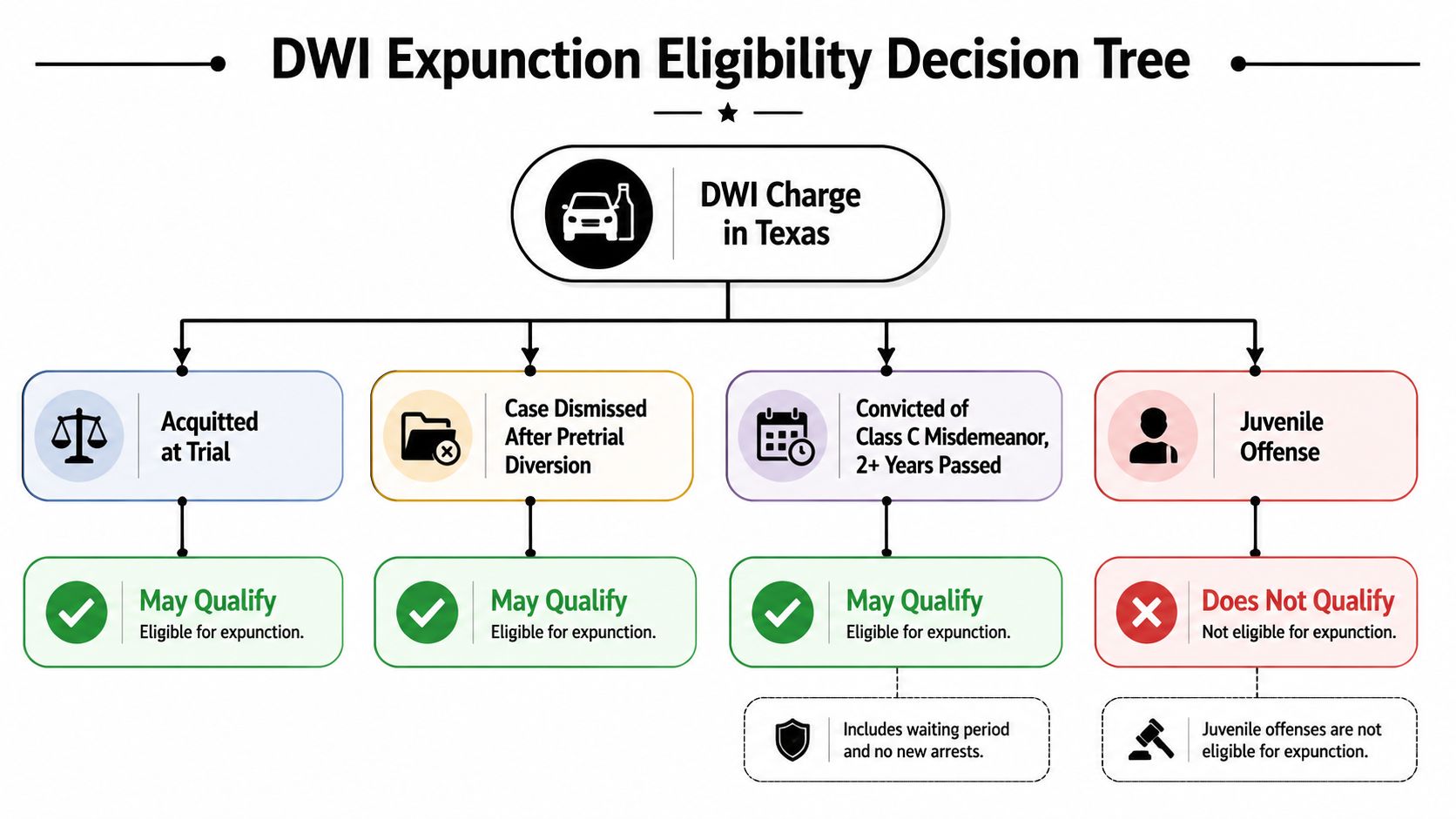
Texas draws a hard line here. Under Texas law, a final DWI conviction cannot be expunged, so the key threshold is whether the case ended without a conviction.[^mcconathy] That usually means dismissal, acquittal, a grand jury no-bill, or an arrest that never matured into a charge.
The best way to sort this out is to look at the case outcome first, then the offense level. Waiting periods for Texas expunction depend on the offense level and outcome, with published guidance citing 180 days for a Class C misdemeanor, one year for a Class A or B misdemeanor, and three years for a felony, while acquittals can make a person eligible immediately and dismissed cases may be governed by the statute of limitations rather than a fixed short delay.[^doug] In DWI cases, the offense level matters because it changes when you can file and whether a petition can move forward yet.
Dismissal, acquittal, and no-bill are not the same thing
A dismissal means the prosecutor dropped the case or the court disposed of it without a conviction. An acquittal means a judge or jury found you not guilty, and that can make you eligible right away.[^doug] A no-bill means a grand jury refused to send the case forward, which also points toward eligibility.
An arrest that never became a formal charge can qualify too, because the law focuses on whether the case ever became a live criminal matter. That matters for people who were arrested, booked, and released, but never saw the charge turn into a filed case.
Good filing habit: get the actual court disposition before you assume you qualify. A bond paper or a jail release sheet isn't enough by itself.
What Crimes Can Be Expunged in Texas is useful if you need to compare a DWI with other offenses that may qualify under different rules. The point here is simple, if the case ended without a conviction, you may have a path. If it ended in a final conviction, expunction is off the table.
The HB 3016 First-Time DWI Sealing Pathway
A lot of people hear “you can't expunge a DWI” and stop there. That's too broad, because some first-time cases can still be sealed through the modern nondisclosure route created by HB 3016.[^hb3016] It is narrower than expunction, but it can still protect a lot of people from public exposure.
The first-time DWI seal is strict
The basic requirements are simple to say and hard to meet. The offense must be a first-time DWI, the BAC must have been under 0.15%, there must have been no accident involving another person, and all court-ordered terms must be complete before the petition is filed.[^hb3016] If one of those pieces is missing, the sealing path usually closes.
A useful example is the first offender stopped at a checkpoint with a 0.09 BAC, no crash, and a completed case. That person may fit the HB 3016 framework if the waiting period has also been satisfied. The same driver with a crash, a higher BAC, or unfinished probation paperwork is in a very different position.

What sealing changes in real life
Sealing does not erase the case. It limits public access, which is often enough to help with job searches, housing applications, and some private background checks. Agencies with legal access can still see the record, so this is not the same as a full expunction.
For people trying to understand the paperwork side, Texas DUI Record Sealing Guide walks through the broader process in plain language. If the facts of your case line up, sealing can be the path that opens when expunction does not.
Common Scenarios That Change Your Eligibility
The hardest cases are rarely the ones that fit a neat checklist. They're the ones where the arrest outcome, the paperwork, and the person's assumptions all point in different directions.
A person on deferred adjudication often thinks, “I wasn't convicted, so I'm fine.” That instinct is understandable, but Texas looks at the specific remedy being pursued, and many articles oversimplify the answer by treating conviction as the only issue. For some people, the central question is whether nondisclosure is available after a conviction or deferred adjudication, not whether expunction is.
A second common case involves a juvenile arrest that never moved far in the system. Those matters can turn on different rules than adult DWIs, which is why a quick internet answer usually misses the mark. The same is true for out-of-state drivers who were arrested in Texas, especially if they hold a CDL elsewhere. The Texas case controls the Texas record, even if the driver lives somewhere else.
A pardon creates another fork in the road. A governor's pardon can change the legal framework, but it does not automatically mean every record-relief option works the same way as a dismissal or acquittal. The details matter, and they matter more than the label attached to the outcome.
One source notes that many Texas DWI articles focus on the simple “conviction = no expunction” rule, but fewer explain the narrower path to nondisclosure after a DWI conviction or deferred adjudication, and a key disqualifier is a BAC greater than 0.15 for people who were convicted rather than acquitted or dismissed.[^cleanslate] That is why two people can both hear “you're not eligible,” while one may still have a sealing route the other doesn't.
Bottom line: the story on the citation is not always the story on the record. If your facts are unusual, don't guess.
The Expunction Process Step by Step
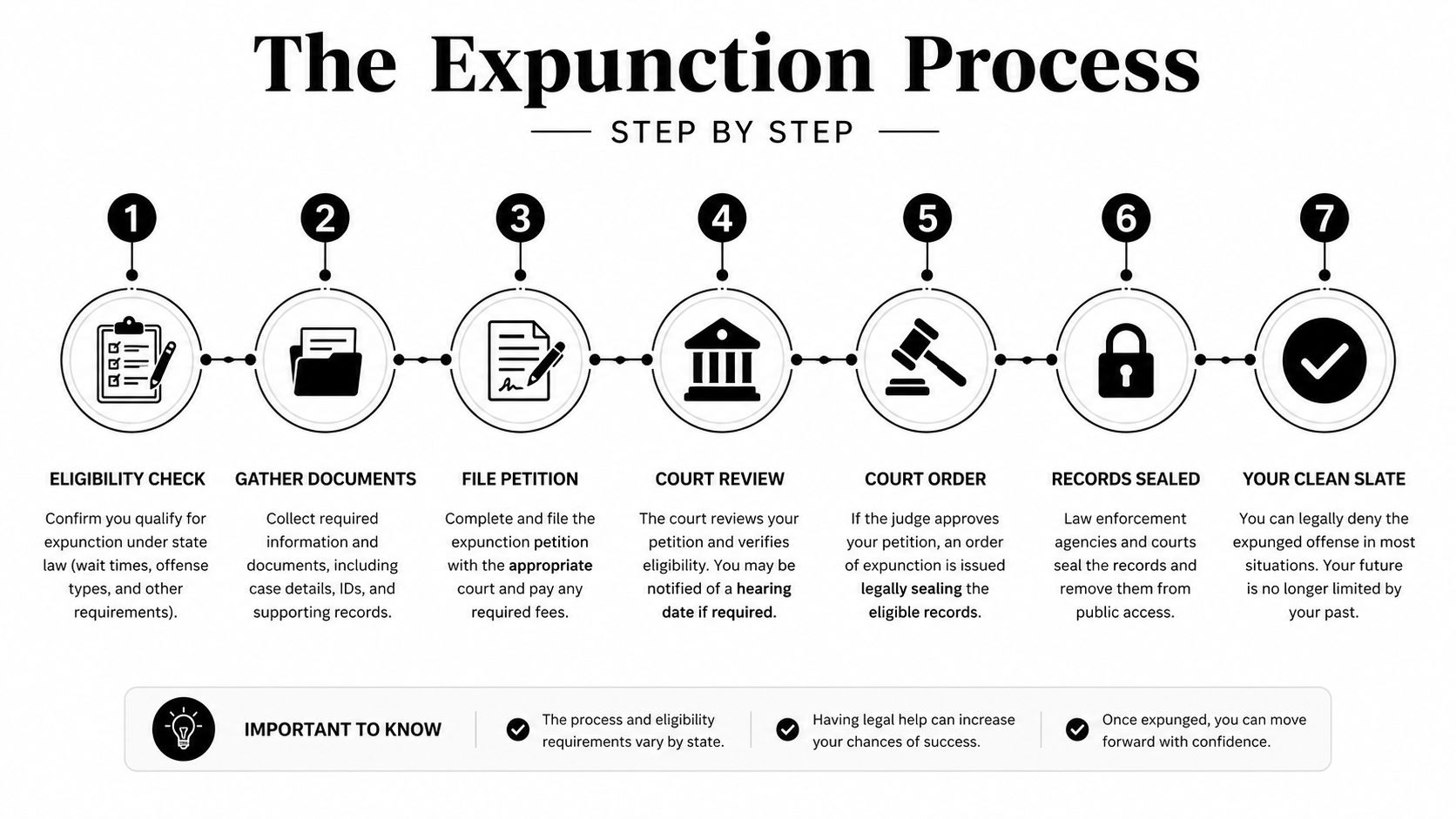
Once the case fits the law, the process becomes procedural. The petition for expunction is filed in the civil district court of the county where the arrest happened, and it has to name the agencies that hold the records.[^mcconathy] That usually includes the arresting department, DPS, the county jail or sheriff, and any other custodian tied to the arrest.
What the filing and hearing usually look like
After filing, the agencies named in the petition are served, and the court gives them an opportunity to object. In a clean, eligible case, the hearing is often short and uncontested. If the judge signs the order, the agencies must destroy the arrest records covered by the order.
The timing can feel different depending on the county. In Houston, Dallas, Austin, and San Antonio, the local clerk's office, the judge's docket, and the agency response times all affect how fast the file moves. The paperwork has to be exact, because even a small mistake can slow the process down.
What the final order really does
A signed expunction order lets you legally deny the arrest in most settings because the underlying arrest record is ordered destroyed. That is a very different result from merely sealing a file. It also means the agencies named in the order have to scrub their own records, not just stop public access.
The record-relief process is technical, which is why some people work with an attorney and others lean on county-specific clerk guidance. The Texas DWI Court Process From Arrest to Resolution is a useful companion when your case is still active and you need to understand the rest of the criminal process too.
Evidence and Documentation That Strengthen Your Case
The law decides eligibility, but paperwork decides whether you can prove it. If you're preparing for a petition, start collecting the records that show the case outcome and the status of every court requirement.
The most important documents usually include the disposition order or judgment, the county clerk's docket sheet, proof that probation or other court terms were completed, the DPS driver record, and the arrest incident number from the agency that made the arrest. Those papers help the court connect the dots between the arrest and the legal result.
A few missing items can cause real delay. Incomplete termination paperwork, unresolved surcharges, and unrelated warrants can slow down a petition or lead to objections. That is why people who are “almost eligible” should still start gathering records early.
Practical rule: don't wait until the filing day to hunt down paperwork. A clean record file saves time, money, and frustration later.
If your case was dismissed long ago, the paper trail can still be rebuilt, but it takes patience. If your case was acquitted, the court record may be easier to track down, but you still need the right certified documents. Either way, the goal is the same, create a file that shows the judge exactly why the relief is allowed.
When to Hire a Texas DWI Attorney and What Comes Next
A record-clearing petition looks simple until it isn't. The forms are technical, the service rules matter, and agencies can object if the file is incomplete or the facts don't fit the statute. That is why many people use a Houston DWI lawyer or another local Texas DUI attorney to handle the filing, service, objections, and hearing.
A defense lawyer can also review the arrest from the beginning. That includes the stop, the breath or blood test, any field sobriety test, and whether implied consent rules were handled correctly. BAC means blood alcohol concentration, and the number can matter for both the criminal case and the record-relief path. Administrative license suspension refers to the separate driver's-license process that can happen after a DWI arrest, which is why a DWI license suspension issue can exist even while the criminal case is still pending.
For many clients, the criminal case and the record-relief case are connected, but they are not the same. You may need to fight DWI Texas at the arrest stage, the ALR stage, and later on the expunction or sealing stage. The right order matters.
The Law Office of Bryan Fagan, PLLC handles DWI defense and record-relief matters for Texans who need a practical answer, not guesswork. A lawyer's job here is to tell you which door fits, expunction, nondisclosure, or neither, and to move the paperwork forward without wasting time.
| Pathway | Who Qualifies | Typical Wait |
|---|---|---|
| Expunction | Dismissal, acquittal, no-bill, or arrest that never became a charge | Immediate after acquittal, or tied to the applicable waiting period for dismissal cases |
| Nondisclosure under HB 3016 | Some first-time DWI cases with BAC under 0.15%, no accident involving another person, and completed court terms | After the required waiting period is satisfied |
| No relief | Final DWI conviction | No expunction under Texas law |
If you need help sorting out dwi expunction eligibility Texas, the Law Office of Bryan Fagan, PLLC can review your arrest, explain whether expunction or nondisclosure fits, and help you take the next step. Visit Law Office of Bryan Fagan, PLLC to request a free consultation and get clear guidance from a Texas team that handles DWI cases every day.
[^mcconathy]: Texas DWI record expunging guidance
[^hb3016]: Texas DWI sealing guidance under HB 3016
[^cleanslate]: Texas eligibility guidance on expunction and nondisclosure
[^doug]: Texas expunction waiting periods guidance

