
A DWI arrest can be overwhelming, but you don't have to face it alone.
Maybe you were stopped late at night, took a breath or blood test, and now you're trying to figure out whether your first DWI in Texas has to end with a conviction. Maybe you've already heard the phrase deferred adjudication and want a straight answer about whether it can protect your record. That's a smart question.
For many drivers, DWI deferred adjudication in Texas can be a real path forward. But it's also one of the most misunderstood parts of Texas DWI law. People often hear “dismissed” and assume the whole case disappears. Others assume everyone with a first offense qualifies. Neither is true.
If you're looking for clear guidance, start with the basics. A Houston DWI lawyer or Texas DUI attorney should help you understand not only whether deferred adjudication is possible, but also how it fits into the full process after an arrest, including bond conditions, the criminal case, and the separate DWI license suspension case with the Texas Department of Public Safety.
Understanding DWI Deferred Adjudication in Texas
Deferred adjudication is a form of community supervision. In plain language, it means you enter a plea of guilty or no contest, but the judge holds off on formally finding you guilty. If you complete the court's conditions successfully, the case is dismissed instead of ending in a final conviction.
A simple way to think about it is this. The court gives you a probationary opportunity to prove you can follow the rules. If you do, you avoid a formal DWI conviction. If you don't, the protection can disappear.
Why this option matters
That distinction matters because a dismissal after successful deferred adjudication is different from a standard DWI conviction. It can affect jobs, housing, professional licensing, and how your background is viewed going forward.
Practical rule: Deferred adjudication is not the same as winning your case at trial, but it can be a strong result when the evidence, the facts, and your eligibility line up.
Texas didn't always allow this outcome in DWI cases. Texas DWI deferred adjudication became legally available for the first time on September 1, 2019, when the Texas Legislature enacted House Bill 3582, amending Article 42A.102 of the Texas Code of Criminal Procedure. Before that, deferred adjudication for DWI had been unavailable in Texas for decades, as explained in this discussion of Texas DWI deferred adjudication under HB 3582.
That history explains why so many people still get conflicting information. Some older articles, older advice, and even stories from friends are based on the law as it existed before 2019.
Key terms you should know
A few terms come up in almost every DWI case:
- BAC: This means blood alcohol concentration. It refers to the amount of alcohol measured in your breath or blood.
- Field sobriety test: These are roadside exercises officers use to look for signs of impairment.
- Implied consent: In Texas, by driving on public roads, you're considered to have agreed to provide a breath or blood specimen under certain circumstances after a lawful DWI arrest. Refusing can trigger separate license consequences.
- Administrative license suspension: This is the civil license process, often called the ALR process, handled separately from your criminal court case.
What happens after a DWI arrest
Individuals don't just need the legal definition. They need the roadmap.
After an arrest, the usual path looks like this:
- Arrest and booking take place.
- Bond conditions may be set.
- You may face a separate ALR hearing issue tied to your license.
- The criminal case moves through court settings, negotiations, and possible motions.
- Your defense lawyer evaluates whether to challenge the stop, the testing, the field sobriety evidence, or the prosecutor's case.
- In the right case, deferred adjudication may become part of the strategy.
That's why the right response isn't panic. It's action. If you want to fight DWI Texas cases effectively, you need to know where deferred adjudication fits and where it doesn't.
Who Qualifies for DWI Deferred Adjudication
You were arrested for a first DWI, nobody was hurt, and you have never been in trouble before. It is natural to assume deferred adjudication should be available. Sometimes it is. Sometimes one overlooked fact shuts the door completely.
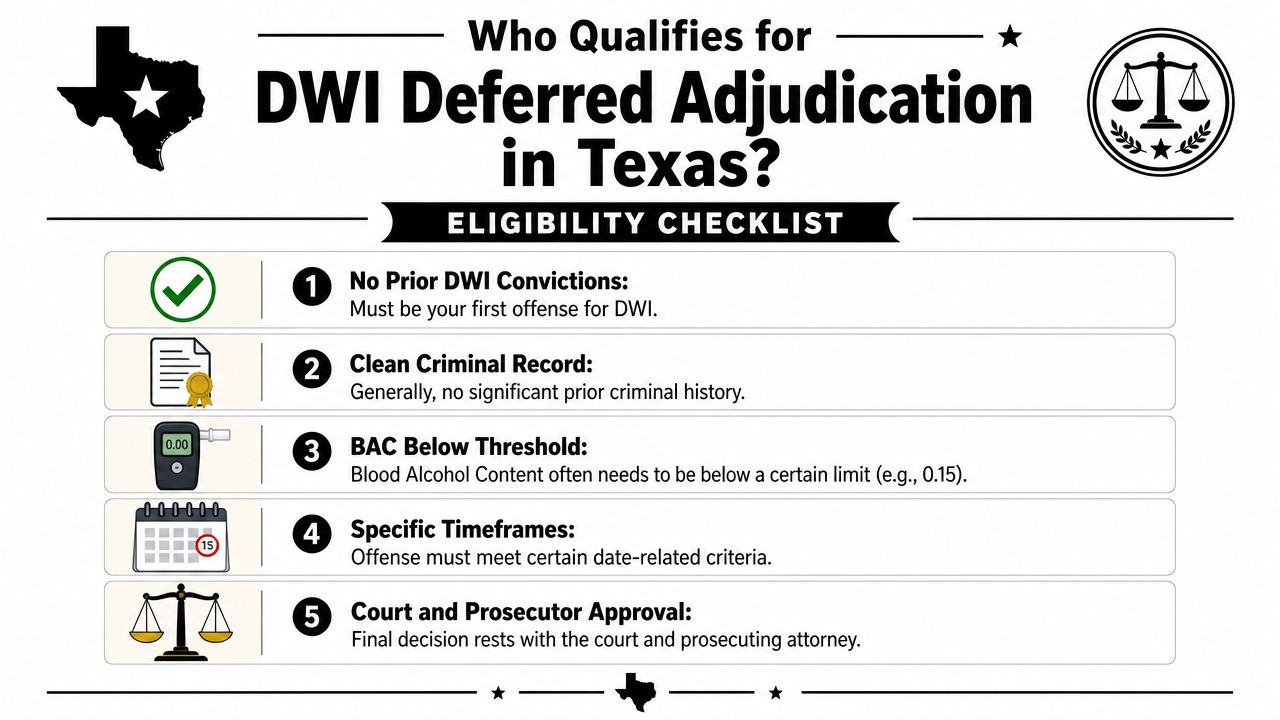
Eligibility works like a gate with several locks. You do not qualify just because this is your first arrest. The court and prosecutor will look at the charge level, the alleged alcohol concentration, whether anyone was injured, and whether you held a commercial driver's license.
The basic eligibility checklist
For many first-time defendants, the starting point is a Class B misdemeanor DWI. That usually means the State did not allege a BAC of 0.15 or higher, and the case did not involve facts that raise the charge to a more serious level.
A person is usually considered a possible candidate for DWI deferred adjudication when these boxes are checked:
- First DWI case
- Class B misdemeanor charge
- No accident involving injury or death
- No commercial driver's license held at the time of the arrest
That list is the screening tool, not the final answer. A lawyer still has to examine the paperwork, the charging language, and the facts the prosecutor believes can be proved.
If you want to see how this question fits into the larger case path, this timeline of a DWI case in Texas from arrest to trial shows where eligibility analysis usually happens.
Two disqualifiers people often miss
Two rules cause more confusion than almost any others.
First, a BAC of 0.15 or higher usually takes the case out of the Class B category and into Class A misdemeanor territory. That matters because deferred adjudication for DWI is tied to a narrower group of cases than many people expect.
Second, a person who held a CDL at the time of arrest is not eligible for DWI deferred adjudication, even if the arrest happened in a personal vehicle instead of a commercial one. Texas practitioners regularly point out this CDL restriction in discussions of deferred adjudication for DWI, including this overview of what deferred adjudication means in Texas DWI cases.
That CDL point deserves extra attention. It is one of the most missed details online, and it changes strategy immediately.
If you held a CDL when you were arrested, the conversation usually shifts away from deferred adjudication and toward dismissal issues, suppression issues, trial strategy, or another case result that protects you as much as possible.
First offense does not automatically mean eligible
Many defendants get tripped up here. “First offense” is only one piece of the test.
A driver may have no prior DWI history and still be ineligible because the State alleges:
- a BAC in the disqualifying range,
- an injury crash,
- a more serious charge than Class B misdemeanor,
- or CDL status at the time of arrest.
Some cases also cross into felony territory because of prior history or aggravating facts. If your charge is more serious than a first-time misdemeanor, this guide on Felony DWI in Texas: Third Offense and Child Passenger explains how that happens.
Why legal eligibility is only the first question
Qualifying on paper does not guarantee the prosecutor will offer deferred adjudication, and it does not mean accepting it is always the best move.
I tell clients to treat eligibility like getting through the front door of the building. You are inside, but you still need the right destination. In some cases, deferred adjudication is the smart and realistic outcome. In others, the stronger move is to attack the stop, the arrest, the testing, or the State's ability to prove intoxication.
A seasoned Houston DWI lawyer should evaluate both tracks at the same time. One track asks, “Can you legally receive deferred adjudication?” The other asks, “Should you pursue it, or is there a better result available based on the weaknesses in the case?”
The Deferred Adjudication Process Step by Step
A client sits in my office after a first DWI arrest and asks a fair question: “If deferred adjudication is on the table, what do I have to do?” The short answer is that the case does not end with one good court date. It moves through a series of stages, and each stage has its own rules, deadlines, and risks.
The wider criminal case still follows the normal court path at the beginning. If you want context for how those early hearings usually unfold, this guide to the timeline of a DWI case in Texas from arrest to trial gives a helpful overview.
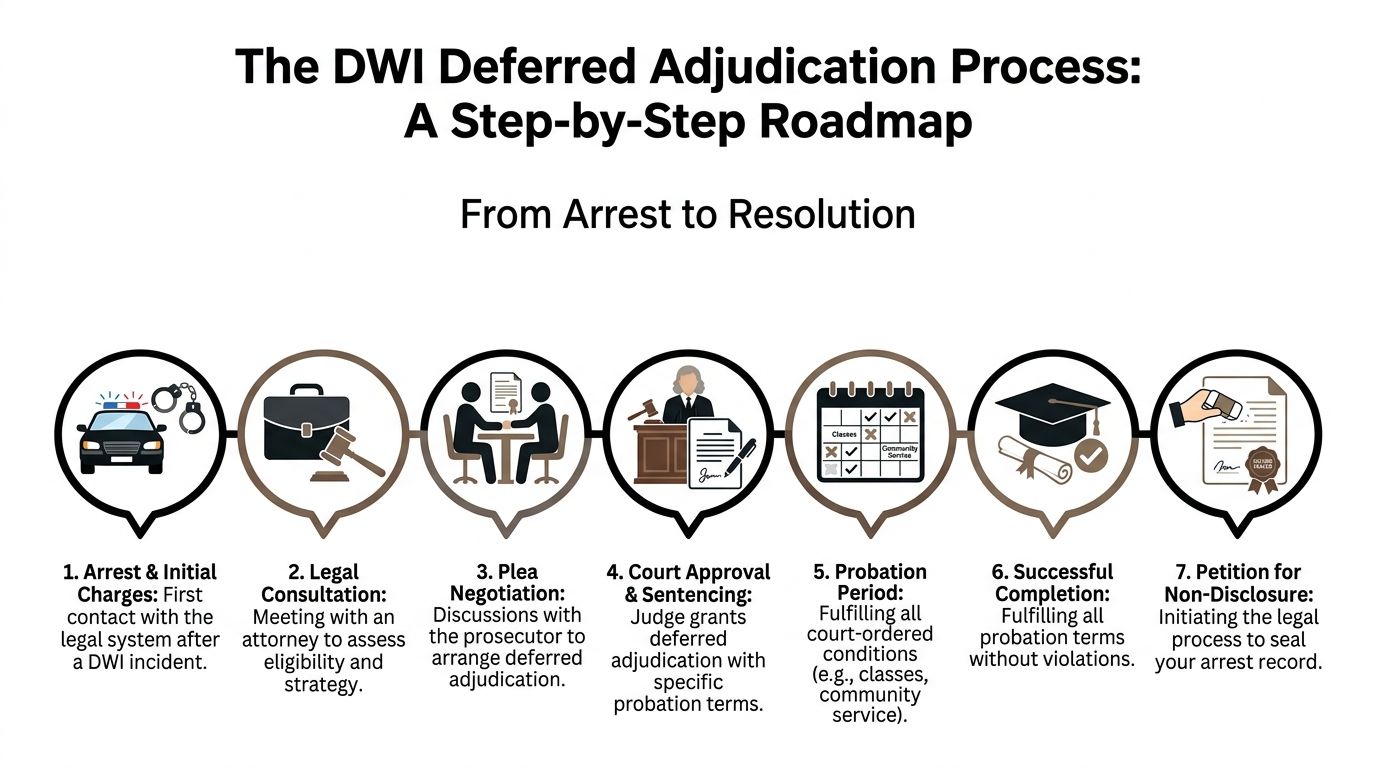
Deferred adjudication works like a supervised trial period. The judge does not enter a final finding of guilt at the start. Instead, the court gives you a set of conditions, and your result depends on whether you complete them successfully.
Step 1. Arrest, bond, and first court settings
After the arrest, you may be booked, released on bond, and given immediate conditions. Those conditions can include no alcohol use, travel limits, reporting requirements, or an ignition interlock device.
This part feels procedural, but it matters. A bond violation early in the case can make later negotiations harder.
Step 2. Defense review and case strategy
Your lawyer should review the stop, the reason for the arrest, body cam or dash cam footage, field sobriety testing, witness accounts, and any breath or blood evidence. This is the stage where a good defense lawyer asks two questions at the same time.
First, is deferred adjudication realistically available? Second, is the State's case weak enough that pushing for dismissal, reduction, or trial makes more sense?
That two-track review is important because deferred adjudication is one option, not the automatic goal in every case.
Step 3. Negotiation and plea paperwork
If deferred adjudication becomes the best available outcome, your attorney can negotiate for it with the prosecutor. To receive deferred adjudication, the defendant usually pleads guilty or no contest, and the judge agrees to defer a finding of guilt while placing the person on community supervision.
That plea decision is significant. You should understand the conditions, the length of supervision, and what can go wrong before accepting the offer.
Step 4. Community supervision begins
Once the judge grants deferred adjudication, the case enters the supervision phase. This is the part many people underestimate.
Court conditions often include:
- regular reporting to a supervision officer,
- alcohol or drug testing,
- a DWI education program,
- community service,
- payment of fines, fees, and court costs,
- an ignition interlock device when ordered,
- and a strict rule against violating new laws.
Some courts add other terms based on the facts of the case. The order is not generic. It is your rulebook for the months ahead.
Here is the basic sequence:
| Stage | What happens |
|---|---|
| Plea | You plead guilty or no contest |
| Deferral | Judge postpones a finding of guilt |
| Supervision | You complete court-ordered conditions |
| Completion | Court dismisses the case if you succeed |
Step 5. Compliance matters every month
Clients sometimes hear “dismissal” and assume the hard part is over. It is not. Deferred adjudication has to be completed, not just granted.
A missed test, unpaid fee, failed interlock report, new arrest, or skipped class can trigger a motion to adjudicate. If that happens, the judge can end the deferral, find you guilty, and sentence you within the lawful range for the offense. In plain terms, deferred adjudication gives you an opportunity, but it also gives the court continued control over the case.
The ALR case is separate from the criminal case
Many people are surprised by this. A good result in criminal court does not automatically protect your driver's license.
Texas treats the Administrative License Revocation process as a separate civil matter handled apart from the criminal DWI prosecution. The Texas Department of Public Safety explains the administrative license revocation hearing process, including the deadlines and suspension issues tied to a failed or refused chemical test.
That means a person can receive deferred adjudication in the criminal case and still deal with a license suspension in the ALR case. The two tracks run side by side, like two cases on parallel rails. One affects the criminal charge. The other affects driving privileges.
A short video can help clarify how the system works in practice.
Step 6. Successful completion and dismissal
If you complete every condition the court imposes, the judge dismisses the case without entering a final conviction. That is a meaningful result, but it is not the end of the record issue.
The arrest, court filings, and deferred adjudication history do not disappear on their own. For many people, the last stage that really matters is what happens after dismissal, including whether and when a nondisclosure petition can be filed. That waiting period is often missed in shorter online guides, but it is part of the full life cycle of a deferred adjudication case in Texas.
DWI Deferred Adjudication vs A Conviction
A client sits in my office after a first DWI arrest and asks a very reasonable question: “If I can get probation either way, why does deferred adjudication matter?”
The answer is that the two outcomes may feel similar at the front end, but they lead to different long-term results. During supervision, both can require classes, fees, reporting, testing, and strict court rules. The fork in the road shows up later, in how the case is labeled, how it appears on background checks, and what options may still be available to limit public access to the record.
Side-by-side comparison
| Outcome | DWI Deferred Adjudication | DWI Conviction (Standard Probation) |
|---|---|---|
| Final case status | Case may be dismissed after successful completion | Ends in a conviction |
| Public record impact | Arrest and court history still appear unless later sealed | Conviction remains part of the record |
| Background checks | May show the arrest and deferred result until nondisclosure is granted | Shows a DWI conviction |
| Future applications | In some settings, you may accurately state you were not convicted, depending on the wording of the question | You usually must disclose the conviction when asked |
| Future DWI consequences | Can still affect how a later DWI is treated under Texas law | Conviction clearly counts against you |
| Risk if you violate terms | Court can proceed to a finding of guilt and sentencing based on the plea already entered | Conviction already exists, and the court addresses the probation violation within that conviction |
Why the difference matters
Deferred adjudication works like a case put on hold with conditions attached. A conviction is a case the court has already finished by formally finding you guilty.
That distinction matters in real life. Employers, licensing boards, landlords, and schools often react differently to “deferred adjudication and dismissal” than they do to “DWI conviction.” The record is still there unless it is later sealed, but avoiding a final conviction can still put you in a better position.
This is also where people get tripped up. A dismissal after deferred adjudication is a strong result, but it is not a magic eraser. If your goal is to reduce what the public can see later, you also need to understand the separate Texas DWI nondisclosure process and waiting periods.
The risk people often underestimate
Deferred adjudication is not a free pass. You usually enter a plea to get it.
That means the margin for error is smaller than many people expect. If you miss reporting, fail a test, pick up a new charge, or violate another condition, the judge can move from “we are giving you a chance” to “we are sentencing this case.” You do not return to square one and demand a brand-new trial if supervision went badly.
For the right person, that risk is manageable. For someone with a demanding job, travel issues, treatment concerns, or a history that makes compliance harder, it needs serious thought before accepting the offer.
A practical way to evaluate the offer
A good decision usually comes from four questions.
- How strong is the State's evidence, and is there a real chance to beat the case or improve the offer?
- Do you qualify under Texas law, including the often-missed rule that CDL holders are not eligible for DWI deferred adjudication?
- Can you realistically complete every term of supervision without avoidable violations?
- Will avoiding a final conviction make a meaningful difference for your work, professional license, immigration concerns, or future plans?
A seasoned Texas DWI defense attorney should walk through those questions carefully, not just sell the idea of deferred adjudication as the default answer. Sometimes it is the smart move. Sometimes the better strategy is to challenge the stop, the testing, the officer's observations, or the plea terms themselves.
Sealing Your Record After Successful Completion
This is the part many people don't learn until after the case is dismissed. A dismissal does not mean your record disappears overnight.

Dismissal is not the end of the record issue
After successful deferred adjudication, the criminal case may be dismissed, but the arrest and court history can still appear on background checks. That's why many people are frustrated after doing everything right. They assume the court result automatically cleans up the public record. It doesn't.
The next step is usually a Petition for Nondisclosure. This is the legal request that asks the court to seal the record from public view in many situations. For a fuller discussion, see this guide on DWI nondisclosure in Texas.
The waiting period matters
Timing is critical here. After a Texas DWI case is dismissed through deferred adjudication, the defendant must wait a mandatory period, typically 1 to 2 years depending on the charge, before filing a Petition for Nondisclosure, according to this explanation of waiting periods for DWI nondisclosure after deferred adjudication.
That waiting period is one of the most missed details in online DWI content.
You can finish deferred adjudication successfully and still have the case show up on a background check until the nondisclosure process is available and completed.
What nondisclosure actually does
A nondisclosure order doesn't destroy the record. Instead, it limits public access to it. In practical terms, that usually means most private employers, landlords, and background screening companies won't be able to see it once the order is granted.
This is one reason the full lifecycle matters so much. In DWI deferred adjudication Texas cases, there are really two victories to pursue:
- Finish supervision and get the case dismissed
- File for nondisclosure after the waiting period
If you stop after step one, your record problem may still follow you longer than you expected.
Take the First Step to Protect Your Future
When you're arrested for DWI, the pressure hits fast. You're worried about court, your license, your job, your family, and what happens if this follows you for years. That reaction is normal.
The good news is that a DWI arrest is not the same as a final outcome. Depending on the facts, deferred adjudication may be available. Other times, the better strategy is to challenge the stop, the arrest, the field sobriety evidence, or the chemical testing. A defense lawyer's job is to sort through those options and protect your position at every stage.
If you're asking whether you should bring in counsel now, this article on whether to call a lawyer after a DWI arrest in Texas is a good place to start. The Law Office of Bryan Fagan, PLLC handles DWI defense matters involving criminal court strategy, ALR issues, testing challenges, and record-related follow-up such as nondisclosure.
If you want to fight DWI Texas charges intelligently, timing matters. Early action can help preserve defenses, protect your license position, and give you a clearer path forward. The sooner you get specific advice about your case, the more options you may be able to keep on the table.
If you're facing a DWI charge and need clear answers about deferred adjudication, license suspension, or how to protect your record, contact Law Office of Bryan Fagan, PLLC to request a free consultation or case evaluation. You'll get a practical review of your situation, your possible defenses, and the next steps to help protect your future.