 Skip to content
A DWI arrest can be overwhelming, but you don't have to face it alone.
You may be sitting at your kitchen table right now, paperwork spread out, trying to figure out whether this is “just” a first DWI in Texas or something that can derail your license, your job, and your peace of mind. That reaction is normal. Many who are arrested for a DWI have never dealt with criminal court, an ALR hearing, or a prosecutor building a case against them.
Here's the first thing I want you to understand. An arrest is not a conviction. The officer's report is not the final word. And a Class B DWI case is often won or lost at a few specific intervention points, especially in the days right after the arrest.
Your Guide to Navigating a Texas DWI Arrest
The first night after a DWI arrest often brings a consistent pattern of reflection and worry. You replay the stop. You wonder whether saying less would've helped. You worry about your license, your record, and whether your employer will find out.
That panic is understandable, but it's not useful. Strategy is useful.
If this is your first arrest, start by learning what happens after a DWI. That gives you the basic timeline. Then focus on the parts of the case where your lawyer can influence the outcome.
What matters immediately
A Class B DWI case has two tracks. One runs through criminal court. The other targets your driver's license through the administrative process.
Those tracks move fast, and they don't wait for you to “see what happens.”
Practical rule: Treat the first days after a DWI arrest as evidence-gathering time, not damage-control time.
Write down everything you remember while it's still fresh. Where were you stopped? What did the officer say? Did you perform field sobriety tests? Were you offered a breath test? Was there body cam or dash cam? Small details often become the difference between a weak defense and a strong one.
Your mindset matters
Don't assume the charge means the state has a clean case. In many first-offense cases, the prosecution relies heavily on officer observations, roadside testing, and chemical test evidence that may be challenged.
That's why the right response isn't panic or blind optimism. It's disciplined action:
- Preserve documents: Keep the citation, bond paperwork, temporary driving permit, and any notice about your license.
- Protect your words: Don't explain your case to friends, coworkers, or on social media.
- Get legal analysis early: A lawyer needs time to review the stop, the testing, and the deadlines before they harden into problems.
If you're facing a DWI Class B misdemeanor in Texas, your goal is simple. Protect your license, attack weak evidence, and put yourself in position for the best available outcome.
What Is a Class B Misdemeanor DWI in Texas
A Class B misdemeanor DWI is a specific legal classification, not a vague accusation. In Texas, a first-time DWI is generally charged as a Class B misdemeanor when the state claims your BAC, or Blood Alcohol Concentration, was 0.08% to 0.149% under Texas Penal Code § 49.04. If the BAC reaches 0.15% or higher, the charge rises to a Class A misdemeanor, as explained by this Texas DWI charge breakdown.
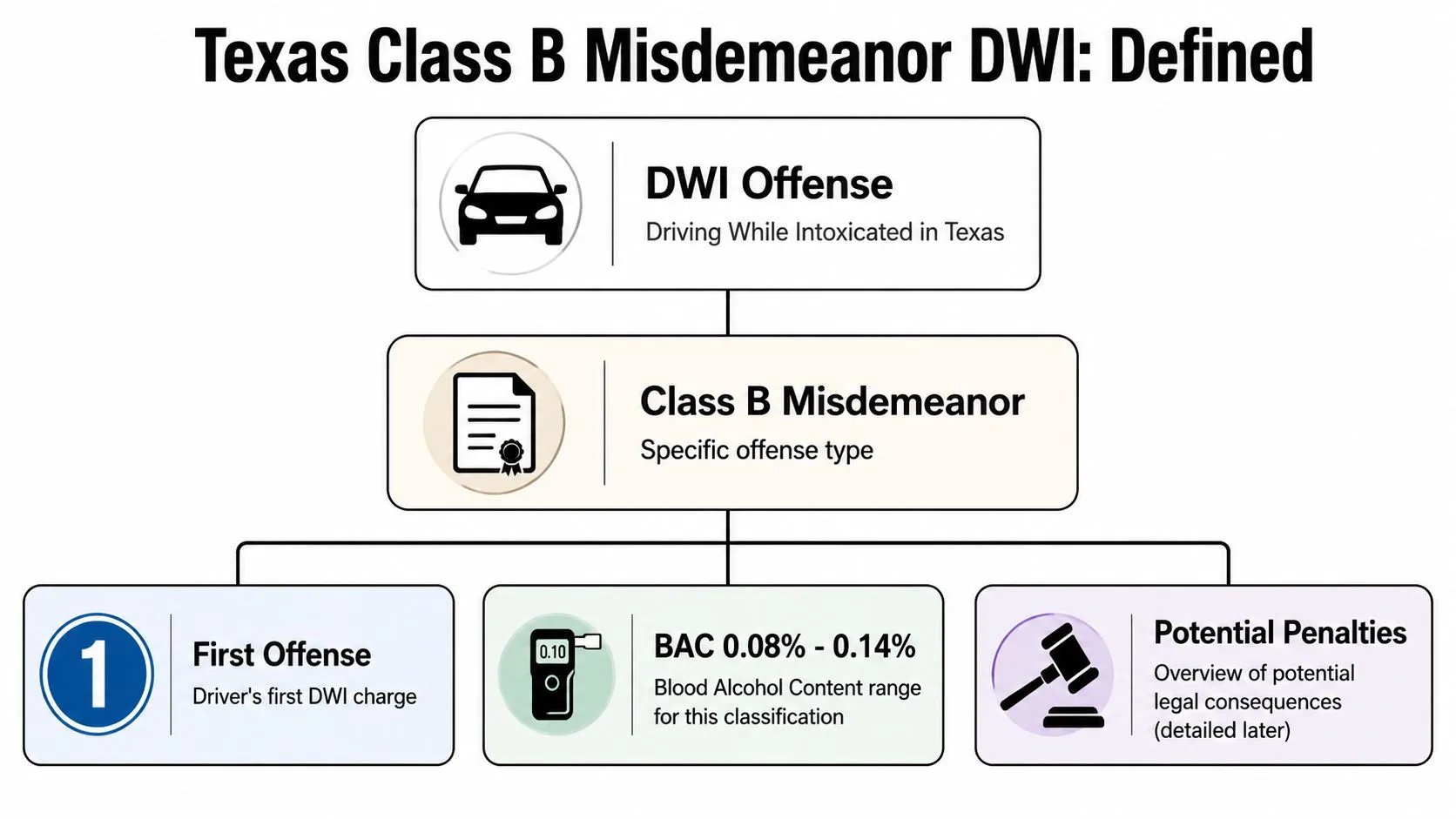
Consider it a diagnosis. The label matters because it affects the punishment range, the defense strategy, and what the prosecutor has to prove.
The key terms you need to know
BAC means the measured amount of alcohol in your blood or breath. In a DWI case, the state may try to use a breath or blood result to place you in the Class B range.
Implied consent means that by driving on Texas roads, you're considered to have agreed to provide a breath or blood sample if an officer lawfully requests one after a DWI arrest. Refusing has separate license consequences, which I'll address later.
Field sobriety test usually refers to the roadside balancing and eye-movement tests officers use to claim a driver lost the normal use of mental or physical faculties. These tests are often subjective, and they are not the same as a breath or blood test.
What the state must prove
For a DWI Class B misdemeanor in Texas, the prosecutor needs admissible evidence that you were operating a motor vehicle in a public place while intoxicated. Sometimes that case is built around a chemical test. Sometimes it's built around officer observations and field tests.
That distinction matters. The state's case is only as strong as the evidence behind it.
Here's the practical point. The “Class B” label doesn't mean your case is minor. It means your lawyer needs to attack the classification itself, the testing, the stop, and the officer's conclusions. If facts suggest a more serious allegation, such as repeat-offense exposure or a child passenger issue, Felony DWI in Texas: Third Offense and Child Passenger explains when a Texas DWI becomes a felony charge.
A DWI charge is a legal claim the state must prove. It isn't proof by itself.
Understanding the Full Scope of Class B DWI Penalties
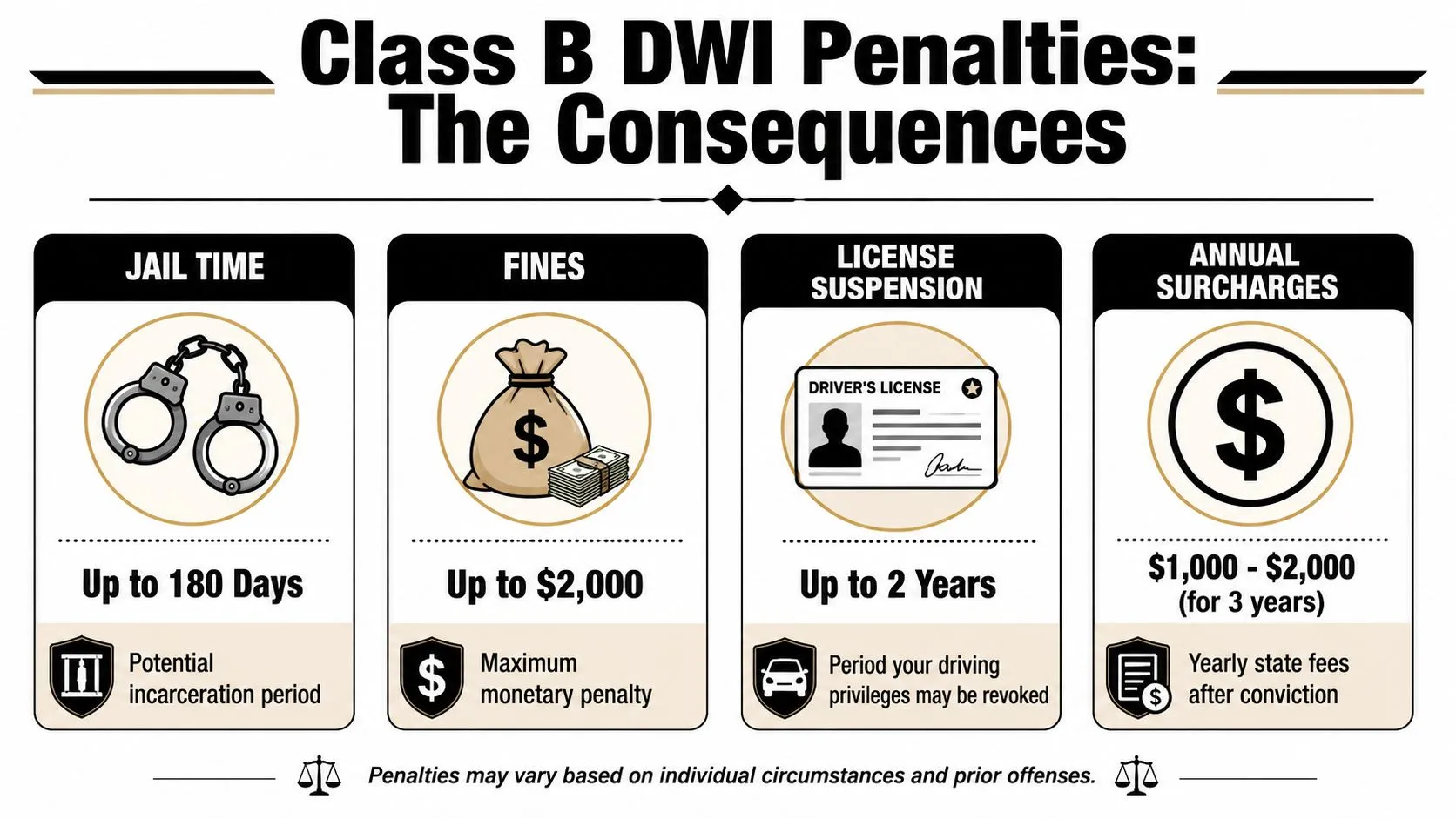
A conviction for a Class B DWI in Texas carries real consequences. The statute allows 72 hours to 180 days in county jail and a maximum fine of $2,000. Alcohol-related convictions can also trigger an annual surcharge of $1,000 for three years, and the total cost of a first offense may range from $5,000 to $24,000, according to this summary of Texas Class B DWI penalties.
Here's a visual overview of the exposure you may be facing.
What those penalties mean in real life
The jail range gets everyone's attention first, and it should. Even when someone avoids serving the full range, the threat of confinement changes how prosecutors negotiate and how judges view the case.
The fine is only part of the financial hit. Court involvement, license issues, and follow-up requirements often create more disruption than people expect. That's why I tell clients to stop thinking only about “the ticket” and start thinking about the full legal and practical cost.
For a broader look at how these consequences fit into Texas law, review Texas DWI penalties.
Consequences beyond jail and fines
A Class B DWI conviction often carries obligations that affect daily life:
- Driving restrictions: Your license may be suspended or limited.
- Ignition interlock device: In some cases, the court may require a device that prevents the vehicle from starting if alcohol is detected.
- Classes and supervision terms: Courts commonly require compliance steps tied to probation or supervision.
This video helps frame the stakes and why early defense work matters.
The numbers are not the strategy
Too many people make the same mistake. They read the punishment range and assume the only question is how much punishment they'll get.
That's the wrong approach.
Your lawyer's job isn't to accept the state's version of events and bargain from weakness. Your lawyer should test the stop, the observations, the roadside investigation, the chemical testing, and the paper trail. In many first DWI in Texas cases, the best result comes from strengthening the defense's position before plea talks ever begin.
| Issue | Why it matters |
|---|---|
| Jail exposure | It gives the state pressure in negotiations |
| License consequences | They can interfere with work and family obligations |
| Long-term cost | The case can affect finances well beyond the courtroom |
The Crucial 15 Day Deadline for Your Driver's License
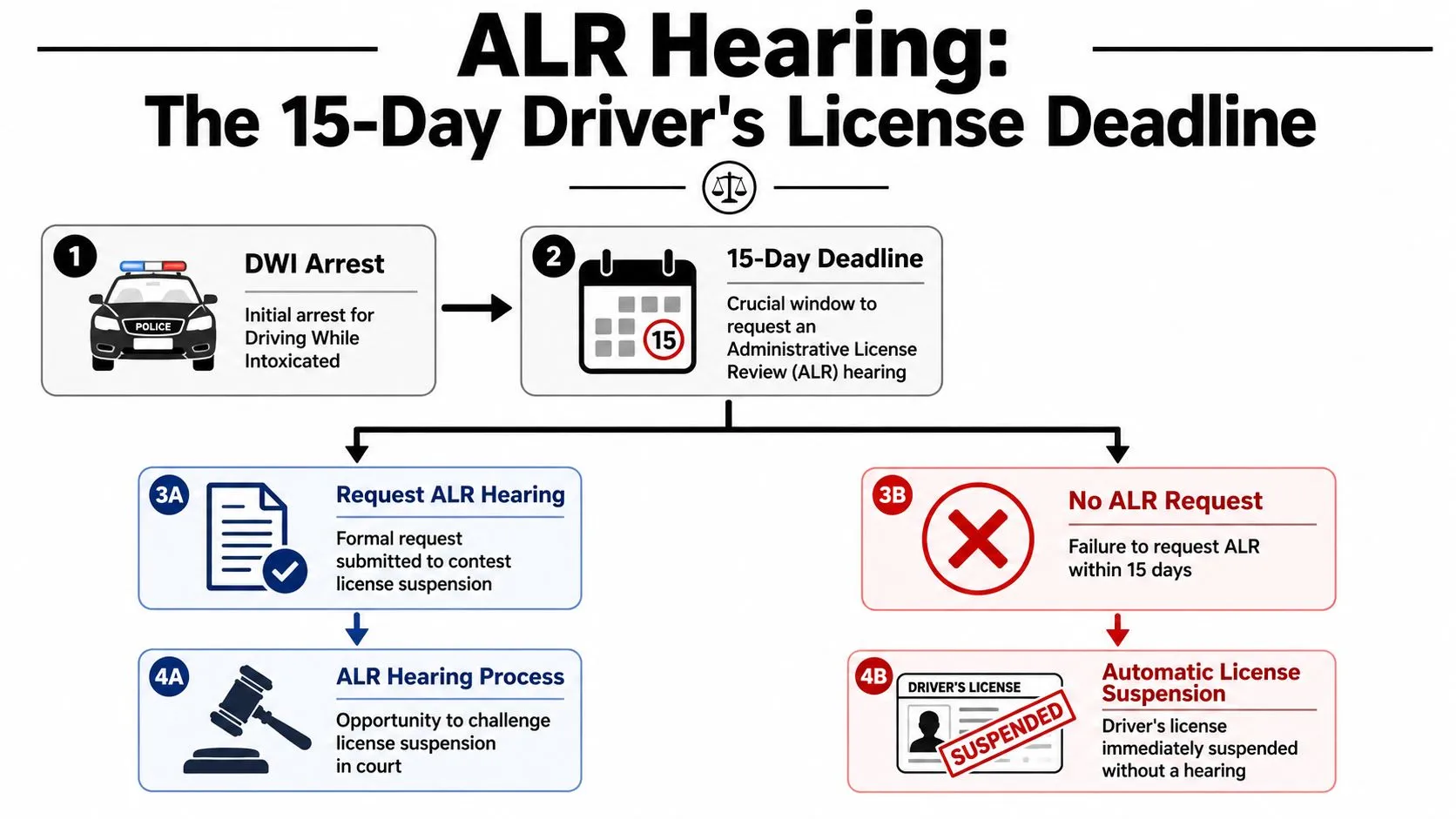
Your DWI case and your driver's license are not the same fight. A DWI arrest usually triggers a separate civil process aimed at suspending your license. That process is called an Administrative License Review, often shortened to ALR.
An administrative license suspension is the state's attempt to suspend your driving privileges through that separate process. If you ignore it, you can lose your license even while the criminal case is still pending.
Why implied consent matters here
Under Texas implied consent rules, refusing a breath test can trigger an automatic 180-day ALR suspension, regardless of what happens in the criminal case. That civil penalty is enforced in 90% of refusal cases, based on the facts discussed in this explanation of refusal-based ALR suspensions.
A lot of drivers think refusal is a shield. It isn't. It may change the evidence in the criminal case, but it creates a serious license problem immediately.
Miss the ALR deadline and you hand the state your license issue without a fight.
What you should do right away
You generally need to act fast after arrest if you want to challenge the suspension. That's where people lose ground. They focus on the court date and forget the license clock is already running.
Take these steps immediately:
- Read every paper from the arrest for any notice tied to your license.
- Calendar the deadline the same day you get home.
- Talk to counsel before assuming you can't drive because there may be options to contest the suspension or seek limited driving relief.
If your license is already suspended or at risk, learn about how to get an occupational license. That can matter if you need to drive for work, school, or essential household duties.
Why the ALR hearing helps the criminal case
An ALR hearing isn't just about driving privileges. It can also give your lawyer an early chance to examine the officer's basis for the stop and arrest. That matters because early testimony often exposes weak points, inconsistencies, or missing proof.
A smart defense treats the ALR process as an opportunity, not just a deadline.
How a Class B DWI Differs from Other DWI Charges
A Class B DWI sits in the middle of the Texas DWI system. It's more serious than a minor traffic matter, but it's not the highest level of exposure. That difference matters because your defense strategy should focus on preventing escalation.
Class B versus Class A
The biggest line between the two is the BAC allegation. As covered earlier, once the state claims a higher test result, the charge becomes more severe.
That changes more than the label. It changes how prosecutors value the case, how a judge may view the facts, and what risks you face if you take the case to trial.
Class B versus felony DWI
A felony DWI is a different category altogether. Repeat allegations, child passenger cases, or cases involving accidents and injuries can move a DWI into much more dangerous territory.
If your arrest involved a crash, DWI Involving an Accident or Injury in Texas explains how an accident escalates the stakes of a Texas DWI charge.
Here's the practical comparison:
- Class B misdemeanor DWI: Often the starting point for a first offense.
- Class A misdemeanor DWI: A higher-level misdemeanor tied to more serious alleged intoxication evidence.
- Felony DWI: A charge that can reshape the entire case, from bond conditions to long-term record consequences.
Special situations that change the analysis
Some drivers face stricter collateral consequences even when the criminal charge itself looks familiar.
For example, a CDL holder may face major employment consequences from a DWI arrest because driving privileges are tied directly to income. A driver under 21 can also face a different legal framework under Texas alcohol laws. Those cases require more than a generic defense. They require a defense built around the client's real-world risks.
The right question isn't only “What charge am I facing?” It's also “What facts could make this worse, and how do we stop that now?”
That's why I push clients to deal with the case early. Delay gives the state time to organize evidence and lock in narratives. Early action gives the defense a chance to control the pressure points.
Common Defenses to Fight a DWI in Texas
A DWI case is defendable. Not every case should go to trial, but every case should be prepared as if trial is possible. That's how you gain an advantage and how you expose weak evidence.

Attack the stop first
If the officer lacked a lawful basis to stop your vehicle, the entire case can weaken fast. A bad stop can lead to motions to suppress evidence, and suppression changes everything.
I look for simple but critical questions. What driving behavior was observed? Does the video match the report? Did the officer stretch innocent conduct into suspicion?
Don't treat field sobriety tests as science
A field sobriety test is often presented like objective proof. It isn't. These roadside tests depend on instructions, conditions, officer scoring, lighting, footwear, surface conditions, and the driver's physical state.
Common defense angles include:
- Poor instructions: If the officer explained the test badly, the results are less reliable.
- Bad conditions: Uneven pavement, traffic noise, poor lighting, or weather can affect performance.
- Physical limitations: Injury, fatigue, age, anxiety, or medical issues can create “clues” that have nothing to do with intoxication.
Challenge breath and blood evidence hard
Chemical testing sounds powerful to juries, but it's only persuasive when the collection, operation, maintenance, and interpretation are done correctly.
That means your Houston DWI lawyer or Texas DUI attorney should ask:
- Was the machine working properly?
- Did the officer follow proper procedure?
- Is there a record problem in the testing process?
- Does a medical condition offer another explanation?
A breath result is not magic. It's a piece of evidence handled by human beings, and human beings make mistakes.
Build a defense around intervention points
The strongest DWI defenses usually come from timing. Early review of videos, records, witness memories, and testing procedures gives your lawyer room to file motions, challenge weak proof, and negotiate from strength.
That's where a firm like Law Office of Bryan Fagan, PLLC can fit in as one option for Texas drivers who need defense work that includes ALR hearings, chemical test challenges, and criminal court representation.
If you want to fight DWI Texas charges effectively, stop asking whether the state has “some evidence.” Ask whether the state has reliable, admissible, persuasive evidence. Those are very different things.
Your First Steps After a DWI Arrest and How We Can Help
The first moves after arrest should be practical, disciplined, and immediate. Don't wait for the first court date to get organized.
Do these things now
Start with the basics:
- Write your timeline: Note where you were, what you drank if anything, when the stop happened, what the officer asked, and what testing occurred.
- Save evidence: Keep receipts, messages, rideshare history, and names of anyone who saw you before or after the stop.
- Stay quiet publicly: Don't post, text broadly, or “clear things up” with statements that can be used against you.
Then deal with the legal side fast. A first DWI in Texas often feels survivable, so people drift. That drift hurts cases.
Understand the possible outcomes
Not every DWI case ends in a straight conviction. Depending on the facts, outcomes may include dismissal, a reduction, negotiated terms, or deferred adjudication.
Under Texas Penal Code 42.04, a Class B misdemeanor DWI conviction carries a minimum jail sentence of 72 hours, but that can be avoided if the defendant receives probation or community supervision. Deferred adjudication can also allow the case to end without a formal conviction on the record if the supervision terms are successfully completed, as described in this overview of first-offense DWI outcomes in Texas.
That's why early legal work matters. If your lawyer identifies a weak stop, a testing problem, or a negotiation path quickly, the entire direction of the case can improve.
What representation should look like
You need more than someone to stand next to you in court. You need a lawyer who will do the unglamorous work that changes cases:
- Review the stop and arrest for legal defects.
- Request and examine evidence such as reports, video, and testing records.
- Handle the license issue quickly so the DWI license suspension fight doesn't get lost.
- Push toward the best resolution available based on facts, not fear.
If you're dealing with a DWI Class B misdemeanor in Texas, don't guess your way through it. Get a strategic review of the facts while the case is still fresh and while your options are still open.
If you're facing a DWI charge, Law Office of Bryan Fagan, PLLC offers free consultations for Texans who need help protecting their license, evaluating defenses, and building a plan for court. You don't have to sort this out alone. Get a case evaluation, get clear answers, and take control of your next step before deadlines and evidence start working against you.

