 Skip to content
A DWI arrest can be overwhelming — but you don’t have to face it alone. One minute, you're driving home; the next, your future feels completely uncertain. If you're overwhelmed and full of urgent questions, you're not alone. This guide is here to cut through the legal jargon and give you a clear, straightforward look at what a DWI arrest means and what comes next.
Your Guide to Texas Drinking and Driving Laws

A DWI arrest can feel disorienting, but you don’t have to navigate the legal system by yourself. The choices you make in the hours and days after an arrest are absolutely critical. Understanding your rights isn't just a good idea—it's the first and most important step toward building a defense. Think of this guide as your roadmap.
This is your first conversation about protecting your name, your license, and your future. We’ll demystify the complex terms, explain the real-world consequences you’re facing, and show you that a strategic fight is possible. With a knowledgeable Houston DWI lawyer in your corner, you can face what's ahead with confidence.
Why Texas Laws Are So Strict
There's a reason Texas has some of the toughest DWI laws in the nation. The state takes a hard-line stance against intoxicated driving because of the devastating toll it takes on our communities. This isn't just about punishment; it's a response to a persistent and tragic public safety problem.
Even with these strict laws, the numbers are sobering. In 2022, an alarming 42% of all traffic deaths in Texas involved an impaired driver, putting our state among the highest in the country for alcohol-related fatalities. These statistics are exactly why law enforcement and prosecutors pursue DWI cases so aggressively.
A DWI arrest kicks off two separate legal battles at the same time: a criminal case to determine guilt and an administrative case to decide your driving privileges. You have to act fast on both fronts.
What to Expect From This Guide
Our goal is to give you the knowledge you need to feel in control. We'll walk through the essentials of the drinking law in Texas so you're prepared for what's coming.
Here’s what we’ll cover:
- Key Definitions Explained: We’ll clarify what really matters, like the difference between a DWI and a DUI, what a 0.08% Blood Alcohol Concentration (BAC) actually means for your case, and what a field sobriety test is.
- The Two Legal Fronts: You'll learn about the criminal court process and the separate, time-sensitive Administrative License Revocation (ALR) hearing. Understanding the Texas implied consent law is a huge piece of this puzzle.
- Penalties and Consequences: From a first DWI in Texas to a felony charge, we will break down the potential penalties, including fines, jail time, and an administrative license suspension.
- Building Your Defense: We will show you how to fight DWI Texas charges by challenging the evidence, from shaky field sobriety tests to unreliable breathalyzer results.
A DWI charge feels like it could define the rest of your life, but it doesn't have to. By understanding the system and partnering with an experienced legal team, you can start working to protect your rights and fight for the best possible outcome.
Key DWI Terms Defined
Getting arrested for a DWI throws you into a world of confusing legal jargon. When you’re trying to figure out what's happening, this strange new language just adds to the stress. Let's cut through the noise and translate the essential terms that the state will use to build its case against you.
Understanding these concepts is the first step toward regaining some control. It gives you the power to see how a case is constructed and, more importantly, how a sharp Texas DUI attorney can start to take it apart.
DWI vs. DUI: What Is the Difference?
Most people use "DWI" and "DUI" interchangeably, but in Texas, that's a mistake. They refer to two completely different offenses, and the distinction is all about the driver's age. Knowing which one applies is critical to your case.
DWI (Driving While Intoxicated): This is the charge you’ll face if you’re an adult (21 or older) caught operating a motor vehicle in a public place while intoxicated. In Texas, "intoxicated" means either not having the normal use of your mental or physical faculties due to alcohol or drugs, or having a BAC of 0.08% or higher.
DUI (Driving Under the Influence): This charge is exclusively for minors under the age of 21. Thanks to Texas's zero-tolerance policy, a minor can be charged with a DUI for having any detectable amount of alcohol in their system.
A DUI is usually a Class C Misdemeanor, but a DWI is much more serious. Even a first DWI in Texas starts as a Class B Misdemeanor, bringing far more severe penalties.
Blood Alcohol Concentration (BAC)
You’ve heard this term on TV and in the news. Blood Alcohol Concentration, or BAC, is simply the measurement of alcohol in your bloodstream, shown as a percentage. In Texas, certain BAC levels trigger specific legal outcomes.
The number everyone knows is 0.08%. That's the legal limit for most adult drivers. But here’s what many people don't realize: you can still be charged with a DWI even if your BAC is below 0.08%. If an officer believes you've lost the "normal use of your faculties," the number becomes less important.
The legal limits are not one-size-fits-all. They change depending on who you are and what you drive.
- Standard Adult Drivers (21+): 0.08% BAC
- Commercial Drivers (CDL Holders): 0.04% BAC
- Drivers Under 21: Any detectable amount of alcohol
For a deeper dive into these specifics, you can learn more about the legal alcohol limit in Texas in our detailed guide. These BAC thresholds are the backbone of the prosecution's case.
Implied Consent Law Explained
Here’s a rule you agreed to without ever signing a paper: the Implied Consent law. Think of it as part of the "terms and conditions" you accepted when you received your Texas driver's license.
This law means that by the simple act of driving on a Texas road, you have automatically agreed to give a breath or blood sample if a police officer lawfully arrests you for a DWI.
Saying "no" doesn't make the problem go away. In fact, refusing the test creates a new, separate problem. It triggers an immediate and automatic administrative license suspension. This civil penalty, known as the Administrative License Revocation (ALR), happens independently of your criminal case. Grasping this concept is crucial for understanding what’s at stake from the very first moments of a DWI stop.
Texas DWI Penalties Explained

To really understand what you’re up against after a DWI arrest, you have to look at the potential consequences head-on. In Texas, the penalties aren’t just a simple slap on the wrist. They are built to be tough, and they ramp up significantly with each new offense, threatening your freedom, your finances, and your ability to drive.
The first step toward building a real defense is knowing exactly what’s at stake. A skilled Houston DWI lawyer can guide you through this process, fighting to protect your future and minimize the damage. Let's break down what that looks like, from a first-time charge all the way to a felony.
Penalties for a First DWI Offense
A first DWI in Texas is usually charged as a Class B Misdemeanor, as long as there aren’t other aggravating factors involved. But don't let the "misdemeanor" label fool you—even for a first-time mistake, the penalties are serious.
The state has a strict playbook for DWI enforcement. For a first offense, you’re looking at jail time ranging from 72 hours to 180 days, fines that can go up to $2,000, and a DWI license suspension that could last for a full year. Courts also often require you to install an Ignition Interlock Device (IID) in your car, which tests your breath for alcohol before it will start. These measures show just how seriously the state takes intoxicated driving, a stance that has been part of a broader effort you can learn about Texas's commitment to deterrence on lawcommentary.com.
Things get worse if your blood alcohol concentration (BAC) was 0.15% or higher. That automatically bumps the charge up to a Class A Misdemeanor, and the penalties get much steeper:
- Fines: Up to $4,000
- Jail Time: Up to one year in county jail
- License Suspension: Up to two years
Escalating Consequences for a Second DWI
If you’re arrested for a second DWI, the state now sees you as a repeat offender, and the gloves come off. A second DWI is a Class A Misdemeanor, no matter what your BAC was.
You can expect longer jail sentences, bigger fines, and a much longer license suspension. The mandatory minimum jail sentence is 30 days, but it can stretch up to a full year. The fines can hit $4,000, and your driver's license can be taken away for up to two years. An IID is almost guaranteed at this point.
A second DWI conviction is the court’s way of saying its patience has run out. The system’s focus shifts from rehabilitation to punishment, which makes building a strategic defense more crucial than ever.
Felony DWI: Third Offense or More
A third DWI conviction is a game-changer. It elevates the charge to a third-degree felony, which is a life-altering event. A felony conviction brings consequences that go far beyond jail and fines—it can strip you of your right to vote, own a firearm, and can make it nearly impossible to get certain jobs or professional licenses.
The penalties for a third-degree felony DWI are severe:
- Prison Time: From 2 to 10 years in a state prison.
- Fines: Up to $10,000.
- License Suspension: Up to two years.
These penalties can get even worse if there are other enhancing factors, like causing an accident with an injury or having a child passenger in the car. The whole point of a strong legal defense is to fight DWI Texas charges with everything you have to avoid the devastating fallout of a felony conviction.
The table below gives you a quick summary of the escalating criminal penalties. It’s a good starting point, but remember these numbers don't include extra costs like court fees, probation fees, or the monthly expense of an IID.
Texas DWI Penalties at a Glance
| Offense Level | Jail Time | Maximum Fine | License Suspension |
|---|---|---|---|
| First DWI (Class B Misdemeanor) | 72 Hours – 180 Days | $2,000 | 90 Days – 1 Year |
| First DWI w/ BAC ≥ 0.15% (Class A Misdemeanor) | 30 Days – 1 Year | $4,000 | 180 Days – 2 Years |
| Second DWI (Class A Misdemeanor) | 30 Days – 1 Year | $4,000 | 180 Days – 2 Years |
| Third DWI (3rd Degree Felony) | 2 – 10 Years | $10,000 | 180 Days – 2 Years |
Trying to face these penalties on your own is a huge risk. With an experienced Texas DUI attorney on your side, you can challenge the state's evidence, negotiate for reduced charges, and work toward a result that protects your freedom and your future.
What Happens After a DWI Arrest
When you’re arrested for a DWI, it feels like one single, overwhelming catastrophe. But in the eyes of Texas law, your arrest immediately kicks off two separate legal fights on two different fronts.
One is the criminal case—the one everyone knows about, where the state tries to prove you committed a crime. The other is a civil case, an administrative battle against the Texas Department of Public Safety (DPS) with one thing on the line: your driver's license. Most people don't even realize they're fighting for their license until it's too late.
Understanding that you’re in a two-front war is the first and most critical step in building your defense. A Houston DWI lawyer can manage both cases for you, but you need to know what you're up against.
The Administrative License Revocation (ALR) Hearing
The first fight—and the one with the tightest deadline—is the battle to save your driver's license. This process is called an Administrative License Revocation, or ALR. It’s a civil proceeding handled entirely by the DPS, completely separate from your criminal court case.
This process starts automatically the moment an officer believes you either failed a chemical test (by blowing a 0.08% BAC or higher) or refused to provide a breath or blood sample. The officer will take your license and give you a piece of paper that serves as a temporary permit. That paper also starts a very important clock.
You have only 15 days from the date you get that notice to request an ALR hearing. If you miss this deadline, your license will be suspended automatically. No second chances.
This 15-day window is non-negotiable and one of the most critical moments in your entire case. If you fail to act, you forfeit your right to challenge the suspension. An experienced attorney can file the hearing request for you, which immediately stops the automatic suspension until your hearing date.
But the ALR hearing is more than just a chance to save your driving privileges. It’s a powerful strategic tool. This is your lawyer's first—and sometimes only—chance to get the arresting officer under oath before the criminal trial. We can question them about the traffic stop, their administration of the field sobriety tests, and the breath or blood test procedures. Any inconsistencies or mistakes we uncover can become invaluable ammunition for getting your criminal case weakened or dismissed down the road.
For a deeper look, we have a complete guide on the Administrative License Revocation process in Texas on our site.
The Criminal Court Process
While the ALR process is moving forward, the criminal case runs on a parallel track. This is where you are formally charged with Driving While Intoxicated. A conviction here can lead to jail time, thousands in fines, and a permanent stain on your criminal record.
The criminal journey is much longer and more complicated than the ALR hearing. It typically unfolds in these stages:
Arraignment and Bond: This is your first official appearance in court. The judge will read the charges against you, and you'll enter a plea (which is almost always "not guilty" at this stage). Your bond conditions—the set of rules you must follow while your case is active—will also be set.
Discovery and Investigation: Your defense attorney will immediately start demanding all the evidence the prosecutor has. This includes everything from police reports and dash cam videos to the maintenance logs for the breathalyzer machine. We comb through every single detail, looking for procedural errors, constitutional violations, or simple holes in the state's case.
Plea Negotiations: Once we know the strengths and weaknesses of the evidence, your lawyer will begin negotiating with the prosecutor. The goal is to achieve the best possible outcome. Depending on the facts, that could mean getting the charge reduced to a non-DWI offense (like Obstruction of a Highway) or fighting for a complete dismissal.
Trial: If the prosecutor refuses to offer a fair deal, your case will be set for trial. You have a constitutional right to let a jury of your peers decide your fate, or you can have your case heard by a judge. At trial, the State of Texas must prove your guilt "beyond a reasonable doubt"—the highest standard in our legal system. Your attorney will be there to challenge their evidence, cross-examine their witnesses, and fight for an acquittal.
Fighting on two fronts requires a skilled and organized approach. By understanding both the ALR and criminal court processes, you and your attorney can work together to protect your rights and effectively fight DWI Texas charges.
How to Fight a Breath Test Result and Other Evidence
After a DWI arrest, it’s easy to feel like the fight is already lost. But an arrest is not a conviction. The state’s entire case against you is built on evidence—and every single piece of that evidence can be challenged by a skilled Houston DWI lawyer.
Think of the prosecution's case as a chain. For them to get a conviction, every link in that chain has to be strong and unbreakable. Our job is to find the weak links and shatter them. A winning defense isn’t built by luck; it's built by methodically pulling apart every action the officer took, from the second they first saw your car to the moment you were booked into jail. We dismantle their argument, piece by piece, to create the leverage needed to get your charges reduced or dismissed entirely.
Questioning the Legality of the Traffic Stop
Every DWI case begins with a traffic stop. But an officer can't just pull you over on a whim or a "hunch." The Constitution demands they have reasonable suspicion—a specific, factual reason to believe you’ve broken a law. This is the very first, and most fundamental, link in their chain.
If we can prove the officer didn't have a valid reason for the stop in the first place, then any evidence they gathered after that moment becomes inadmissible. That means sobriety test results, statements you made, and even chemical test results can be thrown right out of court. This is often the fastest route to getting a case dismissed. We'll dig into the police report and dash cam footage, asking the tough questions:
- Did you really commit the traffic violation they claimed, like speeding or failing to signal?
- Was the officer’s report of “erratic driving” just an exaggeration that the video doesn't support?
- Was the stop based on a vague or unreliable tip from an anonymous caller?
If the foundation of the stop is shaky, the whole case built on top of it can collapse. It’s one of the most effective ways to fight DWI Texas charges right from the start.
This infographic shows the two separate legal battles—the criminal case and the ALR hearing—that begin after an arrest.
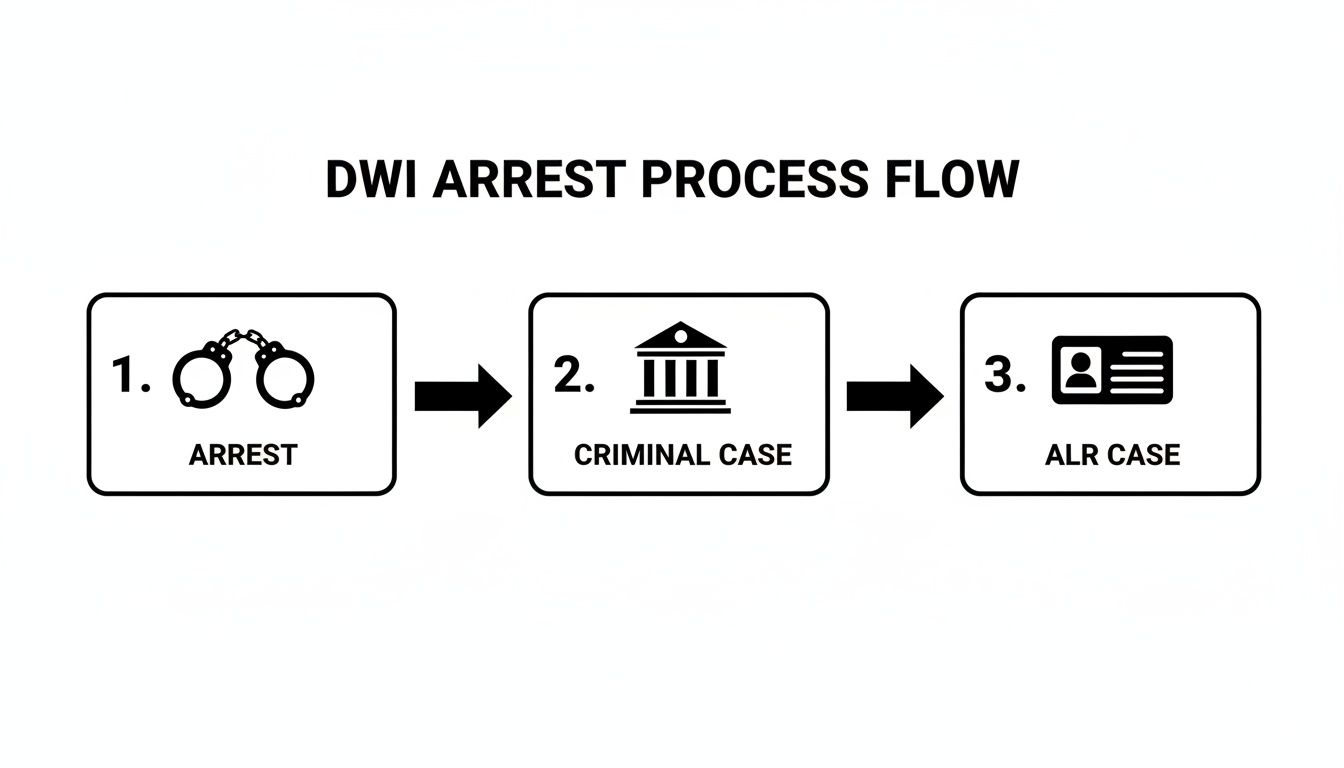
As the flowchart illustrates, you have to protect your freedom in criminal court while, at the same time, fighting to save your driver's license in the administrative case.
Contesting Field Sobriety and Chemical Tests
The heart of the prosecutor’s case usually comes down to the Standardized Field Sobriety Tests (SFSTs) and the results of a breath or blood test. But here’s what they don’t tell you: these tests are far from perfect. A field sobriety test is really just a subjective physical challenge—one that many sober people would struggle with in broad daylight, let alone on the side of a dark road with police lights flashing in their eyes.
We challenge the validity of these tests by pointing out all the other things that could have caused you to "fail":
- Medical Conditions: Problems with your knees, back, or inner ear can make it physically impossible to perform the balance tests correctly.
- Environmental Factors: Was the ground uneven? Was it windy or rainy? Passing traffic and poor lighting can easily disrupt anyone's concentration.
- Improper Instructions: Officers have a strict script they must follow when giving instructions and demonstrating the tests. If they deviate, the results are compromised.
And what about the breath and blood tests? They aren't foolproof, either. Breathalyzer machines need constant maintenance and precise calibration to work correctly. Blood samples have to be drawn, stored, and transported according to a strict scientific "chain of custody." Any misstep along the way can contaminate the sample or produce an inaccurate result. We investigate everything from the machine's repair history to the lab’s handling procedures to find those critical errors.
A DWI case is won or lost in the details. By aggressively challenging the evidence, from the initial traffic stop to the chemical test results, we create the leverage needed to negotiate a dismissal or reduction of the charges.
It’s also important to know that where you were arrested can have a huge impact on your case. Statistics show that dismissal and reduction rates can differ dramatically from one county to the next, simply because of different prosecutorial philosophies. This is why having a local lawyer who knows the tendencies of your specific court and prosecutors is so critical. You can learn more about how Texas DWI statistics vary by county at zealousadvocate.com.
Answering Your Most Urgent Questions About Texas DWI
A DWI arrest can feel like the world is closing in. Your mind floods with questions about what comes next, and the sheer uncertainty of it all can be paralyzing. You're not the first person to feel this way, and you're certainly not alone.
We're going to tackle some of the most common and urgent concerns people have right after being arrested. While every single case has its own unique details, getting clear, straightforward answers can give you back a sense of control and help you prepare for the road ahead.
Will I Lose My License Immediately After a DWI Arrest?
No, not automatically—but you have to act fast. The state starts the suspension process right away, but you have a very short 15-day window to request an Administrative License Revocation (ALR) hearing. This hearing is your one shot to challenge the automatic suspension.
If you miss that deadline, you give up your right to fight, and the suspension goes into effect. A skilled Texas DUI attorney can file this request for you, putting an immediate stop to the suspension and representing you at the hearing. This is a critical first move, as the ALR hearing is also a prime opportunity to gather evidence that can be used in your criminal case.
Can I Refuse a Breathalyzer or Blood Test in Texas?
Yes, you absolutely have the right to refuse a chemical test. However, that choice comes with its own set of immediate consequences. Under Texas’s “Implied Consent” law—which you agree to just by having a driver's license—a refusal triggers an automatic DWI license suspension. In many cases, this suspension is even longer than the one you'd get for failing the test.
But there's a strategic upside to refusing: you deny the prosecutor their most powerful piece of evidence—a specific number for your BAC. A case without a number is often much more difficult for the state to prove beyond a reasonable doubt. It's a complex decision, but a good Houston DWI lawyer knows how to build a strong defense whether you provided a sample or not.
A DWI charge is incredibly serious, but an arrest is not a conviction. There are many opportunities to challenge the state's case, from questioning the reason for the traffic stop to scrutinizing the accuracy of every test administered.
Is It Possible to Get a DWI Charge Dismissed in Texas?
Absolutely. Getting a full dismissal is the number one goal of any strong DWI defense, and it's a very achievable outcome. A dismissal happens when your lawyer systematically finds and exposes the weaknesses in the prosecution's case against you.
For example, a winning defense might prove that:
- The officer never had the reasonable suspicion legally required to pull you over in the first place.
- The field sobriety tests were administered incorrectly or on an uneven surface, making them invalid.
- The breathalyzer machine hadn't been calibrated or maintained properly, which makes its results completely unreliable.
Every case is built on a unique set of facts, and nearly every one has potential flaws. A thorough investigation by a lawyer dedicated to helping you fight DWI Texas charges can uncover the exact arguments needed to push for a complete dismissal, protecting your record, your license, and your future.
Don’t Let One Mistake Define Your Future
Reading through a guide like this can be overwhelming. A DWI charge in Texas is a heavy weight to carry, and it’s easy to feel like your life has been turned upside down. But this is not the end of the road. It’s a critical moment, and the choices you make right now will shape everything that comes next.
You’ve learned about the complexities of Texas DWI law, from BAC limits to license suspensions. The most important takeaway, however, isn’t a legal statute—it’s knowing that you have rights, and you have the power to fight for them.
You don't have to face this alone. While you're trying to figure out what to do, the prosecution is already building its case against you. The single best thing you can do for yourself is to act quickly and get an experienced advocate in your corner.
The clock is ticking, especially on the 15-day deadline to save your driver's license. A skilled Houston DWI lawyer from The Law Office of Bryan Fagan can take that burden off your shoulders and immediately start navigating the legal maze for you. We know the local courts, we know the prosecutors, and we know how to build a defense designed to protect your freedom and your future.
Call us 24/7 for a free, no-obligation consultation. Let's talk about what happened and how we can start fighting for the best possible outcome in your case.
Don’t wait to get the help you need. Contact The Law Office of Bryan Fagan, PLLC today for a free case evaluation at https://texasduilawfirm.com.

