 Skip to content
A DWI arrest can be overwhelming, but you don’t have to face it alone.
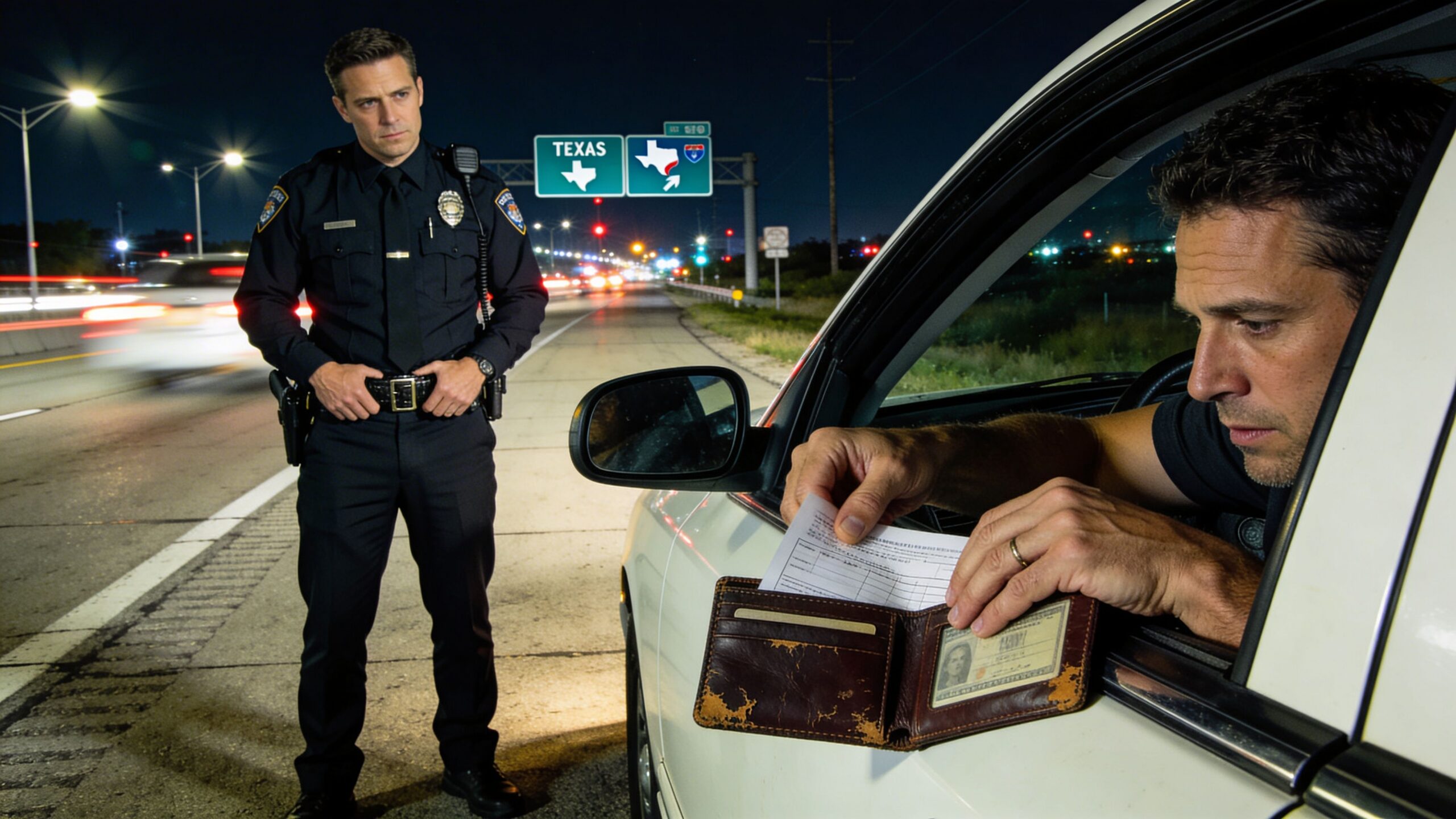
You’re driving home. You see flashing lights in the mirror. Your stomach drops. You replay the last few minutes and start guessing. Was it speed? A lane change? Did the officer see you leave a bar? Then the window comes down, and you hear the question almost every driver recognizes: do you know why i pulled you over.
That question holds more significance than it appears. In a Texas DWI stop, it’s often the first test. If you start talking, guessing, apologizing, or trying to sound cooperative, you may hand the officer exactly what they need to push the stop further. If you stay calm and answer strategically, you protect ground that may matter later in court.
That Sinking Feeling When You See Flashing Lights
A lot of good people make the same mistake in the first seconds of a stop. They think talking will help.
They say things like, “Was I speeding?” or “I know, I drifted a little,” or “I only had one drink with dinner.” They’re nervous, trying to be respectful, and hoping honesty will make the stop easier. In a DWI investigation, that can backfire fast.
Traffic stops are common. In 2020, an estimated 21% of U.S. residents aged 16 or older had contact with police, and traffic stops were a primary form of that contact, according to the Bureau of Justice Statistics. That same source makes an important point. Questions at the start of a stop are often used to observe behavior and elicit admissions.
Your stress is normal
When an officer walks up to your window, your body reacts before your brain catches up.
You may talk too much. You may laugh nervously. You may reach for documents too fast and fumble them. None of that means you’re guilty. But officers often treat those moments as evidence of impairment.
Practical rule: The stop starts before you say a word, and your first words can still make things worse.
The first question is not small talk
“Do you know why I pulled you over?” sounds casual. It isn’t.
It invites you to fill in the blanks. If you guess wrong, you still look unsettled. If you guess right, you may admit a traffic violation. If you mention drinking, even casually, you’ve made the officer’s job easier.
That’s why the right mindset matters. You’re not there to solve the officer’s investigation. You’re there to get through the stop safely while protecting your rights and your future.
Why Police Ask "Do You Know Why I Pulled You Over?"
Officers ask this question because it works.
It gets drivers talking. It gets admissions. It gives officers a chance to study tone, word choice, confusion, eye contact, and how quickly a driver starts explaining. In a DWI context, that’s valuable evidence.

They want you to admit something
The cleanest answer for an officer is an admission from you.
If you say, “I was probably going a little fast,” you may have supplied the reason for the stop yourself. If you say, “I touched the line back there,” you may have helped justify more scrutiny. Drivers often think these minor admissions make them sound honest. In reality, they can help support the stop and the next phase of the investigation.
They are studying how you answer
The question also lets the officer watch you under pressure.
A pause, rambling answer, slurred speech, or an unnecessary explanation can all become part of the report. Officers don’t need you to confess to DWI. They just need enough observations to keep building the case.
They may be trying to expand the stop
A stop can begin with one issue and grow into something else. That’s why lawyers talk so much about the line between a valid stop and an expanded investigation. If you want a plain-English breakdown, this explanation of probable cause vs. reasonable suspicion is a good place to start.
An officer may suspect impairment from the start. Or the officer may begin with a routine traffic issue and then look for a reason to pivot into DWI questions. Your words can become that pivot.
Even lawmakers have recognized the tactic
California changed the script. According to KQED’s report on Assembly Bill 2773, California’s Assembly Bill 2773, effective in 2024, requires officers to state the reason for a traffic stop before asking questions. The law targeted pretext stops and the practice of using an open-ended question to fish for information.
Texas doesn’t give drivers that same protection.
That means you need your own strategy. My view is simple. Treat this question as an investigative move, not a courtesy. If you answer like it’s harmless conversation, you’re already behind.
The officer’s question is designed to make you help build the case. You don’t have to do that.
Understanding Your Legal Rights During a Texas Traffic Stop
You have rights during a stop, but you need to understand how they work on the roadside.
A lot of drivers think, “If the officer didn’t read me my rights, what I said can’t be used.” That’s wrong in the early part of a traffic stop. And that misunderstanding hurts people every day.
Reasonable suspicion and probable cause
These are not the same thing.
Reasonable suspicion is the lower standard. It’s what an officer needs to justify stopping your car for investigation. Think of it as a specific reason to pull you over and check further.
Probable cause is the higher standard. It’s what the officer needs to make an arrest. In a DWI case, the officer tries to collect enough observations, statements, and test results to reach that point.
That distinction matters because many cases are fought at the beginning. Was the stop justified? Did the officer legally extend it? Did the officer gather evidence lawfully after the initial contact?
Miranda usually does not protect you here
Many drivers are blindsided at this point.
Under U.S. law, Miranda warnings are required only during a custodial interrogation, not during the initial investigative phase of a traffic stop. That means officers generally do not have to read you your rights before asking roadside questions, and statements like “I only had two beers” can still be used against you. That legal principle is discussed in this video explanation of Miranda during traffic stops.
So yes, your roadside admissions can absolutely become evidence.
What you must provide and what you should not volunteer
You should comply with lawful requests for basic identifying documents.
Keep your response focused and controlled:
- Provide identification: Driver’s license, registration, and proof of insurance when requested.
- Keep movements slow: Tell the officer where the documents are before reaching.
- Don’t volunteer details: You do not need to explain where you’ve been, where you’re going, or whether you drank.
- Don’t argue roadside: Legal challenges belong in court, not on the shoulder of the road.
If the stop turns toward breath testing, implied consent becomes a major issue. Texas drivers should understand what refusal can trigger, and this guide on whether you can refuse a breathalyzer in Texas helps frame that decision.
Key terms you need to know
A Texas DWI case gets easier to understand once you know the vocabulary.
| Term | Plain-English meaning |
|---|---|
| BAC | Blood alcohol concentration. This is the measurement used in alcohol testing. |
| Field sobriety test | Roadside coordination tests officers use to look for signs of impairment. |
| Implied consent | By driving in Texas, you are considered to have agreed to provide a breath or blood specimen after a lawful DWI arrest under certain circumstances. |
| Administrative license suspension | A license suspension handled through a separate process tied to testing issues, often called the ALR process in Texas practice. |
The most important point is simple. You are not required to talk your way through a DWI investigation. In most cases, talking only helps the officer.
The Right Way to Respond and Protect Your Future
You don’t need a speech. You need a script.
When the officer asks, do you know why i pulled you over, your job is to stay polite, give required documents, and stop there. Don’t guess. Don’t confess. Don’t try to charm your way out of it.
The best first response
For most drivers, the safest answer is short and neutral:
“No, officer.”
That answer does three things. It stays respectful. It avoids admitting a violation. It doesn’t give the officer a new thread to pull.
If the officer keeps asking questions, stay just as controlled.
Useful responses include:
- “I’m providing my license and insurance.”
- “I’d prefer not to answer questions.”
- “I want to remain silent.”
You do not need to be rude. You do need to be disciplined.
What not to say
Many DWI arrests grow out of the driver’s own words. A common mistake is admitting a small violation like speeding or drifting, which can then be used as evidence of poor judgment or recklessness and help support probable cause, as discussed in this video on what not to say during a stop.
These are bad responses:
- “I was only going a little fast.”
- “I’m sorry, I had a couple drinks.”
- “I’m tired, that’s why I was swerving.”
- “I’m coming from a bar, but I’m fine.”
- “I only live a few minutes away.”
Every one of those statements gives the officer more to write down.
Traffic Stop Do's and Don'ts
| Action | Do | Don't |
|---|---|---|
| Initial response | Say “No, officer” or remain politely neutral | Guess why you were stopped |
| Tone | Stay calm and respectful | Argue, joke, or act sarcastic |
| Documents | Provide license, registration, and insurance when requested | Dig around suddenly or reach without warning |
| Questions about drinking | Decline to answer | Minimize with “just one” or “just two” |
| Questions about where you were | Say you prefer not to answer | Volunteer bar, restaurant, or party details |
| Traffic violation accusations | Listen without admitting fault | Apologize and confirm the violation |
| Physical behavior | Keep hands visible | Fumble, point, or make quick movements |
How to sound calm without sounding guilty
A lot of people worry that silence makes them look suspicious.
That’s the wrong concern. The primary risk is giving the officer words that can be repeated in a police report and later quoted in court. Polite silence is better than helpful conversation.
Use a steady voice. Keep your hands visible. Follow lawful instructions. But don’t try to explain your way out.
A simple roadside script
If you freeze up under pressure, remember this pattern:
- Pull over safely.
- Keep your hands visible.
- Wait for instructions.
- Provide documents when asked.
- Answer the opening question with “No, officer.”
- Decline follow-up investigative questions.
- Do not admit drinking, fatigue, speeding, or lane mistakes.
“I’d like to remain silent and not answer questions.”
That line is powerful because it is clear, polite, and protective.
From Roadside Questions to DWI Tests in Texas
Once the officer thinks the stop may involve alcohol or drugs, the encounter changes.
The officer starts collecting indicators. These may include how you speak, how you move, whether there is an odor of alcohol, whether your eyes appear bloodshot, and whether you have trouble handling simple instructions. At that point, the opening question has already done its work if you gave the officer extra information.
Field sobriety tests
A field sobriety test is a set of roadside exercises officers use to look for signs of impairment.
The three tests drivers hear about most often are:
- HGN: The eye test, where the officer watches eye movement.
- Walk-and-Turn: A heel-to-toe test with instructions that must be followed exactly.
- One-Leg Stand: A balance test done under stress, often on uneven ground or poor lighting.
These tests are presented as objective. In practice, they are often highly subjective. The officer gives instructions, watches for “clues,” and writes the report. If you are tired, anxious, older, injured, overweight, wearing the wrong shoes, or standing on a bad surface, that can affect performance.
Breath tests and blood tests
Here, implied consent matters.
In plain English, implied consent means Texas treats driving as carrying certain obligations if you are lawfully arrested for DWI. One major consequence involves chemical testing. An officer may request a breath or blood specimen, and refusing can trigger an administrative license suspension through a separate process.
That separate process is commonly called the ALR process. It is not the criminal case itself, but it can hit your ability to drive fast.
Why the stop can turn quickly
A stop that begins with a lane issue or speed allegation can quickly become a DWI case if the officer believes there are signs of impairment. That shift often happens because of a combination of observations and your own statements.
That’s why the first minutes matter so much. Silence doesn’t stop the officer from investigating. It does stop you from making the report stronger.
Know the sequence
The roadside progression usually looks like this:
| Stage | What the officer is doing |
|---|---|
| Initial contact | Looking for admissions, nervousness, confusion, and physical signs |
| Follow-up questions | Asking about drinking, destination, and recent activity |
| Exit from vehicle | Watching balance, coordination, and compliance |
| Field sobriety phase | Gathering more observations to support arrest |
| Chemical test decision | Requesting breath or blood after arrest, with license consequences in play |
A short video can help make this process easier to recognize under pressure.
Why definition matters in a DWI case
A few terms control major decisions:
- BAC is the alcohol concentration measurement tied to breath or blood evidence.
- Field sobriety test means roadside exercises used to support impairment claims.
- Implied consent means Texas can attach license consequences to refusal after a lawful arrest.
- Administrative license suspension means a separate threat to your driving privileges, apart from the criminal charge.
If you understand those terms before you need them, you’re less likely to panic and make a bad decision in the moment.
After a DWI Arrest The Clock Starts Ticking Immediately
An arrest is not the end of the case. It is the start of a deadline-driven fight.
The first hours and days matter. Your memory is freshest. Video may still be available. Witnesses are easier to locate. And one administrative deadline in Texas is especially important.
The ALR deadline is immediate
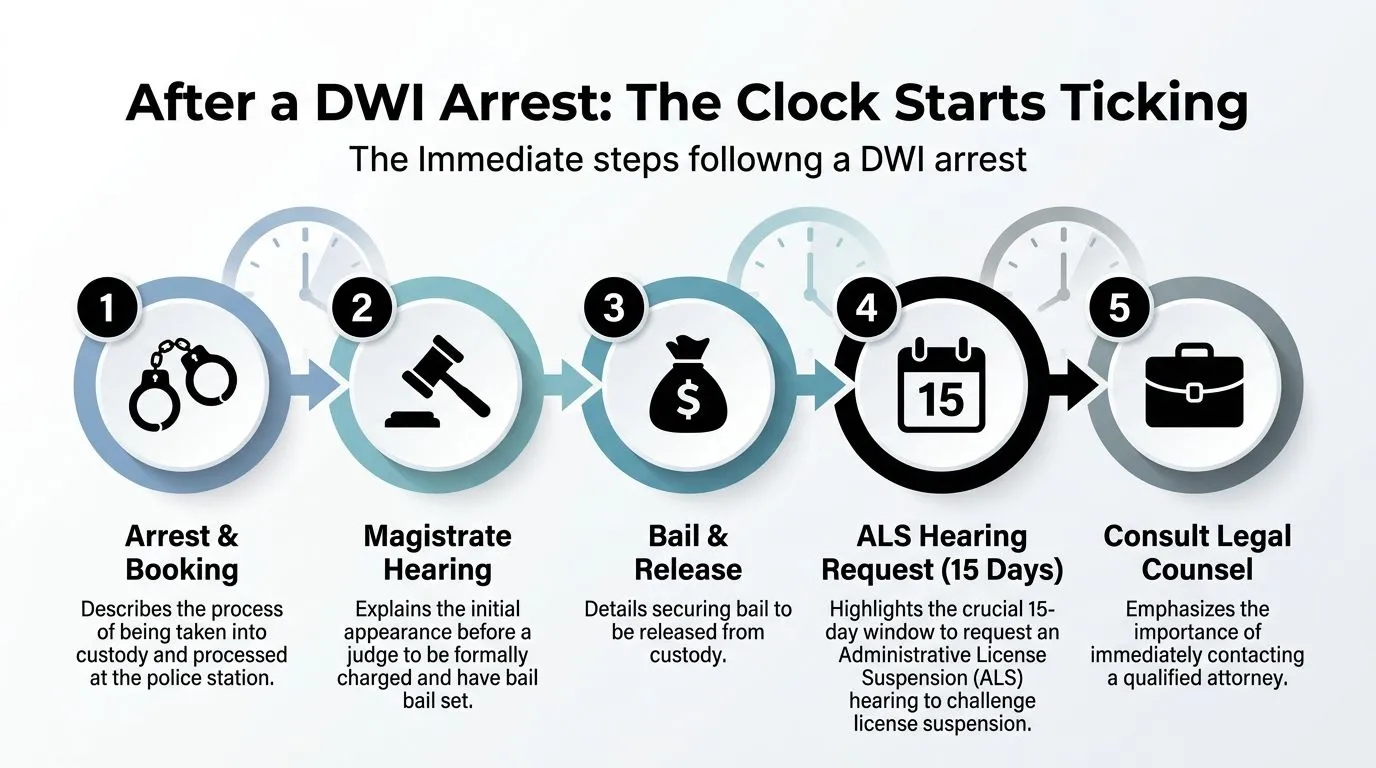
If your case involves a license suspension issue, you generally have 15 days from the date of arrest to request an ALR hearing.
Miss that window, and the suspension process can move forward without that challenge. This is one of the most important deadlines in the entire case because it affects your ability to drive and can also create an early chance to examine the officer’s version of events.
What happens right after arrest
The process usually moves fast.
Here is the practical sequence:
Arrest and booking
You’re taken into custody, fingerprinted, photographed, and processed.Magistrate hearing
A judge advises you of the charge and addresses conditions of release.Bond and release
You may be released after bond is set and conditions are accepted.ALR hearing request
This must be addressed quickly if license consequences are in play.Defense preparation
The criminal case begins taking shape almost immediately.
What you should do while details are fresh
Do this as soon as you can:
- Write down the timeline: When you were stopped, what was said, what you were asked, and what you answered.
- Note physical conditions: Weather, lighting, road surface, footwear, injuries, fatigue, and medical issues.
- Save documents: Bond papers, tow paperwork, test paperwork, and release documents.
- Identify witnesses: Anyone who saw your driving, your stop, or your condition before the arrest.
Write down your memory before you sleep on it. Small details become valuable later.
First DWI in Texas still needs a serious response
A first DWI in Texas is not a “just pay the ticket” problem.
Even a first case can affect your license, employment, insurance, professional reputation, and future criminal record. The biggest mistake I see is delay. People wait because they hope the case will sort itself out. It won’t.
If you want to fight DWI Texas the right way, the first move is fast, organized action.
How a Houston DWI Lawyer Begins Your Defense
A good defense starts at the first second of police contact, not at trial.
That matters because a DWI case is often built piece by piece. The stop. The conversation. The request to exit. The field tests. The arrest. The test request. If one part is weak or unlawful, that can affect everything after it.
The first question in the case
A Houston DWI lawyer should examine the opening of the stop with a hard eye.
That review often includes questions like these:
- Was there a lawful reason for the stop?
- Did the officer improperly extend the detention?
- Did your statements come from pressure, confusion, or improper questioning?
- Were field tests administered fairly?
- Was breath or blood evidence obtained lawfully?
Legal strategy becomes concrete at this stage. A defense lawyer doesn’t just say, “My client is a good person.” A defense lawyer attacks the state’s proof.
DWI penalties and why they raise the stakes
Texas DWI law can expose you to criminal penalties, license consequences, court conditions, and long-term record damage.
That’s why terms like Texas DUI attorney, DWI license suspension, and first DWI in Texas matter in real life, not just in search results. The right lawyer is not there only to stand beside you in court. The right lawyer works to reduce damage early, challenge weak evidence, and look for paths toward dismissal, reduction, or a better outcome.
The defense work often starts before the prosecutor is ready
Early defense action can include:
- Requesting the ALR hearing: This protects your position on the license side and may create an early opportunity to question the officer.
- Preserving evidence: Dashcam, bodycam, dispatch records, and test records can matter.
- Evaluating suppression issues: If evidence was gathered unlawfully, it may be challenged.
- Reviewing license strategy: This is especially important if your job depends on driving. Information about Texas DWI license defense can help you understand that side of the case.
The goal is not panic. It provides an advantage.
People often call a lawyer assuming the case is already lost because they were arrested.
That is not how DWI defense works. Arrest is not conviction. Police reports are not infallible. Field tests are not perfect. Breath and blood evidence can be challenged. The initial stop itself may be vulnerable.
A strong defense asks one blunt question at every stage: can the state actually prove this lawfully and reliably?
That is how you protect your record, your license, and your future. Not with roadside explanations. Not with hope. With disciplined action and immediate legal review.
If you were stopped, arrested, or you’re worried about a DWI license suspension, don’t wait. The Law Office of Bryan Fagan, PLLC helps Texans challenge DWI stops, ALR hearings, breath and blood evidence, and criminal charges across Houston and beyond. If you need a Houston DWI lawyer or Texas DUI attorney, request a free consultation to review your case, protect your driving privileges, and build a plan to fight your DWI in Texas.

