
A DWI arrest can be overwhelming, but you don't have to face it alone.
If you're reading this after a late-night arrest, a bond release, or a call from a family member asking what happens next, your mind is probably racing. You may be worried about your license, your job, your record, your insurance, and whether one mistake will follow you for years. Those fears are understandable.
The short answer to "Do I need a lawyer for a DWI in Texas?" is yes, in most cases, you should talk to one right away. Not because every case goes to trial, and not because every arrest ends in a conviction, but because Texas starts the process fast. Important deadlines can begin immediately, and one of the first threats isn't always jail or court. It's your ability to keep driving.
Many people wait too long because they think the first court date is the first real deadline. It usually isn't. If you want a practical overview of that early stage, this guide on whether you should call a lawyer after a DWI arrest in Texas is a helpful starting point.
A DWI Arrest Is Overwhelming but You Have Options
The first few days after a Texas DWI arrest often feel disorganized. You may have paperwork in your hand, a court date you don't fully understand, and instructions that sound more technical than helpful. That's normal. It's common not to have prior experience with the DWI system.
What matters now is knowing that you still have options. A DWI case isn't one single event. It's a series of decisions, deadlines, and legal issues. Some involve your driver's license. Others involve the criminal charge itself. A good defense starts by sorting those pieces out quickly.
Why the answer is usually yes
If you ask a defense lawyer, "Do I need a lawyer for a DWI in Texas," the true question behind it is usually this: can I protect my license, reduce the damage, and avoid making things worse? That's where legal help matters.
A lawyer can step in early to:
- Protect your driving privileges by responding to the administrative process on time
- Review the stop and arrest for problems with probable cause or police procedure
- Evaluate testing issues involving breath, blood, or field sobriety evidence
- Handle court communication so you don't guess your way through a criminal case
- Look for outcomes short of conviction when the facts support negotiation or dismissal
Practical rule: The earlier a lawyer reviews the arrest, the more options you usually have to preserve evidence, respond to deadlines, and build leverage.
The first goal is stability
When people panic, they often focus only on the final outcome. But your first job isn't to predict how the case ends. It's to stabilize the situation. That means identifying deadlines, protecting your license if possible, and making sure you don't miss a step that hurts you later.
Texas DWI law is serious, but it isn't unbeatable. The path forward gets easier once you understand what is happening and why each step matters.
The 15-Day ALR Deadline Your First and Most Urgent Fight
You get out of jail, find your phone full of missed calls, and start thinking about court. That reaction is normal. But the first deadline that can hurt you often arrives before your first court date even matters. It involves your driver's license, and it starts running almost immediately.
After a Texas DWI arrest, you have a short window to request an Administrative License Revocation hearing. If no request is made in time, the state can move ahead with suspending your license. For many people, that is the first real disruption. Work gets harder. School drop-offs get harder. Medical appointments, probation meetings, and basic errands all become more complicated.
Here is the timeline at a glance:

What ALR means in plain English
Administrative License Revocation, or ALR, is the part of a DWI arrest that deals with your ability to drive. It is a separate process from the criminal charge. A simple way to understand it is this: one track threatens your license, while the other track deals with the DWI accusation in court.
That distinction trips people up. A lot of drivers assume they can wait until the court date and sort everything out then. The ALR process does not wait for that.
If you were recently arrested for DWI in Texas, quick action can protect options that disappear fast.
Why lawyers focus on this deadline first
A lawyer often starts here because this deadline is immediate and missing it can hand the state an early win. Requesting the hearing is not only about trying to keep you on the road. It can also create an early opportunity to review the officer's reasons for the stop, the arrest, and the testing request.
That matters because the first stage of a DWI case is often about stability. Before you worry about final outcomes, you want to stop avoidable damage. Protecting your driving privileges, or at least preserving the chance to fight for them, is part of that.
This pressure falls hardest on people whose daily lives depend on driving:
- CDL holders who need a valid license to keep working
- Parents who handle school, childcare, and appointments
- Commuters with no practical public transportation option
- Workers who travel between job sites, clients, or counties
A missed deadline can turn a scary case into a transportation crisis.
What a lawyer can do during the ALR stage
At this point, a lawyer's job is part shield and part early investigator. Counsel can request the hearing on time, track the paperwork, prepare you for what the process looks like, and start examining the state's version of events.
The ALR hearing can also help expose details early. In some cases, it gives the defense a chance to hear testimony or pin down facts before the criminal case is further along. That does not guarantee a result, but it can give your defense a better starting position than waiting and reacting later.
This video gives a useful overview of the urgency involved in the early stage of a Texas DWI case:
Missing the ALR deadline does not end your criminal case. It can cost you an early chance to fight for your license and gather useful information at the start.
Early terms that confuse people
A few phrases show up quickly after a DWI arrest, and they are easier to deal with once they are translated into plain English:
- BAC means blood alcohol concentration.
- Implied consent means Texas treats driving as agreement to provide a breath or blood specimen in certain lawful DWI investigations.
- Field sobriety test usually refers to roadside exercises an officer uses to look for signs of intoxication.
- Administrative license suspension means the state can suspend your driving privileges through the ALR process apart from anything that happens in criminal court.
The Two Cases Against You ALR vs Criminal Court
A Texas DWI arrest usually creates two legal problems at the same time. That's why the process feels confusing. You're not dealing with one case. You're dealing with two.
A Texas-focused source explains that a DWI arrest creates an administrative license revocation case with the Department of Public Safety and a separate criminal case in court, and your license can be suspended through the ALR process even if you are not ultimately convicted in criminal court, according to this explanation of Texas DWI proceedings.

What the ALR case is about
The ALR case is about one thing: your privilege to drive.
It is handled on the administrative side, not in the criminal courtroom. The questions there are tied to license suspension and the events surrounding the arrest. Even when people feel confident they can work out the criminal charge later, the ALR side can move ahead on its own track.
What the criminal case is about
The criminal case is where the state seeks penalties tied to the DWI charge itself. That can include:
- Jail exposure
- Fines
- A criminal record
- Court conditions and supervision
- Longer-term consequences for employment or licensing
These two matters can overlap in evidence, but they are not the same proceeding.
A simple way to think about it
Think of a DWI arrest like opening two files on the same day.
One file is labeled license.
The other is labeled criminal charge.
You have to respond to both. Winning one doesn't automatically win the other. Losing one doesn't automatically lose the other either. That's why a complete defense isn't just "show up in court and explain what happened."
A DWI defense works best when someone is tracking both fronts at the same time, because the administrative timeline and the court timeline don't always move together.
Where people often get confused
The confusion usually comes from assumptions like these:
| Common assumption | What actually happens |
|---|---|
| "My first court date is my first deadline." | Your license issue may already be moving before that. |
| "If I beat the criminal case, my license is automatically safe." | The ALR matter can have its own outcome. |
| "The hearing about my license isn't that important." | For many people, keeping the ability to drive is the first urgent priority. |
When considering a Houston DWI lawyer or Texas DUI attorney, this is one of the first things you should ask about: whether that lawyer handles both the ALR side and the criminal side as part of one strategy.
Texas DWI Penalties by Offense Type
After the first shock wears off, many people ask the same question: "What could happen to me?"
That question matters, but it helps to answer it in the right order. The 15-day license deadline often needs attention first because your ability to drive can be at risk almost immediately. After that, you need a clear picture of the criminal penalties tied to the charge itself. A good defense strategy has to account for both. If you are also trying to protect your driving privileges, this guide to Texas DWI license defense options can help explain that separate part of the case.
Texas punishes DWI more harshly with each conviction. A first case is serious. A repeat case can change the stakes fast, including the difference between county jail and prison.
Texas DWI Penalties at a Glance
| Offense | Jail Time | Fine | License Suspension |
|---|---|---|---|
| First DWI | Up to 180 days, with at least three mandatory days | Up to $2,000 | Up to one year |
| Second DWI | One month to one year | Up to $4,000 | Up to two years |
| Third DWI | Two to 10 years in prison | Up to $10,000 | Penalties increase sharply |
Those numbers are the starting point, not the full picture.
A DWI case works a little like a staircase. Each prior conviction can move you up to a higher step, where the consequences become harder to manage and the prosecutor has more pressure points to use in plea talks. That is one reason early case decisions matter so much. A quick guilty plea may feel like the fastest way to end the stress, but it can make a later arrest far more dangerous.
Why the charge level matters
Even a first-offense DWI can bring jail exposure, fines, a suspended license, court conditions, and a lasting record. For someone who drives to work, takes children to school, or holds a professional license, those penalties can ripple into daily life almost immediately.
Repeat cases raise the pressure much more. At that point, the case is no longer just about paying a fine and getting through court. It can become a fight over long-term freedom, employment, insurance costs, and whether one case will keep shaping the next several years of your life.
Facts that can raise the stakes
The offense count is not the only factor. Certain facts can make the case more serious or harder to resolve favorably, including:
- A high BAC allegation
- A child passenger allegation
- An accident or claimed injury
- A commercial driver's license issue
- A prior criminal or alcohol-related history
These details affect how prosecutors evaluate the case, how judges view risk, and what kinds of plea offers may be available.
That is why two people charged with "DWI" can face very different outcomes. The label may sound the same, but the exposure depends on your record, the facts of the stop, the testing evidence, and how quickly the defense gets to work.
What a Texas DWI Lawyer Actually Does for Your Case
Many understand that a lawyer "represents" them. Fewer know what that looks like in practice. In a Texas DWI case, the work often begins long before trial.
A Texas source explains that the state must prove intoxication and operation of a motor vehicle, often using breath tests, blood tests, field sobriety evidence, and police procedures. That same source notes that an effective defense may challenge the basis for the stop, test reliability, and procedural errors, as described by this Texas DWI defense overview.

The first stage is investigation
A lawyer doesn't start with a speech. A lawyer starts with the file.
That can include reviewing:
- The police report
- Body camera or dash camera footage
- Breath or blood test records
- Field sobriety test details
- Timing, location, and officer observations
- Any paperwork tied to the arrest and booking
Sometimes the issue is whether the officer had lawful grounds to stop you. Sometimes it's whether the arrest was supported by the evidence. Sometimes it's whether testing was handled correctly.
Then the defense starts taking shape
A skilled lawyer may look for legal and factual pressure points such as:
Probable cause problems
If the stop or arrest wasn't legally supported, the defense may challenge that directly.Testing reliability issues
Breath and blood evidence can raise questions about collection, handling, procedure, or interpretation.Field sobriety weaknesses
These tests are often presented as clear indicators, but real-world conditions matter. Lighting, footwear, weather, medical issues, and officer instructions can all affect performance.Procedural errors
Police procedure matters. A mistake in how evidence was obtained or documented can change the direction of the case.
Legal reality: Good DWI defense is often technical. It isn't just telling your side of the story. It's testing whether the state can actually prove its case under the rules.
A lawyer also handles the practical pressure
Many clients don't need a dramatic courtroom moment first. They need someone to take control of the process.
That may include requesting hearings, appearing in court, speaking with prosecutors, evaluating plea options, preparing motions, and advising you about whether to contest or negotiate. If you're dealing with a DWI license suspension, resources on Texas DWI license defense can help you understand that part of the process.
One option some Texans consider for this kind of representation is Law Office of Bryan Fagan, PLLC, which handles DWI defense matters including license hearings and court proceedings.
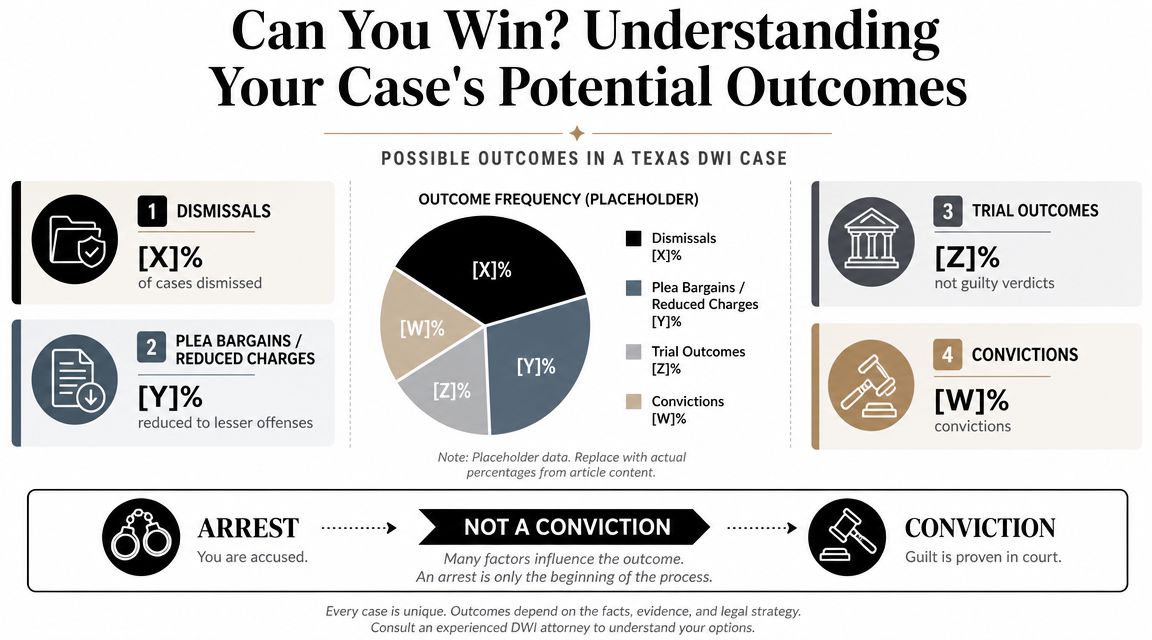
Can You Win Understanding Your Case's Potential Outcomes
A DWI arrest is serious. It is not the same thing as a conviction.
Texas statewide data from 2020 shows 83,088 DWI charges. Of those, 3,275 resulted in releases with no charge, 33,476 ended in guilty pleas, 1,826 involved not-guilty pleas, 23,258 resulted in convictions on the original charge, and 10,302 resulted in convictions on a different charge, according to Texas DWI outcome data discussed here. Those numbers show something important. Cases end in different ways.
The main takeaway from the data
The takeaway isn't that every case can be beaten. It is that outcomes vary widely, and the state's original charge doesn't always survive unchanged.
That matters because many people make an early decision based on fear. They assume the arrest decides everything. It doesn't. The evidence still has to be evaluated, challenged where appropriate, and negotiated or litigated with care.
Common paths a case may take
A Texas DWI case can end in several ways, depending on the facts and the defense strategy:
Dismissal
Sometimes the evidence is too weak, a legal issue develops, or the state decides not to proceed.Reduction to a different charge
The 2020 Texas data includes many convictions on a different charge, which shows that the original allegation can change.Plea resolution
Some cases are resolved through negotiated agreements rather than trial.Trial
In some situations, the right move is to fight the charge in court and require the state to prove every element.
What this means for you
If you're asking whether to fight DWI in Texas, the honest answer is that the value of fighting depends on the evidence, the legal issues, your history, and your goals. But it is a mistake to assume there is nothing to fight.
An arrest begins the case. It does not write the ending.
The strongest approach is usually to get a lawyer involved early enough to preserve your options, identify weaknesses in the state's proof, and choose a strategy based on facts instead of panic.
Frequently Asked Questions About Texas DWI Defense
Do I need a lawyer for a first DWI in Texas
In most situations, yes. A first allegation can still threaten your license, your record, and your finances. Many people underestimate a first case because they have never been in trouble before. But the system doesn't slow down just because it is your first arrest.
A lawyer can help you respond to deadlines, evaluate the evidence, and avoid decisions that may hurt you later.
Can I represent myself
You can, but that doesn't mean you should. DWI cases involve legal procedure, evidence issues, deadlines, and administrative consequences that are easy to misunderstand. If your case includes breath or blood evidence, field sobriety tests, or a disputed traffic stop, the legal analysis gets technical quickly.
Even confident, organized people often find that self-representation is much harder than they expected.
What should I look for when hiring a Houston DWI lawyer
Look for someone who can clearly explain the difference between the license case and the criminal case, answer questions directly, and discuss how they review evidence. You want a lawyer who understands:
- ALR hearings
- Breath and blood evidence
- Field sobriety testing issues
- Motion practice and suppression issues
- Local court procedure
A good consultation should leave you with more clarity than you had before the call.
How much does a DWI lawyer cost
Fees vary based on the complexity of the case, the county, the lawyer's experience, and whether the case is likely to involve extensive motion work or trial preparation. Because pricing differs from firm to firm, the most useful step is to ask for a clear explanation of what is included.
If cost is your concern, compare legal fees to the larger financial consequences that can come with a DWI allegation, including court-related costs, license problems, and work disruption.
Can I get a DWI off my record in Texas
Sometimes, but eligibility depends on how the case ends and your legal history. Two terms often come up here:
- Expunction means clearing eligible records from public access in certain situations.
- Non-disclosure refers to sealing certain records in situations allowed by Texas law.
Not every DWI case qualifies. This is one of those questions that needs a case-specific answer. If your charge is dismissed, reduced, or resolved in a particular way, your options may be different than you expect.
What should I do right after a DWI arrest
Start with the basics:
- Read every paper you were given and keep it in one place.
- Write down what happened while it is still fresh.
- Do not miss deadlines tied to your license or court appearance.
- Avoid discussing the facts casually with people who don't need to know.
- Schedule a legal consultation quickly so you know what comes next.
Is a breath test result unbeatable
No. A breath result can be powerful evidence, but it is still evidence that must be handled and interpreted properly. The same is true for blood testing and police observations. The issue in a defense case is not whether the state has paperwork. The issue is whether the state can prove guilt under the law with reliable evidence.
That is why people ask, "Do I need a lawyer for a DWI in Texas?" and why the answer is usually practical rather than dramatic. You need someone who can test the evidence, protect your license, and guide the case from the beginning.
If you were arrested and need answers now, Law Office of Bryan Fagan, PLLC offers free consultations for Texans facing DWI charges. You can get help understanding the ALR deadline, your court process, possible defenses, and whether expunction or record-sealing issues may matter later. The sooner you ask questions, the sooner you can make a calm, informed plan for your case.