 Skip to content
A DWI arrest can be overwhelming—but you don’t have to face it alone. One minute you’re driving, the next your world is turned upside down. But your first move can define your entire defense. The most important thing you can do is call an experienced Dallas DWI defense attorney right away to protect your rights, challenge the evidence, and build a strategy to protect your future. Acting fast is your single biggest advantage.
What To Do Immediately After a Dallas DWI Arrest
A DWI arrest in Dallas can leave you disoriented and scared, but the actions you take in the first 48 hours are absolutely critical. This is your window to shift from a state of fear to one of proactive defense. It all starts with understanding your rights and the urgent deadlines you're up against.

The most important thing you can do is exercise your right to remain silent. It's human nature to want to explain your side of the story, but every word you say can—and will—be used against you. Politely tell the officer you will not answer any questions without your lawyer present.
The moments after a DWI arrest are a blur of confusion and high-stakes deadlines. The table below breaks down the immediate, non-negotiable steps you must take to protect your driver's license and build the strongest possible defense.
Your DWI Arrest Checklist: The First 48 Hours
Follow these critical steps immediately after a Dallas DWI arrest to safeguard your rights and driving privileges before key deadlines pass.
| Action Item | Why It's Critical | Deadline |
|---|---|---|
| Contact a DWI Attorney | Your lawyer needs to file crucial paperwork, preserve evidence, and guide you through the next steps before deadlines pass. | Immediately |
| Request Your ALR Hearing | This is the ONLY way to fight an automatic license suspension. Miss this, and you lose your license, period. | Within 15 days |
| Write Down Everything | Document every detail of the stop, arrest, and tests while it's fresh. These notes are invaluable for your defense. | ASAP |
| Preserve Evidence | Save receipts, GPS data, and get contact info for any witnesses. This evidence can disappear quickly. | Within 24-48 hours |
Taking these actions puts you back in control. It allows your attorney to get ahead of the prosecution and start fighting for you from day one.
The 15-Day Deadline You Cannot Miss
After a DWI arrest in Texas, a clock starts ticking on your driver's license. You have only 15 days from the date of your arrest to request an Administrative License Revocation (ALR) hearing.
This is not a suggestion; it is a non-negotiable deadline. Failing to request this hearing results in the automatic suspension of your driver’s license, regardless of the outcome of your criminal case.
Think of the ALR hearing as round one of your fight. It’s a civil proceeding, separate from your criminal case, where we can challenge the state's attempt to suspend your license. More importantly, it's our first chance to gather evidence and question the arresting officer under oath—testimony that can be incredibly valuable for your criminal defense later on.
When you hire a skilled Dallas DWI attorney, we handle this deadline for you, ensuring the request is filed correctly and on time.
Understanding Key Terms and Your Next Steps
The legal language thrown at you during a DWI can be confusing. Here are a few key terms explained in clear, simple language:
- Blood Alcohol Concentration (BAC): This is the percentage of alcohol in your bloodstream. In Texas, the legal limit for drivers 21 and over is 0.08%. For commercial drivers, it's 0.04%, and for drivers under 21, any detectable amount is a violation.
- Implied Consent: Just by driving on a Texas road, you have legally agreed to give a breath or blood sample if an officer lawfully arrests you for DWI. Refusing the test has its own set of consequences, starting with a longer, more severe automatic license suspension.
- Field Sobriety Test: These are physical and mental exercises an officer may ask you to perform during a traffic stop to gauge impairment. They are highly subjective and often administered incorrectly.
- Administrative License Suspension: This is a civil penalty separate from your criminal case. It is automatically triggered by a BAC test failure or a test refusal unless you request an ALR hearing within 15 days.
Your immediate job is to preserve your memory of the events. As soon as you can, write down every single detail you recall about the traffic stop, what the officer said, the questions they asked, and any tests you were asked to perform. These notes could be the key to your defense. For more guidance, our detailed post-arrest checklist for DUIs in Texas gives you a clear, step-by-step plan.
Facing this process alone is a risk you simply don't have to take. At the Law Office of Bryan Fagan, PLLC, we handle the urgent legal filings and deadlines so you can focus on your life. We are here to provide the reassurance and aggressive defense you need right now.
The True Cost of a Texas DWI Conviction
When most people think about the cost of a DWI, their minds go straight to court fines and the threat of jail. While those are serious, they're just the beginning. A DWI conviction in Texas is like a stone dropped into a pond; the initial splash is the criminal case, but the ripples keep spreading, touching every corner of your life for years to come.

Understanding what's really on the line is the first step toward building a defense that protects more than just your freedom—it’s about safeguarding your financial future, your career, and your reputation. As your Dallas DWI defense attorney, our job is to stop those ripples before they can turn into a tidal wave.
Texas DWI Penalties Explained
Texas law takes DWI offenses seriously, and the penalties escalate quickly. Here’s a quick look at the direct consequences you’re up against:
- First-Time DWI: A Class B Misdemeanor, punishable by fines up to $2,000, jail time from 72 hours to 180 days, and a driver's license suspension for up to a year.
- DWI with a BAC of 0.15% or Higher: Even for a first DWI in Texas, this is elevated to a Class A Misdemeanor, with fines climbing to $4,000 and up to a full year in jail.
- Second DWI: This is also a Class A Misdemeanor. The potential fines hit $4,000, but jail time increases to a minimum of 30 days up to one year, with a license suspension of up to two years.
- Third or Subsequent DWI: This is a Third-Degree Felony. A conviction can land you in state prison for 2 to 10 years, with fines up to $10,000 and a long-term license suspension.
These are the penalties the judge hands down. But frankly, the costs that pile up outside the courtroom are often the ones that hurt the most.
The Hidden Financial Ripple Effects
Beyond the court-ordered fines, a DWI conviction unleashes a flood of hidden expenses. It’s not an exaggeration to say a first-time DWI in Dallas can cost you anywhere from $6,000 to $15,000 or more when all is said and done.
This figure includes mandatory DWI education classes, court-ordered substance abuse evaluations, and monthly probation fees. But the real budget-killers are the long-term costs.
A DWI conviction is one of the fastest ways to see your car insurance premiums explode. It's not uncommon for drivers to see their rates triple—or even more—and be forced to carry high-risk SR-22 insurance for years just to stay legal on the road.
On top of that, the Texas Department of Public Safety (DPS) will hit you with annual surcharges just to keep your license. These fees can run from $1,000 to $2,000 per year for three years. Then there's the cost of the mandatory ignition interlock device (IID). You'll have to pay for the installation and the monthly monitoring fees for this device, which prevents your car from starting if it detects alcohol on your breath.
Our firm has put together a full guide to help you get a handle on all these expenses. You can learn more by reading about the hidden costs of a DUI charge.
Professional and Career Consequences
For many of our clients, the most devastating consequence of a DWI conviction isn't the money—it's the threat to their livelihood. A permanent criminal record can put your current job on the line and slam the door on future opportunities.
If you hold a professional license—if you're a nurse, pilot, teacher, real estate agent, or even a lawyer—a DWI conviction can trigger a review by your state licensing board. This could lead to a suspension or, in the worst cases, a full revocation of the credentials you've worked so hard to achieve.
And for Commercial Driver's License (CDL) holders, the impact is immediate and catastrophic. A DWI conviction in your personal vehicle can lead to a one-year disqualification of your CDL for a first offense. A second offense means a lifetime ban. It doesn't just put your job at risk; it can end your entire career.
This is why a strategic defense isn't just about fighting the criminal charge. It’s about protecting every part of your life from these devastating collateral consequences.
How a Top Dallas DWI Attorney Builds Your Defense
A DWI charge is an accusation, not a life sentence. The prosecutor’s case might look airtight on the surface, but an experienced Dallas DWI defense attorney knows most cases are built on a foundation of shaky procedures, subjective opinions, and questionable evidence. Our job is to find those cracks and tear the whole thing down.
Think of the State's case like a cheap chain—it’s only as strong as its weakest link. A skilled lawyer doesn't just hope for a lucky break; we methodically hunt for that one faulty link. Because if we can break it, the entire case against you can fall apart.
Challenging the Initial Traffic Stop
Your defense starts long before the officer ever asks you to step out of the car. The Fourth Amendment protects you from unreasonable seizures, which means the police officer needed a legitimate, legal reason—reasonable suspicion—to pull you over in the first place.
This is the first and often most critical hurdle for the prosecution. An officer can't just stop you on a hunch, because you're driving late at night, or based on a vague feeling. They have to point to a specific, observable fact, such as:
- A clear traffic violation, like speeding, running a stop sign, or having an expired registration.
- Erratic driving, like weaving across lanes, braking for no reason, or nearly hitting something.
If we can prove the officer didn't have a valid reason for the stop, then everything that came after—the field sobriety tests, your statements, and even the breath or blood test—can be thrown out of court. This is often the quickest and most powerful way to win a DWI case in Texas.
Exposing Flaws in Field Sobriety Tests
Standardized Field Sobriety Tests (SFSTs) are far from the scientific proof police want you and a jury to believe they are. They are essentially coordination exercises that many sober people would fail in a quiet, well-lit room, let alone on the side of a highway with flashing lights in their eyes.
A common misconception is that "failing" a field sobriety test means you're intoxicated. The reality is these tests are incredibly subjective and full of potential errors, making them fertile ground for a strong legal challenge.
An effective defense dissects every second of how these tests were given. We dig into several key areas:
- Improper Instructions: Did the officer give the instructions exactly as required by the National Highway Traffic Safety Administration (NHTSA) manual? Even a small deviation can invalidate the test.
- Environmental Factors: Was the test done on a flat, dry, well-lit surface? We look for uneven pavement, poor lighting, wind, or bad weather—anything that could have thrown you off.
- Personal Factors: Do you have any medical issues, old injuries, or are you over 65? Things like age, weight, and physical limitations can make passing these tests impossible for a sober person.
Even the shoes you were wearing can make a difference. We scrutinize every frame of dashcam and bodycam video to spot these errors and use them to argue the test results are unreliable.
How to Fight a Breath Test Result
The so-called "scientific" evidence from a breath or blood test is usually the prosecution's prized possession, but it's nowhere near as foolproof as they claim. We launch a full-scale assault on the validity of these chemical tests. You can learn more about the legal mechanics behind this in our guide on how to file a motion to suppress evidence in Texas.
With breath tests, we immediately demand the maintenance and calibration logs for the specific machine used in your case, like the Intoxilyzer 9000. We also check the officer's credentials. Were they even certified to operate the machine? A breathalyzer that hasn't been properly cared for is just a number-generating machine, not a reliable tool.
For blood tests, the fight gets even more intense. We audit the chain of custody—the detailed log that tracks every single person who handled your blood sample from the moment it was drawn to the moment it was tested. Any gap or mistake in that paper trail could mean contamination or tampering. We also challenge the lab's testing procedures, the qualifications of the lab tech, and whether the blood draw itself was done legally by a qualified medical professional.
What Happens After a DWI Arrest: Two Battles, One Strategy
When you get arrested for a DWI in Texas, it feels like the world stops. But what most people don't realize is that the legal system just started two different clocks ticking against you. A DWI isn't one case; it's two separate battles fought on different fronts at the same time.
You're facing a civil action to take away your driver's license and a criminal case that could affect your freedom and future. It's a complex fight, and how you handle one can dramatically impact the other. An experienced DWI lawyer knows how to manage both battlefields, turning a strategic win in one into a powerful advantage in the other.
The First Battle: The Administrative License Revocation (ALR) Hearing
The first fight is a sprint, not a marathon. This is the Administrative License Revocation (ALR) hearing, a civil case against the Texas Department of Public Safety (DPS). The only thing at stake here is your driver's license.
But here’s the catch: you have only 15 days from the date of your arrest to formally request this hearing. If you miss that deadline, your license is automatically suspended. No questions asked.
This ALR hearing is your first—and often best—chance to get the arresting officer on the record. Under oath. Your attorney can cross-examine the officer about the stop, the tests, and the arrest, locking in their story long before the criminal case even gets going.
Winning this hearing can save your license. But more importantly, it can blow holes in the prosecution's case. We can uncover inconsistencies and procedural mistakes that give us serious leverage when we negotiate with the prosecutor later on.
This timeline breaks down how a DWI case unfolds and where we can challenge the evidence at every step, from the moment you see flashing lights to the final review in both the ALR hearing and the criminal trial.
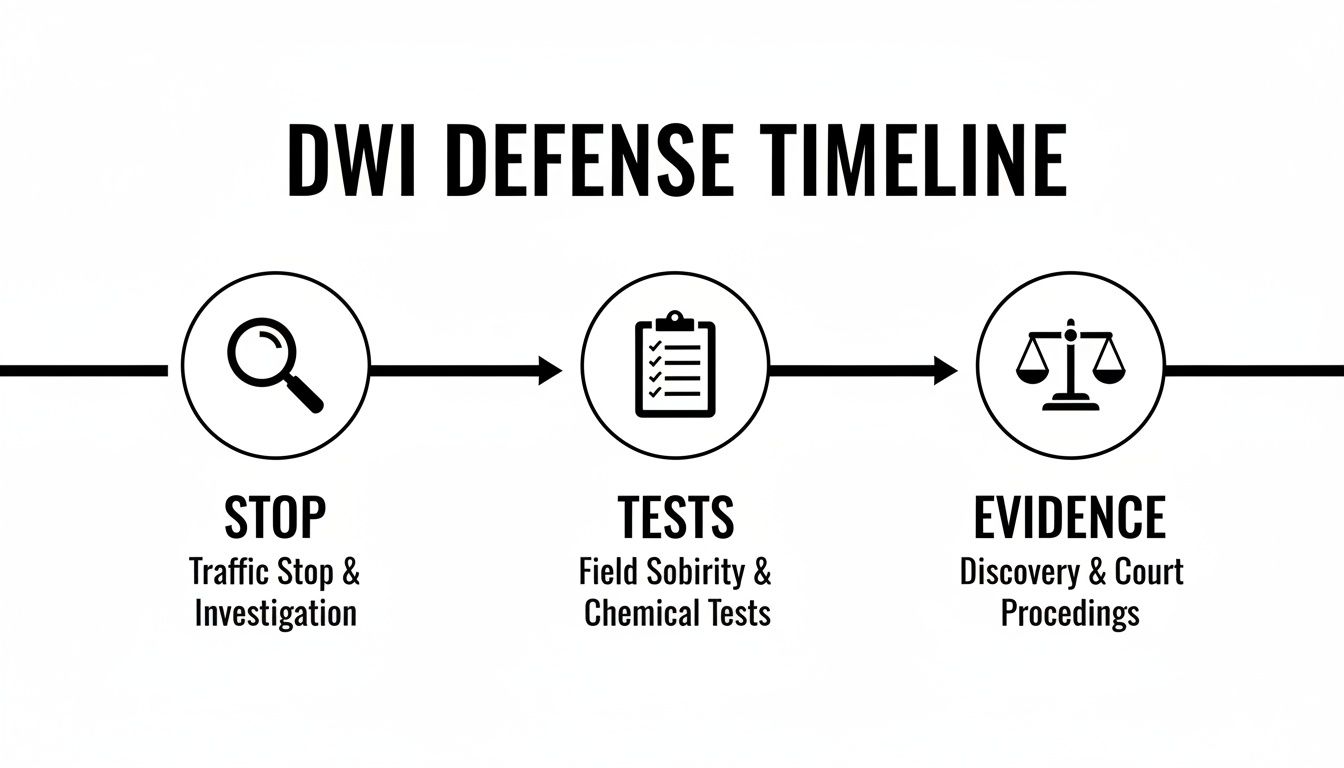
As the graphic shows, every single stage—from the initial stop to how the tests were given—is a potential weak point for the prosecution. A skilled attorney knows exactly where to look for those errors to build a powerful defense for you.
The Second Battle: The Criminal Court Case
While the ALR process moves fast, the criminal case is a slow, grinding fight. This is where you face the state prosecutor, and the stakes are much, much higher. A conviction here can mean heavy fines, probation, jail time, and a permanent criminal record that will follow you everywhere.
Dallas County is known for its aggressive DWI prosecution. With thousands of arrests each year, prosecutors and police are under pressure to secure convictions. Historically, a first-offense conviction could mean a DWI license suspension of up to two years and fines as high as $4,000. However, a well-executed defense can completely change that outcome. In fact, some data shows that 20-30% of DWI cases fought by a defense attorney end in a dismissal or reduction. You can find more information about how Texas DWI statistics impact defense strategies on mathurlawoffices.com.
In the criminal courtroom, our job is to take the prosecutor's case apart, brick by brick. This involves a multi-pronged attack:
- Filing motions to suppress evidence that was gathered illegally.
- Challenging the officer's reason for stopping you in the first place.
- Discrediting the so-called "science" behind the field sobriety tests.
- Finding and exposing errors in how your breath or blood sample was taken, handled, and tested.
This is where the ALR hearing really pays off. If the officer's story changes between the ALR hearing and the criminal trial, their credibility is shot. We can use their sworn testimony from that first hearing to show a jury they can't be trusted. This is exactly why you need a Texas DUI attorney who knows how to fight both battles as part of one unified, strategic defense.
How to Choose the Right Dallas DWI Defense Attorney
After a DWI arrest, the most important decision you'll make doesn't happen in a courtroom—it's who you choose to stand beside you there. This isn’t the time to hire just any lawyer. You need a dedicated advocate, a specialist who lives and breathes DWI defense every single day.
A general practice attorney might know the basics, but a true DWI specialist understands the intricate science behind breath and blood tests, the procedural traps police often fall into, and the specific tendencies of Dallas County judges and prosecutors. The right attorney will replace your fear and uncertainty with a clear, actionable plan.
Key Questions to Ask During Your Consultation
Your initial consultation is more than a free chat—it's a job interview where you are the hiring manager. You need to ask sharp, insightful questions that cut through the sales pitch and reveal an attorney's true level of expertise.
Here are the questions that will tell you if you’re talking to a genuine DWI defender or a generalist:
- "What percentage of your cases are DWI-related?" If the answer isn't a high majority, they're not a specialist. You don't want a lawyer who dabbles in DWI defense; you want one who is completely immersed in it.
- "Tell me about your experience in the Dallas County courts." Every courthouse has its own rhythm, and every prosecutor has a unique style. An attorney with deep local roots brings a home-field advantage that can't be overstated.
- "How do you challenge breath and blood test results?" A top-tier attorney won't hesitate. They should immediately talk about attacking the Intoxilyzer 9000's calibration logs, demanding the blood vial for independent testing, or scrutinizing the chain of custody. Vague answers are a major red flag.
- "Looking at my situation, what are the first three things you would do to start my defense?" This separates the thinkers from the paper-pushers. A confident specialist will instantly lay out a strategy, likely starting with the ALR hearing request to save your license and a demand for all the state's evidence.
You're not listening for a guarantee of a specific outcome—no ethical lawyer can promise that. What you're listening for is a clear focus on strategy and process.
What to Look for in a DWI Defense Firm
Courtroom skill is critical, but so is the support you get outside of it. The legal system is confusing and intimidating. You deserve a team that sees you as a person in a tough spot, not just another case number.
Choosing a law firm is also about choosing a partner for this difficult journey. You need an attorney who sees you as a person in a tough spot, not just another case file. Confidence, communication, and compassion are just as vital as legal knowledge.
The Dallas area has an incredibly crowded legal market. One directory alone lists over 177 attorneys specializing in DWI, a reflection of the high arrest numbers in Dallas County. This intense competition makes genuine expertise easy to spot. The firms that stand out are the ones that offer 24/7 availability, provide educational resources to demystify the process, and communicate with you consistently.
That is the standard of service we hold ourselves to at the Law Office of Bryan Fagan, PLLC. You can learn more about the deep expertise available from top-rated Dallas DWI attorneys on superlawyers.com.
Your future is on the line. Take the time to find an attorney who is not just a skilled legal tactician but also a trusted advisor who is committed to protecting your rights and your peace of mind.
Your Most Pressing DWI Questions, Answered
When you're staring down a DWI charge in Dallas, your mind is probably racing with questions. It's an overwhelming spot to be in, but getting straight answers is the first step back to solid ground. Let's tackle some of the most common questions we hear from clients, because knowing where you stand is half the battle.
A DWI arrest can feel like a final verdict, but that couldn't be further from the truth. With the right legal strategy, there are plenty of ways to fight DWI Texas. Our job as your Dallas DWI defense attorney is to find the best one for your specific situation.
Can My DWI Charge Actually Be Dismissed in Texas?
Yes, absolutely. Getting a DWI charge dismissed is not a pipe dream—it’s a realistic goal in many Texas cases. But a dismissal doesn’t just happen by luck. It’s the direct result of an aggressive, detail-oriented defense.
For example, a case can be thrown out if we can prove the police violated your rights, like pulling you over without a legitimate reason (reasonable suspicion). A dismissal can also happen if we get crucial evidence thrown out. If the breathalyzer machine wasn’t calibrated correctly or the officer botched the field sobriety tests by not following national standards, we can file a motion to suppress that evidence, making it legally useless to the prosecution.
Once we take away the prosecution’s key evidence, their case often falls apart. This can force them to dismiss the charge entirely or offer a significant reduction. While no lawyer can ever promise a specific outcome, a powerful defense is built by digging into every single detail to create these opportunities for a full dismissal.
What’s the Real Difference Between a DWI and a DUI in Texas?
People use these terms interchangeably all the time, but in the eyes of Texas law, they are completely different. Knowing which one you’re facing is critical because the penalties and defense strategies are miles apart.
- DWI (Driving While Intoxicated): This is the charge for adults who are 21 or older. It applies if you’re caught driving with a Blood Alcohol Concentration (BAC) of 0.08% or higher, or if drugs or alcohol have impaired your normal abilities. A first-offense DWI is a serious Class B Misdemeanor.
- DUI (Driving Under the Influence): This charge is only for minors under the age of 21 who have any detectable amount of alcohol in their system. It's a Class C Misdemeanor, which is less severe than a DWI but still comes with serious consequences that can follow a young person for years.
Should I Have Refused the Breathalyzer Test?
This is the question we get most often, and there’s no easy answer. It’s a strategic trade-off, and there isn't a "right" choice that works for everyone. Both refusing and consenting create different legal battles—and different defense opportunities.
Under Texas’s "implied consent" law, if you refuse a breath or blood test, you’re facing an automatic driver's license suspension. That's the downside. However, the upside is that you deny the prosecutor their single most powerful piece of evidence: a number that says you were intoxicated. A refusal can make it much, much harder for them to prove their case against you in criminal court.
If you did give a sample, our defense will be an all-out attack on the science—challenging the machine's accuracy, the officer's training, and the testing procedures. If you refused, our first fight is to save your license at the ALR hearing. Either way, a strong defense is always possible.
At the Law Office of Bryan Fagan, PLLC, we start by listening. We understand a DWI arrest can be overwhelming, and we promise to hear your side of the story with empathy and without judgment. From there, our team springs into action to protect your license and launch a deep-dive investigation into your arrest. You don't have to face this alone. To discuss your case with a team of experienced Houston and Dallas DWI lawyers dedicated to protecting your future, request a free and confidential consultation today.

