
A DWI arrest can be overwhelming—but you don’t have to face it alone. If you've just been charged with a Class B misdemeanor in Texas, you're probably feeling uncertain about what comes next. This type of charge, which often includes a first DWI in Texas, theft of property valued between $100 and $750, or possession of up to two ounces of marijuana, is more serious than a traffic ticket but less severe than a felony.
While a Class B misdemeanor is a serious legal matter, it’s important to remember that a charge is not a conviction. With a confident and strategic legal approach from an experienced Houston DWI lawyer, you can protect your rights, your license, and your future.
What a Class B Misdemeanor Charge Really Means in Texas
An arrest can be a confusing and isolating experience, but understanding exactly what you're up against is the first step toward regaining control. Facing the Texas criminal justice system is a daunting prospect, but you don't have to do it alone. Let's break down what a Class B misdemeanor charge actually means for your case.

In Texas, criminal offenses are organized by severity. Misdemeanors are less serious than felonies but still carry significant penalties, including potential jail time, hefty fines, and a possible DWI license suspension. A Class B misdemeanor sits right in the middle of the misdemeanor hierarchy.
Putting the Charge in Context
Think of the Texas misdemeanor system as a three-rung ladder. At the bottom is a Class C misdemeanor, the least severe charge, typically punishable by only a fine. At the very top is a Class A misdemeanor, which carries the harshest misdemeanor penalties.
A Class B misdemeanor in Texas sits squarely on that middle rung.
Common offenses that fall into this category include:
- First-Time DWI: A first offense for Driving While Intoxicated (DWI) where your Blood Alcohol Concentration (BAC) is under 0.15 is typically charged as a Class B misdemeanor.
- Theft: Stealing property or services with a value between $100 and $750.
- Marijuana Possession: Knowingly possessing two ounces or less of marijuana.
- Criminal Trespass: Illegally entering or remaining on someone else’s property without their consent.
A Class B misdemeanor conviction carries a potential punishment of up to 180 days in county jail and a fine of up to $2,000. These are the statutory maximums—not a guaranteed outcome.
An experienced Texas DUI attorney can fight to minimize these consequences or work to have the charges reduced or dismissed entirely. The key is to act quickly to fight DWI Texas charges and build a strong defense from day one.
How Misdemeanor Levels Compare
Seeing where a Class B charge stands can provide crucial perspective. While it’s definitely more serious than a Class C offense like a speeding ticket, it doesn’t carry the same weight as a Class A charge or a felony, which can involve state prison time.
To help you understand exactly where your charge falls, here's a quick look at how Texas law classifies misdemeanors.
Texas Misdemeanor Classifications at a Glance
| Misdemeanor Class | Maximum Jail Time | Maximum Fine |
|---|---|---|
| Class A Misdemeanor | Up to 1 year in county jail | Up to $4,000 |
| Class B Misdemeanor | Up to 180 days in county jail | Up to $2,000 |
| Class C Misdemeanor | No jail time | Up to $500 |
This table makes it clear that while a Class B misdemeanor is a serious matter, it is fundamentally different from higher-level charges. The goal of a strong legal defense is to avoid a conviction that leads to these maximum penalties.
Even if the evidence seems stacked against you, there are always avenues to challenge the state's case, from questioning the probable cause for the initial traffic stop to disputing the results of a field sobriety test.
A charge for a Class B misdemeanor in Texas does not have to ruin your life. With a knowledgeable attorney by your side, you can navigate the legal process with confidence, assert your rights, and work toward the most favorable resolution possible. You don't have to face this alone.
Common Offenses That Lead to a Class B Misdemeanor
The legal definition of a Class B misdemeanor in Texas gives you the black-and-white rulebook, but what really matters is understanding the real-world situations that put people in this spot. Many different actions can land you with a Class B charge, but some—especially DWI—are far more common than others.
Seeing these common offenses helps you realize two things: you're not alone, and every charge is built on a specific set of facts—facts that an experienced attorney can and should challenge.
First-Time Driving While Intoxicated (DWI)
A DWI is, without a doubt, one of the most frequent reasons people find themselves facing a Class B misdemeanor. For many, it's their first and only brush with the law.
Imagine you're pulled over after a night out with friends in Houston. You're asked to perform a field sobriety test, which feels confusing and unfair. Then you take a breathalyzer test and it shows a Blood Alcohol Concentration (BAC) of .08. If this is your first offense, you’re looking at a first DWI in Texas, which is a Class B misdemeanor under Texas Penal Code § 49.04. Suddenly, you're facing up to 180 days in county jail, a fine of up to $3,000, and a DWI license suspension that could last for months.
To get a conviction, the prosecutor has to prove beyond a reasonable doubt that you were:
- Operating a motor vehicle in a public place,
- While legally "intoxicated"—either by not having the normal use of your mental or physical faculties or by having a Blood Alcohol Concentration (BAC) of 0.08% or more.
Every one of those points is an opportunity for a skilled Houston DWI lawyer to fight back. We can question the legality of the traffic stop, challenge the way field sobriety tests were administered, and dispute the reliability of the breath or blood test. Sometimes, all it takes is one mistake by law enforcement to get the evidence thrown out.
Other Common Class B Misdemeanors
While DWI is the big one, it's far from the only charge in this category. Knowing the elements of other common offenses shows how a defense strategy works: we force the prosecution to prove every single detail of their case.
A core principle of any strong defense is holding the state accountable. Prosecutors can't rely on assumptions; they must present hard evidence for every element of the alleged crime. If they can't, their case falls apart.
Other common Class B misdemeanors include:
- Theft of Property or Services: This charge applies when the value of the stolen items or services is between $100 and $750. The state must prove you unlawfully took property with the specific intent to permanently deprive the owner of it.
- Possession of Marijuana: Knowingly or intentionally possessing a "usable quantity" of two ounces or less of marijuana is a Class B misdemeanor in Texas.
- Criminal Trespass: This happens when you enter or stay on someone else's property without their consent, after being given notice that entry was forbidden (like a "No Trespassing" sign) or being told to leave and failing to do so.
- Harassment: This can involve making obscene comments over the phone, sending repeated electronic messages intended to harass, or threatening someone with bodily injury.
In every one of these cases, the burden of proof rests entirely on the state. An arrest is just the beginning of the story, not the end. A strategic defense can expose the weak spots in the prosecutor's arguments, protecting your rights and your future.
The Full Price of a Conviction: More Than Just Fines and Jail
A criminal charge is a stressful experience, and many people focus only on the immediate penalties a judge might hand down. The truth is, a conviction for a Class B misdemeanor in Texas carries consequences that stretch far beyond the courtroom. These hidden, long-term impacts—often called collateral consequences—can ripple through your life for years, affecting your job, your rights, and your future.
Understanding what’s truly at stake is the first step toward building the strong, proactive defense you need.

The Texas Penal Code lays out the official, on-the-books penalties for a Class B misdemeanor conviction. These are the maximums, not a guaranteed outcome, but they represent the starting point for what you're up against.
- Jail Time: Up to 180 days in county jail.
- Fines: Up to $2,000, not including hefty court costs and administrative fees.
A good defense lawyer’s job is to fight to keep these maximums from ever becoming your reality. But honestly, those statutory penalties are just the tip of the iceberg.
The Lasting Impact on Your Daily Life
For most people, the single most damaging result of a conviction is the creation of a permanent criminal record. This isn't just a file in a cabinet; it’s a public document that can follow you everywhere, creating roadblocks you never saw coming. It’s not about just paying a fine and moving on—it’s about navigating the fallout for the rest of your life.
These "hidden" penalties often include:
- Driver's License Suspension: A DWI conviction triggers an administrative license suspension that is entirely separate from the criminal case. For a first offense, this can last anywhere from 90 days to one year. You have only 15 days to request an ALR hearing to fight this.
- Employment Problems: Background checks are now standard for many jobs. A misdemeanor conviction can get your application tossed, especially for roles that require trust, handling money, or driving.
- Housing and Loan Denials: Landlords and mortgage lenders frequently review criminal histories. A conviction can easily lead to a denied apartment lease or loan application.
The term "collateral consequences" refers to all the civil penalties and disabilities that pop up after a criminal conviction, even though they weren't part of the official sentence. These consequences can dramatically impact your rights and opportunities long after you’ve paid your debt to society.
This is exactly why just accepting a quick plea deal to "get it over with" can be a catastrophic mistake. You might think you're putting the problem behind you, but in reality, you could be signing up for a whole new set of long-term troubles. To see how this plays out specifically for drunk driving offenses, you can learn more about Texas DUI penalties in our detailed guide.
Professional and Personal Ramifications
For many Texans, the shockwaves of a Class B misdemeanor conviction go even further, directly threatening their livelihood and even their most fundamental rights. Your professional reputation and immigration status could suddenly be on shaky ground.
A conviction can create career-ending problems in these areas:
Professional Licenses
If you're a nurse, teacher, pilot, real estate agent, or hold any other state-issued professional license, a conviction will likely trigger a review by your licensing board. This can lead to suspension, revocation, or make it incredibly difficult to renew your credentials.
Firearm Rights
Under federal law, anyone convicted of a misdemeanor crime of domestic violence is permanently barred from owning a firearm. While a standard first DWI in Texas won't automatically take away your gun rights, certain assault-related Class B charges absolutely can.
Immigration Status
For non-citizens, including green card holders, a conviction for certain misdemeanors can be deemed a "crime involving moral turpitude." This is a serious label that can trigger deportation, get your naturalization application denied, or make it impossible to re-enter the U.S.
Facing a Class B misdemeanor in Texas isn't just about a potential fine or a few weeks in jail. It’s about protecting your career, your family, and everything you’ve worked for. A skilled attorney understands the full picture—and builds a defense designed to shield you from both the immediate sentence and the devastating collateral damage that can follow.
How to Fight a Class B Misdemeanor in Texas
Getting arrested for a Class B misdemeanor in Texas can feel like the state has an open-and-shut case against you. It's easy to feel like you have no options. But an arrest is just the beginning of the story, not the end. A strong defense isn't about magic tricks; it's about methodically taking apart the prosecutor's case, piece by piece, to protect your rights.
The state’s case is almost never as solid as it looks on paper. An experienced defense attorney knows exactly where to find the cracks—the procedural mistakes, the weak evidence, and the violations of your constitutional rights. Our work begins the second we start digging into the details, starting with the very first moment you encountered law enforcement.
Questioning the Initial Stop and Arrest
Every criminal case has a starting point. For charges like DWI or drug possession, that’s usually a traffic stop. But here’s something crucial to remember: a police officer can’t just pull you over on a hunch. They need reasonable suspicion—a clear, specific reason to believe you’ve broken a law.
We immediately start asking tough questions about that initial stop:
- Did the officer actually witness a traffic violation, like speeding or swerving?
- Was the stop based on a flimsy or anonymous tip that wasn't corroborated?
- Does the officer’s report have inconsistencies or change stories about why you were pulled over?
If we can prove the stop was illegal, any evidence gathered because of it—from field sobriety tests to breathalyzer results—can be thrown out. This is often the quickest and most powerful way to get a case dismissed before it even gets going.
From there, we look at the arrest itself. An arrest requires an even higher legal standard called probable cause. If an officer arrests you without enough solid evidence to believe you actually committed a crime, the arrest is unlawful. We will scrutinize every detail of the officer’s report to make sure your rights weren't trampled on.
How to Fight Breath and Blood Test Results
Once we’ve put the stop and arrest under a microscope, we pivot to the evidence the state wants to use against you. In a first DWI in Texas, this almost always comes down to field sobriety tests (FSTs) and chemical tests like a breath or blood sample. Under Texas "implied consent" laws, you are deemed to have consented to these tests just by driving on Texas roads, but refusing a test has its own consequences, like a DWI license suspension.
Field Sobriety Tests: These tests are notoriously subjective and unreliable. Your ability to perform them can be thrown off by dozens of factors that have nothing to do with intoxication—like nerves, fatigue, a medical condition, or even the shoes you were wearing. We challenge the results by showing the officer gave improper instructions, the tests were done on an uneven surface, or they failed to follow standardized procedures.
Breath and Blood Tests: These might seem like hard science, but they are surprisingly prone to error. We know how to challenge these results by investigating critical questions:
- Was the breathalyzer machine recently and properly calibrated?
- Was the officer who gave you the test even certified to operate it?
- Could you have had a "rising BAC"—meaning your blood alcohol was actually lower when you were driving than when you were tested an hour later at the station?
- For blood tests, was the sample drawn, stored, and transported according to the strict legal chain of custody needed to prevent contamination?
A proactive and strategic defense is about forcing the prosecution to prove every single element of their case beyond a reasonable doubt. By finding the weak links in their chain of evidence, we create the leverage needed to negotiate a dismissal, a reduction of charges, or a not-guilty verdict at trial.
Fighting a Class B misdemeanor in Texas demands a thorough and aggressive defense. Your future is far too important to leave anything to chance. By challenging every aspect of the state's case—from the initial stop to the final piece of evidence—a skilled attorney can dramatically improve your odds of protecting your record, your license, and your freedom.
What Happens After a DWI Arrest: Step-by-Step Guidance
After an arrest for a Class B misdemeanor in Texas, the legal system can feel like a labyrinth designed to confuse you. The paperwork, the court dates, the unfamiliar terms—it's overwhelming and intimidating. But here’s the thing: while the process is complex, it’s not random. It follows a predictable set of steps.
Understanding this path is the first step toward regaining control. When you know what’s coming, you can make smarter decisions and work with your attorney to build the strongest possible defense. You don't have to face this alone. A strategic lawyer is your guide, explaining what’s happening at every stage and fighting for your rights.
Let's walk through the court process from start to finish.
The First 48 Hours: Booking, Bond, and Arraignment
It all starts the second those handcuffs click. You'll be transported to a local jail for booking. This is where they take your fingerprints, your mugshot, and record your personal details. It’s an impersonal and often stressful experience, but it’s a routine part of the system.
Soon after, you'll go before a judge for a bond hearing, also known as magistration. The judge will set a bail amount—the money required to secure your release from jail while the case moves forward. This is your first opportunity for a lawyer to make a difference. An attorney can argue for a lower, more affordable bond, or even for a Personal Recognizance (PR) bond, which lets you out on a written promise to return to court, no cash needed.
This flowchart lays out the key phases of building a defense strategy.
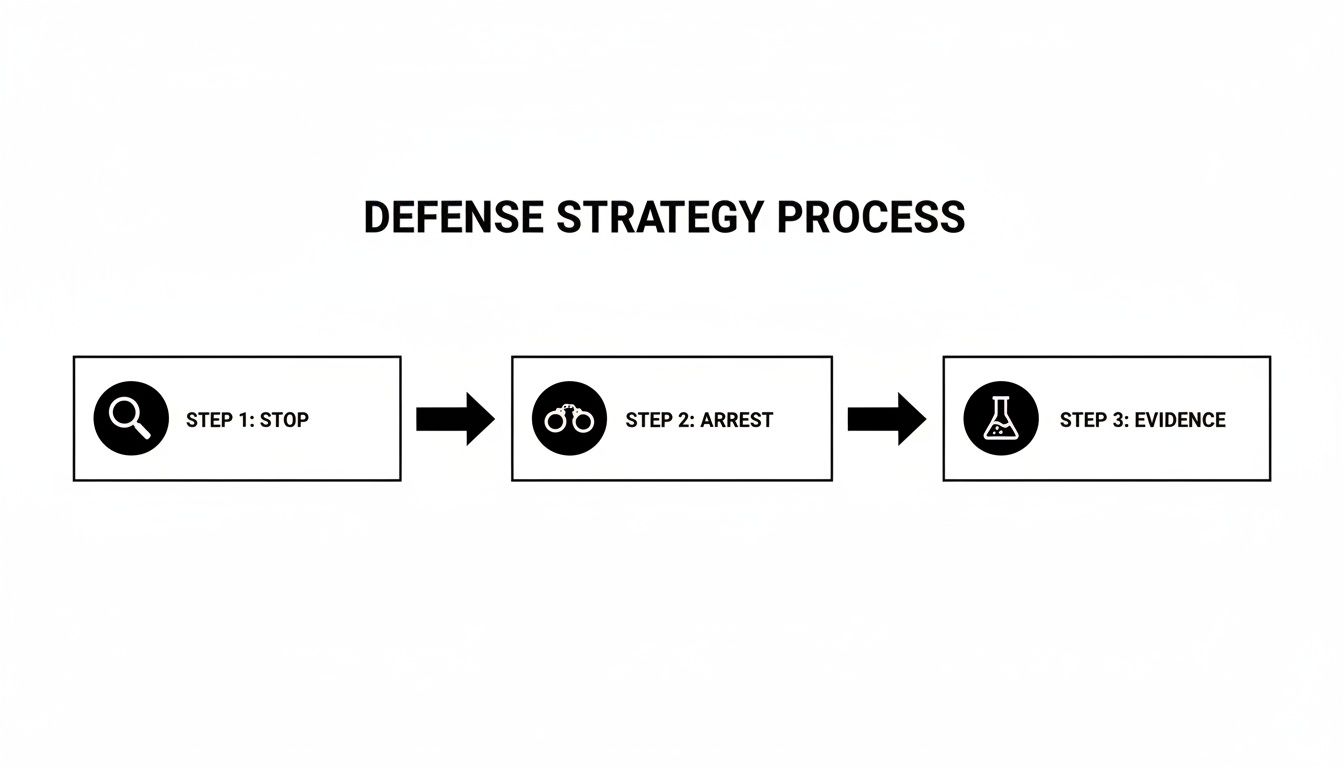
As you can see, every stage—from the traffic stop itself to how evidence is collected and challenged—is a chance to strengthen your case.
Next comes the arraignment. This is your first official appearance in court. The judge will formally read the charge against you and ask for your plea: guilty, not guilty, or no contest. In almost every situation, your attorney will advise you to plead not guilty. This is crucial. It preserves all your legal rights and gives your defense team the time needed to dig into the facts of your case.
Pretrial Phase: Discovery, Motions, and Negotiations
After the arraignment, your case moves into the pretrial phase. This is where the real work begins, and it’s where a skilled Texas DUI attorney or criminal defense lawyer truly earns their keep.
Your lawyer will start a process called discovery, formally demanding that the prosecutor turn over every piece of evidence they have against you. This isn’t a friendly request; it’s a legal right. We get access to everything, including:
- The full police report and the officer’s handwritten notes
- All bodycam and dashcam video footage
- Statements from any witnesses
- The results of any breath or blood tests
Once we have the evidence, we put it under a microscope. Was the initial stop legally justified? Were the field sobriety tests performed by the book? Was the breathalyzer machine working correctly and recently calibrated? We hunt for any crack in the state’s case.
This deep dive allows your attorney to file pretrial motions. These are formal requests to the judge. The most powerful is a Motion to Suppress Evidence. If we can prove evidence was obtained illegally—say, from an unconstitutional stop—we can ask the judge to throw it out. Often, this guts the prosecution’s case and leads to a dismissal.
Armed with the weaknesses we've found, your lawyer then enters negotiations with the prosecutor, arguing for a dismissal or a reduction of the charges.
Resolution: Plea Bargains, Diversion Programs, or Trial
Ultimately, your Class B misdemeanor case will end in one of three ways.
- Plea Bargain: This is a negotiated agreement. You might agree to plead guilty, often to a less serious offense, in return for a predictable, and hopefully more lenient, sentence.
- Pretrial Diversion or Deferred Adjudication: For many first-time offenders, this is the best-case scenario. You agree to a term of probation with certain conditions. If you complete everything successfully, the charge is dismissed. This keeps a final conviction off your record and opens the door to getting the arrest sealed later on.
- Trial: You always have the constitutional right to make the state prove its case. If a fair deal can't be reached, we take the fight to a judge or jury. At trial, your attorney will present your defense and challenge the prosecutor's evidence, holding them to the high standard of proving guilt "beyond a reasonable doubt."
Getting through this process successfully isn't about luck; it's about strategy. A knowledgeable attorney ensures that from day one, every move is made with one goal in mind: protecting your record and your future.
Answering Your Questions About Class B Misdemeanors
When you’re staring down a criminal charge, your mind is probably racing with a thousand questions. The what-ifs and the unknowns can feel just as stressful as the charge itself. We get it. We hear these same urgent concerns every day from people facing a Class B misdemeanor in Texas.
Let’s cut through the noise and get you some straight answers. Our goal is to give you the clarity you need to feel more in control and see that you have a path forward.
Can a Class B Misdemeanor Be Removed From My Record?
Yes, it’s often possible, but everything hinges on how your case ends. If your charge gets dismissed or you’re found not guilty at trial, you can pursue an expunction. Think of this as the legal equivalent of a "destroy" button—it completely wipes out all records of the arrest.
Now, if you complete a deferred adjudication program, an expunction isn't an option. But don't lose hope. You can often petition the court for an order of non-disclosure. This order seals your record from the public, making it invisible to employers, landlords, and others running a standard background check. To get the full picture on this crucial process, you can explore how to seal your record with an order of non-disclosure in our guide.
Will I Go to Jail for a First-Time DWI?
While the law says a Class B misdemeanor carries up to 180 days in county jail, it is definitely not a given—especially for a first DWI in Texas. With a solid defense strategy, many people facing a first-time offense avoid jail entirely.
An experienced Houston DWI lawyer can fight for alternatives like probation (also called community supervision). This allows you to serve your sentence in the community while meeting certain conditions, like attending classes or doing community service. The key is to challenge the state's case right from the start, creating the leverage needed to negotiate a much better outcome.
How Much Does a DWI Lawyer Cost?
The cost of a skilled defense lawyer will vary depending on how complex your case is. It’s natural to worry about the price, but it’s critical to see this as an investment in your future, not just another bill to pay. The long-term damage of a conviction—from lost jobs to skyrocketing insurance rates—can easily cost you far more than a strong legal defense.
A conviction is permanent. A strong defense is your opportunity to stop that from happening. Don't let cost stop you from at least exploring your options and fighting for your rights.
Most reputable firms, including ours, offer free consultations. This gives you a chance to talk through what happened, understand your legal options, and get a clear picture of the potential costs without any commitment. It’s the single most important first step you can take.
A Class B misdemeanor in Texas charge can feel like your world is caving in, but you have more power in this situation than you might think. The choices you make right now will shape your future. At The Law Office of Bryan Fagan, PLLC, our team has extensive experience defending Texans against DWI charges. We are here to listen, offer strategic guidance, and fight to protect everything you've built. You don't have to face this by yourself. Request your free, no-obligation case evaluation today and let us start building your defense. https://texasduilawfirm.com