
Yes, a DWI can sometimes be reduced in Texas, but it isn't automatic and it usually happens through negotiation, not by merely asking the judge for a break. The reason people fight hard for that result is clear: a first DWI in Texas is generally a Class B misdemeanor that can bring up to 180 days in jail, up to $2,000 in fines, a driver-license loss of up to one year, and an additional $3,000 sentencing fine may apply.
A DWI arrest can feel like your whole life just narrowed to one bad night, one police report, and one court date. Those facing a DWI often share similar worries. Will I lose my license? Will this stay on my record? Can this cost me my job? Can a DWI be reduced in Texas before it wrecks everything else?
The honest answer is yes, sometimes. But that outcome depends on the facts, the evidence, the prosecutor, and how effectively your attorney exposes weaknesses in the State's case.
That matters because DWI cases are rarely won by wishful thinking. They're won through early investigation, careful review of the stop, field sobriety testing, chemical testing, and pressure points that create an advantage for a better outcome. A calm, strategic defense often does far more than a rushed guilty plea.
Your DWI Arrest Does Not Have to Define Your Future
The first few days after an arrest are usually the worst. You're replaying the stop in your head, checking your bond paperwork, wondering what happens to your driver's license, and trying to decide whether this is something you can “just handle” on your own.
In many cases, that instinct is costly.
A DWI case has two tracks. One is the criminal case in court. The other can involve your license through an administrative license suspension, which is the separate process used by the State to suspend your driving privileges after an arrest or test refusal. If you wait too long to act, you can lose opportunities in both places.
The question most clients ask first
When people ask whether a DWI can be reduced in Texas, what they usually mean is this: can the charge be changed to something less damaging than a DWI conviction?
Sometimes the answer is yes. A reduction can mean the prosecutor agrees to dismiss the DWI charge and replace it with a lesser offense. That can lower criminal exposure and may also reduce some of the long-term stigma tied to a DWI conviction.
Practical rule: A reduction is a strategy, not a guarantee. The stronger the defense issues, the more room there is to negotiate.
That's why the right response after an arrest isn't panic. It's preservation. Save paperwork. Write down what happened. Get legal counsel involved before the evidence hardens into the State's version of events.
Key terms you should understand early
A few terms come up in almost every Texas DWI case:
- BAC: Blood alcohol concentration. This is the alcohol measurement prosecutors often use in breath or blood cases.
- Field sobriety test: A roadside coordination test used by officers to claim impairment. These tests are often challenged because conditions, instructions, and scoring matter.
- Implied consent: By driving in Texas, you're treated as having consented to a breath or blood test request under certain circumstances. A refusal can trigger separate license consequences.
- Administrative license suspension: A separate license action that can follow a failed or refused test, apart from the criminal case itself.
If you need a Houston DWI lawyer or Texas DUI attorney, the goal isn't just showing up in court. The goal is protecting your record, your license, and your future options with a plan that fits your case.
Understanding DWI Reductions Versus Dismissals
A reduction and a dismissal solve very different problems, and that difference matters the moment you start weighing outcomes. For one client, avoiding a DWI conviction may protect a professional license review. For another, the primary concern is a CDL, employer background check, or how an out-of-state licensing board will read the final record.
A dismissal means the DWI charge is dropped. In criminal court, that is usually the best result.
A reduction means the prosecutor agrees to resolve the case as a lesser offense instead of DWI. You still answer a criminal case, but you may avoid a DWI conviction and some of the consequences that attach specifically to that label.
A DWI conviction creates the most serious long-term exposure. It can affect sentencing, insurance, job opportunities, and license-related issues that often matter more than the fine or jail range.
What a reduction can look like
In Texas, a reduced charge often means reckless driving or obstruction of a highway/passageway in place of DWI. The result depends on the facts, the county, and whether the defense gives the State a sound reason to agree. If you want a closer look at how those agreements work in practice, review this page on Texas DUI plea deals and negotiated reductions.
That middle-ground result can be the right answer when a full dismissal is not realistic but a DWI conviction would do unnecessary damage. The criminal outcome is only part of the analysis. A reduced plea may still need to be checked against employer reporting rules, compact-state licensing questions, and the policies used by agencies that regulate nurses, teachers, pilots, commercial drivers, and other credentialed professionals.
Here is the practical difference:
| Outcome | What it means |
|---|---|
| Dismissal | The DWI charge is dropped |
| Reduction | The DWI is replaced with a lesser offense |
| Conviction | You are convicted of DWI as charged |
Favorable outcomes do happen
Fighting a DWI charge is not a symbolic exercise. In a reported statewide snapshot for 2020, there were 83,088 DWI charges, with 6,771 dismissals and 3,275 releases, while 33,476 defendants pleaded guilty. The same Texas DWI-defense source estimates dismissals at about 10% to 15%, with another 30% ending in conviction on a lesser charge, suggesting that about 45% of contested cases may end in dismissal or reduction rather than a full DWI conviction, according to Texas DWI case outcome statistics discussed by Doug Murphy Law.
Those numbers do not mean every case is reducible. They do confirm that reductions and dismissals are regular parts of Texas DWI practice.
The police report rarely tells the whole story. In many DWI cases, the defense value is in what the report leaves out, overstates, or cannot support.
Why this distinction matters to your decisions
If the State's evidence has legal or factual holes, dismissal may be the right goal. If the proof is mixed, a reduction may protect your record better than forcing a weak trial posture. If the case is strong for the prosecution, the job shifts to limiting the damage in a way that makes sense for your work, license, and future mobility.
That is the practical answer to whether a DWI can be reduced in Texas. Yes, often enough to treat it as a serious option. The right target depends on more than the charge itself. It depends on what outcome actually protects your life after court.
The Legal Mechanics of Fighting for a Reduced Charge
A reduced charge usually doesn't happen because someone asks politely. It happens because the defense gives the prosecutor a reason to reconsider the original filing.
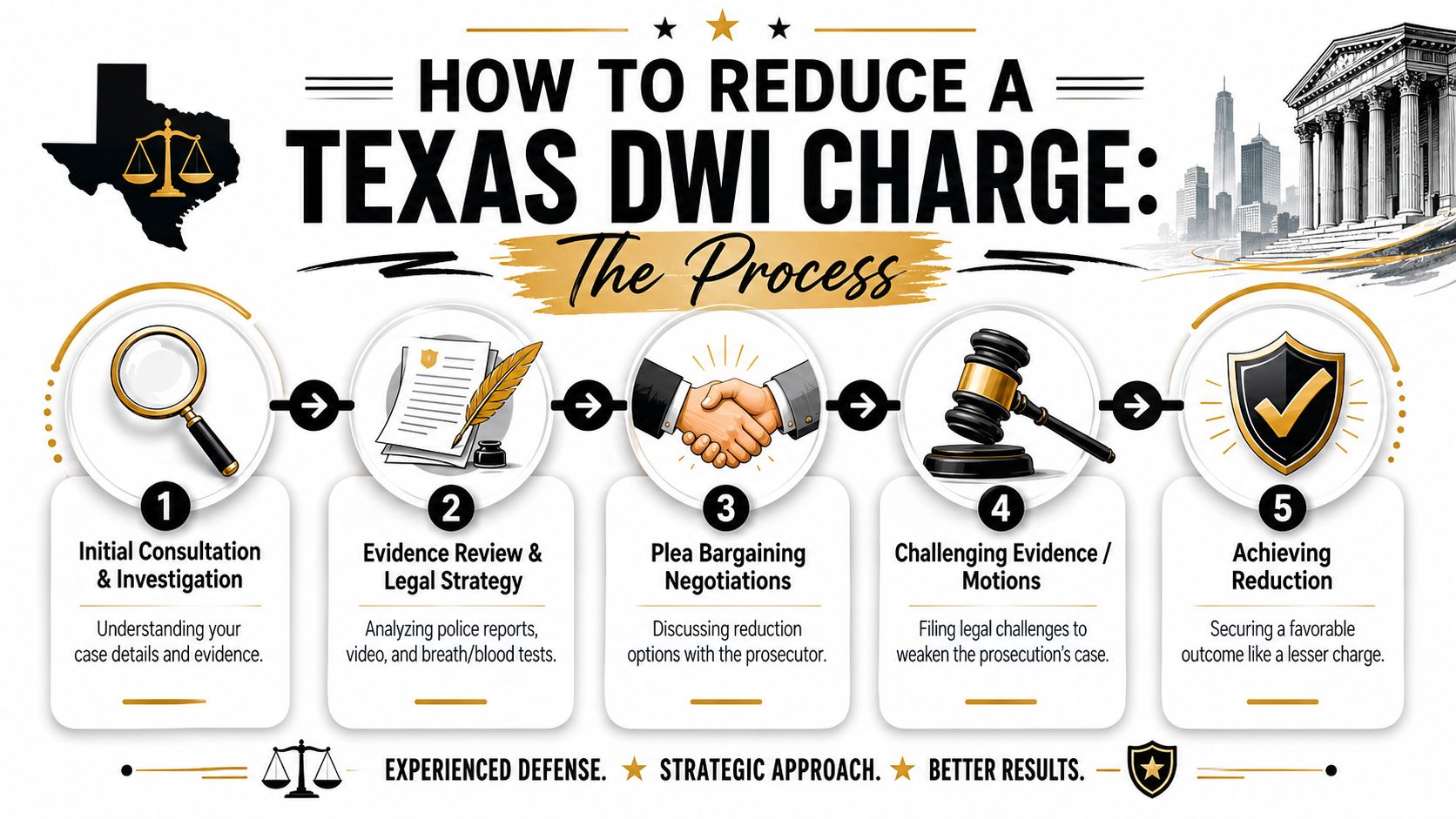
In Texas, a DWI reduction is usually a plea-negotiation outcome, not a unilateral judge action. The prosecutor has to agree to withdraw the DWI and accept a lesser offense such as reckless driving or obstruction of a highway/passageway. The practical point of influence is the strength of the State's evidence, especially the legality of the stop, probable cause, and suppression issues that can weaken admissible proof before trial, as explained in this discussion of Texas DWI reductions and plea negotiations.
Where leverage comes from
A prosecutor is more open to negotiation when the case has risk. That risk can come from legal defects, factual weaknesses, or proof problems.
Common pressure points include:
- The traffic stop itself: If the officer lacked a lawful reason to stop you, the defense may challenge everything that followed.
- Probable cause for arrest: The State must justify moving from roadside suspicion to arrest.
- Field sobriety issues: Poor instructions, bad conditions, medical limitations, and video that contradicts the report can matter.
- Chemical test problems: Breath and blood cases depend on procedure, records, and admissibility.
A strong defense lawyer doesn't just complain about those problems. The lawyer builds them into motions, hearing strategy, and negotiation posture.
Motions matter more than most people think
A motion to suppress asks the court to exclude evidence obtained unlawfully or handled improperly. If key evidence gets suppressed, the prosecutor may lose the strongest parts of the case.
That can shift the discussion from “take the DWI plea” to “what lesser charge can resolve this?”
For readers trying to understand how negotiated outcomes work in practice, our page on Texas DWI plea deals walks through how these resolutions are approached.
What works: forcing the State to defend weak evidence.
What doesn't: assuming a clean record alone will persuade a prosecutor to reduce a charge.
The usual sequence in a reduction case
Early case review
Bond papers, notice of suspension, charging documents, and arrest details are gathered quickly.Evidence collection
Police reports, videos, testing records, and witness information are reviewed for inconsistencies.Pretrial challenge
The defense identifies stop issues, arrest issues, and evidence problems that can be raised formally.Negotiation from strength
The prosecutor evaluates trial risk. If the case has weaknesses, reduction discussions become more realistic.Decision point
You decide whether to accept a reduced charge, continue litigating, or prepare for trial.
A good Houston DWI lawyer doesn't treat plea bargaining as surrender. In many cases, it's the result of building enough pressure that the State no longer feels comfortable insisting on the original charge.
Factors That Strengthen Your Case for a Reduction
Not every DWI case has the same settlement value. Some facts make prosecutors dig in. Others make them more willing to talk.
The biggest mistake people make is focusing only on whether they “felt drunk.” DWI cases are built on evidence, procedure, and presentation. Your case can improve or worsen based on details that seem minor at first.
Chemical test results can change the whole case
For first-time Texas DWI cases, chemical-test evidence often drives the charging level. A BAC of 0.15 or higher can upgrade a first DWI from a Class B misdemeanor to a Class A misdemeanor, and it can also block deferred-adjudication eligibility in many cases. Defense strategy often focuses on machine maintenance records, the required observation period, blood-draw chain of custody, and lab analyst credentials. If the test result is excluded, the case may drop back to a lower framework or lose a major piece of proof, as described in this overview of reduced DWI charges in Texas.

That's why a test number is never the end of the analysis. It's the start of one.
What tends to help in negotiations
Some facts consistently make a case more workable for the defense:
- First-time allegations: A person with no prior DWI history often has more room to negotiate than someone facing repeat allegations.
- No crash and no aggravating facts: Cases without an accident or other harmful facts are often easier to position for a reduction.
- Professional, calm conduct: Respectful behavior during the stop doesn't erase the charge, but it can affect how the prosecutor views the case.
- Weak roadside evidence: If the video does not match the officer's written conclusions, that can be powerful.
For examples of evidence problems that can reshape a defense, see common police mistakes in Texas DWI arrests.
What usually hurts
Some facts make a reduction harder:
| Case fact | Usual effect |
|---|---|
| High BAC allegation | Raises the stakes and often hardens the State's position |
| Poor driving evidence | Gives the prosecutor a stronger narrative |
| Accident involvement | Makes negotiations more difficult |
| Bad statements by the driver | Can strengthen probable cause and trial proof |
If your case includes a breath or blood test, your lawyer should examine the records behind that number, not just the number itself.
Personal factors matter, but only with legal support
People often ask whether being employed, having a family, or needing to keep a clean record for work will help. Those facts matter more when they're paired with actual legal advantage.
A prosecutor may listen to hardship arguments. A prosecutor takes evidence problems more seriously.
That's why the right strategy combines both. Humanize the client. Challenge the case. Push for the result that protects your future as much as possible.
The High Stakes of a Texas DWI Conviction
The value of a reduction becomes obvious once you look at what a conviction can bring.
Texas treats DWI seriously. For many people, the criminal penalties are only the beginning. A conviction can affect driving privileges, background checks, work opportunities, and professional standing long after the court case ends.
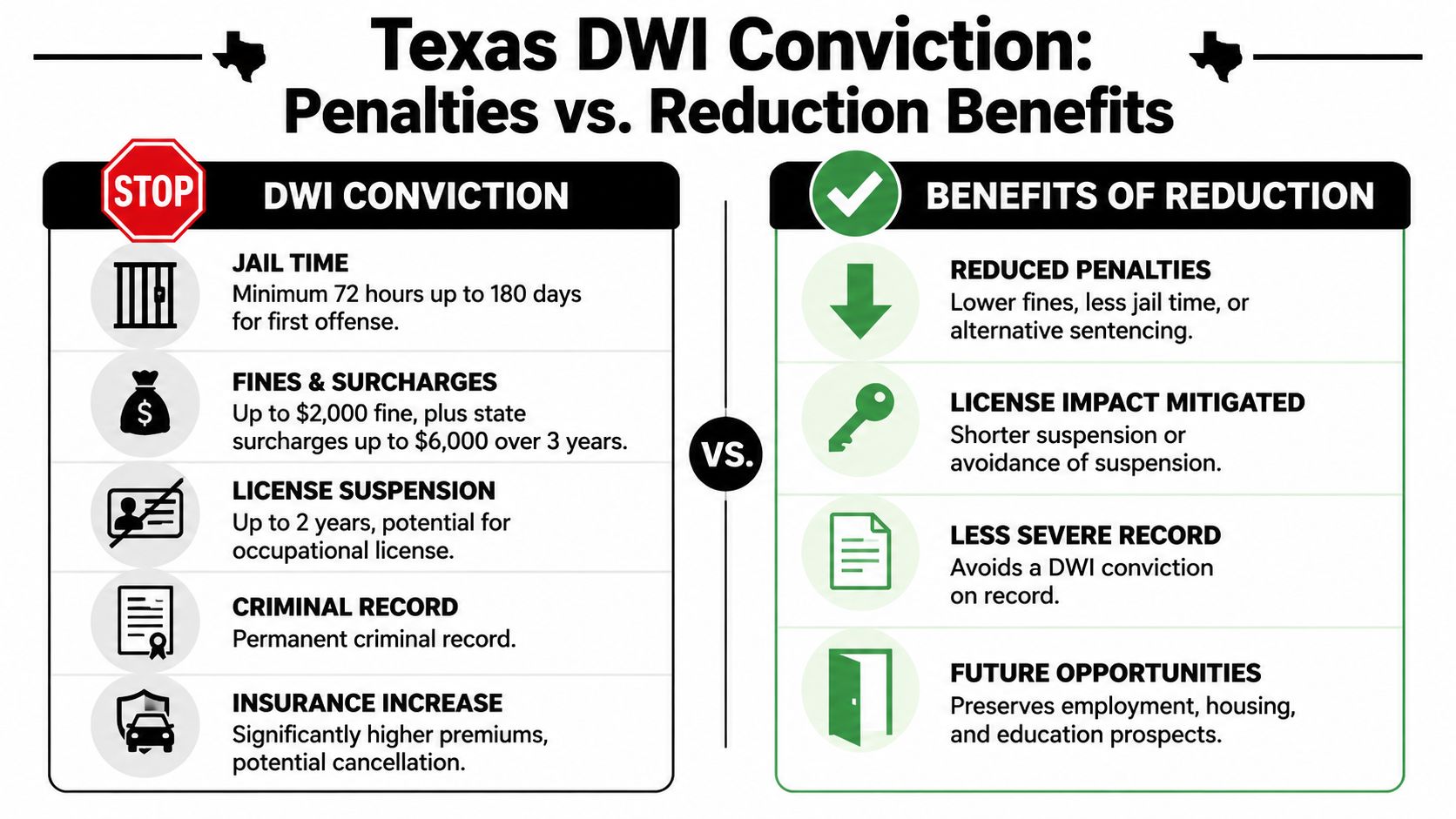
This comparison helps show what's at risk.
For a closer look at how DWI penalties can affect a case, this video is useful:
What Texas law puts on the table
In Texas, a first DWI conviction is generally a Class B misdemeanor punishable by up to 180 days in jail, a fine of up to $2,000, and a driver-license loss of up to one year. The state also notes that an additional sentencing fine of $3,000 may apply. A second offense can carry up to one year in jail and a fine of up to $4,000. A third offense can be charged as a felony with 2 to 10 years in prison and a fine of up to $10,000, according to Texas Department of Transportation information on impaired-driving penalties.
Those penalty ranges are why people ask whether they can fight DWI Texas charges instead of pleading guilty.
Why pleading guilty too quickly can be a mistake
Early in a case, many defendants think the fastest path is the cheapest path. That often isn't true.
A quick plea can lock you into consequences before your lawyer has reviewed the stop video, the officer's basis for arrest, the test procedures, or possible collateral fallout. It can also close off negotiation paths that might have produced a lesser charge.
Here's the practical point:
- A reduction can lower criminal exposure
- A reduction can lessen the long-term label attached to the case
- A strategic defense can create choices you don't have on day one
A first DWI in Texas may look minor on paper compared with a felony, but for many clients, significant damage comes from what follows them after court. That's why reducing the charge, when possible, is often worth pursuing aggressively.
Navigating License Suspension and Collateral Consequences
Many individuals focus on court and miss the second problem until it's already moving against them. A DWI case often involves a criminal prosecution and a separate license process at the same time.
That's where terms like implied consent and administrative license suspension become more than technical language.
Implied consent means Texas treats drivers as having agreed to provide a specimen under certain lawful DWI arrest circumstances. Administrative license suspension is the separate process that can affect your license based on an alleged failure or refusal, even while the criminal case is still pending.

Your license problem may move faster than your court case
If you're worried about a DWI license suspension, don't assume the court date will handle it. It usually won't.
The license side requires its own attention, deadlines, and strategy. That's why people often need help with both the criminal case and the administrative case at once. Our guide to Texas DWI license suspension issues explains that process in more detail.
A reduced charge may not fully protect your career
This is the part many articles miss. For some people, the biggest risk isn't the misdemeanor itself. It's what the arrest and outcome can trigger elsewhere.
That concern is especially sharp for:
- CDL holders: A commercial driver may care more about disqualification and job loss than the criminal fine.
- Licensed professionals: Nurses, pilots, teachers, and others may face reporting duties or board scrutiny.
- Out-of-state drivers: A result in Texas may still follow them home through reciprocal reporting or local consequences.
A major underserved issue in this area is exactly this question: if a Texas DWI is reduced, does that protect your job or license? Existing coverage often focuses on the criminal plea result but does not clearly explain how a reduction interacts with non-criminal consequences or why a favorable criminal outcome may still leave serious regulatory damage unresolved, as noted in this discussion of reduced Texas DWI charges and collateral consequences.
A criminal court result and a licensing result are related, but they are not the same thing. You need a strategy that accounts for both from the start.
The practical takeaway for working professionals
If you hold a CDL, professional credential, or out-of-state license, your attorney should evaluate more than whether the DWI can be reduced in Texas. The attorney should also ask:
- What gets reported?
- What still appears on a background check?
- What does your employer require?
- What does your licensing board care about?
- Does a reduced plea still create a problem outside criminal court?
That broader review is often what separates a narrow case resolution from a useful one.
Your Next Steps How to Strategically Pursue a Reduction
A week after an arrest, many clients are less worried about court than about Monday morning. Can they drive to work. Does their employer need to know. Will a reduced charge still put a CDL, nursing license, security clearance, or out of state license at risk. Those questions should shape the defense strategy from day one.
Start by preserving facts while they are still fresh. Write down why you were stopped, what the officer said, whether field sobriety tests were given, whether you provided a breath or blood sample, and anything unusual about the stop, arrest, or booking process. Save every paper you received, including bond conditions, towing paperwork, the notice tied to your driver's license, and any court date information.
Then avoid creating new problems. Do not post about the arrest. Do not text friends your version of events. Do not assume a reduced plea solves every professional or licensing issue by itself. In many cases, the best result in criminal court is the one that also limits reporting problems, background check damage, or licensing fallout.
A short action list that helps
Get legal advice early
Early review gives your lawyer time to examine the stop, request records, preserve video, and spot weaknesses before deadlines pass.Treat the ALR case as a separate fight
The driver's license case runs on its own track. Missing that deadline can cost you an advantage and create avoidable work problems even if the criminal case later improves.Organize the case around your real exposure
A first offender with no professional license may make different choices than a CDL holder, pilot, nurse, teacher, or out of state driver. The right target is not always just "a reduction." It may be a result that protects employability, reporting status, or travel.Keep every document and timeline detail
Small inconsistencies often matter. So do medical issues, witness names, and the timing of food, alcohol, or medication.Do not wait for the State to define the case
Early defense work often shapes plea discussions. Waiting usually gives up opportunities to challenge the stop, testing, or charging decision before positions harden.
What to look for in counsel
Choose a lawyer who looks past the charge label. A good DWI reduction strategy should account for the criminal file, the license case, and the practical consequences that follow a plea. That includes whether an employer requires disclosure, whether a licensing board asks about alcohol related conduct, and whether another state may still treat the Texas result as a serious driving offense.
The Law Office of Bryan Fagan, PLLC handles Texas DWI defense matters, including criminal court representation and related license issues. That kind of coordinated review matters because a plea that looks acceptable in court may still create avoidable trouble for a professional license or driving privileges elsewhere.
For those who need a Houston DWI lawyer, are trying to fight a Texas DWI allegation, or are dealing with a first DWI in Texas, the best next step is a case specific review done early. A skilled lawyer can assess whether a reduction is realistically available, what evidence needs immediate attention, and whether the proposed resolution will protect your job, license, and long term record.
