
A DWI charge can be overwhelming, and facing probation adds another layer of stress. If you're on probation for a DWI in Texas, one thing is certain: alcohol testing is almost always a mandatory condition. The court requires proof that you are complying with its order for total abstinence, and understanding these rules is the first step toward successfully completing your probation and moving forward. You don't have to face this alone.
What to Expect with Alcohol Testing on Texas Probation
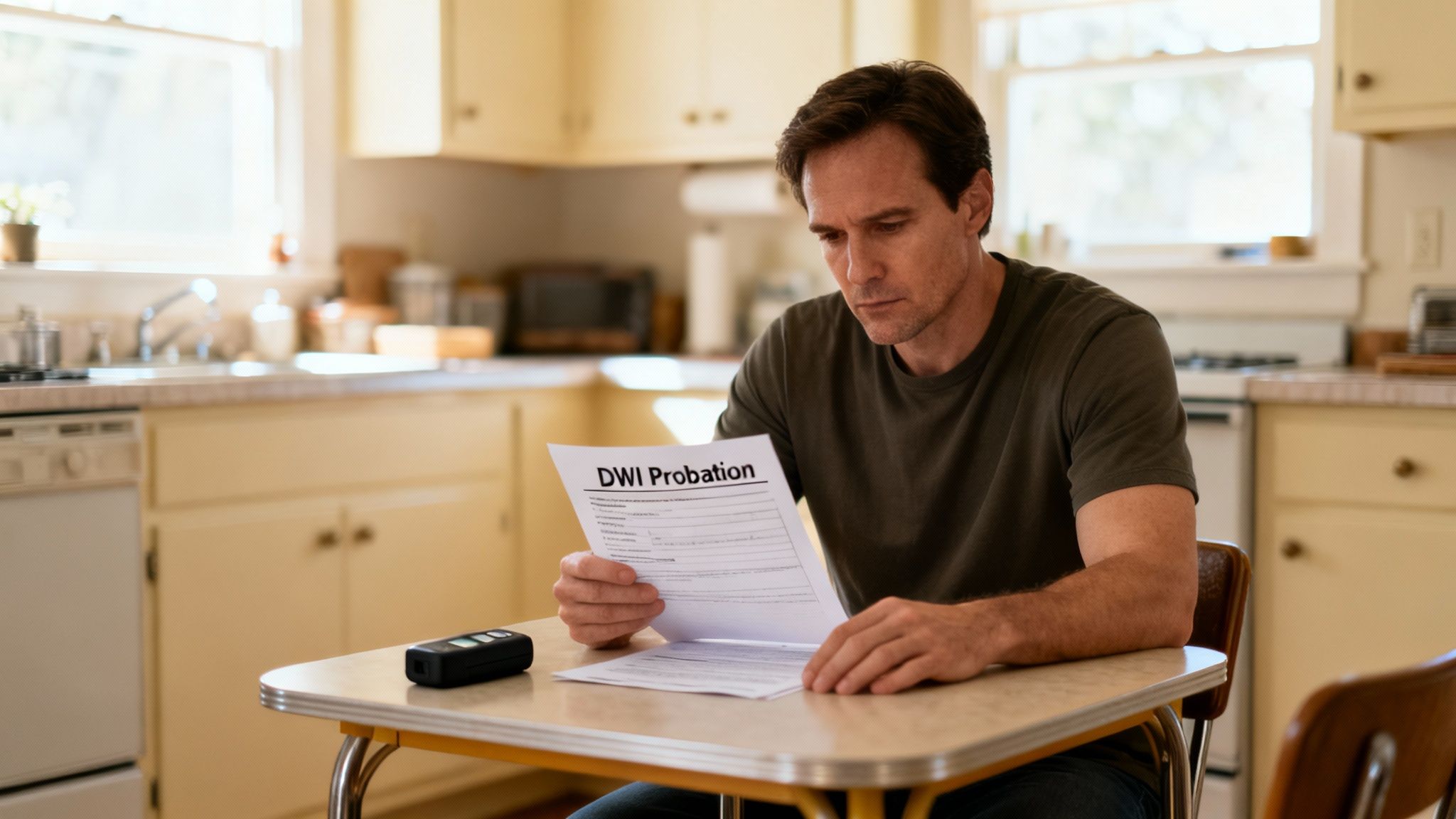
When you are placed on DWI probation, the court will outline specific conditions you must follow. A key condition is abstaining from alcohol, and your probation officer will use various methods to ensure you comply. These methods can range from random tests to constant monitoring, depending on the specifics of your case.
- Random Testing: You may be required to call a number or check a website daily to see if you have been selected for a random urine or breath test. You must report to a testing facility immediately if chosen.
- Ignition Interlock Device (IID): If the judge ordered an IID, your car becomes part of the testing process. This device requires you to provide a breath sample before your car will start and will prompt you for additional samples at random intervals while you are driving.
- Continuous Monitoring: For more serious cases or repeat offenses, a judge might order a SCRAM (Secure Continuous Remote Alcohol Monitor) bracelet. This device is worn on your ankle and tests your perspiration for alcohol 24/7.
These requirements can feel like a major intrusion on your life, but understanding the rules is the best way to maintain control and avoid violations. Fully understanding the conditions of your DWI probation is the most important step you can take. If you are ever unsure about your obligations or face an alleged violation, a skilled DWI lawyer can clarify what's required and help build your defense.
A Guide to Probation Alcohol Monitoring Methods
When a Texas court orders you to stay away from alcohol as part of your DWI probation, they use specific technologies to monitor your compliance. Understanding these methods is crucial to navigating your probation term without accidental violations. Think of these tools as different forms of verification—some take occasional snapshots, while others provide a continuous record. Your probation officer will determine which method is appropriate for your case, and it is your responsibility to understand how each one works.
Breathalyzers: Portable Devices and Ignition Interlocks
Breath testing is a common form of alcohol testing on probation because it provides instant results. These devices measure your Blood Alcohol Concentration (BAC)—the amount of alcohol in your bloodstream—from a deep-lung breath sample. There are two main types you might encounter.
- Portable Alcohol Sensors (PAS): These are handheld devices similar to those used by police during traffic stops. Your probation officer may require you to come in for a random test at their office, or you might be assigned a portable device that prompts you to test at specific times.
- Ignition Interlock Devices (IID): If ordered by the court, this device is wired into your vehicle's ignition system. You must provide an alcohol-free breath sample to start the engine. The device will also require "rolling re-tests" while you're driving to ensure you remain sober. For more details, see our guide on how ignition interlock devices work.
While these machines are sensitive, they are not infallible. Calibration errors or improper use can lead to inaccurate results. This is why having an experienced attorney is vital if a test result is ever questioned.
EtG and EtS Urine Testing
For a longer detection window, probation officers often use urine tests that screen for alcohol metabolites. The most common is the Ethyl Glucuronide (EtG) test. Unlike a breathalyzer, which measures current impairment, an EtG test can detect alcohol consumption long after its effects have worn off.
An EtG test's primary advantage for probation is its long detection window. It can identify alcohol metabolites in your system for up to 72-80 hours after consumption, making it a powerful tool for enforcing total abstinence.
However, this sensitivity can also be a significant drawback. EtG tests can sometimes be triggered by "incidental exposure" to alcohol from everyday products like hand sanitizer, mouthwash, certain foods, and cold medicines. This creates a real risk of a "false positive" that could be mistaken for a probation violation.
Continuous Monitoring with SCRAM Bracelets
For cases requiring the highest level of supervision, a court may order a Secure Continuous Remote Alcohol Monitor—commonly known as a SCRAM bracelet. This is a tamper-resistant ankle monitor worn around the clock.
The device works by testing your sweat for alcohol every 30 minutes. The data is then transmitted wirelessly to your probation officer for review.
Living with a SCRAM device requires adherence to strict rules:
- Do not submerge it in water. This means no swimming or baths.
- Avoid alcohol-based products near the bracelet. Certain lotions, body sprays, or colognes can trigger a false reading.
- Never tamper with the device. Any attempt to remove or obstruct the bracelet will send an immediate alert to your probation officer.
The demand for these technologies is significant. The global market for alcohol testing services, driven largely by the criminal justice system, is on track to hit around USD 4.5 billion by 2025. You can see more details on this growing industry in this market research analysis. If you're ordered to use any of these devices, understanding the technology and your responsibilities is the first and most important step toward successfully completing probation.
What Happens After a Failed Alcohol Test
Receiving a call from your probation officer about a failed alcohol test can be alarming. The most important thing to do is remain calm and think strategically. A failed test is not an automatic trip to jail; it is the start of a legal process, and you have the right to defend yourself.
The process begins when your probation officer is notified of the alleged violation. They are required to report non-compliance to the court, typically by filing a Motion to Revoke Probation (MTRP).
The Motion to Revoke Probation
An MTRP is a formal accusation, not a final judgment. It is a request from the prosecutor, on behalf of the state, asking the judge to revoke your probation and impose the original sentence, which could include jail time.
When an MTRP is filed, the court will almost always issue a warrant for your arrest. It is crucial to address this warrant proactively. A skilled Houston DWI lawyer can often arrange for you to turn yourself in and post bond without spending unnecessary time in custody, demonstrating to the court that you are taking the matter seriously.
This process is usually initiated by a failed test from one of the common alcohol monitoring methods.
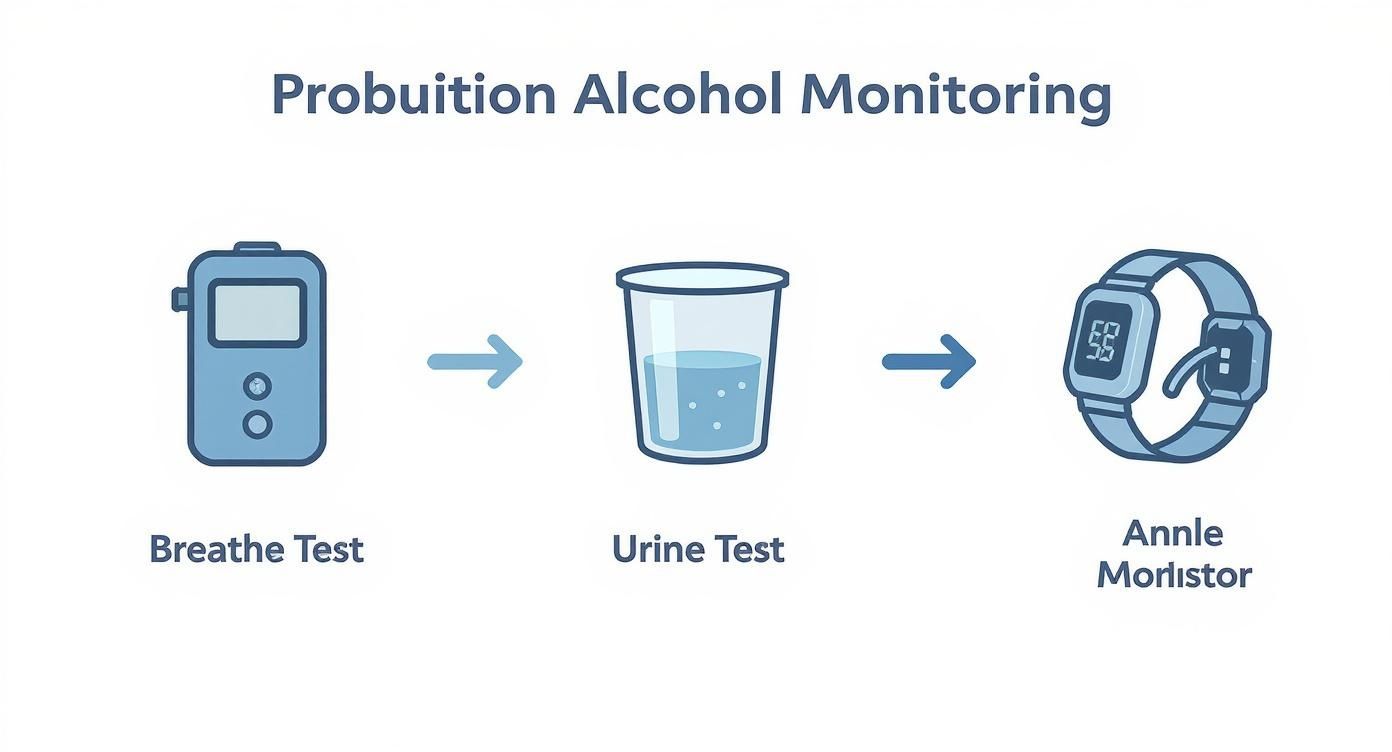
Probation officers use breath, urine, or continuous ankle monitoring to enforce abstinence. However, each of these methods has the potential for error.
Your Probation Revocation Hearing
After the MTRP is filed, the court schedules a revocation hearing. It’s important to understand that this hearing is different from your original DWI trial. The rules of evidence are more relaxed, and the standard of proof is much lower.
In a criminal trial, the prosecutor must prove guilt "beyond a reasonable doubt." At a probation revocation hearing, they only need to show by a "preponderance of the evidence" that you likely violated a condition. This lower standard makes a strong legal defense absolutely essential.
The hearing is held before a judge, with no jury. The prosecutor will present evidence, such as test results and testimony from your probation officer. You and your attorney will have the opportunity to challenge this evidence and present your side of the story.
Possible Outcomes of the Hearing
The judge has several options after hearing both sides. The outcome depends on the circumstances of the alleged violation, your probation history, and the strength of your defense.
Possible outcomes include:
- Probation is Reinstated: The judge may find the violation was minor or the state's evidence was insufficient. You could receive a warning and continue on probation.
- Probation is Modified: The judge could keep you on probation but with stricter conditions, such as more frequent testing, mandatory counseling, or an extended probation term.
- Probation is Revoked: In the most serious cases, or for repeat violations, the judge can revoke your probation and impose the original sentence, including jail time up to the maximum allowed for your DWI offense.
Facing a notice for a failed alcohol test on probation is a serious legal challenge that requires an immediate, strategic response. With the right legal help, you can navigate this process, challenge the state’s evidence, and fight to protect your freedom.
How to Challenge a Failed Probation Alcohol Test
Receiving notice of a failed alcohol test can feel devastating, but it is not a conviction. A test result is a piece of evidence that can be flawed, misinterpreted, or incorrect.
A skilled Texas DUI attorney views a failed test not as an endpoint but as the starting point of an investigation. We approach the result with the same scrutiny as any evidence in a DWI trial. Your freedom is too important to be determined by a potentially faulty machine or a flawed process.
Investigating Faulty Testing Equipment
One of the most effective defense strategies is to challenge the reliability of the testing device itself. Whether it's a portable breathalyzer, an ignition interlock, or a SCRAM bracelet, these are all machines that require proper maintenance and calibration to function correctly.
An experienced lawyer will immediately file motions to obtain all records for the device used in your test, seeking answers to critical questions:
- Was the device calibrated on schedule? A missed calibration can compromise a machine's accuracy and lead to falsely high readings.
- Were there any error logs or malfunction reports? A history of technical issues can cast doubt on the reliability of your test result.
- Was the test administered correctly? Human error is a significant factor. A probation officer who fails to follow proper protocol can contaminate a sample or cause an invalid result.
Proving the equipment was unreliable is a powerful defense. We have extensive experience in this area, and you can learn more about our approach when we challenge breathalyzer results in Texas.
Environmental Factors and False Positives
Modern alcohol tests, especially sensitive EtG urine tests and SCRAM monitors, can detect trace amounts of alcohol from everyday products. This is known as "incidental exposure," and it is a common cause of false positives.
A positive test does not automatically prove you consumed an alcoholic beverage. Many common household items contain enough alcohol to trigger a violation, turning an innocent action into a serious legal issue.
We will carefully review your activities in the days and hours leading up to the test to identify potential sources of a false positive. Common culprits include:
- Mouthwash: Many brands have a high alcohol content that can affect a breath test.
- Hand Sanitizer: Frequent use of alcohol-based sanitizers can lead to absorption through the skin or inhalation of fumes, potentially triggering a SCRAM or EtG test.
- Certain Foods and Medications: Items like kombucha, fermented foods, and some over-the-counter medicines like NyQuil contain trace amounts of alcohol.
- Workplace Fumes: Exposure to alcohol-based fumes from paints, solvents, or industrial cleaners can be absorbed by the body.
Breaking Down the Chain of Custody
For urine or blood tests, the chain of custody is crucial. This is a formal record that tracks every person who handled your sample, from collection to analysis.
If the chain of custody is broken, the test result's credibility is compromised. Gaps in documentation, improper storage, or unlabeled vials suggest the sample could have been contaminated, mixed up, or tampered with. We will scrutinize every step in the process, as a single mistake can be grounds to have the evidence dismissed.
When facing an alleged probation violation, it is essential to explore every possible defense. Your attorney will analyze the specifics of your case to determine the most effective strategy.
Here’s a look at some common strategies we might use:
Challenging a Failed Test Potential Defense Strategies
| Defense Strategy | What It Means | Example Scenario |
|---|---|---|
| Faulty Equipment | Questioning the accuracy and maintenance of the testing device (breathalyzer, SCRAM, etc.). | The maintenance log for the ignition interlock device shows it was 3 months overdue for its required calibration, making any readings unreliable. |
| Incidental Exposure | Arguing that a positive result came from a non-beverage source of alcohol. | Your work as a painter exposes you to alcohol-based fumes daily, which could have triggered the SCRAM monitor. |
| Broken Chain of Custody | Proving that the sample (urine/blood) was mishandled, contaminated, or improperly documented. | The lab's paperwork has a 4-hour gap where no one signed for the urine sample, meaning it could have been tampered with. |
| Improper Test Administration | Showing the person who gave the test did not follow the legally required procedures. | The officer failed to observe you for the mandatory 15-minute period before administering the breath test, potentially leading to a false high. |
| Medical Conditions | Using a documented medical issue to explain the positive reading. | You have Gastroesophageal Reflux Disease (GERD), which can trap mouth alcohol and cause a falsely elevated breathalyzer reading. |
These are just a few of the avenues we can explore. A failed test is not the final word. With a thorough investigation and a strategic defense, you can fight back.
How a Houston DWI Lawyer Defends Your Freedom

Facing an accusation of violating your DWI probation is not something you should handle alone. The stakes are high, and the legal system can move quickly. This is the time to partner with a legal professional who knows how to protect your rights and fight for your freedom.
An experienced Houston DWI lawyer does more than just appear in court. We launch an immediate, proactive defense designed to dismantle the prosecutor’s case.
Our first step is to get ahead of the problem. We contact your probation officer to understand the specific allegation—whether it was a failed EtG test, a missed check-in, or a positive reading from your ignition interlock device. This allows us to anticipate the state’s arguments and begin building a counter-strategy.
Building Your Proactive Defense
Next, we focus on the evidence. We never accept a failed test result at face value. Instead, we request and analyze all related documentation, searching for procedural errors and inaccuracies that could render the evidence unreliable. This includes scrutinizing calibration logs, verifying the chain of custody, and ensuring the test was administered according to strict legal protocols.
At the same time, we gather evidence that supports your side of the story. This is about more than just finding flaws in the prosecution's case; it's about presenting the judge with a compelling reason to rule in your favor.
Evidence we can use to defend you includes:
- Witness Statements: Testimony from friends, family, or coworkers who can speak to your sobriety and character.
- Receipts and Timelines: Documents that can prove your whereabouts or provide context that contradicts the alleged violation.
- Medical Records: Paperwork documenting conditions like GERD or prescriptions that could explain a false positive.
Advocating for You at the Revocation Hearing
The probation revocation hearing is where our preparation comes together. We stand beside you in court, ready to advocate fiercely on your behalf. We challenge the state's evidence, cross-examine the probation officer, and present our findings to the judge. Our goal is to create reasonable doubt about whether a violation actually occurred.
Even if the evidence of a violation seems strong, our work isn't over. We shift our focus to mitigation, negotiating for alternatives to jail time. We can argue for continuing your probation, perhaps with modified conditions like additional counseling or more frequent check-ins. We can also propose other options that satisfy the court's concerns without derailing your life.
Facing a motion to revoke your probation can feel like your world is at risk. Our mission is to shield you from the worst consequences, protect your freedom, and help you get back on track. You don’t have to face this fight alone.
Common Questions About Probation Alcohol Testing in Texas
Navigating DWI probation in Texas can feel like walking a tightrope. The rules are strict, the technology is sensitive, and the fear of a misstep is constant. It’s natural to have questions. This section provides clear, straightforward answers to some of the most common concerns we hear.
Can I Drink Non-Alcoholic Beer While on Probation in Texas?
The short answer is no. It's a risk you should not take.
While marketed as "non-alcoholic," most NA beers and similar beverages contain trace amounts of alcohol, often up to 0.5% ABV. This is not enough to cause impairment, but the highly sensitive tests used for probation, such as an EtG urine test or a SCRAM bracelet, will almost certainly detect it. A positive test, regardless of the source, can trigger a probation violation. To protect yourself, total abstinence is the only safe strategy.
What Happens If I Accidentally Miss a Random Alcohol Test?
Missing a required alcohol test is typically treated as a failed test. The court may assume you missed the test to hide alcohol consumption. This is a serious violation, and your probation officer will likely file a Motion to Revoke Probation (MTRP).
If you missed the test for a legitimate and provable reason, such as a documented medical emergency or a serious car accident, you must act quickly.
Do not wait for the probation officer to call you. Immediately gather your proof (e.g., hospital discharge papers, a police accident report) and contact your Texas DUI attorney. Your lawyer can present your evidence to the probation officer and the court to argue that the absence was unavoidable. In these situations, timing is critical.
How Long Does an EtG Test Detect Alcohol?
The Ethyl Glucuronide (EtG) test is widely used by probation departments because of its long detection window. Unlike a breathalyzer, which detects alcohol for about 12-24 hours, the EtG test identifies a metabolite that remains in your system much longer.
An EtG test can detect alcohol consumption for up to 72 to 80 hours after your last drink—a full three days. This makes it effective for enforcing total abstinence but also notorious for picking up incidental exposure from products like mouthwash or hand sanitizer.
Do I Have to Pay for My Own Alcohol Testing on Probation?
Yes. In nearly all Texas DWI probation cases, the individual on probation is responsible for the costs of their own supervision. It is important to be prepared for these expenses, which can add up quickly.
You will typically be responsible for:
- Fees for each random urine test.
- Monthly monitoring fees for an ignition interlock device (IID).
- Daily fees for a SCRAM continuous alcohol monitoring bracelet.
- Monthly supervision fees paid to the county probation department.
Failure to pay these court-ordered fees is itself a violation of your probation and can result in an MTRP. An experienced Houston DWI lawyer will ensure you understand all of your conditions—financial and otherwise—so you can navigate your probation successfully.
A DWI charge and the resulting probation can be a heavy burden, but you don't have to carry it alone. At The Law Office of Bryan Fagan, PLLC, our team is dedicated to defending your rights and fighting for the best possible outcome for your case. If you have questions about your probation or are facing an alleged violation, contact us for a free consultation to learn how we can protect your future.