
A DWI arrest after a crash can make your whole life feel unstable in a matter of minutes. You’re worried about jail, your license, your job, your insurance, and what your family is going to say. That reaction is normal.
You are not powerless, and you are not out of options. In Texas, accident defense lawyers don’t just show up in court and talk. We protect evidence, challenge bad police work, fight license suspension, and force the State to prove every part of its case.
Your First Steps After an Accident and Arrest
The crash happens. Then the lights. Then the questions. Before you can process any of it, you are dealing with jail, a wrecked vehicle, possible injuries, and a license problem that starts fast. If you hold a CDL or you are visiting Texas from another state, the pressure is even worse because one bad move here can follow you home or hit your livelihood immediately.
Start protecting yourself now.
Texas accident cases are won or lost early. The first day matters because evidence disappears, memories change, and officers write reports that prosecutors will later treat like fact unless your lawyer gets in front of them.

What to do in the first 24 hours
Keep your mouth closed and your records organized.
Be polite, then stop talking
Give your name and identifying information. After that, say clearly that you want to remain silent and speak with a lawyer. Do not explain the crash. Do not guess about speed, drinks, medications, fatigue, or fault.Do not try to clean up the story
People under stress say things that sound harmless and later become admissions. “I only had a couple.” “I looked down for a second.” “I’m shaken up.” Prosecutors use those statements to build impairment and fault arguments.Write down the timeline while it is fresh
Record the time of the stop, where you were coming from, road and weather conditions, what the officer asked, whether body cam or dash cam was visible, whether you were asked to do field tests, and who saw the crash. Small details often become defense issues later.Save every piece of paper
Keep the bond sheet, temporary permit, citation, tow paperwork, hospital records, property receipts, and any notice about license suspension. Take photos of them in case something gets lost.Stay off your phone unless it is for your defense
Do not text friends about what happened. Do not post online. Do not talk about the case on a recorded jail call. If a prosecutor can read it to a jury, assume it can hurt you.
What to expect after booking and bond
After an arrest, the process usually moves in a blur. Booking, fingerprints, photographs, bond, release conditions. If the crash involved injuries, a passenger, a child, a commercial vehicle, or a driver from out of state, the State often looks harder for added charges or aggravating facts.
Read your bond conditions carefully. Judges may restrict driving, alcohol use, travel, or require check-ins and monitoring. Violating those terms creates a new problem you do not need.
If you drive for a living, treat this as an employment emergency too. CDL holders face different practical risks even before the criminal case is finished. Out-of-state drivers have another problem. Texas can report the case back to your home state, and your home state may take its own action against your license.
The deadline you cannot miss
If your license was taken or you received a notice of suspension, act immediately. The ALR hearing is separate from the criminal case, and missing that deadline gives away one of your first chances to fight back.
Use this Texas DUI post-arrest checklist for the first days after an arrest and get counsel involved right away.
Over the next 72 hours, focus on four things:
- Get a defense lawyer involved early: A lawyer can seek dash cam, body cam, 911 audio, dispatch logs, blood draw records, accident reconstruction material, and witness information before it disappears.
- Protect medical evidence: If you were hurt, your injuries may explain poor balance, confused statements, or performance on field sobriety tests. Save discharge papers, prescriptions, imaging, and follow-up instructions.
- Identify every witness: Passengers, other drivers, bystanders, tow operators, and ER staff may all have pieces of the story the police report left out.
- Avoid side conversations with insurers: Give basic claim information if required, but do not speculate about fault or intoxication without legal advice.
A bad first night does not decide your case. A disciplined first week can change it.
Understanding DWI and Accident-Related Charges in Texas
If you were in a wreck, got arrested, and now you are staring at paperwork full of legal terms, I know how this feels. It feels bigger than one bad night. The good news is that these cases follow a structure, and once you understand the charge, you can start making smart decisions instead of panic-driven ones.
Texas uses technical language, but the core issues are simple. The State has to prove you were intoxicated, that you were operating a vehicle, and, in injury or death cases, that your intoxication caused the harm. In accident cases, that last part matters a lot.
The key terms you need to know
BAC means blood alcohol concentration. It is the alcohol level the State will try to use against you through breath or blood testing. That number matters, but it is not self-proving. Machines fail. Blood procedures get mishandled. Officers and lab personnel make mistakes.
Implied consent means Texas can ask for a breath or blood specimen after a lawful DWI arrest. If you refuse, the State can try to suspend your license through a separate civil process, even if the criminal case is still pending.
Field sobriety tests are the roadside tests officers use to claim impairment. They are part observation, part instruction-following, and part officer interpretation. Injuries from the crash, shock, fatigue, bad lighting, uneven pavement, medical conditions, age, and footwear can all affect performance.
Administrative license suspension is the civil fight over your driving privileges. It is separate from the criminal prosecution, and it operates on its own timeline.
Why accident cases get treated differently
A crash changes everything.
Police usually spend more time on the scene, talk to more witnesses, look harder for signs of intoxication, and build a file with more moving parts than a routine traffic stop case. Prosecutors also tend to push harder when there is property damage, an injured driver, a hurt passenger, or a fatality. That is why accident cases need a defense plan built around facts, not fear.
These cases also hit different people in different ways. A commercial driver may be worried less about jail and more about losing a CDL and a career. An out-of-state visitor may be dealing with a Texas charge while also worrying about what happens back home. Those are not side issues. They are often the true stakes, and your defense strategy should reflect that from day one.
The range of charges you may face
A wreck does not automatically mean the State files the most serious charge available. The exact allegation depends on the injuries, your record, and what prosecutors believe they can prove.
| Charge type | What it generally means | Why it matters |
|---|---|---|
| First DWI in Texas | A misdemeanor allegation that you operated a vehicle while intoxicated | It can still affect your record, license, job, insurance rates, and immigration status |
| Felony DWI | A more serious allegation, often tied to prior history or severe facts | Prison exposure increases, and the long-term consequences get much harder to contain |
| Intoxication assault | A charge based on serious bodily injury after an alleged intoxication-related crash | The State must prove both intoxication and that your intoxication caused the injury |
| Intoxication manslaughter | A charge involving death after an alleged intoxication-related incident | These cases carry severe punishment and demand immediate defense work |
If the case involves serious bodily injury, focus on causation. That is where many accident cases turn. A person can be injured without your driving causing it. A crash can happen without intoxication causing it. The State has to connect those dots with admissible evidence.
For a closer look at how Texas handles serious injury allegations, review intoxication assault with vehicle and serious bodily injury in Texas.
The charge on your paperwork is the State’s accusation. It is not the final truth, and it is not the end of the case.
What this means for your next move
Do not hire a lawyer who treats every accident DWI like a standard stop on a highway shoulder. Accident cases are more technical. They can involve reconstruction evidence, medical records, blood testing issues, witness conflicts, CDL consequences, and interstate license problems.
You need a defense lawyer who can explain, in plain English, where the State’s proof is weak and how to attack it. In these cases, small details decide big outcomes. Who caused the wreck. Whether an injury changed how you looked or spoke. Whether the officer made assumptions before the evidence was in. Whether the State can prove intoxication caused the collision, not just that a collision happened.
How a Strategic Defense Lawyer Fights Your Charges
A good defense doesn’t start with excuses. It starts with evidence.
I want you to think about your case the way accident defense lawyers do. We don’t begin by asking, “How do we explain this?” We begin by asking, “What can the State prove, and what did the police do wrong along the way?”

Start with the stop and the scene
Take a common scenario. There’s a late-night crash at an intersection. Police arrive. Someone says they smell alcohol. The officer starts asking questions, orders roadside tests, and makes an arrest.
That may sound routine. It isn’t routine to the defense.
We look at whether the officer had lawful grounds for the detention, whether witness accounts conflict, whether body cam matches the report, and whether the crash itself could have been caused by something unrelated to intoxication. A distraction, road condition, another driver’s action, poor visibility, or a simple mistake by the officer can all matter.
A strategic defense often attacks the foundation first. If the stop, detention, or arrest was unlawful, key evidence may be excluded. That’s where a motion to suppress evidence in a Texas DWI case can become one of the most important tools in the file.
Field sobriety tests are not as reliable as police reports make them sound
Officers often describe field sobriety tests as objective. They are not. They are highly dependent on conditions and officer instruction.
If you were standing on gravel, wearing work boots, dealing with an injury from the crash, confused from airbag deployment, or trying to follow rushed directions under flashing lights, those facts matter. Many test performances that officers call “clues” are perfectly consistent with stress, pain, or ordinary human error.
When the video doesn’t match the report, the report loses value fast.
That’s why we compare every written statement to the body cam, dash cam, 911 audio, and dispatch timeline. We don’t accept the officer’s summary at face value.
Breath and blood evidence live or die on procedure
Many cases turn at this point.
Texas requires attention to procedure in chemical testing. One important area is machine upkeep. According to analysis discussing crash-related trial preparation and procedural precision, Texas breathalyzer calibration and maintenance must occur every 6 to 12 months, and favorable outcomes increase when attorneys uncover non-compliance or inadequate officer training.
That gives the defense real places to dig:
- Maintenance records: Was the machine serviced and calibrated on schedule?
- Operator qualifications: Was the person administering the test properly trained and certified?
- Collection method: If blood was drawn, who drew it, where, and under what conditions?
- Chain of custody: Can the State prove the sample was handled correctly from start to finish?
A prosecutor may present a number and act like the case is over. It isn’t. The number only matters if the State can prove the process was lawful and reliable.
Here’s a useful overview of how these issues play out in practice:
Building leverage before trial
Strong defense work changes negotiation. If we expose weak probable cause, flawed testing, inconsistent witness statements, or bad procedure, the prosecutor has a harder case and more risk.
That can lead to several outcomes:
- Dismissal pressure: If key evidence is excluded, the State may not be able to proceed.
- Charge reduction: Sometimes the issue becomes minimizing damage when proof problems are significant but not total.
- Trial readiness: If the prosecutor won’t deal fairly, being ready for trial matters. Real trial preparation changes how the State values the case.
One practical option for Texans facing these issues is the Law Office of Bryan Fagan, PLLC, which handles DWI defense, ALR hearings, and evidence challenges in Texas courts.
The central point is simple. If you want to fight DWI Texas charges effectively, you need a lawyer who treats every stage of the case like a fact investigation, not a plea form.
Navigating the Two Fronts ALR Hearings and Criminal Court
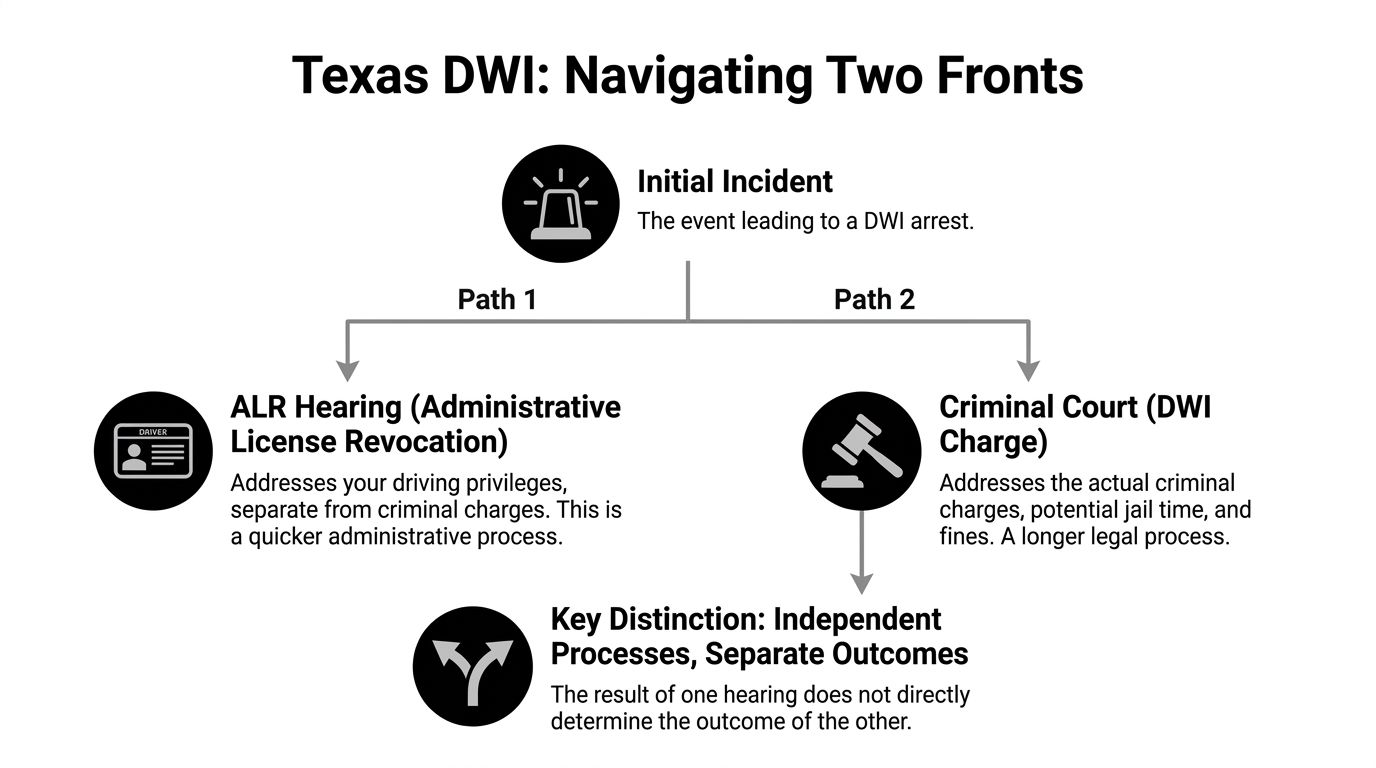
Most drivers think they have one DWI case. In Texas, you usually have two.
One case is about your license. The other is about the criminal charge. They run on separate tracks, with separate rules, and one can move much faster than the other.
The side-by-side difference
| Issue | ALR hearing | Criminal court |
|---|---|---|
| Main question | Whether DPS can suspend your license | Whether the State can convict you of DWI or a related offense |
| Type of case | Administrative | Criminal |
| What’s at stake | Your driving privileges | Conviction, fines, jail, probation, and a criminal record |
| Who is involved | DPS and an administrative process | Prosecutor, judge, and possibly jury |
| How defense lawyers use it | To fight suspension and question the officer under oath | To challenge evidence, negotiate, file motions, and prepare for trial |
That difference matters for anyone dealing with DWI license suspension fears. Winning one does not automatically win the other. Losing one does not automatically lose the other.
Why the ALR hearing matters more than people think
Many lawyers treat the ALR hearing like paperwork. That’s a mistake.
The ALR hearing can be one of the earliest chances to lock an officer into testimony. If the officer later changes details in criminal court, that earlier sworn testimony can help the defense. It also gives us an early view of the State’s story before the criminal case has fully developed.
A smart lawyer doesn’t just try to save your license at the ALR hearing. A smart lawyer uses that hearing to build the criminal defense.
Trial leverage changes negotiations
Most personal injury cases settle, but motor vehicle trial data shows plaintiffs winning 67.28% of cases in the set discussed by Redmond Firm’s review of lawsuit success rates. In practice, that kind of trial risk matters when evidence is weak or procedures were mishandled.
For a DWI accident defense, the lesson is practical. When the prosecution knows its stop, test, or paperwork has problems, trial pressure can improve negotiations. Not every case should go to trial. But every serious defense lawyer should prepare as if it might.
A working timeline you should expect
- Early stage: Arrest, temporary permit, notice issues, bond conditions
- Administrative stage: License-related deadlines and hearing requests
- Criminal court stage: Arraignment or first setting, evidence review, motions, negotiations
- Decision stage: Resolution by dismissal, reduction, plea, or trial
If you’re facing a first DWI in Texas, this two-front system can feel unfair. It is complicated. But it’s manageable when someone is driving the strategy instead of reacting to events.
Choosing the Right Accident Defense Lawyer in Texas
You are already dealing with enough. A wreck, an arrest, missed work, family pressure, insurance calls, and a court date can make every lawyer sound the same. They are not the same.
The right lawyer for an accident-related DWI case in Texas should do one thing from the start. Build a defense that protects your license, your criminal case, and your ability to keep living your life. If you hold a CDL or you were arrested while visiting Texas, that lawyer also needs a plan for the extra consequences that can follow you long after the court date.

Ask consultation questions that expose strategy
A consultation should tell you how the lawyer thinks under pressure. Price matters, but it should not be your only filter. Cheap representation can get expensive fast if the lawyer misses deadlines, overlooks suppression issues, or treats a crash case like a routine traffic arrest.
Ask direct questions:
- How would you challenge the officer’s basis for the stop or arrest in a crash case?
- What do you look for first in body camera, dash camera, and witness statements?
- How do you attack blood or breath evidence in Texas DWI cases?
- Will you personally handle both the criminal case and the license hearing issues?
- How often do you file motions and take cases to trial?
- Have you handled cases involving CDL holders or drivers from other states?
- Who will stand next to me in court?
Listen for direct answers. A lawyer who speaks in slogans during the consultation usually stays vague when the case gets hard.
Look for experience that fits this exact problem
Accident-related DWI cases are their own category. They often involve accident reconstruction issues, witness confusion, medical explanations for behavior, and arguments about whether alcohol caused the crash. A general criminal lawyer may miss those openings. A general personal injury lawyer is the wrong fit entirely.
You want a defense lawyer who regularly handles DWI cases in Texas courts and knows how to work with technical evidence instead of just reacting to the police report.
Here is what matters:
| What to look for | Why it matters |
|---|---|
| Regular DWI defense work | These cases involve testing procedures, officer training, and legal issues that general practice lawyers often miss |
| Experience with accident cases | Crash scenes create separate questions about causation, witness reliability, and physical evidence |
| Strong motion practice | Bad stops, weak warrants, and flawed testing often need formal court challenges |
| Trial readiness | Prosecutors treat the case differently when they know defense counsel will try it well |
| Clear client communication | You need a lawyer who can explain the plan in plain English and keep you from making costly mistakes |
If a lawyer cannot explain your case clearly, that is a warning sign.
CDL drivers need a defense built around their livelihood
For commercial drivers, this is not just a criminal charge. It is a threat to your paycheck.
A plea that looks manageable for a non-commercial driver can wreck a CDL career. Your lawyer needs to understand the difference between protecting a regular license and protecting the ability to work. That means asking about your driving status, employer reporting issues, disqualification risks, bond conditions that affect work, and how every case decision could hit your commercial privileges.
Ask these questions if you drive for a living:
- Have you defended CDL holders in Texas DWI or crash cases before?
- How do you account for commercial licensing consequences while fighting the criminal case?
- What result would protect my job best, not just close the file fastest?
- Can you explain the likely effect of each option on my CDL in plain terms?
If the lawyer treats your CDL as a side issue, keep looking.
Out-of-state drivers need a lawyer who plans beyond Texas
If you live outside Texas, hiring blindly is a mistake. You need counsel who understands that a Texas arrest can create problems back home with your license, your travel schedule, and your work.
The right lawyer should be ready to explain which parts of the case may require your presence, what may be handled remotely, and how Texas proceedings can affect your home-state driving record. That is not a small detail. It is part of the defense strategy from day one.
A good lawyer gives you a roadmap
By the end of the first serious conversation, you should know where the case is headed over the next few weeks. You should understand the immediate deadlines, what evidence needs to be secured, where the State’s case may be weak, and what the first court settings are likely to involve.
You do not need a sales pitch. You need a plan.
If you leave the consultation more confused than when you started, hire someone else. Good accident defense lawyers bring order to a bad situation, and they do it early.
Take the First Step to Protect Your Future Today
You may be sitting at home staring at bond papers, a towing bill, and a court date, wondering how one bad night turned into a threat to your license, your job, and your future. That reaction is normal. Panic is not a plan.
Start with action. A crash-related DWI case is beat with early decisions, not wishful thinking. The officer’s report is only one version of what happened. The stop, the arrest, the blood or breath test, the field sobriety tests, and the claim that alcohol caused the crash all need to be examined fast. If you hold a CDL or you live outside Texas, the stakes are even higher because this case can follow you into your work and your home-state license record.
You do not need to solve the whole case today. You need to protect it today.
That means getting a lawyer involved before you make another statement, miss an ALR deadline, or assume the criminal case is the only problem. In Texas, accident-related DWI cases often split into two fights at once. One affects your ability to drive. The other affects your criminal record, finances, and freedom. A good defense plan addresses both from day one.
If this is your first DWI, do not assume the State will go easy on you because nobody was badly hurt. If this involves a felony allegation, do not assume the case is hopeless because the charge sounds severe. If you drive for a living, do not hire a lawyer who treats your CDL like a side issue. If you were arrested while visiting Texas, do not assume you can ignore the case once you cross state lines.
The right move is simple. Get clear legal advice now, preserve the evidence, and make decisions based on strategy instead of fear.
The Law Office of Bryan Fagan, PLLC offers free consultations for Texans facing DWI and accident-related charges. If you need guidance on your ALR hearing, criminal court defense, license issues, or the first steps after an arrest, request a case evaluation and get clear answers about your options now.