
A DWI arrest can be overwhelming, but you don't have to face it alone.
If you were just booked on a third DWI arrest, you're probably dealing with several problems at once. You may be trying to get out of jail, figure out your bond conditions, protect your license, and understand whether this charge means prison is automatic. Those are fair questions, and the fear is real.
A 3rd DWI in Texas is serious. But serious doesn't mean hopeless. The State still has to prove the case, the felony enhancement isn't automatic unless the prior convictions can be properly established, and there may be paths that avoid the worst outcome. The right response is not panic. It's quick, organized action.
Facing a Third DWI Arrest Acknowledging the Stakes
The first hours after a third DWI arrest often feel chaotic. You're handed paperwork, given court dates, and told conditions that may include alcohol monitoring or an ignition interlock device. Family members are asking questions you can't answer yet.
Start with two truths.
First, this is a high-stakes case. Second, an arrest is not a conviction.
What usually happens right away
After a felony DWI arrest, you can expect the case to move on two tracks at the same time:
- Criminal court: In criminal court, the prosecutor tries to prove intoxication and, in a third-offense case, prove the prior convictions needed to keep the case at the felony level.
- License case: A separate administrative process can affect your ability to drive while the criminal case is still pending.
- Bond conditions: The judge may impose rules that affect daily life, including testing, travel limits, or driving restrictions.
Practical rule: The biggest early mistake is treating a third DWI like a paperwork problem. It isn't. It's a felony case that needs a defense plan immediately.
Terms you need to understand early
A few legal terms come up fast in Texas DWI cases:
- BAC: Short for blood alcohol concentration. This is the alcohol level the State may try to prove through a breath or blood test.
- Field sobriety test: These are roadside tests officers use to claim impairment, such as balance, divided attention, and eye-movement testing.
- Implied consent: By driving on Texas roads, you are treated as having agreed to provide a breath or blood sample after a lawful DWI arrest.
- Administrative license suspension: This is the separate license action tied to a DWI arrest, apart from the criminal prosecution.
What helps most at this stage is structure. Save every document, write down what happened while it's fresh, and speak with counsel before you try to explain the case to anyone else. A careful defense begins long before trial. In many cases, it begins with what happened during the stop, the arrest, and the State's ability to prove your record.
How a Texas DWI Becomes a Third Degree Felony
You get booked, bond out, and start telling yourself the old cases were too long ago to matter. Then the paperwork says felony. That happens more often than people expect in Texas.
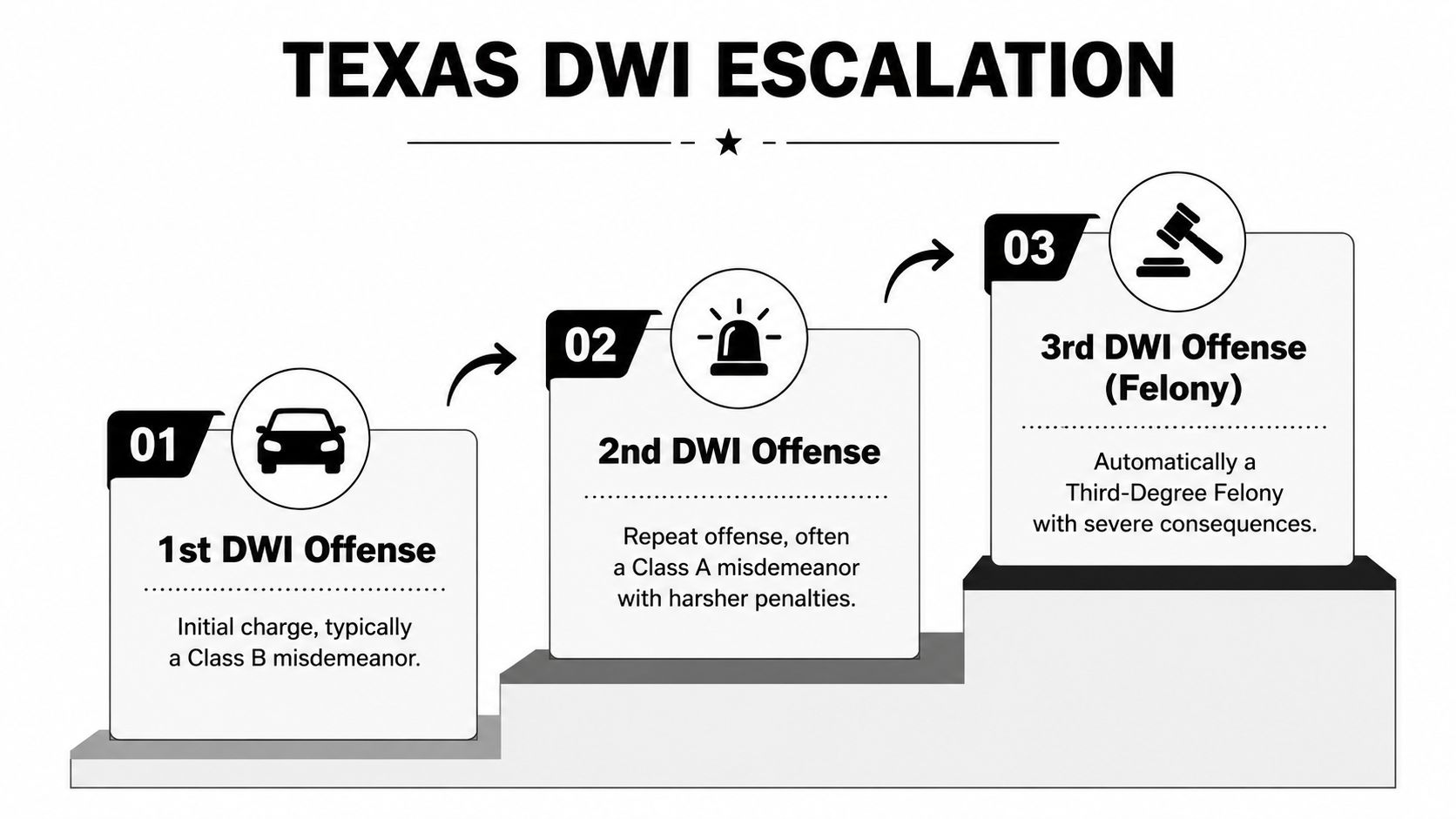
A DWI becomes a third-degree felony because of prior convictions, not because this is your third arrest. That distinction matters. In many cases, it becomes one of the first places the defense needs to look closely.
The legal jump from misdemeanor to felony
Texas law allows the State to charge a current DWI as a third-degree felony if it can prove two prior DWI convictions. The statute appears in Texas Penal Code § 49.09(b). If you want a fuller explanation of when a DWI becomes a felony in Texas, the answer usually turns on prior convictions or another qualifying aggravating fact under Texas law.
The word "prove" is doing real work here. Prosecutors usually need certified judgments, charging records, and reliable proof that the person named in those prior cases is you. If the paperwork is incomplete, inconsistent, or tied to the wrong person, the felony enhancement can become a contested issue instead of an automatic one.
Old cases still count
Texas does not give DWI priors an expiration date for enhancement purposes. A conviction from years ago can still be used to raise a new case to felony level.
That surprises many good people.
I often see clients focus on the stop, the breath test, or what happened at the jail, while the State is building the felony level of the case from courthouse records. Both sides of the case matter. If the prior convictions are not proven correctly, the prosecution may have a harder time keeping the case in felony posture.
What counts, and what the State still has to connect
A third arrest is not the same thing as a felony third offense. The State has to show that the prior cases qualify and that they belong to you.
That can raise practical defense questions such as:
- whether the prior judgments are final and usable for enhancement
- whether the names, dates of birth, cause numbers, or fingerprints match
- whether the records are certified and complete
- whether an older out-of-state case is really equivalent to a Texas DWI for enhancement purposes
Those issues are not technical side arguments. They can affect the charge level, plea options, sentencing exposure, and how much advantage the defense has from the start.
In a third DWI case, the State does not get a felony simply by saying you have two priors. It has to prove them the right way.
Penalties and Sentencing for a Felony DWI Conviction
Once a DWI is charged as a felony, the consequences extend beyond a fine or short county jail sentence. The punishment range becomes a state prison issue, and the long-term effects can follow you well after the criminal case ends.
The punishment range on paper
Past DWI convictions in Texas can be used to enhance a current charge to a third-degree felony even if they occurred more than 10 years ago, as Texas law does not impose a lookback period and sets the mandatory minimum sentence at exactly 2 years, with the maximum at 10 years.
A conviction can also bring a fine of up to $10,000. And this is prison exposure, not just county jail exposure.
What sentencing can include
Here is the practical view of what a felony DWI sentence may involve:
| Consequence | What it means for you |
|---|---|
| Prison range | The case carries 2 to 10 years if convicted |
| Fine | The court may impose up to $10,000 |
| Probation conditions | If supervision is granted, the court can still require jail time and strict conditions |
| License consequences | Driving privileges can be affected separately from the criminal judgment |
The record problem doesn't go away
A felony DWI conviction carries a permanent record that generally cannot be cleared through expunction or nondisclosure, according to this discussion of third DWI consequences in Texas. It can affect employment, professional licensing, housing, firearm rights, and voting rights while incarcerated.
That permanence changes how defense lawyers evaluate the case. In a first-offense misdemeanor, some people think only about immediate punishment. In a felony DWI, the record itself is one of the biggest penalties.
What doesn't work
Waiting for the case to "work itself out" rarely helps in a felony DWI. Neither does assuming the judge will see you as a good person and fix the charge without a targeted legal argument. Courts deal in evidence, procedure, and proof.
The best sentencing outcome usually starts earlier, with aggressive case review, factual investigation, and pressure on the State's evidence before trial settings begin to harden into plea negotiation advantage.
Your Driver's License The Separate ALR Battle
You can walk out of jail focused on the felony case and still lose your license because of a separate DPS process already running on its own track. That catches a lot of people off guard after a third DWI arrest.
The ALR process moves fast
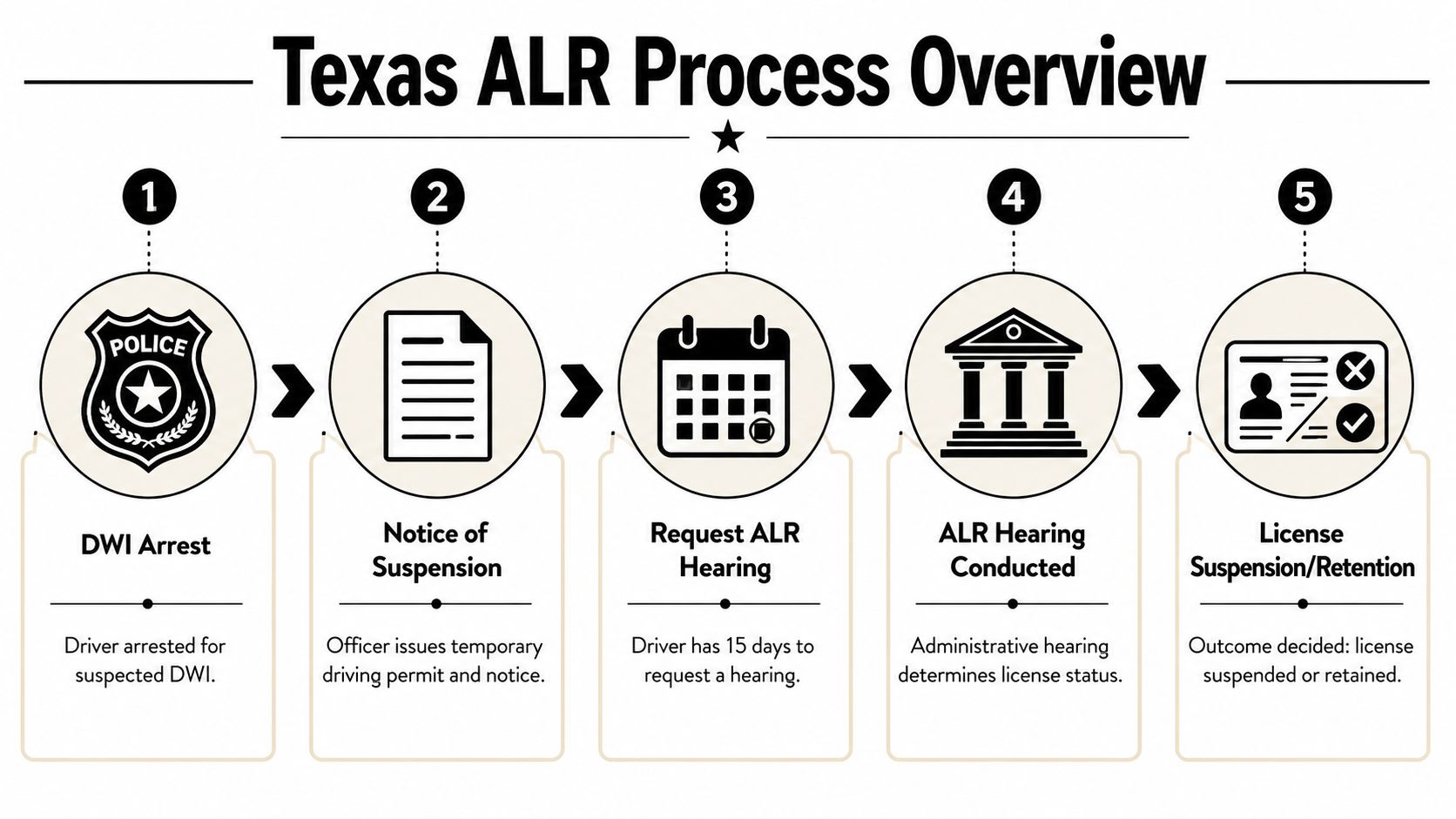
Administrative License Revocation, or ALR, is the civil case over your driving privileges. It is separate from the criminal prosecution, and it starts quickly. If the officer reports a refusal or a test result that supports suspension, DPS can move to suspend your license even while the felony case is still in its early stages.
The deadline matters. You generally have 15 days from the date of arrest to request the hearing. Miss it, and the suspension can begin automatically.
A Texas DWI license suspension case also creates an early chance to question the officer under oath. In practice, that hearing can do two jobs at once. It can protect your ability to drive, and it can give your lawyer testimony that may help later in the criminal case.
Key terms that matter here
A few terms come up in almost every ALR case:
- Implied consent: By driving on Texas roads, you are treated as having agreed to provide a breath or blood sample after a lawful DWI arrest.
- Administrative license suspension: This is the civil action against your license. It does not decide guilt or innocence in the criminal case.
- BAC: If there was breath or blood testing, DPS may rely on that alcohol concentration in the suspension proceeding.
Winning in criminal court does not automatically save your license. The ALR case has to be handled directly and on time.
How long a suspension can last
For someone accused of a third DWI, the license consequences can be severe. A suspension can last up to two years, and DPS charges a reinstatement fee before driving privileges are restored.
That part of the case deserves attention early, especially for anyone who needs to drive to work, take children to school, or keep a professional license in good standing.
What happens at the hearing
An ALR hearing is narrower than a criminal trial, but I treat it seriously because it often gives the first clear look at the officer's version of events. The hearing officer is not deciding the felony charge. The issues are usually whether the stop, arrest, warning, and test request were handled in a way that allows DPS to suspend your license.
A lawyer may use that hearing to:
- Test the stop: Was there a lawful reason to pull you over?
- Probe the arrest: Did the officer have a valid basis to arrest for DWI?
- Preserve testimony: Early statements under oath can expose inconsistencies or missing details.
In a third DWI case, that early testimony can matter more than people expect. The State's case is not automatic, and the license hearing is often the first place to start pressing on proof instead of accepting the arrest paperwork at face value.
Building Your Defense Challenging the State's Case
A third DWI arrest can make it feel like the result is already decided. It is not. The State still has to prove intoxication in the current case and prove the prior convictions it is using to turn the charge into a felony.
Standard DWI defenses still matter
The first step is still careful, methodical defense work. I look at the stop, the officer's observations, the field sobriety testing, the arrest decision, and the breath or blood evidence. Felony label or not, weak police work is still weak police work.
That review can expose problems with:
- The traffic stop: If the officer did not have a lawful reason to pull you over, the rest of the evidence may be open to challenge.
- Field sobriety testing: These tests depend on instructions, lighting, road surface, footwear, medical conditions, and officer scoring.
- Breath or blood evidence: Collection errors, machine maintenance issues, lab handling, and chain of custody problems can all matter.
For a practical look at how lawyers beat DWI cases in Texas, focus on the pattern. Good defense work comes from examining the facts line by line, not accepting the offense report as the final word.
The felony enhancement is often the real fight
A common assumption is that a third arrest automatically means a felony conviction. That is not how these cases work.
For a third DWI to stay charged as a felony, the State must prove two prior DWI convictions that legally count for enhancement. That sounds routine until the paperwork is tested. In many cases, the enhancement file deserves as much attention as the patrol video, because a problem with one prior can change the whole posture of the case.
Where the State's proof can break down
Prosecutors usually prove prior convictions through certified records, fingerprints, judgments, and other identifying documents. If those records are incomplete, inconsistent, or tied to the wrong person, the felony enhancement can be challenged.
A defense lawyer should examine questions like these:
- Identity: Can the State prove that the prior convictions belong to you, not someone with a similar name?
- Record quality: Are the judgments certified, complete, and admissible?
- Out-of-state priors: Does the prior offense from another jurisdiction match what Texas law requires for enhancement?
- Final disposition: Was the earlier case a conviction, or was it dismissed, reduced, or resolved in a way that does not support felony treatment?
That issue gets missed more often than it should.
I have seen cases where the prosecution's confidence rested on a stack of records that looked solid until someone read every page and checked every detail. When the enhancement proof is weak, the charge may still be serious, but the State's position is weaker, the defense has more room to negotiate, and the outcome is no longer limited to the worst version of the case.
Potential Outcomes Beyond the Worst Case Scenario
A third DWI arrest can make it feel like the case is already over. You may be hearing "felony" and assuming prison is the only realistic result. That is not how these cases always end in Texas.
Results turn on details. A weak traffic stop, shaky blood or breath evidence, problems with prior-conviction proof, and your conduct after arrest can all change the range of outcomes. In some cases, the fight is about whether the State can prove the charge at all. In others, the fight is about keeping a bad case from turning into the worst possible sentence.
The real outcome range
A third DWI case can resolve in several different ways, including:
- Dismissal: If key evidence is thrown out or the prosecution cannot prove an element of the case, dismissal can become a real possibility.
- Reduction: If one of the alleged prior convictions does not hold up for enhancement, the felony allegation may be open to attack.
- Negotiated plea: Some cases end with an agreement that limits jail exposure, protects against harsher terms, or avoids trial risk.
- Trial: Trial makes sense in some cases, especially when the State is overcharging the facts or overestimating the strength of its proof.
Good strategy starts with an honest case evaluation. Some people need a trial lawyer ready to challenge every part of the file. Others are better served by gaining an advantage early and using it to reach a controlled result.
Probation is often overlooked
Probation, called community supervision in Texas, is difficult in a third DWI case. It is still a real possibility in the right case.
I tell clients the same thing. Judges look closely at conduct after arrest. A person who follows bond conditions, shows up, tests clean when required, and takes the case seriously presents a different sentencing picture than someone who racks up violations. Prosecutors notice that too.
That does not mean probation is easy or guaranteed. It means you should not assume a felony DWI automatically ends in prison.
What probation can actually involve
If community supervision is on the table, expect strict conditions. They often include:
- Jail time up front: A probation sentence can still include a jail term.
- Ignition interlock: The court may require an interlock device as a condition of release or driving.
- Treatment or classes: Alcohol education, counseling, or evaluation may be required.
- Regular reporting and testing: Missed appointments or failed tests can put probation at risk quickly.
- Long-term court oversight: These cases usually come with tight rules and very little room for mistakes.
For some clients, probation is a strong result because it avoids a prison sentence. For others, the conditions are so demanding that the defense has to weigh that option against the risk and benefit of trial. That is a real trade-off, not a slogan.
What helps your position
Courts tend to respond better when a person shows stability and follow-through. Useful facts can include steady work, family responsibilities, compliance with bond terms, and early steps to address alcohol issues when appropriate.
What hurts is predictable. Missed court dates, failed tests, new arrests, careless social media posts, and ignoring court orders all make a hard case harder. In a third DWI, small mistakes can have outsized consequences.
Your Next Steps How to Protect Your Future Today
When you're facing a felony DWI, your next steps matter more than your explanations. The case won't improve because you hope it does. It improves when you act early and strategically.
What to do right now
Use this checklist as soon as possible after release:
- Save every document. Keep your bond paperwork, notice of suspension, tow papers, and any court settings in one place.
- Write down the facts. Record where you were, what you ate or drank, when the stop happened, what the officer said, and whether tests were requested.
- Don't discuss the case casually. Text messages, social media posts, and offhand statements to friends can all become problems later.
- Follow bond conditions exactly. If the court ordered testing, an interlock, or no alcohol use, treat those conditions seriously.
- Act before the ALR deadline expires. The license issue moves quickly, and delay can cost you your best chance to challenge the suspension.
Choosing the right kind of lawyer
Not every criminal defense practice handles felony DWI cases with the same depth. You need someone who understands both the science and the enhancement issues.
Look for counsel who can evaluate:
- Prior conviction proof
- ALR hearing strategy
- Breath and blood evidence
- County-specific court practice
- Trial risk versus negotiation value
For people comparing options, Law Office of Bryan Fagan, PLLC handles Texas DWI matters including ALR hearings, repeat-offense charges, and felony DWI defense.
Questions worth asking in a consultation
A useful consultation should answer practical questions, not just general ones:
- Can the State prove two prior convictions?
- Are there stop or testing issues worth litigating?
- What bond conditions should be modified, if any?
- Should you request an occupational license if driving becomes restricted?
- Is the case positioned for negotiation, or should it be prepared for trial from the start?
Get legal advice before you make strategy decisions based on fear. Third DWI cases turn on proof, procedure, and timing.
A Houston DWI lawyer or Texas DUI attorney should be able to explain your case in concrete terms. You should leave that meeting understanding your immediate deadlines, the likely pressure points in the evidence, and the realistic paths forward. Whether you're trying to fight DWI Texas charges, protect your license, or understand how a third case differs from a first DWI in Texas, clarity is the first step toward control.
If you're dealing with a third DWI arrest, now is the time to act. The consequences are serious, but the State's case is not automatic, and early defense work can make a real difference. Request a free consultation with Law Office of Bryan Fagan, PLLC to review your charge, protect your rights, and build a strategy for your criminal case and your DWI license suspension.