
A DWI arrest can be overwhelming, but you don’t have to face it alone.
If you’re dealing with a 2nd offense DWI in Texas, you’re probably worried about jail, your license, your job, and what your family is about to go through. That reaction is normal. A second arrest is serious. It also is not the end of your case.
The most important thing to understand is simple. An arrest is not a conviction. Texas gives the State power, but it also gives you rights, deadlines, hearings, and legal tools that can change the outcome. A strong defense starts early, and it starts by treating your case like two fights at once, not one.
Facing a Second DWI Arrest You Are Not Alone
A second DWI charge hits differently than the first one. Many individuals already know what a booking room feels like, what bond conditions can do to daily life, and how fast panic sets in when you realize this isn’t going away on its own.
You may be asking hard questions right now. Will I lose my license? Can I keep working? Am I going to jail? Can this be reduced? Those are the right questions.
You need a plan, not panic.
A seasoned Houston DWI lawyer looks at a second-offense case from two angles immediately. First, how to stop or limit the license damage. Second, how to attack the criminal case before the prosecution gets comfortable with its evidence.
Practical rule: After a second arrest, every day matters. Waiting usually helps the State, not you.
You still have the right to challenge the stop. You still have the right to question the field sobriety tests. You still have the right to attack the breath or blood evidence. You still have the right to push for dismissal, reduction, or a workable resolution.
That’s the mindset you should have from day one. Serious case. Clear strategy. No surrender.
How a 2nd DWI in Texas Escalates the Consequences
A second DWI case changes the stakes fast. The prosecutor sees a prior alcohol-related arrest and treats the new case as proof of a pattern, not a one-time lapse. That shift affects charging, bond conditions, plea offers, and sentencing.
Under Texas Penal Code § 49.09, a second DWI conviction is a Class A misdemeanor. That means a mandatory minimum jail sentence of 30 days and up to 12 months in county jail, a clear jump from a first-offense case, as explained by Eric Benavides on second DWI penalties in Texas.
First DWI vs second DWI penalties in Texas at a glance
| Penalty | First DWI Offense (Class B Misdemeanor) | Second DWI Offense (Class A Misdemeanor) |
|---|---|---|
| Charge level | Class B misdemeanor | Class A misdemeanor |
| Jail range | Jail time is often fully probated | 30 days minimum to 12 months in county jail |
| Fine | Up to $2,000 | Up to $4,000 |
| License suspension | Up to 180 days | Up to 2 years |
The charge level matters. A Class A misdemeanor gives the State more room to push for harsher conditions and gives the court more reason to treat the case as a public safety problem.
BAC is a central factor, but not the whole case
BAC means blood alcohol concentration. It is the alcohol level the State tries to prove through a breath or blood test.
In a second DWI case, BAC evidence is a central factor in charging decisions, plea discussions, and sentencing arguments. Prosecutors often build the case around that number. A high test result can also shape bond terms, ignition interlock demands, and how aggressively the State resists a reduction.
But BAC is not the whole case. The stop, the officer’s observations, the timing of the test, the machine or lab procedures, and your medical or physical condition can all change how strong the evidence really is.
A related term is field sobriety test. These roadside tests measure balance, eye movement, and divided attention. Officers present them as proof of impairment, but they are often vulnerable to poor instructions, bad roadside conditions, and officer bias.
Punishment often hits your wallet and your work
A second DWI conviction can bring a fine up to $4,000, jail from one month to one year, community service, repeat offender education requirements, and possible ignition interlock requirements, according to the Texas Department of Transportation’s DWI penalty overview.
That list is important because people often focus only on the top-line punishment. In practice, the pressure usually comes from the total package. Court costs, supervision fees, interlock installation and monthly monitoring, higher insurance rates, missed work, and transportation problems can drain a family budget long before the case ends.
Professional consequences can hit just as hard. A second DWI can threaten jobs that require driving, security clearance, professional licensing, company vehicle access, or regular background checks. If your income depends on showing up on time and driving yourself there, license trouble can become an employment problem within days.
This is also where many people make a costly mistake. They focus only on the criminal charge and ignore the separate license fight. In a second DWI, you are dealing with two cases at once. One threatens your record and your freedom. The other threatens your ability to drive, work, and keep daily life intact.
A second DWI is not just a tougher misdemeanor. It is two parallel legal battles: with financial and professional fallout that can outlast the court date.
Key terms you need to understand early
- Implied consent means that by driving in Texas, you are considered to have agreed to provide a breath or blood specimen when lawfully requested under Texas DWI procedures.
- Administrative license suspension is the separate driver’s license process tied to the arrest, not the criminal conviction.
- Ignition interlock device is a breath-testing device installed in a vehicle that can prevent the car from starting if alcohol is detected.
- Probation, also called community supervision, can reduce time behind bars, but it comes with strict reporting, fee, testing, and compliance conditions.
A strong defense starts with a clear view of the risk. Once you know what the State is trying to do, you can make smart decisions about how to limit the damage and fight back.
The First Battle Your Administrative License Revocation Hearing
Many assume the court case is the entire case. It isn’t.
Texas creates two separate proceedings after a DWI arrest. One is the criminal case. The other is the Administrative License Revocation, often called the ALR process. The ALR case focuses on your license, your BAC evidence, and the officer’s conduct. It runs on its own track.
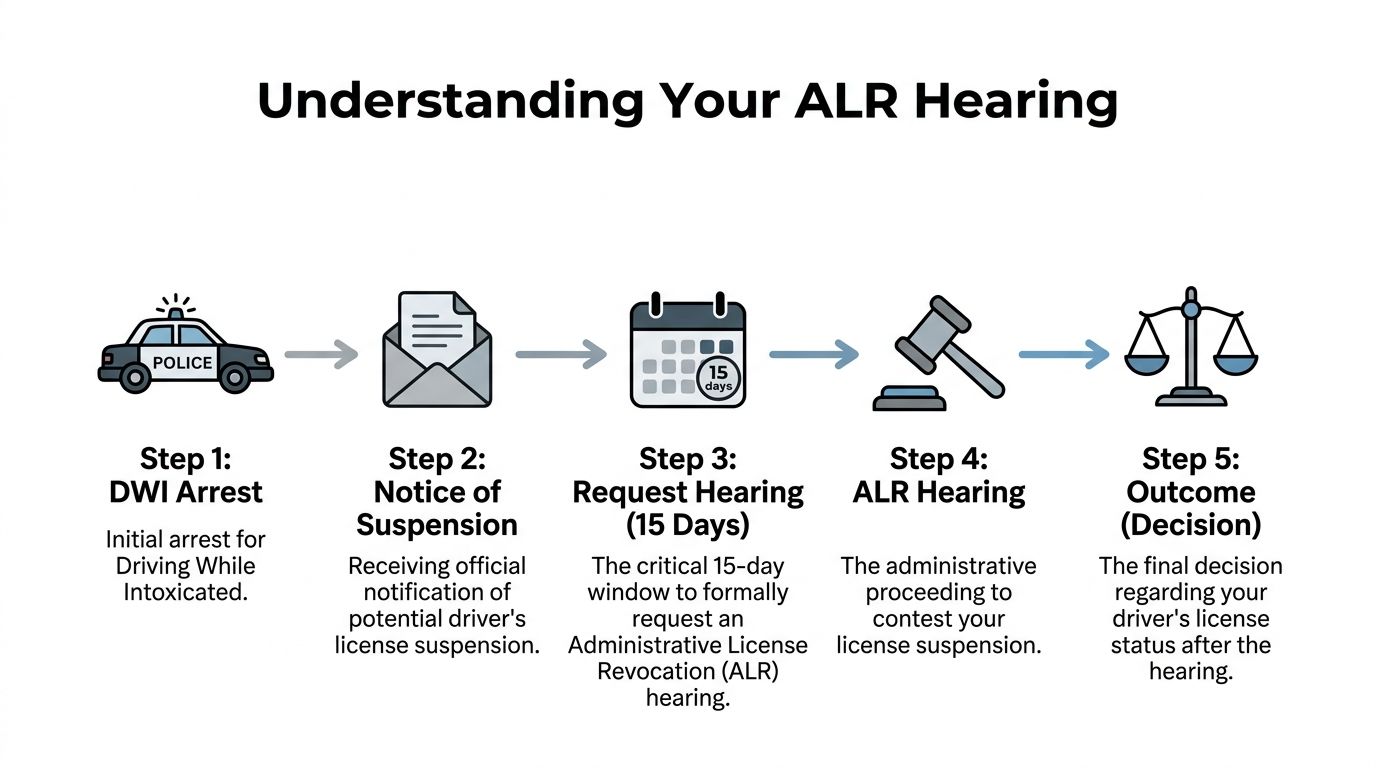
The 15 day deadline is real
You generally have 15 days from the date of arrest to request the hearing. Miss that window, and the suspension process can move forward without providing you the strategic advantage you should have used.
If you need a basic overview of that process, this Texas ALR hearing process guide is a useful starting point.
Here’s the key point. This is not paperwork you handle later. This is the first deadline that can shape the rest of your case.
What administrative license suspension means
Administrative license suspension is a civil process handled apart from the criminal prosecution. It can affect your ability to drive long before your criminal case is resolved.
Texas law creates these two parallel proceedings, and a license can be suspended for 1 year administratively even if the criminal case is dismissed, as discussed by David Hunter on second-offense DUI and ALR hearings in Texas.
That’s why this hearing matters so much for anyone with a commute, school obligations, child transportation duties, or a job that depends on driving.
What implied consent means
Implied consent means Texas says that by driving on Texas roads, you’ve already agreed to provide a breath or blood sample if law enforcement lawfully requests one in a DWI investigation.
That does not mean the officer can ignore procedure. It does not mean every stop is lawful. It does not mean every refusal or specimen result is immune from challenge.
It means the State has an administrative mechanism to suspend your license based on what happened at arrest. Your attorney’s job is to challenge the basis for that suspension.
Why a smart lawyer uses the ALR hearing offensively
The ALR hearing is not just about keeping you on the road. It is also an evidence-gathering opportunity.
At that hearing, your attorney can often examine the arresting officer under oath. That matters because officers commit to a story early. Once they do, inconsistencies become useful.
A strong Texas DUI attorney uses the ALR process to test issues such as:
- The reason for the stop. Was there valid reasonable suspicion?
- The officer’s observations. Were the signs of intoxication specific or vague?
- The test procedures. Were the field sobriety tests explained and performed correctly?
- The specimen evidence. Was the breath or blood result handled under proper procedure?
Win or lose, the ALR hearing can expose weaknesses in the State’s case before the criminal court fight gets serious.
If you’re facing a DWI license suspension, don’t treat the ALR hearing like a side issue. It’s the first battle, and in many cases, it gives your defense its first real advantage.
Navigating Criminal Penalties Jail Fines and Probation
The criminal court side of a second DWI is where direct punishment is imposed. Here, jail exposure, the conviction level, fines, probation terms, and compliance conditions come together.
Jail is no longer a remote possibility
On a second DWI, jail is not just a theoretical maximum hanging in the background. The case starts with a mandatory minimum sentence in play if there is a conviction.
That changes how judges view the file and how prosecutors negotiate it. It also changes how aggressively your defense needs to attack the State’s evidence from the start.
Fines are only the beginning
People often hear “up to $4,000 fine” and assume that’s the main financial issue. It usually isn’t.
Content on second DWI offenses often underestimates the cost of mandatory conditions. DWI education programs can cost $300 to $1,500, and ignition interlock devices average $60 to $150 per month for 1 to 2 years, creating hidden financial penalties that can exceed the fine itself, according to The Texas Trial Attorney on second DWI costs in Texas.
If you want a fuller overview of statutory punishment exposure, this page on Texas second offense DUI penalties gives the framework.
What probation really looks like
Probation sounds better than jail because it is better than jail. But don’t confuse “better” with “easy.”
A second DWI probation package can involve:
- Interlock compliance with every approved vehicle you drive
- Education requirements tied to repeat offender programs
- Community service that takes time away from paid work
- Court monitoring through check-ins, testing, and reporting
- Insurance consequences such as SR-22 related obligations
That’s why I advise clients to evaluate probation realistically. It can protect your freedom, but it can also put your budget and schedule under pressure for a long time.
The hidden penalties hit working people the hardest
The court may see probation conditions as supervision. You may experience them as a second monthly bill, a work disruption, and a transportation problem all at once.
If you’re paid by the hour, if you drive for work, if you run a small business, or if you have a professional license, these compliance requirements can create immediate strain. Missing work for classes, service, device maintenance, or hearings has a real effect on family finances.
Bottom line: The true cost of a second DWI is usually the full package of penalties, not just the court fine.
This is why defense strategy matters so much. A reduction, a dismissal, or a negotiated outcome that cuts down on the charge level can save far more than money. It can preserve your ability to function.
Building Your Defense How to Fight a Second DWI Charge
A second DWI can be defended. That is the position you should take from the start.
Texas files a lot of DWI cases, but the numbers also show room to fight. Texas sees over 80,000 DWI charges annually, and about 12% are resolved without conviction through dismissal or no-charge releases, while many other cases end in reduced-charge outcomes, according to Texas DWI case statistics compiled by Zealous Advocate.

That doesn’t mean every case gets dismissed. It means this: the State loses cases, weakens cases, and reduces cases when the defense finds problems and presses them properly.
Start with the traffic stop
The first question is basic. Why were you stopped?
If the officer lacked reasonable suspicion for the stop, the defense may have a suppression issue. If the stop falls apart, a large part of the prosecution’s case may fall with it.
Common points to review include dash cam video, body cam footage, dispatch records, and the exact wording in the offense report.
Field sobriety tests are not automatic proof
A field sobriety test is only useful to the State if the officer administered it correctly and described it accurately.
That means your lawyer should look at:
- Instructions given at the roadside
- Physical conditions such as lighting, slope, footwear, or weather
- Medical issues that affect balance, speech, or eye movement
- Officer scoring and whether it matches the video
A bad roadside test is still a challengeable roadside test. Jurors often give these tests too much weight until someone slows the evidence down and shows the flaws.
Here’s a short video that helps explain how defense lawyers examine DWI evidence and strategy:
Breath and blood evidence can be challenged
Chemical evidence sounds scientific. That doesn’t make it untouchable.
Breath and blood cases can turn on maintenance records, operator procedure, chain of custody, timing, contamination issues, and whether the result proves intoxication at the time of driving. The State still has to connect the test result to your operation of the vehicle and do it with admissible evidence.
The defense is built piece by piece
A good DWI defense usually isn’t one dramatic argument. It is a series of targeted attacks.
- One issue may be legal. The stop or arrest lacked probable cause.
- Another may be procedural. The specimen process wasn’t handled properly.
- Another may be factual. The video doesn’t match the report.
- Another may be strategic. The weaknesses are strong enough to force a reduction.
The Law Office of Bryan Fagan, PLLC represents clients in DWI cases, including ALR hearings, field sobriety challenges, chemical test challenges, plea negotiations, and trial defense.
The strongest defense cases usually come from early review, fast evidence preservation, and a lawyer who treats every detail like it matters.
If you want to fight DWI Texas, don’t just ask whether you can explain yourself. Ask whether the State can prove its case cleanly, lawfully, and beyond a reasonable doubt.
Plea Negotiations and Your Legal Options
A second DWI case can split in two directions fast. One path is a trial. The other is a negotiated result that cuts damage to your record, your license situation, your job, and your finances. The right choice depends on the proof, not panic.
A useful plea negotiation has one purpose. Improve your position in a real way. That may mean pushing for a reduced charge, limiting jail exposure, shaping probation terms, protecting your ability to work, or avoiding conditions that create months of extra cost. In a second DWI case, those added costs matter. Interlock fees, higher insurance, missed work, court requirements, and professional fallout often hit harder than the fine itself.
What a good plea strategy is trying to do
The goal is a result you can live with, not a quick agreement just to end the stress.
If the State has weaknesses in its proof, your lawyer should use them to demand better terms. If the stop is questionable, the video helps the defense, the testing process has holes, or the officer’s report overstates what happened, those problems can shift the case value. Prosecutors reduce cases for one reason. The defense gives them a reason to.
That reason may support:
- A reduced charge with less damage than a second DWI conviction
- Probation terms that are stricter on paper but more manageable for your work and family
- Lower exposure to jail if the facts and your history support that result
- A resolution that accounts for the parallel license fight, because a plea that looks acceptable in criminal court can still create serious driving consequences
Deferred adjudication is usually not the answer people hope for
Clients ask about deferred adjudication all the time. The question makes sense. The answer in a second DWI case is usually disappointing.
For a repeat DWI allegation, the practical focus is often charge reduction or trial preparation, not deferred treatment of the same charge. A lawyer who knows these cases will spend less time selling false hope and more time testing whether the prosecutor can prove the filed offense.
When negotiation makes sense and when it does not
Negotiation makes sense when the State has enough evidence to create risk, but enough weaknesses to justify pressure. It does not make sense to grab the first offer because court feels intimidating. It also does not make sense to reject a favorable reduction out of pride.
A smart decision weighs the full picture:
- How strong the suppression issues are
- Whether the video helps or hurts
- How a plea affects the ALR and license consequences
- What the case does to your employment, especially if driving matters for work
- Whether the long-term cost of a conviction outweighs the short-term relief of ending the case quickly
A strong plea result comes from preparation, pressure, and a clear theory of why the State should back off.
An experienced Texas DWI lawyer adds value by pricing the case correctly. That means knowing when to press for dismissal, when to push for reduction, and when trial is the better option. In a second DWI case, that judgment can protect far more than your court record. It can protect your license, your income, and your ability to move forward with less damage.
Special Cases CDL Holders and Other DWI Enhancements
Some second DWI cases carry more than the usual risk. If you hold a CDL, work in transportation, or already face aggravating facts, your strategy has to account for professional fallout immediately.
For a second DWI, Texas requires an ignition interlock device as a condition of bond and probation, and for CDL holders, that triggers a DPS revocation that can directly affect your livelihood. The penalties can also become harsher with BAC over 0.15% or an open container violation, which adds a 180-day suspension, according to Gallian Firm’s discussion of what happens after a second DWI in Texas.
CDL drivers face a different kind of pressure
If you drive for a living, even a temporary loss of driving privileges can turn into a job crisis fast.
A delivery driver, a truck driver, an oilfield worker, or anyone whose income depends on a valid driving status cannot treat the case like a weekend inconvenience. For many people, the first legal emergency is employment, not sentencing.
If that applies to you, this guide on how a DUI affects a CDL in Texas is worth reviewing.
Enhancements change the case value
Some facts make prosecutors more aggressive and judges less patient.
Examples include:
- High BAC allegations, which prosecutors use to argue for stricter supervision
- Open container allegations, which can add suspension consequences
- Professional license concerns, where the case can affect future reporting obligations
The lesson is simple. If your case has an added complication, you need a defense plan built around that complication early, not after the court has already imposed conditions.
Your Immediate Next Steps to Protect Your Future
You do not need to solve everything today. You do need to do the right next things.
Do these four things now
Write down the details
Record everything you remember about the stop, the officer’s questions, the tests, the arrest, and anything you said. Small details can matter later.
Stop talking about the case
Don’t explain it to friends, coworkers, or on social media. If the case needs explaining, your lawyer will do it in the right place.
Calendar the 15-day deadline
The ALR hearing request deadline can affect your ability to protect your license early. Missing it diminishes your advantage.
Get legal counsel immediately
Early action gives your attorney time to request records, preserve video, review bond conditions, and build your defense before the case hardens against you.
If you’re worried about a first DWI in Texas, a second case, or future record-clearing options like expunctions, get advice based on your actual facts. General internet answers won’t protect your license or your record.
You have more options at the beginning of a DWI case than you do later. Use them.
If you’re facing a 2nd offense DWI in Texas, get a clear case review before you make another move. The Law Office of Bryan Fagan, PLLC handles Texas DWI defense, including ALR hearings, repeat-offense cases, plea negotiations, and trial strategy. Request a free consultation or case evaluation to find out what can be challenged, what deadlines apply, and what steps can protect your license, your job, and your future.