
A DWI arrest can be overwhelming—but you don’t have to face it alone. If you’ve just been arrested for a first-time DWI in Texas, you are likely facing a Class B Misdemeanor. On paper, that comes with some serious potential penalties: fines up to $2,000, jail time ranging from 3 to 180 days, and a driver's license suspension.
But here’s the most important thing to remember right now: an arrest is not a conviction. These penalties are the maximum, not your automatic fate. With a strategic legal defense, it is possible to protect your rights and minimize the consequences.
Moving From Uncertainty to a Clear Plan

Being arrested for a DWI can feel disorienting. The hours and days that follow are often a blur of anxiety and tough questions about your freedom, your job, and your future. That’s a completely normal reaction.
However, a first-time charge doesn't have to define the rest of your life. The single best thing you can do to regain control is to understand what lies ahead. This guide is designed to cut through the legal jargon and walk you through the realities of a Texas DWI, helping you move from uncertainty to an actionable game plan.
What to Expect Right Away
The legal system moves fast after an arrest. You are immediately facing two separate legal battles that both demand urgent attention. The first is the criminal charge itself, and the second is an administrative fight to save your driver's license. A powerful defense starts with tackling both head-on.
Our goal here is to clarify your rights, demystify the court process, and show you exactly how a strong defense can protect your record. Right after an arrest, the priorities are clear:
- Understand the Charges: You need to know exactly what a "1st dwi offense in texas" means under the law and what the prosecution must prove.
- Protect Your License: You have a strict 15-day deadline to request an Administrative License Revocation (ALR) hearing. If you miss it, your license is automatically suspended.
- Build a Defense: Every piece of evidence, from the traffic stop to the breath or blood test, needs to be analyzed for weaknesses.
The most important thing to remember is that an arrest is not a conviction. Every detail of your case—from the reason you were pulled over to the way tests were administered—can be challenged.
The steps you take right now are critical. By learning about the essential steps after a DUI arrest, you empower yourself to make smart decisions. Let us show you how an experienced Houston DWI lawyer can navigate this complex system for you, turning a moment of crisis into a strategic opportunity to build the strongest possible defense.
Understanding the Charge: What is a First DWI in Texas?
If you're facing a 1st DWI offense in Texas, the first step toward building a strong defense is understanding what the charge actually means. The legal system can feel like a foreign language, but the core concepts are straightforward. Grasping them is the first step toward regaining control and working with your attorney to protect your future.
In Texas, the state has two ways to prove you were "Driving While Intoxicated." The first is the one everyone knows: showing you had a Blood Alcohol Concentration (BAC) of 0.08% or higher.
The second way is more subjective. The prosecution can also convict you by demonstrating that you lost the "normal use of your mental or physical faculties" because of alcohol or drugs. This means you can be arrested and charged with a DWI even if your BAC is under the legal limit. This is often where an officer's subjective observations and disputed field sobriety tests come into play—and where a skilled Texas DUI attorney becomes absolutely essential.
Defining Key Legal Concepts
As you move through the DWI process, you'll hear a few legal terms that have huge implications for your case. Understanding them will help you make sense of what's happening and play a more active role in your own defense.
- Blood Alcohol Concentration (BAC): This is the percentage of alcohol in your bloodstream. For most drivers over 21, the legal limit is 0.08%. For commercial drivers, it’s a much stricter 0.04%, and for anyone under 21, any detectable amount of alcohol is illegal.
- Implied Consent: When you get a Texas driver's license, you automatically agree to provide a breath or blood sample if you are lawfully arrested for DWI. This is "implied consent." Refusing the test doesn't get you off the hook; it triggers a separate set of consequences, including an automatic license suspension.
- Field Sobriety Test: These are standardized physical and mental exercises (like the walk-and-turn or one-leg stand) that police use at the roadside to gauge impairment. These tests are highly subjective and can be challenged.
- Administrative License Revocation (ALR): This is a civil process initiated by the Texas Department of Public Safety (DPS) to suspend your license if you refuse a chemical test or fail one (BAC of 0.08% or higher). This process is entirely separate from your criminal DWI case.
Many people think that refusing a breathalyzer is a get-out-of-jail-free card. The reality is that it just kicks off an immediate, urgent fight to save your license through the ALR hearing, and it won't stop the state from moving forward with the criminal charge.
When a First DWI Gets More Serious
While a standard first-time DWI is a Class B Misdemeanor in Texas, certain factors can instantly escalate the charge and its penalties. These are called aggravating circumstances, and if any are present in your case, a strategic legal defense becomes even more urgent.
One of the most common escalators is a high BAC. If your breath or blood test comes back at 0.15% or higher—nearly double the legal limit—the charge gets bumped up to a Class A Misdemeanor. This can nearly double the potential jail time and fines you face.
Other aggravating factors can turn a first offense into a life-altering felony:
- DWI with a Child Passenger: If you are arrested for DWI with a passenger under 15, the charge is automatically a State Jail Felony.
- Intoxication Assault: If you cause serious bodily injury to someone else while driving intoxicated, you will face charges for Intoxication Assault, a third-degree felony.
- Intoxication Manslaughter: If an accident involving an intoxicated driver leads to someone's death, the charge becomes Intoxication Manslaughter, a second-degree felony with severe prison time.
Knowing these distinctions is fundamental. It helps clarify exactly what you're up against and highlights why you need a Houston DWI lawyer who will dig into every detail. Your defense starts with a clear-eyed view of the law and a proactive plan to fight the prosecution's claims.
The Potential Penalties for a First Texas DWI
Facing a first-time DWI charge is a nerve-wracking experience. It's easy to let your mind race to the worst-case scenarios, but the first step toward regaining control is understanding exactly what you're up against.
In Texas, a standard first DWI is a Class B Misdemeanor. While that sounds serious, it’s critical to know that the penalties laid out in the law are maximums, not automatic sentences. Think of them as the starting point from which a skilled attorney builds your defense, not the place you’re guaranteed to end up.
What a Class B Misdemeanor DWI Entails
For a typical 1st DWI offense in Texas where your blood alcohol concentration (BAC) is under 0.15%, the law sets a specific range of consequences. These penalties are designed to be tough, but they also leave room for a judge’s discretion—which is where a powerful legal strategy can change everything.
Here’s what you could be facing:
- Fines: Up to $2,000. This does not include court costs and other fees, which can easily double the financial impact.
- Jail Time: A minimum of 72 hours and a maximum of 180 days in county jail. For many first-time offenders, this time can often be served on probation instead of behind bars.
- Community Service: You will likely be ordered to complete between 24 and 100 hours of service.
- DWI Education Program: Completing a state-approved, 12-hour DWI education course is mandatory.
It’s vital to see these penalties for what they are: the worst-case scenario. A strong defense is about challenging the prosecution's case to ensure you never face these maximums. The ultimate goal is always to fight for a dismissal, a reduction in charges, or a sentence that disrupts your life as little as possible.
Imagine this common scenario: you’re pulled over in Houston after dinner with friends and blow a 0.08%. You're facing a Class B Misdemeanor. While the law says you could face up to $2,000 in fines, that number can quickly climb with court costs. And while up to 180 days in jail is technically possible, a judge is far more likely to sentence a first-time offender to community supervision (probation), mandatory classes, and community service.
When the Stakes Get Higher
The game changes dramatically if certain aggravating factors are involved. The most common one? A BAC of 0.15% or higher.
This single detail elevates a first DWI from a Class B to a Class A Misdemeanor, which essentially doubles the potential penalties. Understanding this jump is crucial because it completely alters the landscape of your case. A high BAC tells the prosecutor they have a stronger hand, making an aggressive and strategic defense more critical than ever.
You can get a clearer picture by exploring our detailed guide on the full spectrum of DUI penalties in Texas.
The table below breaks down just how much a high BAC reading can impact the consequences you face.
Texas First DWI Penalties at a Glance
This table lays out the potential criminal penalties for a standard first DWI versus one with a high BAC, making the difference crystal clear.
| Penalty | Standard 1st DWI (Class B Misdemeanor) | 1st DWI with BAC ≥ 0.15% (Class A Misdemeanor) |
|---|---|---|
| Fine | Up to $2,000 | Up to $4,000 |
| Jail Time | 72 hours to 180 days | Up to 1 year |
| License Suspension | 90 days to 1 year | Up to 2 years |
| Annual Surcharges | Up to $2,000 for 3 years | Up to $2,000 for 3 years |
| Ignition Interlock | Possible requirement | Often a mandatory condition |
As you can see, the penalties for a Class A Misdemeanor are significantly more severe. The potential fine doubles, jail time extends to a full year, and you could lose your license for much longer. This is why challenging the accuracy of that BAC reading is often a central part of a strong defense strategy.
Navigating the Two Fronts of a DWI: Your License and Your Case
A DWI arrest in Texas means you are suddenly fighting two battles on separate fronts. You have the criminal case, where your freedom and future are on the line. At the exact same time, you're facing an administrative case—a civil process with one goal: to take away your driver’s license.
It is absolutely critical to understand this dual-track system. Each process has its own rules, timelines, and consequences. A misstep in one can create a disaster in the other. A successful defense requires a coordinated strategy that tackles both at once.
The flowchart below breaks down what you're up against in the criminal court system.
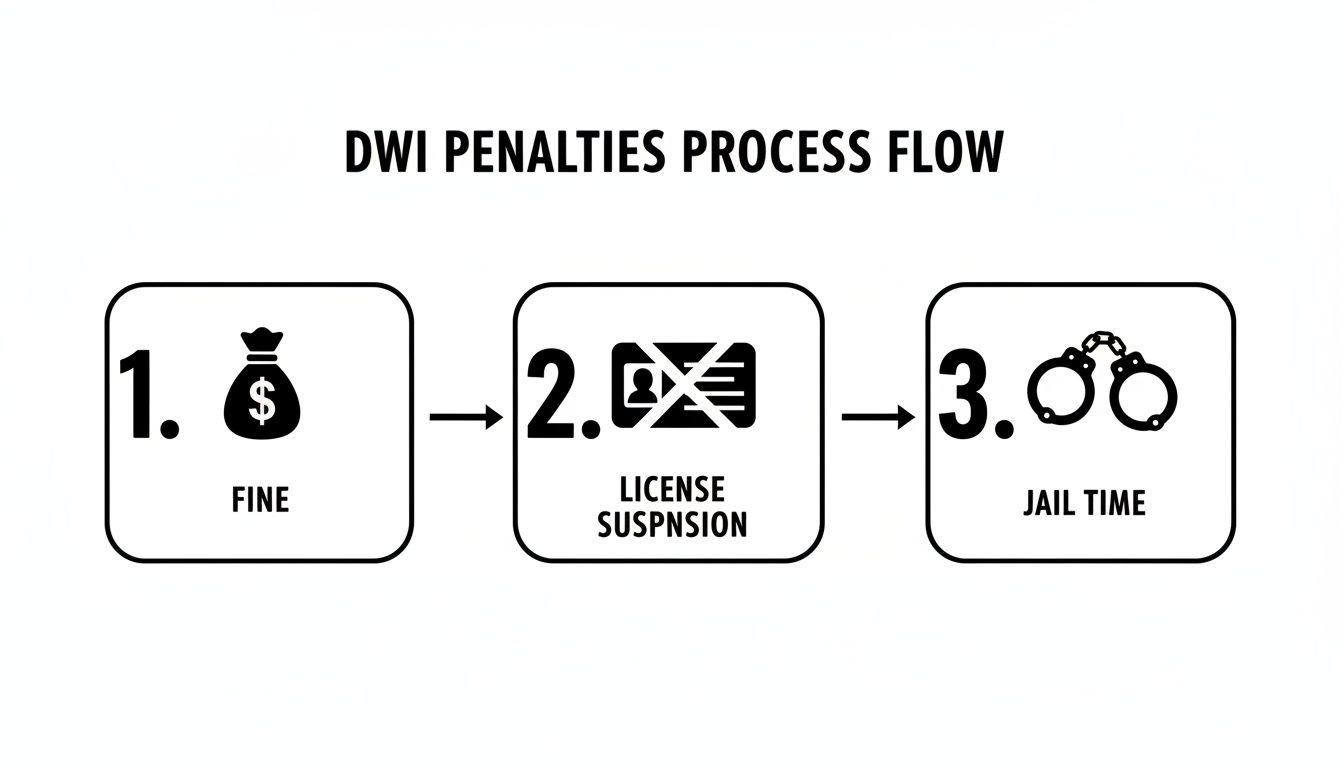
As you can see, a conviction can trigger a cascade of penalties. Our job is to stand in the way of that cascade, working to get the charges reduced, dismissed, or defeated.
The First Battle: The Administrative License Revocation (ALR) Hearing
The most immediate threat you face after a DWI arrest isn't in a courtroom—it's a ticking clock. You have just 15 days to request an Administrative License Revocation (ALR) hearing.
If you either refused to give a breath or blood sample, or if you provided one that came back over the 0.08% BAC legal limit, the Texas Department of Public Safety (DPS) begins the process to automatically suspend your license. The ALR hearing is your only opportunity to stop that from happening.
Here’s why this hearing is so important:
- It Keeps You on the Road: Winning the ALR hearing prevents an automatic suspension. This means you can keep driving legally while the criminal case plays out, which can take months.
- It’s a Strategic Goldmine: The ALR hearing is often our first chance to question the arresting officer under oath. We can challenge their testimony, expose weaknesses in the state’s case, and gather powerful evidence for your criminal defense.
If you miss that 15-day deadline, you lose your right to a hearing, and a DWI license suspension will go into effect. Depending on your case, that suspension could last anywhere from 90 days to two years. Acting fast isn't just a suggestion; it's a necessity.
The ALR hearing is more than just a fight to save your license. It’s an intelligence-gathering mission. What we learn from the arresting officer’s testimony can become the cornerstone of your entire criminal defense strategy.
The Second Battle: The Criminal Court Process
While you're fighting to keep your license, the criminal case for your 1st DWI offense in Texas moves along its own separate track. This process is slower and can take several months—or longer—to resolve. Here is a step-by-step guide to what you can expect.
1. Arraignment and Bond
Your first court appearance is the arraignment. Here, the charges are formally read, you are informed of your rights, and you will enter a plea (usually "not guilty"). The judge will also set your bond conditions, which may include installing an ignition interlock device on your car.
2. Discovery and Pre-Trial Negotiations
This is where the real work of your defense begins. Your attorney will file for discovery, demanding all evidence from the prosecution, including:
- Police reports
- Body cam and dashcam videos
- Breath or blood test results and maintenance records
- Witness statements
Once we have the evidence, we search for weaknesses. Was the traffic stop legal? Was the breathalyzer calibrated correctly? Based on what we find, we negotiate with the prosecutor to get the charges reduced or dismissed. Many DWI cases are resolved at this stage without a trial.
3. Jury Trial
If the prosecutor won't offer a fair resolution, you have a constitutional right to a jury trial. The state must then prove to a jury that you are guilty "beyond a reasonable doubt"—a very high standard. Your attorney will cross-examine their witnesses, present your side of the story, and fight for an acquittal.
A skilled DWI lawyer knows how to manage both the ALR hearing and the criminal proceedings to protect your rights at every turn. To get a better handle on that crucial first step, you can read more about the Administrative License Revocation process in Texas.
How a Strategic Defense Can Protect Your Future

Being arrested for a 1st DWI offense in Texas is a serious moment. But it's critical to remember: an arrest is an allegation, not a conviction. The state has the entire burden of proving its case against you beyond a reasonable doubt.
This is where a strategic, proactive defense completely changes the game. A skilled DWI lawyer doesn't just wait for the prosecution to make its moves. We work immediately to examine every piece of evidence, looking for weaknesses, procedural errors, and violations of your rights. The time to start building that defense is now.
Challenging the Initial Traffic Stop
Every DWI case starts with a traffic stop. An officer cannot pull you over on a hunch; they must have reasonable suspicion that you committed a traffic violation. This is your first line of defense.
We investigate the core question: Was the stop legal? If the officer’s reason for pulling you over was weak—for example, they claimed you were swerving, but the dashcam video shows otherwise—then everything that happened after that illegal stop can be thrown out. This includes field sobriety tests and breath or blood results.
A successful challenge to the traffic stop can lead to the suppression of all evidence. In many cases, this forces the prosecution to dismiss the entire case before it ever reaches a courtroom.
Suppressing evidence is a powerful tool. Without key evidence, the state’s case can fall apart, making it impossible for them to meet the high burden of proof needed for a conviction.
How to Fight a Breath Test Result and Field Sobriety Tests
The heart of most DWI prosecutions rests on two things: Standardized Field Sobriety Tests (SFSTs) and chemical tests (breath or blood). Both are far from perfect and provide fertile ground for a strong defense.
Field Sobriety Tests: These "divided attention" exercises are notoriously subjective and are difficult to perform perfectly even when sober. Your performance can be affected by:
- Pre-existing medical conditions or injuries
- Your age, weight, and physical fitness
- Bad weather, uneven surfaces, or poor lighting
- Confusing or incorrect instructions from the officer
We scrutinize the dashcam video to see if the officer administered the tests exactly according to national standards. Any deviation can be used to argue the results are unreliable.
Breath and Blood Tests: These tests might seem scientific, but they are prone to error. A good defense attorney will investigate:
- Breathalyzer Maintenance: Was the machine properly calibrated? We demand to see the maintenance logs.
- Operator Error: Was the officer certified to operate the machine? Did they follow every required step?
- Chain of Custody: For a blood test, was the sample handled, stored, and transported correctly to prevent contamination?
Any break in these strict protocols can make the results inadmissible in court. Challenging the state's "hard evidence" is a cornerstone of any effective plan to fight DWI Texas charges.
Uncovering Opportunities for a Favorable Outcome
While most DWI arrests in Texas are prosecuted, the final outcome is far from set in stone. Statewide data reveals that a significant percentage of first-offense DWI charges in major counties like Harris and Dallas end in non-conviction outcomes, either through dismissals or charge reductions. You can learn more by looking at these Texas DWI statistics.
This proves one thing: a robust defense works. By challenging the evidence at every turn, a knowledgeable Houston DWI lawyer creates leverage. This pressure often forces the prosecution to offer a better plea deal, like reducing the DWI to a lesser charge such as reckless driving, which carries far less severe consequences. Our goal is always to secure the best possible result for you, whether that’s a full dismissal, a not-guilty verdict, or a negotiated outcome that keeps a DWI conviction off your record.
It’s Time to Take the First Step
Facing a 1st DWI in Texas is a heavy weight to carry, but it’s not something you have to do alone. As we’ve covered, an arrest is just the beginning of the story, not the end. You have rights, options, and a clear path forward—but the most important move you can make is the one you take right now.
Don’t let confusion or fear keep you from getting the legal help you deserve. At The Law Office of Bryan Fagan, we are here to stand up for your rights and fight for the best possible outcome in your case. A powerful defense starts the moment you decide to take action.
Your Free Consultation is Waiting
We invite you to request a free consultation to discuss the details of your case. This is your chance to get straight answers, ask questions, and see exactly how a skilled Houston DWI lawyer can make a real difference. Our team is on standby 24/7 to give you the guidance and support you need.
A strong defense often starts with a single conversation. Taking action today is the best way to protect your rights, your license, and your future.
Every detail matters, from the reason for the traffic stop to the chemical test results. Let us put our experience to work for you. Contact us now to start building your defense. We’re ready to listen and help you take that first step toward putting this behind you.
Common Questions After a First Texas DWI Arrest
If you've just been arrested for a 1st DWI in Texas, your mind is probably racing with questions. It's a confusing and stressful time, and getting clear, straightforward answers is the first step toward taking back control. Below, we tackle some of the most pressing concerns we hear from people in your exact situation.
Keep in mind, while this guide provides a solid foundation, every case has unique details. The best advice will always come from a lawyer who knows the specifics of your arrest.
Will I Definitely Go to Jail for a First DWI?
While a Class B Misdemeanor DWI in Texas carries potential jail time—from 72 hours up to 180 days—it is not a foregone conclusion.
For most first-time offenders, especially without aggravating factors like an accident or a very high BAC, a skilled attorney can often negotiate for community supervision (probation). This is a far better alternative, allowing you to serve your sentence in the community instead of behind bars. It comes with conditions, like reporting to a probation officer and completing certain classes, but it keeps you out of jail. The outcome hinges on the facts of your case and the strength of your defense.
Is It Possible to Get My DWI Charge Dismissed?
Yes, a dismissal is possible. In fact, it's the best possible outcome we fight for. But dismissals aren't just handed out; they have to be earned through a meticulous defense that challenges the prosecution's case.
A good Texas DUI attorney looks for weaknesses that can get a case thrown out. Some of the most common grounds for a dismissal include:
- An Unlawful Traffic Stop: If the officer did not have a legal reason to pull you over, any evidence gathered after that—including breath tests and field sobriety tests—could be suppressed.
- Improperly Administered Tests: Police must follow a strict rulebook when conducting Field Sobriety Tests. If they deviate from it, the results become unreliable and can be challenged.
- Inaccurate Chemical Test Results: Breathalyzer machines must be perfectly calibrated and maintained, and blood samples must have an unbroken chain of custody. We can investigate those records to find errors that cast doubt on the accuracy of your BAC reading.
How Long Will a First DWI Stay on My Record?
In Texas, a DWI conviction stays on your criminal record forever unless you take legal action to seal it. Some first-time offenders may be eligible for an order of nondisclosure after completing their sentence. This doesn't erase the conviction, but it seals it from the general public's view, which is a huge help for job applications and background checks.
An even better outcome is an expunction. If your case is dismissed or you are found not guilty, an expunction allows you to completely destroy all records of the arrest as if it never happened. An attorney can walk you through which option might be available to you and help you clear your name.
What Is an ALR Hearing and Why Is It so Important?
The Administrative License Revocation (ALR) hearing is a separate battle from your criminal DWI case, and it's all about your driver's license. After a DWI arrest, you have only 15 days to request this hearing to challenge the automatic suspension of your license.
This hearing is critical for two reasons. First, it's your only opportunity to prevent your license from being suspended. Second, it gives your lawyer a golden opportunity to question the arresting officer under oath long before your criminal trial. We can lock them into their story and uncover evidence and testimony that can become powerful ammunition for your criminal defense. Don't skip this step.
The hours and days right after a DWI arrest are absolutely crucial. At The Law Office of Bryan Fagan, PLLC, we understand what's at stake and are ready to start building the strategic defense you deserve. Contact us 24/7 for a free, confidential case evaluation to learn about your rights and begin fighting for your future. You can learn more at https://texasduilawfirm.com.