
A DWI arrest in Texas can be overwhelming, but you don’t have to face it alone. The first step toward taking back control is understanding exactly what you're up against. The penalties for driving while intoxicated can be significant, including potential fines, jail time, and an automatic driver's license suspension. These consequences apply even for a first offense and become more serious with each subsequent charge.
Your Guide to Navigating Texas DWI Penalties
Facing a DWI arrest can feel like your world has been turned upside down, but an experienced Houston DWI lawyer can guide you through the process. The legal road ahead is complicated, but this guide is here to give you a clear, straightforward overview of what to expect so you can move forward with confidence. Knowing your rights and the challenges you face is the most critical part of protecting your future.
Right away, you need to know that a DWI arrest triggers two separate legal battles. The first is the criminal case, where the state must prove its allegations, which could lead to jail and heavy fines. The second is a civil process called an Administrative License Revocation (ALR) hearing, which decides the fate of your driving privileges.
Understanding the Two Separate Cases
It is absolutely critical to understand that these two cases run on separate tracks and are independent of one another. The outcome of your criminal case does not automatically determine the outcome of the ALR hearing, and vice versa.
- The Criminal Case: This is the legal proceeding concerning the DWI charge itself. It involves court dates, negotiations with prosecutors, and potentially a trial. Our goal here is to carefully examine the state's case against you to work toward avoiding a conviction, jail time, fines, and a permanent criminal record.
- The ALR Hearing: This administrative hearing is exclusively about your driver's license. You have only 15 days from the date of your arrest to request this hearing. If you miss that deadline, your license will be automatically suspended. A skilled Texas DUI attorney is essential to represent you and fight to protect your driving privileges.
Texas DWI Penalties Explained
Texas lawmakers continue to make DWI laws stricter, increasing the consequences for everyone, including first-time offenders. Today, a first-time DWI conviction in Texas can result in jail time of up to 180 days, a fine of up to $2,000, and a license suspension for up to a full year.
One of the significant changes in recent years is the mandatory installation of an ignition interlock device (IID) for many first-time offenders. You can learn more about the evolving DWI laws and how they might impact your case.
This guide will break down each part of the process, helping you understand the stakes and how to build a strong defense. A DWI charge is serious, but an experienced Texas DWI attorney can help you fight for your rights every step of the way.
Understanding Your First DWI Offense in Texas
For most people, a DWI arrest is their first encounter with the Texas criminal justice system. It can be a confusing and intimidating experience, but it’s critical to remember one thing: an arrest is not a conviction. The State has the burden of proving its case beyond a reasonable doubt, and a smart, strategic defense can change everything.
Getting a handle on the potential penalties is the first step toward building that defense. In Texas, a standard first DWI offense is charged as a Class B Misdemeanor. While it’s a serious charge, it’s one that can be fought with the right legal guidance.
Penalties for a First-Time DWI in Texas
The law outlines the potential penalties for a Class B Misdemeanor DWI, giving you a baseline of what you're facing. A judge has some discretion, but the potential consequences include:
- Jail Time: A conviction carries a mandatory minimum of 72 hours in county jail, but the sentence can go as high as 180 days.
- Fines: The court can impose a fine of up to $2,000. This does not include court costs, probation fees, or other state-mandated surcharges that can add up quickly.
- License Suspension: You could lose your driver’s license for anywhere from 90 days to a full year.
- Community Supervision (Probation): Often, a judge will sentence a person to probation instead of significant jail time. This usually lasts for one to two years and comes with strict conditions, like regular check-ins, DWI education classes, and substance abuse evaluations.
These are just the direct court-ordered penalties. The total financial impact of a DWI often goes far beyond the initial fine. For a deeper look into all the hidden costs, check out our detailed guide to DWI fines in Texas.
How Your BAC Can Change Everything
Your Blood Alcohol Concentration (BAC) is a key piece of evidence in any DWI case. While the legal limit for intoxication in Texas is 0.08%, a BAC significantly higher than that can automatically increase the severity of the charge, even on a first offense.
If your BAC is 0.15% or higher, the charge is enhanced from a Class B to a Class A Misdemeanor. This is a much more serious offense with significantly harsher potential penalties.
Key Takeaway: A BAC of 0.15% or more doubles the potential jail time to a maximum of one year and increases the maximum fine to $4,000. A judge may also be required to order an Ignition Interlock Device (IID) on your vehicle as a condition of your bond or probation.
This "enhancement" is exactly why we challenge every piece of evidence—from the reason you were pulled over to the results of the breath or blood test. An experienced DWI lawyer will scrutinize the entire process used to obtain your BAC reading, looking for errors in machine calibration, test administration, or sample handling that could get the results challenged in court.
Facing a first DWI is daunting, but you have rights. A proactive legal strategy is all about protecting those rights and fighting to keep these potential penalties from becoming your reality.
The Two Fights: Your Criminal Case and Your Driver’s License
When you're arrested for DWI in Texas, you are immediately fighting on two separate fronts, and both battles begin the moment you are arrested. Understanding this is key to navigating the road ahead.
The first fight is the criminal case, where the State of Texas is trying to convict you of a crime. The second is a civil administrative battle called the Administrative License Revocation (ALR) hearing, and it’s a fight for your right to keep driving. These two processes happen at the same time, but they are completely independent of each other.
This flowchart shows how a single DWI arrest instantly splits into two different legal paths, each with its own deadlines and potential consequences.
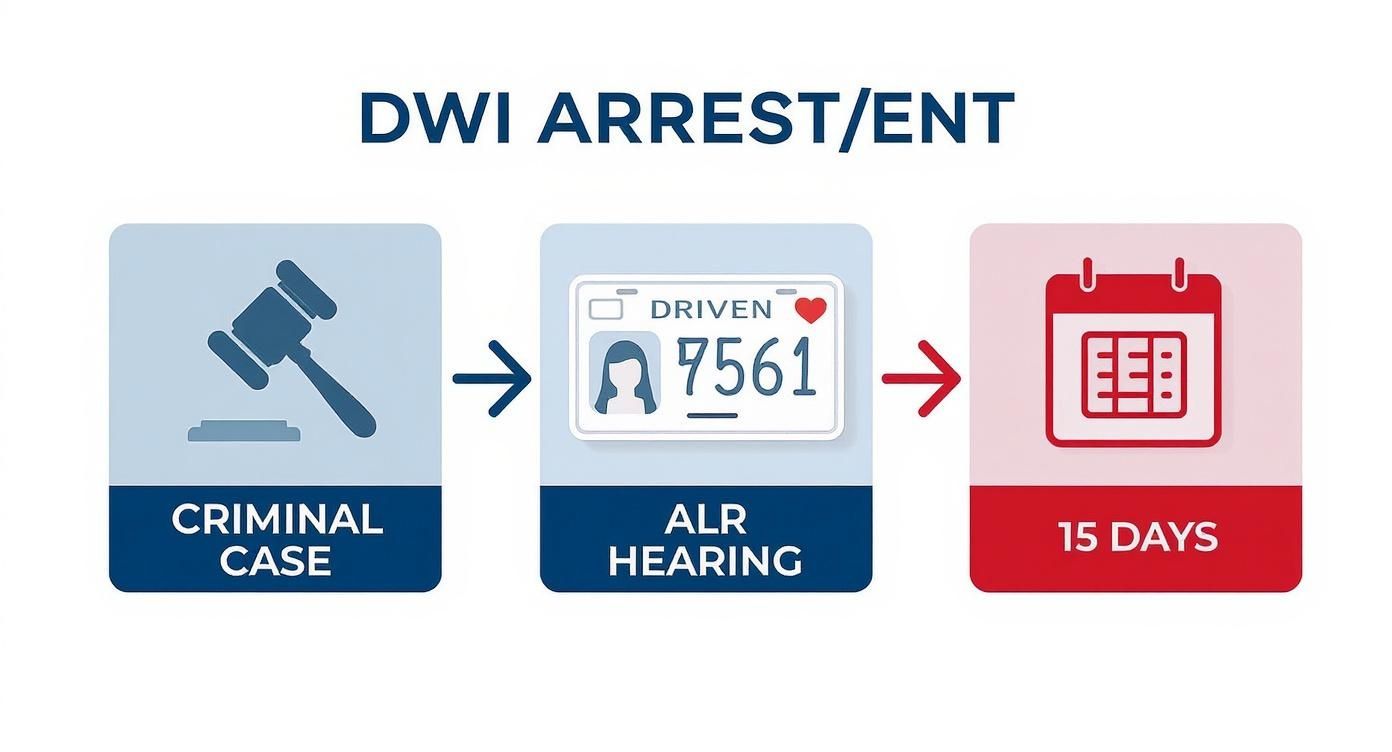
As you can see, that 15-day deadline to save your license is ticking while the criminal case is just getting started. Missing it has immediate consequences.
Your Criminal Case: The Path Through Court
The criminal case is what most people picture when they think about a "DWI charge." It’s a formal legal process where the state prosecutor’s goal is to secure a conviction, which leads to the serious DUI penalties in Texas like fines, jail, and a permanent criminal record.
This process moves through several critical stages:
- Arraignment and Bond: This is your first appearance before a judge, where you’re formally charged and the conditions for your release from jail are set.
- Discovery and Negotiation: We demand all the evidence the prosecutor has against you—from police reports to video footage—and begin looking for weaknesses that can be used in negotiations.
- Pre-Trial Motions: This is where we go on the offensive. We can file motions to get evidence thrown out, such as challenging an illegal traffic stop or a faulty breathalyzer test.
- Trial: If we can’t get the case dismissed or reach a resolution that you’re happy with, we can take the fight to a judge or jury.
A strategic Houston DWI lawyer is your champion through this entire ordeal, working to dismantle the state’s case every step of the way. The outcome here determines whether you walk away with your freedom and a clean record.
Your License Suspension: The ALR Hearing
While the criminal case is slowly moving through the courts, a much more urgent issue is the potential automatic suspension of your driver's license. This isn't handled in criminal court. It’s a separate civil process known as an ALR hearing.
Texas has an “implied consent” law. In simple terms, this means that by accepting a Texas driver's license, you have already agreed to provide a breath or blood sample if you are lawfully arrested for DWI. If you refuse to take the test or if you fail it (by having a 0.08% BAC or higher), the state immediately starts the process to suspend your license.
You have only 15 days from the date of your arrest to request an ALR hearing and challenge this. If you miss that deadline, your license gets suspended automatically, usually for 90 to 180 days, depending on the facts of your case. This happens even if you are later found not guilty in your criminal case.
This hearing is your one opportunity to challenge the suspension. A skilled lawyer can represent you, cross-examine the arresting officer, and identify weaknesses in the state’s reasons for trying to suspend your license. You can learn more about this critical fight by reading about the State Office of Administrative Hearings in Texas and our strategies for defending clients there.
Winning the ALR hearing is a huge victory. It keeps you on the road legally while we focus on the criminal charges. Facing these two battles simultaneously is tough, but it's a fight that can be won with the right strategy.
How Prior Offenses and Other Factors Increase Penalties
While any DWI charge is serious, the penalties in Texas don't just add up—they escalate significantly. The law is designed to impose much tougher consequences on repeat offenses or in situations where others are put at greater risk. Understanding these "enhancements" is crucial to knowing what you're facing and why a strong defense is so important.
If you have a prior DWI conviction on your record, a new arrest places you in a completely different legal category from the start.
The Jump from First to Second DWI
A second DWI charge is an automatic upgrade from a Class B to a Class A Misdemeanor. This change dramatically increases the potential consequences and signals that the state will pursue your case aggressively.
The difference is significant:
- Jail Time: The maximum jail sentence doubles from 180 days to a full year in county jail. The mandatory minimum time served also jumps from 72 hours to 30 days.
- Fines: The maximum fine increases from $2,000 to $4,000, before court costs and other fees are added.
- License Suspension: You could lose your driver's license for up to two years.
- Ignition Interlock Device (IID): An IID becomes mandatory. You will be required to have this device installed on your vehicle to drive.
These enhanced penalties show how seriously the courts treat a second offense. This is a situation where you need a Houston DWI lawyer who can attack the evidence in your new case while also examining the validity of your prior conviction.
When a DWI Becomes a Felony
The most significant leap in DWI penalties occurs with a third arrest. A third DWI, regardless of how long ago the prior offenses occurred, is charged as a third-degree felony. Your case is moved to the district court system, where the stakes can change your life forever.
A felony conviction is a permanent mark that can strip you of fundamental rights, like the right to vote or own a firearm. It can also create barriers to professional licenses, careers, and even housing opportunities.
The penalties for a third-degree felony DWI are severe:
- Prison Time: A conviction can mean 2 to 10 years in a Texas state prison.
- Massive Fines: The maximum fine increases to $10,000.
- Long-Term License Suspension: You can lose your license for up to two years.
Other Aggravating Factors That Increase Penalties
It’s not just your history that can turn a misdemeanor into a felony. The circumstances of the arrest itself can elevate the charge, even for a first-time offender.
- DWI with a Child Passenger: If you are arrested for DWI with a child under the age of 15 in your vehicle, the charge is automatically a State Jail Felony. A conviction carries up to two years in a state jail facility.
- Intoxication Assault: If your alleged intoxication leads to an accident where someone suffers a serious bodily injury, you will be charged with Intoxication Assault, a third-degree felony.
- Intoxication Manslaughter: If that same accident results in a death, the charge becomes Intoxication Manslaughter, a second-degree felony, punishable by 2 to 20 years in prison.
These enhancements paint a serious picture of the legal battle you’re in. A powerful defense isn’t just about reducing fines; it’s about protecting you from years, or even decades, of devastating consequences.
Long-Term Consequences Beyond Fines and Jail

The impact of a DWI conviction in Texas extends far beyond court fines and potential jail time. The long-term consequences can follow you for years, creating frustrating financial and professional roadblocks.
A strong defense isn't just about avoiding a jail cell; it’s about protecting your entire future from these lasting effects. Many people are surprised by how a single conviction can complicate their daily lives, from their commute to their career goals.
The Immediate Financial Aftermath
Even after you’ve paid court-ordered fines, the financial strain from a DWI is just beginning. Two of the most immediate and costly consequences are tied to your ability to drive.
- Ignition Interlock Devices (IID): Many convictions, even for a first offense, will require you to install an IID in your vehicle. This device, which requires a breath sample before your car will start, is not free. You are responsible for all installation, monthly leasing, and maintenance fees, which can add up to hundreds or even thousands of dollars.
- SR-22 Insurance: A DWI conviction labels you a "high-risk driver" to insurance companies. To get back on the road legally, you'll be required to obtain SR-22 insurance. This isn't a policy but a certificate proving you carry the state's minimum liability coverage. You can find a complete breakdown in our guide to Texas DWI insurance requirements.
These two requirements alone create a significant and ongoing financial burden. The costs continue with drastically increased auto insurance premiums, which can remain high for several years after a conviction.
A Permanent Criminal Record and Its Impact
Perhaps the most damaging long-term consequence is the permanent criminal record that comes with a DWI conviction. This can appear on background checks for the rest of your life, creating serious barriers to personal and professional growth.
On top of standard fines, Texas imposes additional state fines between $3,000 and $6,000 upon sentencing. That financial impact is compounded by skyrocketing auto insurance rates, potential job loss, and damage to professional licenses. For non-citizens, a conviction can also severely affect immigration status.
This permanent record can prevent you from:
- Getting a Job: Many employers are hesitant to hire candidates with a criminal record, especially for positions involving driving or sensitive information.
- Maintaining Professional Licenses: A DWI can threaten the licenses of nurses, pilots, commercial drivers, and other professionals.
- Securing Housing: Landlords often run background checks and may deny rental applications based on a criminal conviction.
- Traveling Internationally: Countries like Canada have strict policies that may bar entry to individuals with a DWI on their record.
Facing these long-term consequences can feel overwhelming, but you don’t have to do it alone. A strategic defense from an experienced Texas DWI attorney is focused on preventing these outcomes and protecting what you've worked hard to build.
How a Strategic Defense Can Protect Your Future
Facing the serious DWI penalties in Texas can feel overwhelming, but it’s critical to remember a core principle of our justice system: an arrest is not a conviction. The state has the burden to prove every single element of its case against you, and a proactive, strategic defense is your most powerful tool to protect your future.
Many people mistakenly believe an arrest is an open-and-shut case. That’s simply not true. Every DWI case has unique facts and potential weaknesses—cracks in the prosecution's story that a skilled Houston DWI lawyer can expose. Our job is to be your strategic advocate, dedicated to protecting your rights and fighting for the best possible outcome.
Challenging Every Piece of Evidence
A strong defense starts by questioning everything. We don't take the police report at face value; instead, we scrutinize every detail to find opportunities to challenge the state's evidence from the very beginning.
-
The Initial Traffic Stop: Did the officer have a legitimate, legal reason to pull you over in the first place? If the stop was improper, any evidence they gathered afterward could be thrown out.
-
Field Sobriety Tests: These tests are notoriously subjective and often administered incorrectly. We analyze dashcam and bodycam footage to see if the officer followed strict protocols and whether factors like weather, road conditions, or your physical health could have affected the results.
-
Breath and Blood Tests: We challenge the reliability of chemical tests by examining breathalyzer maintenance logs, calibration records, and the chain of custody for blood samples to ensure proper procedures were followed.
This aggressive approach means the evidence against you can often be contested, weakened, or even suppressed entirely.
Fighting for a Dismissal or Reduced Charge
With a proactive defense, a dismissal or a reduction of charges is often a realistic goal. Statewide statistics from the Texas Department of Public Safety show that approximately 12% of contested DWI cases result in a complete dismissal, and another 4% end with the accused being released with no charges filed at all.
Even better, about 17% of cases end in a conviction for a lesser charge, not the original DWI. All told, this means roughly 1 in 3 Texans who fight their DWI charge ultimately achieve a dismissal, no-charge release, or a charge reduction. You can explore more about these outcomes and the data behind Texas DWI dismissals to see what's possible.
Key Insight: These statistics prove that fighting a DWI charge is far from hopeless. An experienced Texas DWI attorney can significantly improve your odds of achieving a favorable result that protects your record, your license, and your future.
The penalties for a DWI conviction are severe, but they are not inevitable. At The Law Office of Bryan Fagan, PLLC, we are committed to building a powerful defense tailored to the specific facts of your case. Your future is too important to leave to chance.
Answering Your Most Pressing Texas DWI Questions
When you're facing a DWI charge, your mind is racing with questions. The uncertainty can be overwhelming. Let's get straight to the answers for some of the most common concerns we hear from people in your exact situation.
Can I Refuse a Breathalyzer Test in Texas?
Yes, you have the right to refuse a breathalyzer or blood test in Texas. However, that refusal comes with immediate and automatic consequences.
Texas operates under an “implied consent” law. This means that by having a driver's license, you’ve already agreed to submit to a chemical test if an officer has probable cause to suspect you’re intoxicated. Refusing triggers an administrative penalty: your driver's license is automatically suspended for 180 days for a first offense. This happens completely separately from your criminal case. An experienced DWI attorney can fight this suspension at an ALR hearing, but you have a very short window—just 15 days from your arrest—to request one.
What’s the Real Difference Between DWI and DUI in Texas?
People often use DWI and DUI interchangeably, but in Texas law, they are two different charges. The distinction comes down to the driver's age.
- DWI (Driving While Intoxicated): This is the charge for adults 21 and over driving with a BAC of 0.08% or higher, or when their physical or mental abilities are impaired by alcohol or drugs.
- DUI (Driving Under the Influence): This charge is exclusively for minors under the age of 21. Texas has a zero-tolerance policy for underage drinking and driving, so a DUI can be filed if a minor has any detectable amount of alcohol in their system.
Can a DWI Ever Come Off My Record in Texas?
Getting a DWI removed from your record is possible in specific situations, but it is not easy. A final conviction for a DWI is permanent and will follow you for life.
However, there are paths to a clean slate. If your DWI charge was ultimately dismissed or you were found not guilty at trial, you may be eligible for an expunction. An expunction completely destroys the records of the arrest. If you were a first-time offender and successfully completed deferred adjudication probation, you might qualify for an order of non-disclosure, which seals the record from most public background checks.
A DWI arrest can feel like an overwhelming challenge, but it doesn't have to define your future. At The Law Office of Bryan Fagan, PLLC, we build the strategic, assertive defense you need to protect your rights, your license, and your future. Don’t wait to get the answers and help you deserve—request a free and confidential case evaluation with a skilled Texas DWI attorney today.