
You can go to jail for a first DWI in Texas. A first conviction usually carries a minimum of 3 days in jail and can reach up to 180 days, and if your BAC was 0.15% or higher, the charge can be raised and the jail exposure can reach up to 1 year.
A DWI arrest can make it feel like your life just split in two. One part is fear. The other part is confusion. You're worried about jail, your job, your license, your family, and what happens when court starts moving. That reaction is normal.
The good news is that a first arrest does not mean you're automatically going to sit in jail for the full range of punishment. It means you need a defense strategy immediately. In many first-offense cases, the essential work starts right away by protecting your license, examining the stop, reviewing the field sobriety tests, and looking for weaknesses in the State's proof.
If you searched “will I go to jail for a first DWI in Texas,” you don't need vague legal talk. You need a direct answer and a plan. That's what I'm giving you here.
A DWI Arrest Is Overwhelming but You Are Not Alone
A lot of people call a lawyer after a first DWI and ask the same question first. “Am I going to jail?”
Usually, they're sitting at home after bonding out, staring at a stack of papers, not sleeping, and replaying every minute of the stop. They're not hardened criminals. They're teachers, nurses, office workers, parents, engineers, sales reps, and college graduates who never thought they'd be arrested.
What most people get wrong in the first 24 hours
The focus often remains solely on the criminal charge. That's understandable, but it's a mistake. A first DWI in Texas creates pressure from more than one direction, and if you wait too long to react, you give away options.
You also need to understand a few basic terms right away:
- BAC: This means blood alcohol concentration. In DWI cases, BAC becomes a major issue because the State may use a breath or blood result to argue that you were intoxicated.
- Field sobriety test: These are the roadside tests officers use during the investigation. They are not casual exercises. Officers use them to build evidence for arrest.
- Administrative license suspension: This is the license case that can move separately from your criminal case after a DWI arrest.
- Implied consent: In Texas, driving on public roads comes with rules tied to chemical testing after a lawful DWI arrest. That doesn't mean the State wins automatically. It does mean your decision about testing can affect your driver's license.
Practical rule: After a first DWI, your job is not to “wait and see.” Your job is to protect evidence, protect your license, and stop talking about the facts of the case to anyone except your lawyer.
You need a strategy, not panic
Panic makes people do dumb things. They call the court and start explaining. They text friends details that can later be used against them. They miss deadlines because they assume the criminal court date is the only thing that matters.
A calm defense starts with three questions:
- Can the State prove the stop was lawful?
- Can the State prove intoxication cleanly and convincingly?
- Can your lawyer keep the case from becoming worse than it already is?
That is how you reduce risk. Not by hoping. By acting.
The Legal Answer Texas DWI Penalties Explained
Texas law is blunt. A first DWI can carry jail time. The details matter because the punishment range changes depending on how the case is charged.
According to Texas impaired driving penalties published by TxDOT, a first DWI is usually a Class B misdemeanor with up to 180 days in jail, a minimum of 3 mandatory days in jail upon conviction, and a fine of up to $2,000. Texas also says a separate $3,000 state fine can apply at sentencing, and a first offense can trigger driver-license loss of up to 1 year.
The standard charge and the enhanced charge
If the State claims your BAC was 0.15% or higher, the case can be enhanced to a Class A misdemeanor. That raises the jail exposure to up to 1 year and the fine exposure to up to $4,000, as shown in this Texas DWI penalties guide.
That enhancement matters because it changes how prosecutors evaluate the case and how much pressure they may apply in negotiations.
| First-Time DWI Penalties in Texas | Class B Misdemeanor (BAC < 0.15%) | Class A Misdemeanor (BAC ≥ 0.15%) |
|---|---|---|
| Charge level | Class B misdemeanor | Class A misdemeanor |
| Jail exposure | Up to 180 days | Up to 1 year |
| Minimum jail upon conviction | 3 mandatory days | Not separately stated in the verified data, but exposure increases to up to 1 year |
| Fine exposure | Up to $2,000 | Up to $4,000 |
| Separate state fine at sentencing | $3,000 can apply | Not separately expanded here beyond the verified enhancement details |
| License consequence | Up to 1 year loss of license | Up to 1 year loss of license |
What that means in real life
A punishment range is not the same thing as your final outcome. It tells you what is legally on the table. It does not tell you what a smart defense can do with the facts.
Here's the plain-English version:
- A first DWI is serious enough to include jail
- A conviction is different from an arrest
- Your BAC allegation can change the pressure level fast
- Your license is also at risk, separate from the criminal case
The legal system doesn't answer “Will I go to jail?” with a simple yes or no. It answers with a range, and then your lawyer fights over where your case lands inside that range.
That's why I tell clients not to obsess over the maximum sentence on day one. Focus on the things that move outcomes: the stop, the officer's observations, the testing process, the video, your statements, and your deadlines.
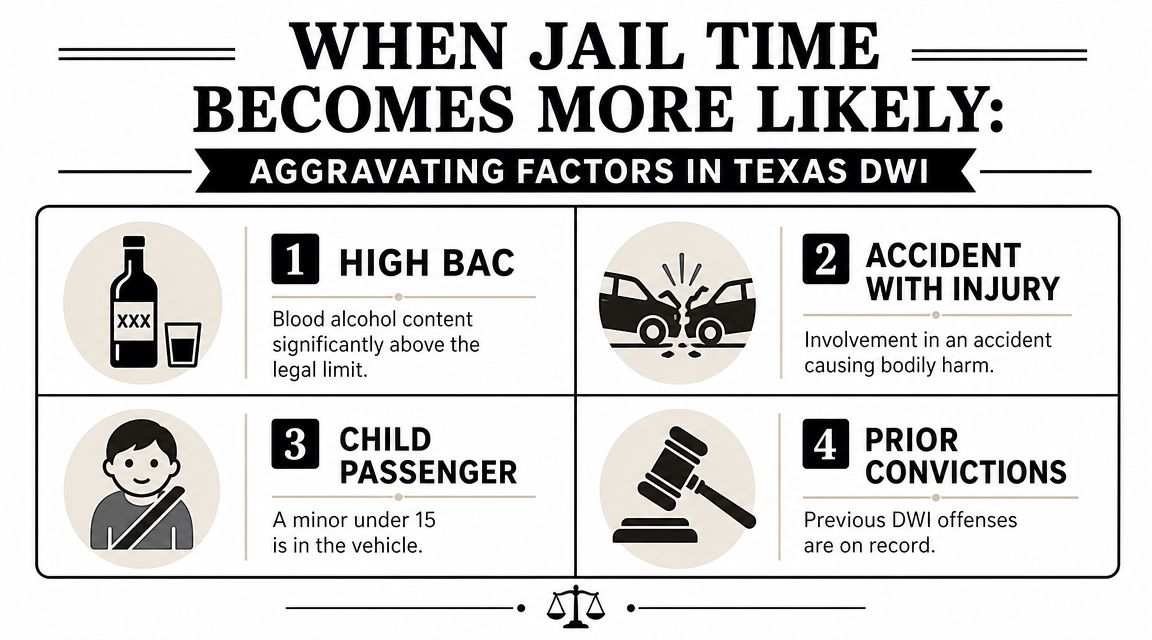
When Jail Time Becomes More Likely Aggravating Factors
Not every first DWI is treated the same. Some facts make prosecutors push harder for jail, stricter bond terms, or tougher plea offers.
One of those facts is already familiar. A high BAC allegation changes the charge level. But that isn't the only issue that can increase your risk.
Facts that make a prosecutor less flexible
Some cases arrive in court with built-in problems. When that happens, the conversation shifts from “Can we keep this low-level?” to “How do we contain the damage?”
A few examples:
- An accident with injury: If your arrest involved a crash and someone was hurt, the State may treat the case much more aggressively.
- A child passenger in the vehicle: If police say a young child was in the car, expect a much harsher response.
- Open container allegations: This can make the case look worse to the prosecutor and the judge.
- Prior criminal history: Even if this is your first DWI, any prior trouble in your background can affect how the State evaluates punishment.
For a broader discussion of how these issues change exposure, review aggravating factors in Texas DUI cases.
Why aggravating facts matter
Jail becomes more likely when the State believes your case will play badly in front of a judge or jury. A prosecutor is still required to prove the case. But aggravating details give the State an advantage in negotiation.
That's why your lawyer has to do more than react. Your lawyer needs to shape the story early. If there's body cam footage, witness confusion, poor field sobriety testing conditions, or weak evidence on the most damaging facts, that needs to be developed fast.
Some DWI cases look worse on paper than they do on video. That difference can change negotiations.
Don't assume the police report is the final word
The arrest report is only one version of events. It is not the verdict. Officers make judgment calls. Sometimes they overstate impairment. Sometimes they leave out facts that help you. Sometimes the video doesn't match the narrative.
That's why a first-offense DWI defense should examine:
- The stop itself
- What was said before arrest
- How field sobriety tests were given
- Whether the physical evidence supports the officer's conclusion
When those pieces are weak, jail becomes less inevitable and the defense gains room to work.
The Second Battle Your Driver's License and the ALR Hearing
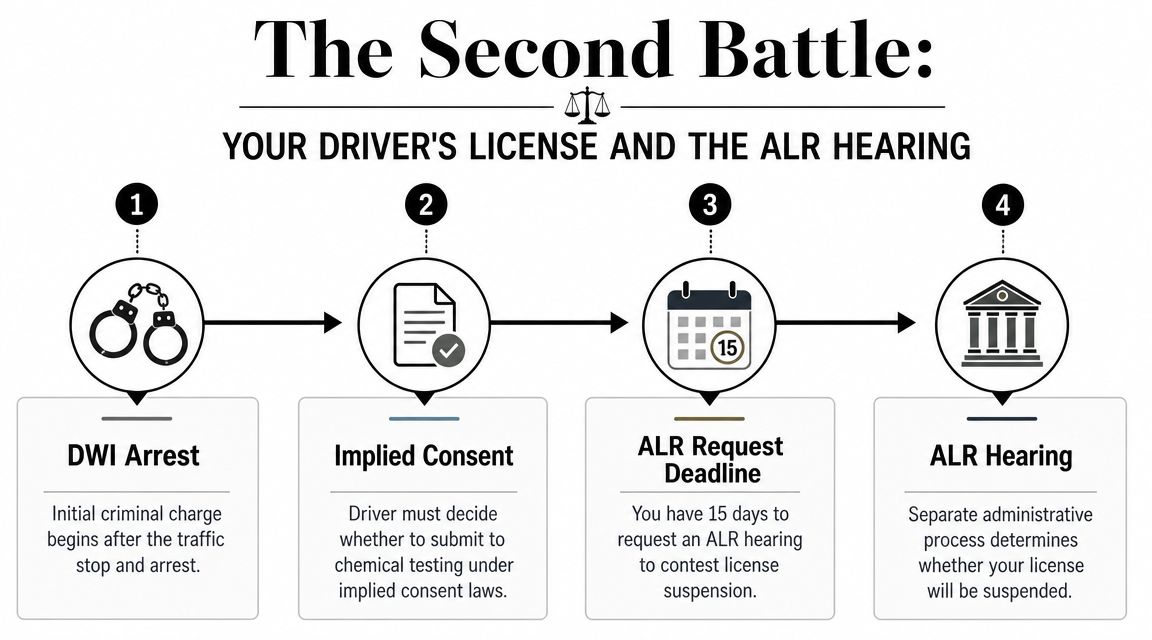
It's often assumed a DWI case is one fight. It isn't. It's two.
You have the criminal case, where the State tries to convict you. You also have the license case, which can start moving almost immediately. If you ignore the second one, you can lose driving privileges even while the criminal case is still unfolding.
Implied consent in plain English
Implied consent means Texas ties driving privileges to rules about chemical testing after a lawful DWI arrest. In practical terms, the officer may ask for a breath or blood specimen, and that decision can affect your license situation.
That license fight is often called an ALR hearing, short for Administrative License Revocation. It is separate from the criminal court case. It has its own timeline, its own issues, and its own consequences.
According to this first-time DWI in Texas explanation, a first offense can lead to a license suspension of 90 days to 1 year, and the ALR hearing request deadline is typically 15 days after the suspension notice at arrest.
Why the ALR deadline matters so much
If you miss that deadline, the suspension process can move forward without a contested hearing. That's a major mistake because the license case can also give your defense lawyer an early chance to question the officer and evaluate evidence.
Use this Texas ALR hearing process guide if you need a practical overview of how that process works.
A useful perspective is this:
- The criminal case threatens your record and freedom
- The ALR case threatens your ability to drive
- Both need attention immediately
If you can't drive, it affects work, family obligations, and your ability to manage the criminal case itself.
What happens after the arrest
The timeline is usually fast and unforgiving. You may leave the arrest focused on bond conditions and court dates, while the license deadline keeps running in the background.
That's why I advise clients to gather every document they received at arrest and have a lawyer review them right away. The paperwork often tells you what the State claims happened and whether the administrative process has already been triggered.
A good defense treats the criminal case and the ALR matter as connected strategy, not two unrelated headaches.
Are There Alternatives to Jail Typical Outcomes and Defense Goals
Yes. In a first Texas DWI case, jail is often avoidable. The right question is not whether the arrest was serious. It was. The critical question is what result your lawyer can build from the facts, and how fast that strategy starts.

A good defense aims at two things at the same time. Keep you out of jail if possible. Limit the damage that follows you long after the court date, including the effect on your record, your work, and your ability to drive.
Common defense goals in a first-offense case
The usual targets in a first-offense case include:
- Community supervision: Many first-time defendants avoid serving straight jail time and resolve the case through supervised conditions instead.
- Deferred adjudication where the facts and court allow it: For some clients, the goal is avoiding a final conviction and putting themselves in a better position for the future.
- Reduction to a less damaging outcome: If the State has proof problems, your lawyer should press that advantage in negotiations and pretrial work.
- Dismissal: If the stop was weak, the testing was unreliable, or the officer made procedural mistakes, dismissal may be a real goal.
Results vary by county, prosecutor, judge, and facts. Local practice matters. So does early pressure on the State's evidence.
What your lawyer should be doing
Your lawyer should not be there just to stand beside you in court. A serious DWI defense means building a strong position early and using it effectively.
That usually means:
- challenging the stop, arrest, testing, and police procedure
- identifying facts that make jail less likely and alternatives more realistic
- presenting you in the best possible light for negotiation or sentencing
- treating the criminal case and the license problem as one connected strategy
That last point matters more than people realize. If your lawyer handles only the court case and ignores the license consequences, you can end up with a result that looks manageable on paper but still disrupts your job and daily life.
The Law Office of Bryan Fagan, PLLC handles DWI defense, ALR hearings, and related case review for Texans who need that coordinated approach.
A first DWI should be treated as a problem to solve, not a punishment you accept at the start.
What not to do
Do not plead early just to get it over with.
A fast plea can cost you options your lawyer might have preserved with a closer review of the stop, the video, the test records, and the officer's reports. It can also make it harder to control the fallout to your license and your record.
The best outcomes usually come from patience, pressure, and a plan.
Your Immediate Next Steps After a DWI Arrest
This is the part that matters most right now. If you were just arrested, action in the next few days can affect both your criminal defense and your driver's license.
Start here.
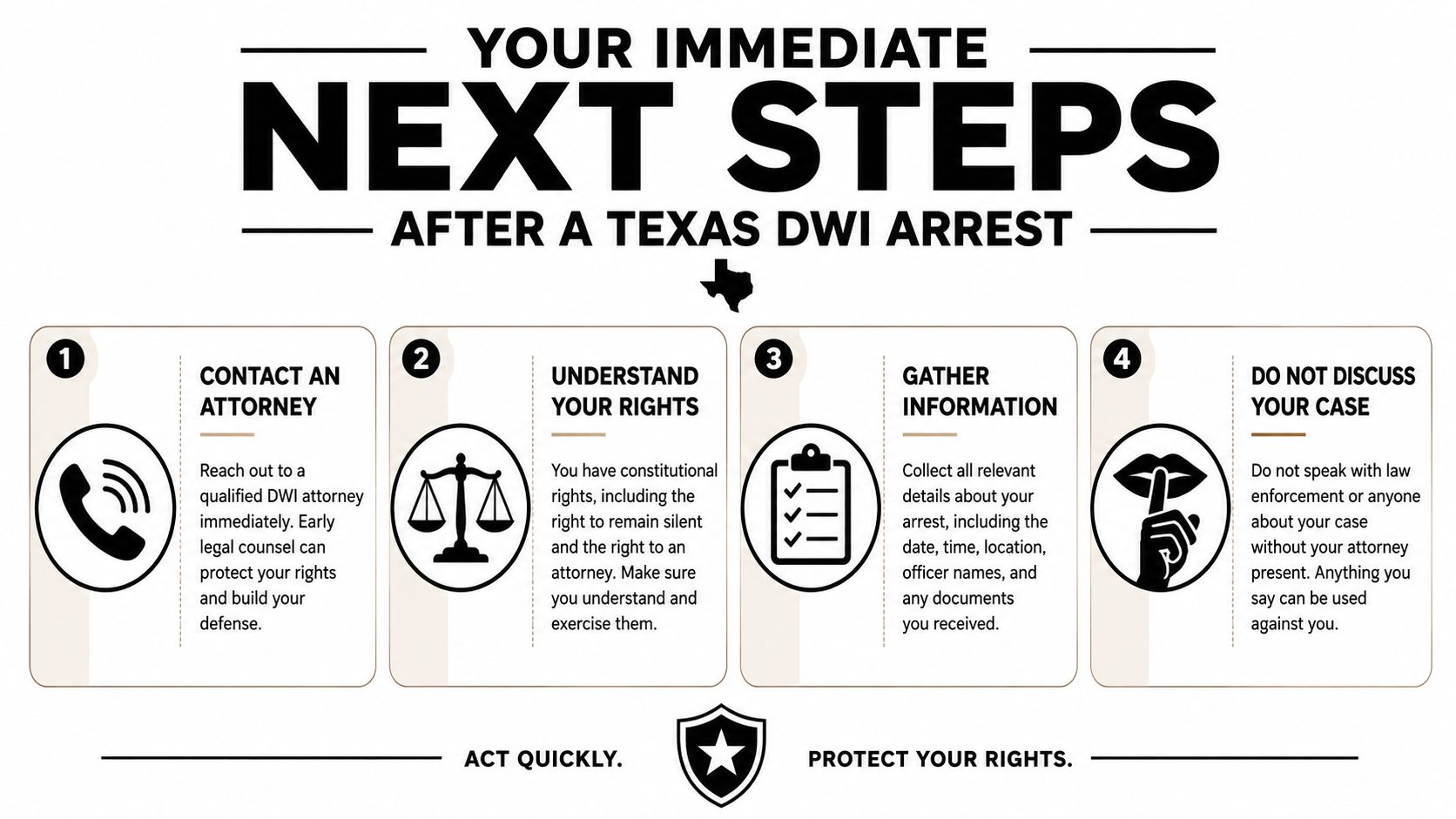
Four steps to take immediately
Call a Houston DWI lawyer or Texas DUI attorney now
Don't wait for the first court date. The earlier a lawyer gets involved, the better your chances of preserving defenses and preventing avoidable damage.Request the ALR hearing before the deadline
According to this explanation of the Texas administrative license process, drivers generally have 15 days to request an ALR hearing after a DWI arrest notice, and missing that deadline can trigger an automatic suspension process without a court fight.Write down everything you remember
Do this while it's fresh. Note where you were, what you ate, what you drank, when you were stopped, what the officer said, whether you were asked to do field sobriety tests, and whether there was video.Stop discussing your case
Don't explain it to police. Don't post online. Don't text your version to friends. Loose statements can become evidence.
Here's a short video that helps explain the urgency after a DWI arrest.
Keep your focus on two goals
You are trying to do two things at once:
- Fight DWI Texas criminal allegations
- Protect against DWI license suspension problems
That two-track mindset matters. If you only prepare for court and ignore the license case, you can lose ground fast. If you only worry about driving and ignore the criminal evidence, you can miss the bigger threat.
Stay calm, stay quiet, save every document, and get legal advice before you make another move.
If you take nothing else from this article, take this. A first DWI in Texas is serious, but it is manageable when you move early and make smart decisions.
If you're asking whether you'll go to jail for a first DWI in Texas, the honest answer is that jail is possible, but it isn't the only outcome and it shouldn't be treated as inevitable. The better move is to get immediate legal advice, protect your license before the ALR deadline runs, and build a defense around the actual facts of your stop, your tests, and your arrest. Request a free consultation with Law Office of Bryan Fagan, PLLC to review your case and discuss your options.