 Skip to content
A DWI-related arrest involving a tragedy can be overwhelming, but you don’t have to face it alone. If you are facing an intoxication manslaughter charge, you are likely feeling terrified about what comes next. The first step toward clarity and building a strong defense is understanding exactly what this charge means under Texas law and how a strategic attorney can protect your rights.
In Texas, intoxication manslaughter occurs when a person, due to intoxication, operates a motor vehicle in a public place and causes the death of another by accident or mistake. This isn’t just a DWI with a tragic outcome; it’s a specific felony offense where the prosecution must prove every single element beyond a reasonable doubt.
The Legal Definition of Intoxication Manslaughter Explained
Many people assume that if they were drinking and involved in a fatal accident, a conviction is automatic. That’s simply not true. The state’s attorney has a heavy burden—they must draw a direct, undeniable line connecting your intoxication to the person’s death.
An arrest is just the beginning of a long legal road where every detail, from the traffic stop to the accident reconstruction, is critical. At The Law Office of Bryan Fagan, PLLC, our job is to examine the prosecution’s case piece by piece, starting with the fundamental building blocks of the charge itself. A confident, experienced Houston DWI lawyer can make all the difference.

What the Prosecution Must Prove
For the state to secure a conviction, a prosecutor must present hard evidence to prove each of the following components of the crime occurred.
To help you understand what your defense team will challenge, here’s a breakdown of the key elements the prosecution must prove.
| Key Elements of Intoxication Manslaughter in Texas | |
|---|---|
| Element | What It Means Under Texas Law |
| Operating a Motor Vehicle | This seems simple, but it means you were physically in control of a car, truck, motorcycle, or even a boat or airplane. The state needs to prove you were the one behind the wheel. |
| In a Public Place | The incident must have occurred on a public road, highway, or any other area where the public has access. A private ranch road, for example, might not qualify. |
| Legal Intoxication | In Texas, this means one of two things: either you did not have the normal use of your mental or physical faculties because of alcohol or drugs, or you had a blood alcohol concentration (BAC) of 0.08% or higher. |
| Causation of Death | This is the most important—and often the most contested—element. The prosecution must prove that your intoxication directly caused the death. It is not enough that you were intoxicated at the scene of the accident. This is the cornerstone of a strong defense. |
Each of these elements is a link in a chain. If we can break just one of those links, the entire case against you can fall apart.
A conviction requires more than showing two events happened at the same time—intoxication and an accident. It requires proof that the first event caused the second. Challenging this link is a cornerstone of a strong defense.
This “causation” element is where many cases are won or lost. For instance, what if the other driver ran a red light? Or what if treacherous road conditions or a sudden vehicle malfunction were the real cause of the accident? If an external factor was the true reason for the crash, we can argue that your intoxication was not the direct cause, creating the reasonable doubt needed to fight the charge.
A skilled Houston DWI lawyer will investigate every possibility to protect your future. You don’t have to figure this out on your own; we’re here to bring strategy and experience to your corner.
How Intoxication Manslaughter Is Different from Other DWI Crimes
It’s easy to get lost in legal jargon, but understanding where an intoxication manslaughter charge fits within Texas DWI law is critical. Think of DWI offenses as a ladder—the higher you climb, the more severe the act and the steeper the consequences. Knowing the difference helps you grasp why a specialized defense is non-negotiable.
A standard first-time DWI, for instance, is usually a Class B misdemeanor. The case is built around operating a vehicle while intoxicated. No one has to get hurt for the charge to stick. While still serious, the penalties are worlds away from offenses that cause harm.
Drawing the Line Between Injury and Fatality
Things change dramatically the moment an accident causes physical harm. This is where Texas law draws a clear line based on the outcome of the incident.
- Intoxication Assault: This charge applies when an intoxicated driver causes “serious bodily injury” to another person. This isn’t just a broken bone; it’s an injury that creates a substantial risk of death, permanent disfigurement, or long-term impairment. This is a third-degree felony.
- Intoxication Manslaughter: This is the charge at the top of the ladder, reserved for cases where an intoxicated driver’s actions lead to the death of another person. As a second-degree felony, it reflects the ultimate, irreversible harm that occurred.
The key distinction is the outcome—a serious injury versus a fatality. In both scenarios, the prosecutor has to prove the driver’s intoxication was the direct cause of the harm. But the loss of a life elevates the charge to one of the most serious felonies in the Texas Penal Code.
Intoxication Manslaughter vs. Vehicular Manslaughter
Another point of confusion is the difference between “intoxication manslaughter” and “vehicular manslaughter.” They sound similar, but legally, they’re built on different foundations.
Vehicular Manslaughter (which in Texas falls under statutes like criminally negligent homicide) is about reckless or negligent behavior. Think extreme speeding, weaving through traffic, or texting while driving—dangerous actions that lead to a fatal crash. The focus is on the driver’s bad decisions.
Intoxication Manslaughter, however, hinges entirely on the element of intoxication. A prosecutor doesn’t need to prove you were also speeding or driving recklessly. Under the law, the act of driving while intoxicated is the reckless act. If that act causes a death, it’s enough for the charge. This subtle but vital distinction is explained further in our guide on DWI vehicular homicide as a second-degree felony in Texas.
The core of an intoxication manslaughter case isn’t just that a tragic accident happened while a driver was intoxicated. The law requires prosecutors to prove that the intoxication itself was the direct cause—the “but for” reason—that the death occurred.
This is where a strong defense finds its footing. If other factors were the true cause of the accident—like the other driver running a red light, hazardous road conditions, or a sudden vehicle malfunction—then that critical link between the intoxication and the tragic outcome can be broken.
The devastating impact of these incidents is clear from national statistics. In the United States, about 34 people die every day in drunk-driving crashes—that’s one preventable death every 42 minutes. You can learn more about these sobering drunk driving statistics from NHTSA.
Because the legal elements are so specific and the stakes are so high, you need a defense attorney who lives and breathes these nuances. An experienced lawyer can dissect the prosecution’s case, challenge their evidence on causation, and fight to protect your freedom and your future.
Penalties and Consequences of Intoxication Manslaughter

Knowing exactly what’s on the line is the first step toward building a defense that can protect your future. A conviction is life-altering, and grasping the full scope of the penalties makes it clear why fighting the charge is so critical. We’re not here to scare you—we’re here to prepare you. A clear view of the risks is the only way to build a defense aimed at protecting your freedom.
Under Texas law, intoxication manslaughter is classified as a second-degree felony. This isn’t just a serious charge; it’s one of the most severe, reflecting the tragic loss of life involved.
Criminal Penalties Explained
If you are convicted, the court must follow a strict sentencing range. The direct criminal penalties are designed to be severe.
- Prison Time: A conviction can result in 2 to 20 years in a Texas state prison.
- Fines: The court can also impose a fine of up to $10,000.
- Community Supervision (Probation): While probation is technically possible, it’s incredibly difficult to secure. Even if granted, it often comes with tough conditions, including mandatory jail time as a prerequisite.
These aren’t just numbers on a legal document. They represent years of your life and a staggering financial blow. The entire goal of a skilled Houston DWI lawyer is to fight for an outcome that eliminates or dramatically reduces these consequences.
Administrative and Civil Consequences
The impact doesn’t stop at the criminal courthouse. A conviction sets off a chain reaction of other penalties that will follow you long after any sentence is served. These are often called collateral consequences, and they can be just as devastating as time in prison.
One of the first things to go is your ability to drive. An intoxication manslaughter charge automatically triggers an Administrative License Revocation (ALR) proceeding. You have only 15 days from the date of your arrest to request an ALR hearing and fight for your license. If you miss that deadline, the suspension is automatic.
On top of that, a conviction will almost certainly lead to a lengthy driver’s license suspension, often lasting for years. You’ll also be forced to pay thousands of dollars in annual surcharges to the Texas Department of Public Safety (DPS) just to keep your license valid in the future.
A felony conviction is a permanent mark on your record that follows you everywhere. It can close doors to employment, housing, and educational opportunities, creating lifelong barriers long after you have paid your debt to society.
How Intoxication Manslaughter Penalties Compare to Other DWI Offenses
It’s easy to confuse these serious charges, but the differences in potential outcomes are massive. Here’s a quick breakdown to put the severity of Intoxication Manslaughter into perspective.
| Offense | Level of Harm | Typical Charge (Felony/Misdemeanor) | Potential Prison/Jail Time |
|---|---|---|---|
| DWI (1st Offense) | None (impaired driving only) | Class B Misdemeanor | 72 hours to 180 days in jail |
| Intoxication Assault | Causes Serious Bodily Injury | Third-Degree Felony | 2 to 10 years in prison |
| Intoxication Manslaughter | Causes Death | Second-Degree Felony | 2 to 20 years in prison |
As you can see, the penalties escalate dramatically based on the harm caused. Intoxication Manslaughter sits near the top of the list, with consequences that can forever alter the course of your life.
The Lifelong Impact of a Felony Record
This is perhaps the most far-reaching consequence of them all. A second-degree felony conviction creates a permanent criminal record that is easily accessible to employers, landlords, banks, and professional licensing boards.
This can create endless obstacles, including:
- Difficulty Finding a Job: Many employers won’t even consider hiring someone with a felony record, especially for positions that require trust.
- Professional License Revocation: If you’re a doctor, nurse, lawyer, teacher, or hold any professional license, a conviction will likely lead to its suspension or permanent revocation.
- Loss of Civil Rights: In Texas, convicted felons lose the right to vote (until the sentence is fully served) and the right to own a firearm for good.
- Housing and Loan Applications: Getting approved for an apartment lease or a loan becomes incredibly difficult with a felony on your record.
Understanding the full range of Texas DWI penalties is absolutely crucial. Everything is on the line—from your freedom to your career to your family’s future. This is exactly why you need an assertive legal ally to stand between you and the prosecution, fighting to protect the life you’ve worked so hard to build.
How a Strategic Defense Can Protect Your Future
Facing an intoxication manslaughter charge feels like standing against an unstoppable force, but remember this critical fact: an arrest is not a conviction. The state carries the entire burden of proof, and a skilled defense attorney’s job is to take their case apart, piece by piece. A strategic defense doesn’t just react to the prosecution; it proactively attacks the foundation of their claims.
Many people in this situation assume the evidence against them is airtight. That’s rarely true. Every step of a DWI investigation, from the traffic stop to the chemical test, is governed by strict legal procedures. If law enforcement cuts corners or violates those protocols, the evidence they collect can be suppressed—thrown right out of court.
This is where a thorough defense begins: by putting every action the police took under a microscope.
Questioning the Initial Traffic Stop
The entire case against you is built on the legality of that first traffic stop. An officer can’t just pull you over on a hunch. They must have reasonable suspicion—a legal standard requiring specific, observable facts—that you either violated a traffic law or were engaged in criminal activity.
Was there a legitimate reason to stop your vehicle? We dig into questions like:
- Did you actually commit the traffic violation the officer claims?
- Can the officer clearly explain the specific things they saw that made them believe you were intoxicated before they stopped you?
- Is there dashcam or bodycam footage that contradicts the officer’s report?
If we can show the stop was illegal, any evidence gathered after that moment—field sobriety tests, breath samples, blood draws—could be ruled inadmissible. This can cripple the prosecution’s case.
Challenging Field Sobriety and Chemical Tests
Officers use Standardized Field Sobriety Tests (SFSTs) and chemical tests (breath or blood) to build their case. But these tests are far from perfect and often provide fertile ground for a powerful legal challenge.
Field Sobriety Tests, for instance, are notoriously unreliable. Your performance can be affected by dozens of factors unrelated to alcohol, including:
- Pre-existing medical conditions or old injuries.
- Nervousness, fatigue, or the stress of the situation.
- Poor weather, uneven pavement, or flashing police lights.
- An officer giving confusing or incorrect instructions.
Likewise, chemical tests aren’t infallible. Breathalyzer machines must be properly calibrated and maintained. Blood samples must be drawn, stored, and transported under strict protocols to prevent contamination. Any mistake in this chain of custody can make the results invalid. We meticulously review maintenance logs, officer training records, and lab procedures to find weaknesses in the state’s scientific evidence. You can explore a wide range of legal strategies in our detailed guide on the many powerful defenses for DUI cases in Texas.
The prosecution presents scientific evidence like it’s absolute fact. Our job is to show the jury the human error, procedural missteps, and scientific uncertainty hiding behind the numbers. Reasonable doubt often lives in those details.
The Critical Issue of Causation
Perhaps the single most powerful defense in an intoxication manslaughter case is to challenge causation. The prosecutor must prove, beyond a reasonable doubt, that your intoxication was the direct cause of the fatal accident. It’s not enough to prove you were intoxicated at the scene of a crash where someone tragically died.
For example, if the accident would have happened anyway, regardless of your sobriety, then your intoxication wasn’t the legal cause. This is where a deep, independent investigation becomes essential.
We bring in accident reconstruction experts and private investigators to uncover the truth. They often find alternative causes the police overlooked, such as:
- The other driver’s actions: Did the other driver run a red light, make an illegal turn, or were they speeding?
- Environmental factors: Were there dangerous road conditions, poor lighting, or missing traffic signs?
- Vehicle malfunction: Could a sudden brake failure or a tire blowout have been the real cause?
By presenting this kind of evidence, we can create powerful reasonable doubt and show a jury that the tragedy, while real, was not legally your fault under the intoxication manslaughter statute. An arrest is an accusation, not a verdict. With an experienced Houston DWI attorney on your side, you can build a formidable defense.
Navigating the Texas Criminal Justice System
The legal journey after an intoxication manslaughter arrest can feel like a maze. A charge this serious kicks off a complex and often overwhelming legal process, but you don’t have to find your way through it alone. Our job is to manage this process for you, protecting your rights at every turn so you can focus on your life.
It all starts the moment an arrest is made. One of the first critical steps is the arraignment, where you are formally charged and a judge sets your bond. This is our first opportunity to advocate for you, fighting for a reasonable bond that allows you to return home while the case moves forward.
Your First Step: The ALR Hearing
What most people don’t realize is that a DWI-related arrest actually triggers two separate cases: the criminal charge and a civil case against your driver’s license. This is known as the Administrative License Revocation (ALR) process.
You have only 15 days from the date of your arrest to request an ALR hearing. If you miss this deadline, your license gets automatically suspended. Requesting this hearing is vital—not just to fight the suspension, but because it gives your attorney an early shot at questioning the arresting officer under oath. This is an invaluable chance to gather information that can be used in your criminal defense.
This diagram shows the core areas we immediately investigate to build a solid defense strategy.
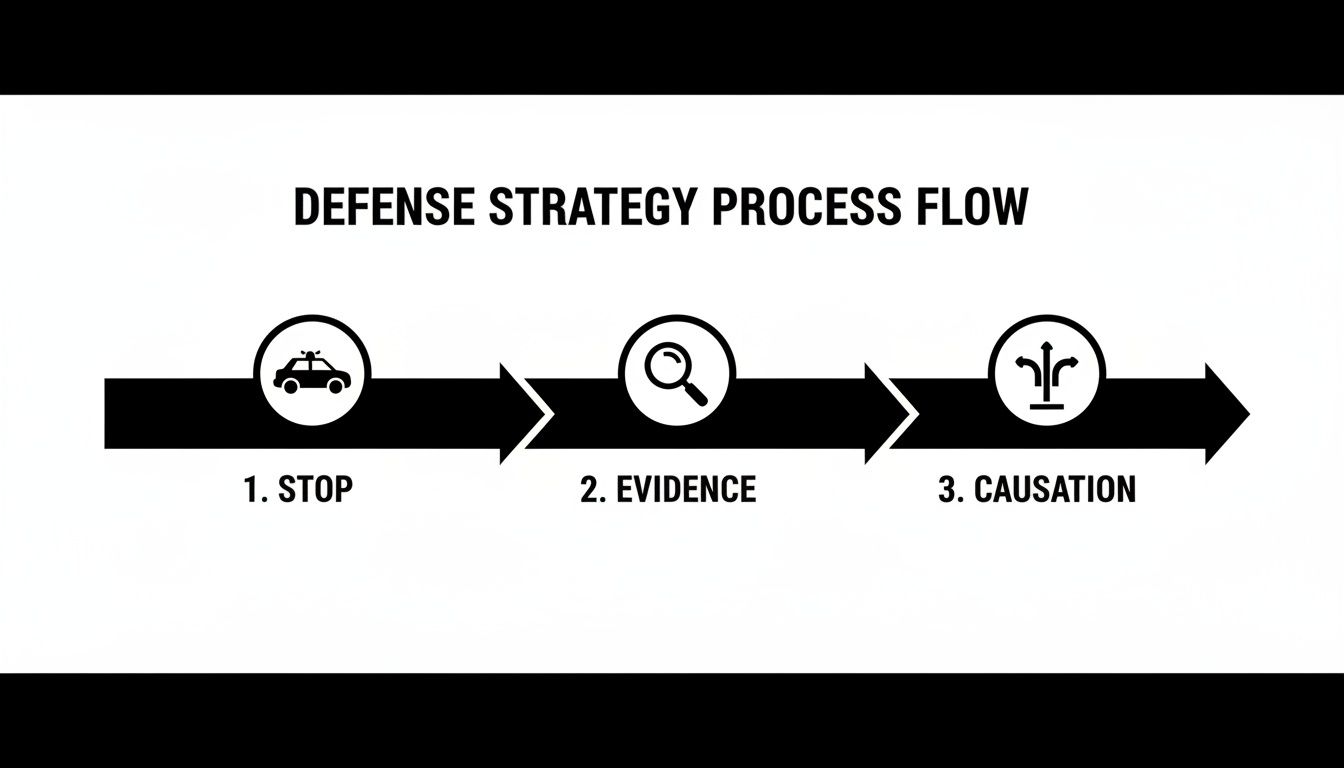
By digging into the traffic stop, the evidence, and what really caused the accident, we can start constructing a comprehensive defense from day one.
From Grand Jury to Pre-Trial Motions
Because intoxication manslaughter is a felony, the case must be presented to a grand jury. The grand jury’s job is to decide if there is enough probable cause to formally indict you. If they do, the criminal case officially proceeds to district court.
This is where the pre-trial phase kicks into gear. It’s an intensive period where we file motions to attack the State’s evidence. For example, we might file a motion to suppress evidence if we believe the initial traffic stop was illegal or if there were problems with how a blood or breath sample was taken. A successful motion can get key evidence thrown out, which can dramatically weaken the prosecutor’s case against you.
The global impact of impaired driving is a big reason these cases are prosecuted so aggressively. The World Health Organization found that 2.6 million deaths in 2019 were attributable to alcohol, with hundreds of thousands resulting from traffic incidents. You can learn more about the global statistics on alcohol-related harm from WHO.int.
Plea Negotiations and Preparing for Trial
Throughout the pre-trial phase, we are in constant communication and negotiation with the prosecutor. Our primary goal is always to get the best possible outcome for you. That could mean a dismissal, a reduction to a lesser charge, or a plea agreement that avoids the risk of a long prison sentence.
But here’s our philosophy: we prepare every single case as if it’s going to trial. This means we are simultaneously investigating the facts, hiring and consulting with accident reconstruction experts, and building a powerful strategy to present to a jury.
Facing the Texas criminal justice system is intimidating, but a clear roadmap and a strategic legal partner can make all the difference. Our firm is dedicated to guiding you through each step, protecting your rights from the initial hearing to the final verdict.
If a plea agreement that protects your best interests can’t be reached, the final step is a jury trial. At trial, the State has the burden to prove every single element of the charge beyond a reasonable doubt. We will be right there to cross-examine their witnesses, present our own evidence, and make a compelling case to the jury on your behalf. You don’t have to go through this alone.
Why an Experienced DWI Attorney Is Your Strongest Ally

When the stakes are this high, the attorney you choose can make all the difference in the world. Facing a charge like intoxication manslaughter is not the time for a general practitioner. These cases are incredibly complex, weaving together scientific evidence, accident reconstruction, and sophisticated legal arguments that demand specialized knowledge.
You absolutely need a dedicated Texas DUI attorney who has gone head-to-head with prosecutors on these specific charges before.
An experienced attorney knows how to dismantle the state’s case piece by piece. They understand the procedural loopholes, the flaws in breath and blood testing, and how to challenge the critical element of causation. From day one, our team begins an independent investigation to find the facts the police may have overlooked or ignored.
The Law Office of Bryan Fagan Difference
Our firm brings a strategic, assertive approach to every single case. We don’t just react to what the prosecution does; we proactively build a defense designed to protect your freedom. We manage every aspect, from the urgent ALR hearing to save your license to the intensive preparation for a potential jury trial.
You are facing a fight for your future, and you deserve an advocate who is as invested in the outcome as you are. With the right legal ally, you have a fighting chance to protect your name and your freedom.
Prosecutors will often lean heavily on the tragic circumstances of the case to sway a jury. They might even try to connect your situation to broader statistics about alcohol-related harm. For example, in the United States, alcohol is a contributing factor in over 7,300 homicides annually, a sobering statistic that courts are well aware of when considering culpability. You can learn more about these alcohol-related death statistics on DrugAbuseStatistics.org.
An experienced attorney knows how to keep the focus squarely on the specific facts of your case, ensuring that raw emotion doesn’t override the evidence.
When you’re facing something as overwhelming as an intoxication manslaughter charge, your mind is flooded with questions. Getting clear, honest answers is the first step toward taking back control of your situation. Here are some of the most common questions we hear.
Can they convict me if my BAC was under the legal limit of 0.08?
Yes, they absolutely can. This is a common and dangerous misconception. While a Blood Alcohol Concentration (BAC) of 0.08% or higher is one way for the state to prove you were intoxicated, it’s not the only one.
Under Texas law, “intoxication” also means not having the “normal use of mental or physical faculties” because of alcohol or drugs. Prosecutors can use an officer’s testimony about your driving, your performance on field sobriety tests, or even your physical appearance to argue you were impaired, regardless of your BAC. An experienced Texas DUI attorney is crucial for poking holes in this kind of subjective evidence.
What’s the real difference between fault and causation?
This is one of the most critical concepts in an intoxication manslaughter defense. Simple fault means you might have made a mistake that played a role in an accident.
Causation, however, is a much higher legal bar that the prosecution must clear. They have to prove beyond a reasonable doubt that your intoxication was the direct cause of the fatal accident. If the tragedy would have happened anyway—for example, if the other driver blew through a red light and hit you—then your intoxication was not the legal cause of death. Establishing this is a cornerstone of how to fight DWI Texas charges effectively.
Causation isn’t just about figuring out who’s to blame. It’s about legally breaking the chain the prosecutor needs to connect your alleged intoxication to the tragic result. If we can snap that link, their entire case can fall apart.
Is prison time a foregone conclusion if I’m convicted?
Intoxication manslaughter is a second-degree felony, which carries a punishment range of 2 to 20 years in a Texas state prison. While probation is technically on the table, it is incredibly difficult to secure and often requires upfront jail time as a condition.
That’s why our goal is never to just aim for probation. A powerful legal defense is built to fight for a complete dismissal of the charges, a reduction to a less serious offense, or an acquittal at trial to avoid the threat of prison entirely.
How fast do I have to act after being arrested?
Immediately. The clock starts ticking the second you are arrested, and you have only 15 days to request what’s called an Administrative License Revocation (ALR) hearing. This is your only chance to stop an automatic DWI license suspension.
This ALR hearing is a civil process, completely separate from your criminal case. If you miss this deadline, you forfeit your right to challenge the suspension. It’s a critical first battle where we can protect your ability to drive and even gather valuable evidence that can be used to defend you in criminal court. You can’t afford to wait.
When your future, freedom, and reputation are on the line, you need a strategic and aggressive legal team fighting for you. The attorneys at The Law Office of Bryan Fagan, PLLC are ready to stand up for your rights and build the powerful defense you deserve. Don’t face this alone. Request your free, confidential case evaluation today by visiting us at https://texasduilawfirm.com or calling us to take the first step toward protecting your future.

