
A DWI arrest can be overwhelming—but you don’t have to face it alone. Before you spiral, it's important to understand that an arrest isn't a conviction, and you have options. In Texas, one of the most powerful tools available is something called deferred adjudication.
Think of it less as a conviction and more like a high-stakes deal with the court. If you hold up your end of the bargain, your case gets dismissed. It’s a genuine second chance to protect your future.
A Second Chance After a Texas DWI Arrest
A DWI arrest can make your future feel uncertain and out of your hands, but that’s not true. Texas law provides an alternative to a final conviction called deferred adjudication. For our clients who are eligible, pursuing this outcome is often a top priority because it’s the clearest path to keeping a DWI conviction off your permanent criminal record for good.
So, what is deferred adjudication, really? Let's break it down in clear terms.
Imagine you're in court for a DWI. Instead of fighting the charge in a full-blown trial, your attorney negotiates a deal where you enter a plea of "guilty" or "no contest." But here’s the crucial twist: the judge doesn't actually find you guilty. Instead, the judge defers—or postpones—that finding of guilt and places you on community supervision, which is a form of probation.
How Deferred Adjudication Works
This period of supervision comes with a strict set of rules you have to follow to the letter. These conditions aren't random punishments; they're designed to be rehabilitative and help you take the next step toward a positive outcome.
Some of the most common requirements include:
- Checking in regularly with a supervision officer.
- Paying all fines, court costs, and supervision fees on time.
- Completing a DWI education class or, in some cases, substance abuse counseling.
- Completing a set number of community service hours.
- Installing an ignition interlock device (IID) on your vehicle, a device that prevents your car from starting if it detects alcohol on your breath.
If you successfully complete every single requirement for the entire term—without any slip-ups—the judge will dismiss the charges against you. The end result? You are never formally convicted of the DWI. This is a massive win that can protect your career, your reputation, and your future.
This isn't an obscure legal loophole; it's a widely used and effective tool in Texas courts. For many people facing a first DWI in Texas, this strategy isn't just an option; it's the best possible way forward. An experienced Houston DWI lawyer can help determine if it's the right path for your case.
The Step-by-Step Deferred Adjudication Process
The court system can feel like a confusing maze, but the path to deferred adjudication follows a clear, structured sequence. Knowing these stages can help replace anxiety with confidence. Think of it as a strategic journey, one that a skilled DWI attorney handles with precision.
The real work doesn't start in the courtroom. It begins with your defense.
Stage 1: Negotiation with the Prosecutor
The first move is for your attorney to sit down with the prosecutor. This is far more than a simple chat; it’s a tactical presentation of your case from every angle. Your lawyer will zero in on the weaknesses in the state’s evidence—perhaps there were issues with the traffic stop, problems with how the field sobriety tests were administered, or questions about the accuracy of a breath or blood test.
At the same time, your attorney will present the human side of your story, highlighting mitigating factors like a clean record, your role in the community, or your commitment to making things right. The goal is to persuade the prosecutor that deferred adjudication is a fair and just outcome. These negotiations are a make-or-break part of securing a favorable plea bargain for your DWI case.
Stage 2: Entering a Plea in Court
Once your attorney and the prosecutor have an agreement, the next step takes place in front of the judge. In a formal court hearing, you will enter a plea of either “guilty” or “no contest” to the DWI charge.
It's crucial to remember that this plea is part of that pre-negotiated deal. The judge knows the objective is deferred adjudication, not a final conviction. Pleading this way is what gives the judge the legal authority to place you on community supervision instead of convicting you.
This moment can feel intimidating, but with your lawyer right there with you, you'll be completely prepared. It's a required formality that unlocks the door to the deferred adjudication pathway.
Stage 3: The Judge Sets the Conditions
After accepting your plea, the judge will officially put off a finding of guilt and place you on community supervision. Then, the judge will lay out the specific terms and conditions you must follow for a set period, which is typically anywhere from six months to two years for a misdemeanor DWI.
This flowchart breaks down the core stages of the deferred adjudication journey.
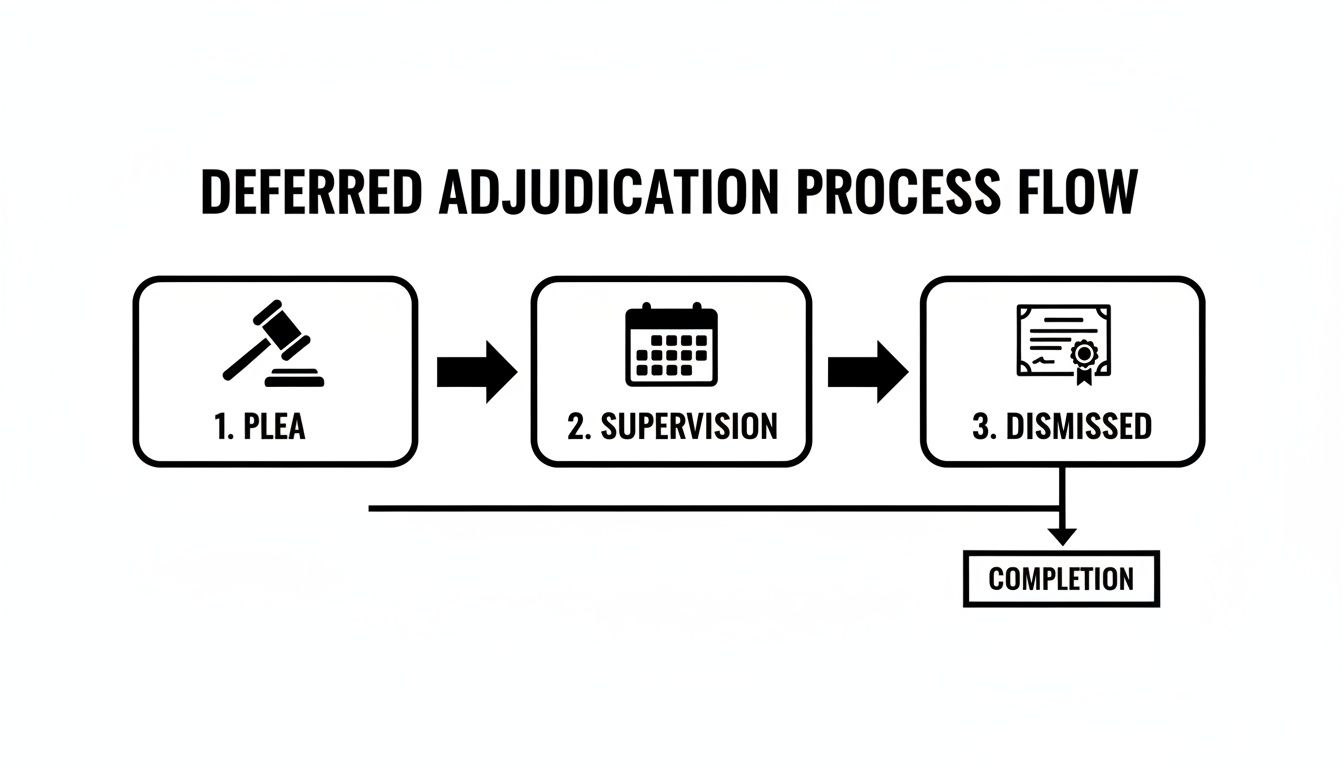
As you can see, the process flows from a formal plea to a period of supervision, and if all goes well, it ends with a case dismissal.
The conditions set by the judge are legally binding. Some of the most common requirements for a DWI deferred adjudication in Texas include:
- Regular Reporting: You’ll be assigned a probation officer you must check in with regularly, usually once a month.
- Fines and Fees: You'll have to pay court costs, fines tied to the DWI, and monthly supervision fees.
- DWI Education Program: You must sign up for and complete a state-approved DWI education class within a certain timeframe.
- Ignition Interlock Device (IID): Texas law often requires an IID to be installed on your vehicle for some or all of your supervision period.
- Community Service: The judge will order a specific number of community service hours that you need to complete.
Getting through this period successfully is the final, and most important, step. It's your responsibility to follow every single condition to the letter. If you do, your case gets dismissed, and you can finally move on without a DWI conviction on your record.
Who Qualifies for DWI Deferred Adjudication in Texas
While deferred adjudication sounds like a fantastic outcome for a first DWI in Texas, it’s not an option for everyone. Think of it as a powerful second chance, but one that comes with a specific set of rules. Figuring out if you meet these qualifications is the first and most important step.
Before a prosecutor offers deferred adjudication—or a judge approves it—they will scrutinize both your past and the specific details of your arrest.
Key Eligibility Factors for Deferred Adjudication
The prosecutor holds most of the cards in this process. Your Houston DWI lawyer’s ability to negotiate a good outcome often comes down to building a strong argument that you’re a low-risk candidate who deserves this opportunity.
Here are the factors that really matter:
- Your Criminal History: This is a big one. Deferred adjudication is almost always reserved for first-time DWI offenders. If you have a prior DWI conviction, your chances of getting an offer are practically zero.
- The Facts of Your Case: The details of your stop and arrest are critical. Was your Blood Alcohol Concentration (BAC) extremely high? BAC is a measure of the amount of alcohol in your system. Texas law draws a hard line here: a BAC of 0.15 or greater makes you legally ineligible for deferred adjudication.
- No Accidents or Injuries: If your DWI arrest involved a car accident—especially one that caused property damage or injured someone—prosecutors will almost certainly shut the door on any discussion of deferred adjudication.
- No Aggravating Circumstances: Certain facts will immediately disqualify you. The most common deal-breaker is having a child passenger under the age of 15 in your vehicle. This automatically elevates the charge to a felony (DWI with Child Passenger) and takes deferred adjudication completely off the table.
Commercial Driver’s License (CDL) Holders and DWI
When it comes to commercial drivers, Texas law is incredibly rigid. There’s no grey area here.
If you held a Commercial Driver’s License (CDL) when you were arrested for DWI, you are statutorily ineligible for deferred adjudication. It doesn’t matter if you were driving your personal truck on your day off—the rule is absolute.
This strict stance is designed to maintain higher safety standards for people who drive for a living. For a CDL holder, the only real way to protect your license and your career is often to fight the DWI charge head-on at trial.
Are You a Strong Candidate?
So, who makes a strong candidate for deferred adjudication? It’s usually someone who fits this profile:
- This is your first DWI arrest.
- Your BAC was under the 0.15 threshold.
- No accident was involved.
- There were no children in the car.
- You do not have a CDL.
Even if you check every one of these boxes, an offer for deferred adjudication is never guaranteed. It almost always requires skillful negotiation from an experienced DWI attorney who can highlight the weaknesses in the state’s case and convince the prosecutor that you’re worth the second chance.
Weighing the Pros and Cons of a Deferred Adjudication Offer
Deciding whether to accept a deferred adjudication offer is a huge moment. It’s like being offered a probationary period for your dream job. If you follow every rule, you get the job for life. But if you make one wrong move, you’re not just out—you could face even worse consequences.
That’s the core trade-off with deferred adjudication. It gives you a powerful opportunity to keep your record clean, but it also comes with a massive risk if you can't meet the strict requirements. You have to understand both sides of this coin before you agree to anything.

The Overwhelming Benefit: A Clean Slate
The main reason anyone considers deferred adjudication is the massive upside: you can avoid a permanent, public DWI conviction. It’s hard to overstate just how much this single benefit can impact the rest of your life.
When you successfully complete all the terms of your supervision, the judge dismisses your case. You are never convicted of the DWI.
This outcome protects you from the long-term damage a criminal record can cause, which often impacts:
- Employment: A DWI conviction can instantly disqualify you from jobs, especially if they involve driving, professional licenses, or positions of trust.
- Housing: Landlords often check criminal histories. A conviction could be the reason your rental application gets denied.
- Professional Licenses: Fields like nursing, teaching, real estate, and law have strict character standards. A DWI conviction could put your entire career in jeopardy.
- Educational Opportunities: Some university programs and financial aid applications can be affected by a criminal conviction.
By keeping that conviction off your record, deferred adjudication offers you a chance to move forward without one mistake defining your future.
The Significant Risks: A High Price for Failure
The benefits are clear, but the risks are just as serious. When you accept a deferred adjudication offer, you’re making a critical trade.
By entering a plea of "guilty" or "no contest," you waive your constitutional right to a trial by jury. You are giving up the chance to fight the charges and be found "not guilty." This is a permanent decision.
If you violate any condition of your probation—even something that seems minor, like missing a meeting with your officer or being late on a fee—the consequences are severe. The prosecutor can file a "Motion to Adjudicate Guilt."
Because you’ve already entered a plea, there is no new trial on the original DWI charge. The judge’s only job is to decide if you violated probation. If they agree that you did, they can find you guilty right then and there and impose a sentence up to the maximum punishment allowed for that DWI offense, including jail time. You lose all the leverage you once had.
A Path That Demands Total Commitment
Choosing deferred adjudication means you are committing 100% to seeing the program through. For those who are truly dedicated, these programs work. National analyses have found they can significantly cut the risk of repeat offenses. You can learn more about the success rates of deferred adjudication programs across the country.
This data shows that for the right person, deferred adjudication is a proven path to a better outcome. It takes discipline, but the reward—a dismissed case and a protected future—is worth the effort. An experienced Houston DWI lawyer can help you weigh these pros and cons based on the specific facts of your case, ensuring you make the most strategic choice for your situation.
What Happens to Your Criminal Record After Deferred Adjudication
Successfully completing deferred adjudication is a huge win, and it ends with the judge dismissing your case. But here's a common—and dangerous—misunderstanding: many people think a dismissed case just vanishes. It doesn’t, at least not automatically.
The reality is, even with a dismissal, the record of your arrest and the original DWI charge stick around. These records are public information, which means they can pop up on background checks run by potential employers, landlords, or licensing boards.

The Ghost of the Arrest Record
Think of it this way: deferred adjudication stops a conviction from ever being added to your record. It doesn't, however, erase the fact that you were arrested and charged in the first place. That initial paper trail still exists.
Without taking the next step, you could find yourself in the awkward position of explaining an arrest for a case that was ultimately dismissed. This is why finishing your probation is only half the battle. The final, essential move is to seal that record from public view.
The Power of an Order of Non-Disclosure
To truly put the incident behind you, the tool you need is an Order of Non-Disclosure. This is a court order that legally prohibits government agencies from releasing information about your deferred adjudication case to the general public.
An Order of Non-Disclosure acts like a legal seal over your records. While the records aren't physically destroyed, they are hidden from public access, meaning they won't show up on most standard background checks for jobs or housing.
This process is a cornerstone of second-chance laws across the country. By 2020, an overwhelming 48 states and Washington D.C. offered court-managed deferral programs, with states like Texas providing broad authority for sealing records. You can see how widely these policies are accepted by reviewing national trends in deferred adjudication and record sealing.
Waiting Periods for Sealing a DWI Record
In Texas, you can't file for non-disclosure the day your deferred adjudication ends. The law builds in mandatory waiting periods.
For most misdemeanor DWIs that are eligible for deferred adjudication, the waiting period is two years from the date your probation is successfully discharged and the case is dismissed.
To be eligible to seal your DWI record after this waiting period, you must meet several criteria:
- You must have successfully completed every single term of your deferred adjudication.
- You must not have been convicted of or placed on deferred adjudication for any other crime (except for minor traffic tickets) during your probation or the waiting period.
- The original DWI charge must not have involved an accident with another person, even if that person was a passenger in your own car.
Getting a non-disclosure isn't an automatic process; it requires filing a formal petition with the court. A skilled Texas DUI attorney can walk you through the process of expunging or sealing a DWI in Texas to ensure your record is properly sealed, giving you the clean slate you worked so hard to earn.
How a Strategic DWI Attorney Can Secure Deferred Adjudication
Deferred adjudication isn’t just handed out—it’s a hard-won outcome that takes a skilled legal strategy to achieve. An experienced DWI attorney doesn’t just walk in and ask for a second chance. We build a powerful case that convinces the prosecutor you’ve earned one. This is about a tactical, detailed defense designed to secure the best possible future for you.
The very first thing your attorney should do is put the state’s evidence under a microscope. We meticulously pick apart every detail of the traffic stop, starting with the most basic question: did the officer even have a valid reason to pull you over? An unlawful stop can be grounds to get the entire case thrown out.
From there, we challenge the administration and results of every test they performed on you.
Building a Strong Negotiating Position
A strong defense is your best leverage in any negotiation. We critically analyze the field sobriety tests, making sure they were administered exactly according to the strict standards set by the National Highway Traffic Safety Administration (NHTSA). Any misstep can cast serious doubt on their validity.
Likewise, we dig into the breath and blood test results. We look for errors in machine calibration, mistakes in how samples were handled, or procedural screw-ups during testing. Finding these weaknesses is key to convincing a prosecutor that taking your case to trial is a risk for them. That’s what makes them open to alternatives like deferred adjudication.
Our job also involves telling the prosecutor who you really are, beyond a case file. We highlight mitigating factors that paint the full picture:
- A clean criminal history and strong ties to your community.
- Your commitment to your job, family, or school.
- Proactive steps you’ve already taken, like attending counseling.
Leveraging Local Court Experience
Successfully negotiating for deferred adjudication also hinges on knowing the local legal landscape. Our team's extensive experience in courtrooms across Houston, San Antonio, and the DFW metroplex gives us invaluable insight into the tendencies of local prosecutors and judges. We know what arguments work.
This knowledge allows us to tailor our approach specifically to your case and your courtroom. Knowing the right questions to ask a criminal defense attorney about their local experience is one of the most important things you can do when choosing your lawyer.
A skilled Texas DUI attorney doesn’t just hope for a good outcome; they create the conditions for one. By systematically tearing down the state’s case and advocating for you as a person, we build the leverage needed to secure a deferred adjudication offer and protect your future.
Your Top Questions About DWI Deferred Adjudication in Texas
When you're facing a DWI arrest, the legal jargon can feel overwhelming. Deferred adjudication is one of those options, and it’s natural to have a lot of questions. Let’s cut through the confusion and get you some straight answers to the questions we hear most often.
Can I Get Deferred Adjudication for a Second DWI in Texas?
As a general rule, the answer is no. Texas law reserves deferred adjudication for first-time DWI offenders. The point of the program is to give someone who made a one-time mistake a path to keep their record clean.
If you already have a DWI conviction on your record, prosecutors will not offer this deal, and judges are almost certain to reject it.
That said, every case is unique. A sharp Houston DWI lawyer can dig into your complete history and the specifics of your new charge to see if any unusual legal angles exist. But being realistic, you should not count on deferred adjudication if this isn't your first DWI.
What Happens If I Violate My Deferred Adjudication Probation?
Violating your probation is the fastest way to turn a second chance into a permanent conviction. The consequences are swift and severe. If you fail to meet even one of the conditions—miss a meeting, fail a drug test, get a new charge—the prosecutor will file a “Motion to Adjudicate Guilt.”
This motion alerts the judge that you've broken the terms of your agreement.
Remember, to get into the program, you had to enter a plea of "guilty" or "no contest." That means you've already waived your right to a trial. The judge can find you guilty right then and there and sentence you to any punishment within the full legal range for a DWI, including jail time. The conviction will then be permanent.
There is zero room for error. The stakes are as high as they get, which is why following every single rule to the letter is absolutely critical.
Does Deferred Adjudication Stop My Drivers License Suspension?
No, it does not. This is a huge point of confusion, and it’s vital you understand it. The criminal court process and the driver's license suspension are two completely separate battles.
Your deferred adjudication is how you resolve the criminal case in court. The potential suspension of your driver's license, known as an administrative license suspension (or ALR), is a civil matter handled by the Texas Department of Public Safety (DPS). This happens because of Texas's implied consent law, which states that by driving on public roads, you agree to submit to a breath or blood test if lawfully arrested for DWI.
- Criminal Case: This involves your plea, your probation terms, and the eventual dismissal of the charge.
- ALR Process: This administrative hearing determines whether your license gets suspended because you failed or refused a chemical test.
To have a shot at preventing the automatic suspension, you must request an ALR hearing within 15 days of your arrest. The outcome of one process has no legal bearing on the other. That’s why you need an attorney who knows how to fight DWI Texas charges on both fronts at the same time.
A DWI arrest can feel like your world is caving in, but it doesn’t have to define your future. At the Law Office of Bryan Fagan, PLLC, our experienced attorneys are here to protect your rights and fight for the best possible outcome, including pursuing deferred adjudication. We know the law, we know the courts, and we know how to build a defense that protects your future. Don't face this alone. Request a free, confidential case evaluation with our team today by visiting us at https://texasduilawfirm.com.