
A DWI arrest in Texas can be overwhelming—but you don’t have to face it alone. Your arraignment hearing is the first real chance to stand your ground and begin defending yourself. Simply put, an arraignment is your first official appearance in court. This is where the judge will formally read the charges against you, you'll be asked to enter a plea, and the conditions of your release (like bail) will be determined.
It’s a crucial first step that sets the tone for your entire case.
Your Arraignment Hearing: The First Step After A DWI Arrest
The moments after a DWI arrest can feel like a blur, but you don't have to navigate them by yourself. Once you're released from jail, you’ll get a notice telling you when and where to show up for your first court appearance, which is called the arraignment.
It’s important to understand this hearing is not a trial. Your guilt or innocence won't be decided here. Instead, think of it as the formal kickoff for the criminal court process.

The main goal of the arraignment is to make sure you understand your rights and the specific DWI charge you’re facing. The judge will read the formal accusation out loud and explain the potential penalties you could face if convicted. This is also when some of the most critical decisions about your immediate future are made, like setting your bail amount and any rules you have to follow while your case is active.
Setting The Stage For Your Defense
While it might seem like a quick, procedural formality, the arraignment is actually a pivotal moment for your defense strategy. What happens in this brief hearing can shape the entire direction of your case. For instance, the plea you enter and the arguments made about your bail conditions can immediately impact your freedom and your ability to prepare for what comes next.
This is exactly why having an experienced Houston DWI lawyer with you from the very beginning is so critical. A strategic attorney ensures your rights are protected and that you don't accidentally say or do something that could harm your case later. They handle the legal complexities, so you can focus on moving forward.
A common misconception is that the arraignment is just a formality you have to get through. In reality, it’s your first and best opportunity to establish a strong defensive position, push back against unfair release conditions, and send a clear signal that you’re ready to fight the charges.
Understanding what an arraignment is represents just one piece of the puzzle. The journey after an arrest can be complex, and for a full picture of what to expect, you should learn about all the crucial steps after a DUI arrest. This hearing is where a smart defense begins, laying the foundation to minimize the consequences and secure the best possible outcome for your future.
What Actually Happens at a Texas Arraignment Hearing
Walking into a courtroom for your arraignment can be intimidating, especially if you don't know what to expect. This part of the process is very formal and procedural, but once you understand each step, you can replace anxiety with confidence. The hearing itself is usually brief, but it’s packed with crucial events that set the stage for your entire DWI case.
A judge will be on the bench, and prosecutors will be there representing the state. If you’ve hired an attorney, they’ll be right there with you, handling all the legal communication and protecting your interests.
The Chronological Flow of an Arraignment
While every courthouse has its own unique rhythm, most arraignments in Texas follow a standard procedure. Knowing this order helps you stay a step ahead and understand why things are happening the way they are.
- Your Case is Called: The clerk will call out your name and case number. At that point, you and your attorney will walk up to the bench and stand before the judge.
- Formal Reading of the Charges: The judge or clerk will formally read the DWI charge that’s been filed against you. They'll state the specific offense (for example, Driving While Intoxicated, a Class B Misdemeanor) to make sure you know exactly what you’re being accused of.
- Advisement of Your Rights: Next, the judge will inform you of your fundamental constitutional rights. This is a critical step; it’s the court’s way of ensuring you know your legal protections.
These rights are non-negotiable and include:
- The right to remain silent and not incriminate yourself.
- The right to an attorney, and to have one appointed if you can’t afford one.
- The right to a trial by a jury of your peers.
- The right to confront and cross-examine the witnesses testifying against you.
Entering Your Plea: The First Strategic Decision
After your rights are read, the judge will ask how you plead to the charges. You typically have three choices: guilty, not guilty, or no contest. In virtually every DWI case, the only strategic move is to plead "not guilty."
Pleading "not guilty" doesn’t mean you’re being dishonest. It’s a legal formality that protects all your rights and forces the prosecution to prove every element of its case against you beyond a reasonable doubt. It’s the key that unlocks the door to your defense, giving your attorney the power to request evidence, challenge police procedures, and negotiate from a position of strength.
Your arraignment hearing is the front door to the criminal justice system—often happening the same day or the day after an arrest. A magistrate reads the charges, makes sure you have a lawyer, and decides the critical issue of your release. Statistics from other big jurisdictions show just how pivotal this stage is. For instance, a 2019 analysis of over 167,000 arraignments revealed that 25% of cases were resolved right then and there. These numbers highlight how what happens at this first appearance can completely change the direction of a case. You can find more insights about initial court hearing outcomes from the Department of Justice.
Setting Bail and Conditions of Release
The last major piece of business at your arraignment is determining the terms of your release while the case moves forward. The judge will set bail, which is a financial guarantee that you’ll show up for all your future court dates.
Before we break down the key events in a table, it's important to know the final major piece of the arraignment puzzle: bail and release conditions. These decisions directly impact your freedom while your case is pending.
Here's a simple rundown of the key stages you'll encounter during this hearing.
Key Events During Your Arraignment Hearing
| Stage of Arraignment | What It Means for You | Why It's Important |
|---|---|---|
| Formal Charges | The judge officially tells you what crime the state is accusing you of. | This ensures there's no confusion about the specific offense, like whether it's a first-time DWI or an enhanced charge. |
| Advisement of Rights | You are informed of your constitutional protections (right to remain silent, right to an attorney, etc.). | Acknowledging these rights is fundamental. It confirms you know you don't have to speak to prosecutors without a lawyer. |
| Entering a Plea | You must answer "guilty," "not guilty," or "no contest." | Pleading "not guilty" is crucial. It preserves all your legal options and forces the state to prove its case. |
| Bail & Release | The judge sets the terms for your release, including any financial bond and mandatory conditions. | This determines if you go home and what rules you must follow, such as installing an ignition interlock device. |
Understanding this flow removes the element of surprise, allowing you and your attorney to focus on the strategic decisions that matter.
There are a few ways this can play out:
- Personal Recognizance (PR) Bond: You’re released on your word—a promise to appear in court without having to put up any money. This is common for a first DWI in Texas, especially if you have strong ties to the community.
- Surety Bond: You pay a fee to a bail bondsman (usually a percentage of the total bail), and they post the full amount for you.
- Cash Bond: You have to pay the entire bail amount directly to the court. You get this money back at the end of your case, as long as you make all your appearances.
On top of bail, the judge will also impose conditions of release. For a DWI case, these often include things like installing an ignition interlock device (IID) on your car, attending an alcohol awareness class, or being ordered not to consume alcohol.
An experienced Texas DUI attorney can make a huge difference here by arguing for a reasonable bail amount and fair conditions. The goal is to avoid unnecessary financial burdens and intrusive restrictions on your freedom. This hearing is your first and best chance to set a positive tone for the rest of your case.
Why Pleading Not Guilty Is Your Strongest First Move
When you stand before the judge at your arraignment, they will ask a simple, direct question: "How do you plead?" The answer you give in that moment is one of the most critical strategic decisions in your entire DWI case. While it might feel counterintuitive, the most powerful and correct answer is almost always "not guilty."
Pleading "not guilty" is a crucial legal formality that protects your constitutional rights. It acts as a shield, preventing an immediate conviction and forcing the State of Texas to do its job—prove every single element of the DWI charge against you beyond a reasonable doubt.
The Power of a Not Guilty Plea
Entering a "not guilty" plea is like hitting the "start" button on your defense. It sets in motion a series of legal processes that are absolutely essential for building a strong case. Most importantly, it kicks off the discovery process.
This is the phase where the prosecution is legally required to hand over all the evidence it has gathered against you. This isn't just a courtesy; it's your right. The evidence packet typically includes:
- The arresting officer's police report.
- Results from any breath or blood tests (BAC levels).
- Body camera and dashcam video footage.
- Maintenance and calibration records for the breathalyzer machine.
Without seeing this evidence, your attorney cannot find the weaknesses in the state's case. Pleading guilty, on the other hand, slams that door shut for good. It's an irreversible move that stamps a final DWI conviction on your permanent record and makes you forfeit any chance to challenge the evidence against you.
What Does This Mean For Your Case?
Think of a "not guilty" plea as buying yourself and your legal team valuable time and opportunity. It opens the door for your lawyer to file motions to suppress evidence that was obtained illegally, challenge the accuracy of a field sobriety test, or question whether the officer had probable cause to pull you over in the first place.
These dynamics play out in Texas courtrooms every day. At The Law Office of Bryan Fagan, PLLC, we see firsthand how pleading not guilty gives our clients the breathing room needed to properly challenge the state's evidence. This lines up with national trends where smart, early moves can lead to much better outcomes. For instance, in one major city, 32% of cases received a favorable outcome called an Adjournment in Contemplation of Dismissal (ACD) right at the arraignment. Overall dismissals hit 5%, but for certain charges, that number jumped to an incredible 52%. These aren't just abstract statistics—they represent real chances to fight for a reduced charge or a complete dismissal, especially if the initial arrest was questionable. You can learn more about how arraignment pleas impact case dispositions here.
This flowchart breaks down the simple, three-step flow of an arraignment hearing.
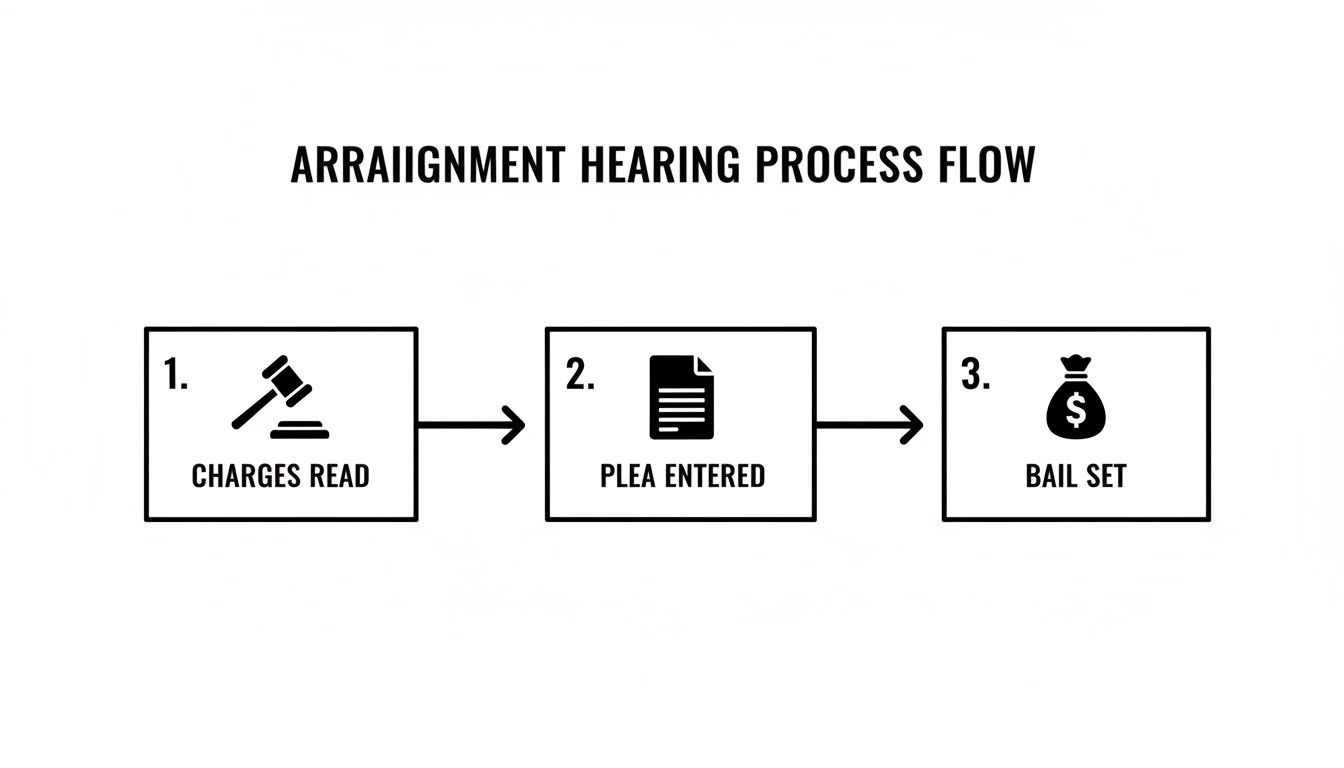
As you can see, entering your plea is the central action you take, happening right between hearing the charges and the court setting your release conditions.
Pleading "not guilty" is not a claim of innocence. It is a declaration of your constitutional right to due process. It tells the court, "I will not accept a conviction unless the state proves its case according to the law."
Ultimately, this plea is the standard, intelligent legal move that unlocks every defense available to you. It keeps all your options on the table and gives your attorney the tools they need to protect your rights, your driver's license, and your future. A guilty plea ends the fight before it even begins; a not guilty plea is your first strategic step toward victory.
The Serious Consequences of Missing Your Arraignment Date
Of all the dates and deadlines you’ll face after a DWI arrest, your arraignment hearing is one you absolutely cannot afford to miss. The Texas court system does not take a Failure to Appear (FTA) lightly. The consequences are immediate, severe, and guaranteed to make your situation significantly worse.
The moment you’re not there when your name is called for arraignment, the judge will issue a bench warrant for your arrest. This means any future interaction with a police officer—even a simple traffic stop—will end with you in handcuffs.
A Warrant Is Just the Beginning
Unfortunately, an arrest warrant is only the first domino to fall. The negative effects of an FTA multiply quickly, creating serious problems for both your DWI case and your daily life.
Here’s what typically happens when you miss your arraignment:
- A New Criminal Charge: On top of the DWI, you’ll likely face an additional criminal charge for Failure to Appear. This comes with its own fines and potential jail time.
- Forfeiture of Your Bond: The money you paid to get out of jail will be forfeited. When you’re eventually arrested on the warrant, the judge will almost certainly set a new, much higher bond, making it far harder to get out again.
- Automatic Driver's License Suspension: An FTA can trigger an immediate suspension of your driving privileges, completely separate from your DWI license suspension or your Administrative License Revocation (ALR) hearing.
This can be a devastating blow, especially if you rely on your license for work.
Missing your arraignment takes a manageable legal problem and turns it into an emergency, adding new criminal charges, higher costs, and a guaranteed loss of freedom when the warrant is served.
What If You Have a Legitimate Conflict?
Life happens. If you have an unavoidable conflict—a true medical emergency or an essential work trip—the answer is never to just skip your court date. The only correct way to handle this is to have your attorney communicate with the court before the hearing.
An experienced Houston DWI lawyer can file a motion to reschedule or, in many misdemeanor cases, appear in court on your behalf. This is one of the biggest advantages of hiring an attorney early. They manage these critical appearances for you, keeping you in good standing with the court and preventing these disastrous setbacks.
The national data on FTAs paints a stark picture. One study found that 26% of defendants failed to appear at their arraignment, leading directly to bench warrants and license suspensions. You can learn more about the impact of failing to appear in court from this Department of Justice report. And remember, this is a separate but equally important deadline to your ALR hearing—you can find out why you should never skip your ALR hearing after a DWI in our detailed guide.
How a DWI Lawyer Turns Your Arraignment into a Strategic Advantage
Having a lawyer with you at your arraignment isn’t just about having someone stand next to you—it’s about turning a mandatory court date into your first strategic opportunity. A skilled DWI lawyer sees it as the first battleground where the tone of your entire case is set. From the moment they step into the courtroom, they’re working to protect your rights and position your defense for success.
Right off the bat, one of the biggest benefits is that for most misdemeanor DWI arraignments, your attorney can often appear for you. That means you may not have to miss work, find childcare, or deal with the anxiety of standing in front of a judge yourself. Your lawyer handles the legal legwork while you keep your life moving.
Arguing for Favorable Bail and Release Conditions
One of the most critical parts of an arraignment is when the judge decides the terms of your release. Without representation, you are at the mercy of the prosecutor's requests. The State could demand a high bail amount or push for restrictive conditions like installing an ignition interlock device (IID), even on a first DWI in Texas.
A strategic DWI lawyer doesn't just accept this; they fight back. They arrive prepared to argue for your release on a personal recognizance (PR) bond, which costs you nothing upfront. They’ll present evidence of your ties to the community—your job, your family, your home—to prove to the judge you aren't a flight risk. This simple step can save you thousands of dollars and keep you free from unnecessary and burdensome restrictions.
Launching an Immediate Defensive Investigation
The moment your lawyer enters a "not guilty" plea at the arraignment, the clock starts on the discovery process. This legally forces the prosecution to hand over all the evidence they have against you. An experienced attorney doesn't just sit back and wait. They immediately file motions demanding every single piece of information, including:
- Police Reports: To analyze the officer’s story and find inconsistencies.
- Dashcam and Bodycam Footage: To see what really happened during the stop and arrest.
- Breathalyzer and Blood Test Results: To begin planning challenges to the accuracy of the science and procedures used.
- Calibration and Maintenance Logs: For the breath test machine used in your case, because faulty equipment can lead to faulty results.
This aggressive, proactive approach gives your lawyer a massive head start. They can start finding the weak spots in the State's case, sometimes spotting critical flaws before the prosecutor has even had a chance to fully review the file. This is a core part of how a DWI lawyer can help you fight your charges, turning a procedural hearing into a powerful fact-finding mission.
Facing Arraignment With vs Without an Attorney
Walking into your first court date alone can feel like navigating a minefield blindfolded. With an experienced attorney, however, that same hearing becomes a calculated first move. The table below shows just how different the outcomes can be.
| Action at Arraignment | Without an Attorney | With a Strategic DWI Attorney |
|---|---|---|
| Plea Entry | May feel pressured to plead guilty or say the wrong thing. | Enters a "not guilty" plea to preserve all legal options. |
| Bail/Bond Hearing | At the mercy of the prosecutor's request for high bail or strict conditions. | Actively argues for a low-cost PR bond and challenges unnecessary restrictions. |
| Advisement of Rights | Hears a list of rights but may not fully grasp their strategic importance. | Ensures rights are protected and uses the opportunity to begin the discovery process. |
| Self-Incrimination Risk | High risk of accidentally making damaging statements to the judge or prosecutor. | Acts as a shield, doing all the talking to prevent any missteps. |
| Next Steps | Leaves the court confused and unsure of what to do next. | Leaves with a clear plan, knowing the defense is already underway. |
As you can see, having professional representation isn't just a comfort—it fundamentally changes the dynamic of the arraignment from a reactive moment of vulnerability to a proactive step in your defense.
Protecting You from Self-Incrimination
Perhaps the most crucial role your lawyer plays at the arraignment is acting as your shield. The courtroom is an intimidating place, and under pressure, it's incredibly easy to say something that could be used against you later.
With an attorney by your side, they do all the talking. They handle the plea, they speak to the judge, and they communicate with the prosecutor. This ensures you don't accidentally volunteer information or make any statements that could damage your case. Your only job is to stand there quietly and follow their lead, knowing that your rights are being fiercely protected.
A skilled attorney transforms your arraignment from a reactive court appearance into a proactive defensive maneuver. They use this hearing to control the narrative, challenge the state's initial requests, and lay the foundation for a successful outcome.
Connecting Your Criminal Case to Your License Suspension
Finally, a sharp DWI attorney knows you're fighting a war on two fronts: the criminal DWI charge and the separate, civil Administrative License Revocation (ALR) process. The clock for saving your driver's license starts ticking the second you're arrested—you only have 15 days to request an ALR hearing.
Your lawyer uses the arraignment as a critical checkpoint to confirm the ALR hearing has been requested in time. By moving quickly on both fronts, they work to protect your ability to drive while simultaneously building the defense for your criminal case. This integrated strategy is the key to minimizing the total impact of a DWI arrest in Texas.
Don't Face the Judge Alone—Your Future Is on the Line
A DWI arrest can be overwhelming, but the arraignment hearing is your first chance to take back control and build a strong defense. The fight for your future starts here, and you do not have to face it alone.
Let’s boil it down to what truly matters:
- The arraignment isn't just a hearing; it's a strategic opportunity. This is where the foundation for your defense is laid.
- Always plead "not guilty." This is non-negotiable. It preserves every single one of your rights and forces the state to prove its case against you.
- Walking in with a skilled Houston DWI lawyer is critical. A good attorney can prevent you from making common mistakes and turn this hearing into an advantage.
Your Case Deserves More Than Just a Defense—It Deserves a Fight
A DWI charge feels overwhelming, but it does not have to ruin your career or define your life. At The Law Office of Bryan Fagan, PLLC, we provide the strategic, reassuring legal support that gives you the confidence to face this head-on. We understand you're worried about your job, your family, and your reputation. We are here to protect everything you've worked so hard to build.
Walking into that courtroom by yourself is a significant risk. The decisions made at your arraignment hearing will echo through the entire case. Let us stand with you from day one, making sure your rights are protected at every single turn.
We invite you to contact us for a free, confidential case evaluation. Our team is ready to listen to your side of the story, answer your questions about what is an arraignment hearing, and start mapping out a defense plan built for your specific situation. This is your chance to fight back. Let's take that first step together.
Common Questions People Ask About Texas DWI Arraignments
Stepping into a courtroom for the first time is nerve-wracking. For most people, the stress comes from not knowing what to expect. Getting answers to the most common questions can go a long way in calming your nerves and helping you feel prepared.
Here are the straightforward answers to what most people in your shoes are wondering right now.
What Should I Wear to My Arraignment?
Think of it like a serious job interview. Your appearance sends a message to the judge and the prosecutor before you even say a word.
Business casual is always a safe bet. For men, this means slacks and a button-down shirt or polo. For women, a conservative blouse with a skirt or slacks works well. You want to look like you're taking this seriously.
Leave the t-shirts, shorts, ripped jeans, and hats at home. Showing the court respect through your clothing is a small but important detail that can only help your situation.
Can My DWI Case Get Dismissed at the Arraignment?
It’s extremely rare for a DWI case to be thrown out completely at this first hearing. The arraignment isn't the finish line; it's the starting line for building your defense.
This is where your attorney begins to lay the groundwork for a future dismissal. They'll use this first court appearance to make initial requests for evidence, like the police report and dashcam video. It's the first official step in scrutinizing the state's case against you and finding its weaknesses.
Think of it as the opening move in a long-term strategy to fight DWI Texas charges, not a one-shot opportunity to walk away free.
How Long Does an Arraignment Hearing Actually Take?
The time you spend standing in front of the judge is usually incredibly short—often just a few minutes. However, you should plan on being at the courthouse for several hours.
Courts run on a docket system, which means they schedule dozens of cases for the same time slot. You’ll have to wait your turn. Bringing a book and a healthy dose of patience is your best bet.
Do I Have to Talk to the Judge Myself?
If you've hired an attorney, they will do almost all of the talking for you. Your lawyer is there to be your voice and your shield.
The judge might ask you a few direct "yes" or "no" questions to confirm you understand what's happening, but that's about it. Your attorney will handle entering your "not guilty" plea and discussing any legal matters with the judge and prosecutor.
This is critical. It prevents you from accidentally saying something that could be twisted and used against you later on. With a lawyer by your side, you can stay quiet and let them navigate the legal minefield for you.
At The Law Office of Bryan Fagan, PLLC, we believe a strong defense starts on day one. An arraignment hearing is your first opportunity to protect your rights, and you should not face it alone. If you have been arrested for a DWI in Texas, contact us immediately for a free and confidential consultation to build a strategic defense plan. Visit us at https://texasduilawfirm.com to get started.