
A DWI arrest can be overwhelming — but you don’t have to face it alone. The flashing lights, the confusing questions, and the uncertainty of what comes next can make your world feel like it's spinning out of control. It's critical to remember one thing: an arrest is not a conviction.
So, what exactly is a DWI in Texas? Put simply, it means you were found operating a motor vehicle in a public place while legally intoxicated. While that definition sounds straightforward, it's broader than most people realize, and the state has multiple ways to prove its case against you. Understanding these details is the first step toward protecting your rights.
Understanding a Texas DWI Charge
Facing a DWI charge is intimidating. The first step toward building a solid defense is understanding what the state must prove. They don't just need to show you were behind the wheel; they must prove, beyond a reasonable doubt, that you were legally intoxicated at the time. This is where a strategic defense begins.
What does "intoxicated" really mean under Texas law? It’s not just about feeling drunk. The prosecution can take two different routes to prove its case:
- Per Se Intoxication: This is the most clear-cut definition. If a chemical test shows your blood alcohol concentration (BAC) was 0.08% or higher, the law automatically considers you intoxicated. It doesn't matter if you felt fine or believed you were driving perfectly. For the prosecution, that number is often the only evidence they need.
- Impairment: The state can also charge you with DWI by arguing you lost the "normal use of mental or physical faculties" because of alcohol, drugs, or a combination of both. This means that even if your BAC is below0.08%, an officer can still arrest you based on your performance on field sobriety tests, your driving behavior, or your general appearance.
This infographic helps visualize that crucial BAC number that trips up so many drivers.
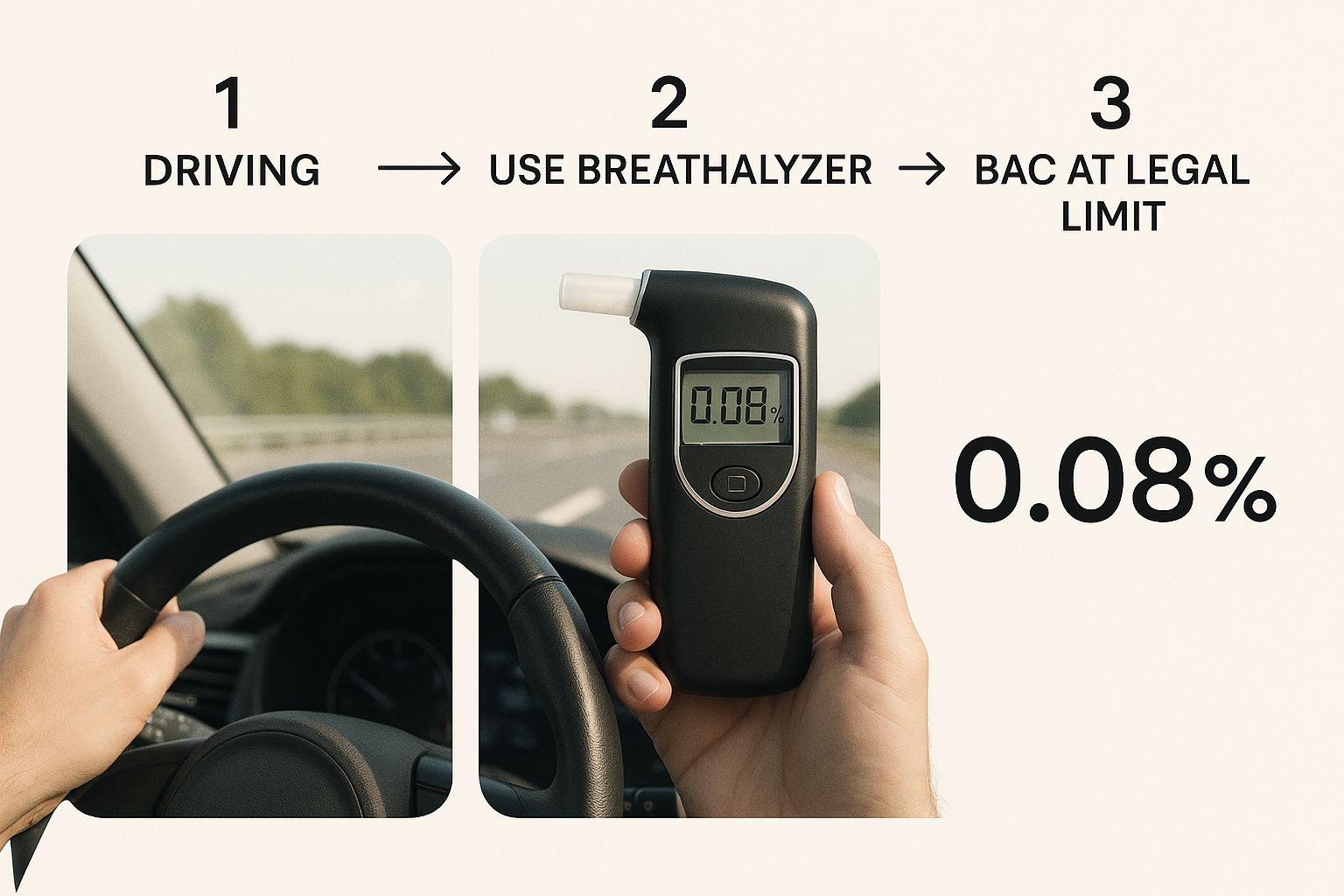
As you can see, the 0.08% BAC level shown on the breathalyzer is the bright line that defines intoxication for most adult drivers in Texas.
DWI vs DUI in Texas
People often use "DWI" and "DUI" interchangeably, but in Texas, they are distinct offenses. Knowing the difference is crucial.
DWI, or Driving While Intoxicated, is the charge filed against adults (21 and older) who are either impaired or have a BAC of 0.08% or higher.
On the other hand, DUI, or Driving Under the Influence, is a charge almost exclusively for minors (under 21). Because Texas has a zero-tolerance policy for underage drinking and driving, a minor can be charged with DUI for having any detectable amount of alcohol in their system.
Here's a quick table to make the difference crystal clear:
Texas DWI vs DUI at a Glance
| Factor | DWI (Driving While Intoxicated) | DUI (Driving Under the Influence) |
|---|---|---|
| Primary Age Group | Adults 21 years and older. | Minors under 21 years of age. |
| Alcohol Threshold | 0.08% BAC or proven impairment of faculties. | Any detectable amount of alcohol. |
| Typical Offense Level | Class B Misdemeanor for a first offense. | Class C Misdemeanor. |
| Core Violation | Operating a vehicle while legally intoxicated. | A minor operating a vehicle with any alcohol. |
Understanding this distinction is the first step in knowing what you’re up against. A DWI is a much more serious criminal charge with far heavier consequences.
Facing a DWI charge can feel like the odds are stacked against you, but every piece of evidence can be challenged. From the reason for the traffic stop to the calibration of a breathalyzer, a skilled Houston DWI lawyer investigates every detail to protect your rights.
It’s also worth noting that the legal definition of a "public place" is surprisingly broad. It’s not just highways and city streets. It can include parking lots for grocery stores, apartment complexes, and any other area the public has access to. You can be arrested for DWI even if you’re on what feels like private property.
The Texas BAC limit for DWI is the cornerstone of the prosecution's case, and your defense starts by scrutinizing every single detail of how that evidence was obtained.
What Happens Immediately After a DWI Arrest

The moments right after a DWI arrest are a blur of confusion and stress. Your mind is racing, but the best way to regain control is to understand what happens next. You’re not just fighting one case; you're now facing two separate legal battles: a criminal one for the DWI charge and a civil one over your driver's license.
When you're arrested, the officer will almost certainly take your physical driver's license and hand you a temporary driving permit. This action kicks off a critical countdown.
The 15-Day Deadline to Save Your License
Under Texas’s implied consent law, you have just 15 days from the date of your arrest to request an Administrative License Revocation (ALR) hearing. This hearing is your one and only opportunity to challenge the automatic suspension of your license.
Miss that 15-day window, and your license gets suspended automatically. The suspension can last anywhere from 90 days to two years, depending on the specifics of your case, such as whether you refused a breath or blood test.
It is absolutely crucial to act fast. The ALR hearing is a completely separate process from your criminal DWI case. Missing this deadline means you forfeit your right to fight the DWI license suspension.
Implied Consent and Your Driving Privileges
How can the state suspend your license so quickly? The answer is a rule called implied consent. In Texas, the simple act of having a driver's license means you’ve already agreed to provide a breath or blood sample if you are lawfully arrested for DWI.
- Refusing a Test: If you refuse to give a sample, your license will be automatically suspended for 180 days for a first DWI in Texas.
- Failing a Test: If you take the test and your BAC is 0.08% or higher, the suspension is 90 days.
The ALR hearing is where your attorney can fight back. They can challenge the legality of the traffic stop and the reasons for the suspension, giving you a chance to keep your driving privileges while the criminal case moves forward.
Arraignment and Setting Bond
After the arrest, you’ll be taken to jail for booking, which involves fingerprints, photos, and paperwork. Shortly after, you’ll have an arraignment—your first formal appearance in court. A judge will read the charges against you and set your bond amount.
Bond is a financial guarantee that you'll show up for future court dates. Understanding the full Texas DWI arrest process from booking to release can help demystify these intimidating first steps. A Houston DWI lawyer can step in to arrange a bond and secure your release as quickly as possible.
Texas DWI Penalties Explained: What to Expect After Arrest
Understanding the potential penalties for a DWI in Texas is a sobering experience. The consequences go beyond fines and jail time, affecting your job, finances, and freedom for years to come.
However, it's crucial to approach this with a strategic mindset, not panic. The penalties described in the law are the maximums, not a foregone conclusion. A strong legal defense is built to challenge the prosecution's case, aiming to minimize or even eliminate these life-altering outcomes.
Texas DWI Penalties Explained
For a first DWI in Texas, you could be looking at:
- Fines: Up to $2,000 in criminal fines—before thousands more in court costs and state-imposed fees.
- Jail Time: A mandatory minimum of 72 hours behind bars, with a maximum of up to 180 days in the county jail.
- DWI License Suspension: Your driver’s license can be suspended for up to one year.
These penalties are just the beginning.
The Hidden Consequences Beyond the Courtroom
The real impact of a DWI conviction extends far beyond the judge's sentence. These "hidden" penalties can be just as difficult to manage.
You may also be ordered to:
- Install an Ignition Interlock Device (IID): A breathalyzer for your car that requires a clean sample before the vehicle will start.
- Complete DWI Education Classes: Courts will almost always require you to attend a 12-hour DWI education program at your own expense.
- Pay Higher Insurance Premiums: Your auto insurance rates will skyrocket, and some providers may drop your coverage entirely.
- Face Professional Consequences: A DWI on your record can jeopardize your job, especially if you drive for work or hold a professional license as a nurse, pilot, or teacher.
The reason Texas is so tough on this is clear when you look at the national picture. In 2023, data from the National Highway Traffic Safety Administration revealed that 34 people died every single day in drunk-driving crashes across the country. To see how this crisis hits closer to home, you can learn more about the local impact from these drunk driving statistics from Dhillon Law Firm.
Texas DWI Penalties by Offense
To give you a clearer picture of how quickly the stakes rise, here is a summary of the potential penalties for DWI convictions in Texas.
| Offense | Jail Time | Fine | License Suspension |
|---|---|---|---|
| First Offense | 3 to 180 days | Up to $2,000 | Up to 1 year |
| Second Offense | 30 days to 1 year | Up to $4,000 | Up to 2 years |
| Third Offense (Felony) | 2 to 10 years in prison | Up to $10,000 | Up to 2 years |
This table illustrates why it is so important to fight DWI Texas charges from the very beginning. A conviction doesn't just penalize you today—it sets you up for much more severe consequences down the road.
How Penalties Escalate for Repeat Offenses
Texas law comes down hard on repeat DWI offenders. Each new conviction brings dramatically steeper fines and longer jail sentences.
A second DWI is a Class A Misdemeanor. The potential jail time jumps to a full year, and the maximum fine doubles to $4,000.
If you're facing a third DWI, it's typically charged as a third-degree felony. That's a game-changer, carrying 2 to 10 years in a state prison and a fine of up to $10,000.
The stakes increase exponentially with each offense. This is why it is absolutely critical to fight your first DWI charge with everything you have—a conviction today makes any future charge far, far more severe.
With an experienced Houston DWI lawyer fighting for you, it's possible to challenge the evidence, question the stop, and work toward a resolution that protects both your freedom and your future.
How to Fight a Breath Test Result and Other DWI Evidence
Getting arrested for a DWI in Texas can leave you feeling hopeless, as if a conviction is inevitable. That is simply not true. An arrest is just the start of the legal process. A skilled Houston DWI lawyer doesn't see your case as a lost cause; they see it as an opportunity to investigate the prosecution's evidence.
Every piece of that evidence can be questioned and challenged. A strong defense is built on a simple reality: police officers make mistakes, breathalyzer machines malfunction, and procedures aren't always followed correctly. Your defense begins by holding the state to its burden of proving its case beyond a reasonable doubt.
Challenging the Initial Traffic Stop
The entire DWI case rests on the legality of the traffic stop. An officer can’t pull you over on a hunch. They must have "reasonable suspicion" that you've violated a traffic law. This could be anything from speeding and swerving to a broken taillight.
If your Texas DUI attorney can show the officer had no valid, legal reason to stop you, then all evidence gathered after that point—the field sobriety tests, the breath or blood results—could be thrown out. This often leads to the entire DWI charge being dismissed.
How to Fight a Field Sobriety Test
Those roadside Field Sobriety Tests (FSTs), like the walk-and-turn or one-leg stand, are notoriously unreliable. They are subjective and difficult for anyone to perform perfectly, even when sober. Medical conditions, fatigue, poor weather, or even confusing instructions from the officer can easily cause a "failure."
And what about the breathalyzer and blood tests? They are far from infallible.
- Breathalyzers require precise calibration and proper administration. Operator error or a device malfunction can easily produce an inaccurately high reading.
- Blood tests are vulnerable to contamination. If the sample isn't drawn, stored, or transported correctly, the results can be compromised.
Digging into the different strategies for defending DUI charges in Texas shows just how many weak points can exist in the prosecution's case.
A DWI charge feels overwhelming, but remember this: the burden of proof is entirely on the prosecution. Your attorney's job is to create reasonable doubt by exposing the weaknesses in their evidence.
Sadly, the stakes are incredibly high, especially for younger drivers. State data from the Texas Department of Transportation reveals a sobering trend: over the last decade, young men between 19 and 35 have been disproportionately involved in fatal DWI crashes. The highest number of these tragic incidents happen between 2 a.m. and 3 a.m. on weekends.
This data highlights just how critical a robust defense is for anyone accused. By meticulously picking apart every detail, from the reason you were pulled over to the science behind a chemical test, a dedicated DWI attorney works to protect your rights and fight for the best possible outcome.
If you're staring down a DWI charge in Texas, it’s easy to feel overwhelmed. But you have more power than you think. An arrest is not a conviction, and a DWI charge is absolutely defensible—but you must act quickly to protect yourself.
There’s a critical clock ticking. You have just 15 days from the date of your arrest to request an Administrative License Revocation (ALR) hearing. If you miss that deadline, the state can automatically suspend your driver’s license long before you have your day in criminal court.
You Don't Have to Face This Alone
Trying to navigate the Texas legal system on your own is a tough, unforgiving road. You shouldn't have to decipher complex laws and fight prosecutors by yourself while your future hangs in the balance. An experienced Houston DWI lawyer acts as your shield, standing between you and the prosecution to ensure your rights are protected every step of the way.
The single most important step you can take right now is asking for help. A proactive defense is the best defense, and it starts with a simple conversation.
Let our experience defending Texans guide you. At The Law Office of Bryan Fagan, PLLC, we’re here to listen to your story and build a defense strategy designed to get you the best possible outcome.
Contact us today for a free, confidential consultation to talk about what happened and learn how we can help protect your future.
Got Questions About Your Texas DWI? We've Got Answers.
When you're facing a DWI arrest, your mind is probably racing with questions. It's a confusing and stressful time, but getting clear, straightforward answers is the first step toward taking control. Here are some of the most common questions we hear from people just like you.
"Should I Refuse a Breathalyzer Test in Texas?"
This is one of the trickiest questions in DWI law, and there’s no one-size-fits-all answer. Texas has an "implied consent" law, which means that by driving on a public road, you've already agreed to provide a breath or blood sample if lawfully asked.
If you refuse, you’re looking at an automatic driver's license suspension. The catch? That suspension is often longer than the one you'd get for failing the test. However, giving a sample hands the prosecutor their strongest piece of evidence against you. The right move depends entirely on the unique circumstances of your stop. An experienced Houston DWI lawyer can walk you through the pros and cons as they apply to your specific situation.
"Can I Get a DWI for Driving on My Prescription Meds?"
Yes, you absolutely can. A DWI charge in Texas has nothing to do with whether a substance is legal or illegal—it’s all about impairment.
The law is clear: if any substance, whether it’s a legally prescribed medication, an over-the-counter allergy pill, or a controlled substance, has impaired your mental or physical faculties, you can be charged with DWI. The key question isn't "Was the drug legal?" but "Did you lose the normal use of your abilities?"
"Will a DWI Charge Stay on My Record Forever?"
A DWI conviction can feel like a life sentence, creating huge obstacles when you're looking for a job or a place to live. But it doesn't always have to be permanent.
If your case is ultimately dismissed or you're found not guilty at trial, you may be able to have the entire arrest record destroyed through a legal process called an expunction. In other, more limited circumstances, you might qualify for an order of non-disclosure, which seals the record from public view. The only way to know for sure if you qualify is to have a Texas DUI attorney review the details of your case.
"How Much Does a Houston DWI Lawyer Cost?"
The cost to fight DWI Texas charges can vary quite a bit. It really depends on the specifics of your case. Key factors include whether it’s your first offense or if you have priors, how complex the evidence is (like a blood test versus a breath test), and whether your case can be resolved early or needs to go all the way to a jury trial.
Any reputable DWI defense firm should offer a free, confidential consultation. This gives you a chance to discuss your case and get a clear, upfront understanding of the legal fees involved with no strings attached.
A DWI arrest can feel like you've hit a dead end, but it's really the start of a legal fight—one you don't have to go through by yourself. At The Law Office of Bryan Fagan, PLLC, our team is ready to build a tough, strategic defense to protect your rights, your license, and your future.
Take the first step and request your free consultation at texasduilawfirm.com