
A DWI arrest can be overwhelming—but you don’t have to face it alone. Walking into your first court date with a clear head can make all the difference. That first court appearance is called an arraignment hearing, and it’s the official starting line for your case.
This isn’t a trial. No one is presenting evidence or arguing your guilt or innocence just yet. Think of it as an administrative checkpoint where the state formally tells you what you’re being charged with. The judge will confirm who you are, read the charges aloud, and ask you for your plea.
Your First Court Appearance After a Texas DWI Arrest
Stepping in front of a judge for the first time is nerve-wracking for anyone. But knowing what to expect during an arraignment can take a lot of the mystery—and anxiety—out of the process. This isn't some dramatic scene from a TV show; it's a procedural step that formally kicks off the legal journey ahead.
The main point of the arraignment is simple: to make sure you understand the accusations against you and are aware of your fundamental rights. With a confident, experienced Houston DWI lawyer standing right beside you, this becomes just another manageable step in building your defense.
At its core, the arraignment sets the stage for everything that comes next. It’s a brief but critical hearing that puts several key pieces of your case into motion.
Who You Will See in the Courtroom
When your name is finally called, you'll walk to the front of the courtroom. Several people will be there, and understanding their roles helps calm the nerves:
- The Judge: This is the person in charge. The judge runs the hearing, makes sure the rules are followed, reads the official charges, and makes decisions about your release conditions (your bond).
- The Prosecutor: This is the lawyer for the State of Texas. Their job is to formally present the DWI charge against you.
- Your Defense Attorney: This is your advocate, your voice in the courtroom. Your lawyer will stand with you, speak for you, and enter a plea of "not guilty" to protect your rights.
- The Bailiff: A law enforcement officer responsible for keeping order and security in the courtroom.
- The Court Clerk: This official handles the court’s paperwork and keeps the administrative side of things running smoothly.
The Main Events of the Hearing
The arraignment follows a predictable script. First, the judge will call your case and confirm your name. Then, they will read the formal DWI complaint that the prosecutor filed. This document spells out the specific charge, like a first-time DWI in Texas, which is usually a Class B Misdemeanor.
The single most important thing that happens at this stage is when your attorney enters a plea of "not guilty" for you. This is not a lie or a denial of facts; it is a critical legal move. Pleading "not guilty" preserves all of your rights and gives your defense team the time it needs to dig in and challenge the state's evidence.
After the plea, the judge will review the conditions of your release, which you'll hear referred to as bail or bond. Your attorney can argue for fair and reasonable conditions, fighting to protect your freedom while your case moves forward.
To give you a clearer picture, here’s a quick rundown of what happens and who’s involved.
| Key Events During Your DWI Arraignment Hearing |
| :— | :— | :— |
| Event | What It Means for You | Who Is Involved |
| Case is Called | Your name is announced, and you approach the front of the courtroom. | Court Clerk, Judge, You, Your Attorney |
| Charges Are Read | The judge formally reads the DWI complaint filed against you. | Judge, Prosecutor |
| Plea is Entered | Your attorney will enter a plea of "not guilty" on your behalf. | Your Attorney, Judge |
| Bond Conditions Reviewed | The judge confirms or sets the conditions for your release from custody. | Judge, Prosecutor, Your Attorney |
| Next Court Date Set | The court schedules your next appearance, often a pretrial conference. | Judge, Court Clerk |
Once these steps are handled, the hearing is over. The judge will set the next court date for a future proceeding, like a pretrial conference. For a deeper dive into the entire timeline, you can learn more about the first-time DWI Texas court process in our comprehensive guide.
With the arraignment complete, the fight to protect your record and your future has officially begun.
Navigating the Arraignment Hearing Step by Step
Walking into a courtroom for your arraignment can be intimidating. It feels like stepping into a foreign world with its own language and unwritten rules. But once you understand the sequence of events, the entire process becomes much more predictable and a lot less scary. Your DWI attorney will be right there with you, guiding you and making sure every step is handled strategically to protect your rights.
The hearing itself is surprisingly quick, often lasting just a few minutes. While it might seem like a minor step in a much bigger journey, what happens here sets the foundation for your entire defense. The court follows a very specific script, starting from the moment your case is called.
The Hearing Begins When Your Case Is Called
The courtroom will probably be packed with other people waiting for their cases to be heard. When the judge calls your name and case number, you and your attorney will walk up to the front. This is the official start. The judge’s first job is simply to confirm your identity and make sure you are the person named in the legal paperwork.
Once that’s done, the judge will formally read the charges filed against you by the prosecutor. This is called the "reading of the complaint." For a typical first-time DWI in Texas, this will likely be a Class B Misdemeanor. This step is a formality to ensure you’ve been officially notified of the specific allegations the State of Texas is making against you.
This flowchart breaks down the simple, three-step flow of the arraignment process.
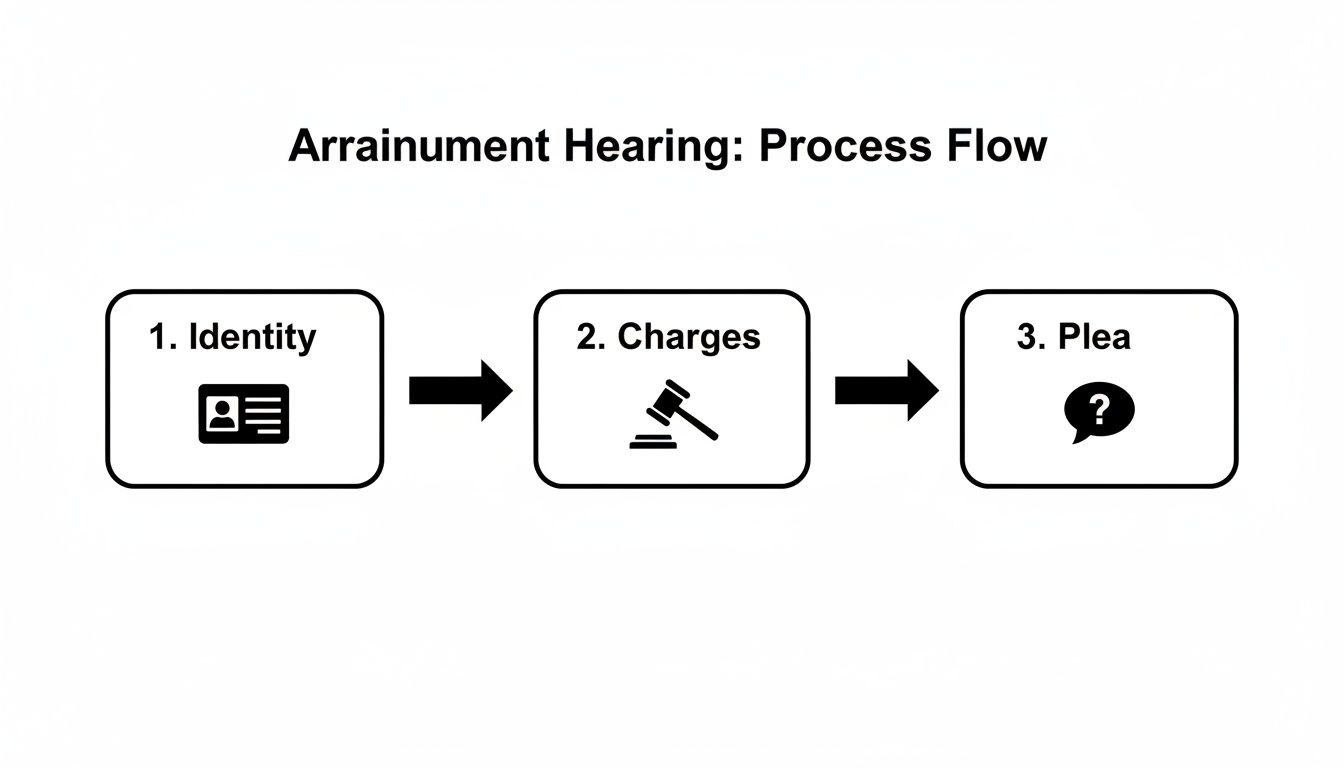
As you can see, the arraignment is a straightforward procedure designed to get the case started, not to argue about the evidence.
Entering Your Plea The Smart Way
After the charges are read, the judge will ask how you plead. This is the most important moment in the hearing, and your attorney will handle it for you. They will enter a plea of "not guilty."
It’s critical to understand what this really means. Pleading "not guilty" isn't you denying what happened on the night of your arrest. Instead, it’s a formal legal move that activates all your constitutional rights—including the right to a trial and the right to see and challenge every piece of evidence the state has against you.
A "not guilty" plea is the key that unlocks your defense. It forces the prosecutor to prove their case beyond a reasonable doubt and gives your Houston DWI lawyer the time needed to investigate everything, from the reason for the initial traffic stop to how the breath or blood tests were handled.
Pleading guilty or "no contest" at this stage would be a massive mistake. It would mean waiving your rights, getting an immediate conviction, and losing any chance you have to fight the DWI charges.
What to Expect if You Don't Have an Attorney
If you show up at your arraignment without a lawyer, the judge will stop the proceedings to advise you of your right to legal counsel. The court knows how serious a DWI charge is and recognizes the importance of having a professional on your side.
The judge will likely ask if you plan on hiring an attorney or if you need the court to see if you qualify for a court-appointed public defender. Most of the time, the judge will grant a brief continuance, which just means they’ll reschedule your arraignment to give you time to find legal help. This is a clear signal from the court itself: moving forward without an experienced Texas DUI attorney is a bad idea.
Once your plea is entered and your legal representation is sorted out, the judge will confirm your bond conditions are still in place and set the date for your next court appearance. This next hearing is usually a pretrial conference, where your attorney and the prosecutor start discussing your case. With the arraignment over, the real work of building your defense begins.
Understanding Bail and Conditions of Your Release
Beyond the formal charges and your initial plea, the arraignment is where a judge makes incredibly important decisions about your freedom while your DWI case is ongoing. This is where we talk about bail and bond, along with the specific rules—or "conditions"—you’ll have to live by. Our job here is to protect your liberty and start building a strong defense right from this moment.
The purpose of a bond is to ensure you show up for future court dates. It is not a punishment. The judge looks at several factors to determine the right bond amount and what conditions make sense for your release.

Factors a Texas Judge Considers
When deciding on your release, a Texas judge doesn’t just pull a number out of thin air. They evaluate key aspects of your life and the case itself. An experienced Houston DWI lawyer knows exactly how to frame these factors in the most positive way for you.
Here’s what’s on their checklist:
- Ties to the Community: Do you have a steady job? Own a home? Have family close by? Strong community ties are a good sign you're not a flight risk.
- Criminal History: The judge will definitely look at your record. A first-time DWI in Texas with a clean slate is viewed much differently than a third offense.
- The Specifics of the DWI Charge: Was there an accident? Was your alleged Blood Alcohol Concentration (BAC) especially high? These details matter and can influence the judge's decision.
- Threat to Public Safety: The judge must weigh whether releasing you poses a danger to the community.
Your attorney’s job is to gather all the positive information to argue for the least restrictive conditions possible. The best-case scenario is a Personal Recognizance (PR) bond, which allows release without paying money upfront.
The Financial Burden of Cash Bonds
Unfortunately, cash bonds are all too common, and they can put a massive financial burden on you and your family. The amount can feel arbitrary and often has little to do with what a person can actually afford. It creates a system where your freedom can depend on how much money you have.
This is a make-or-break moment in the courtroom. Research on court hearings found that 68% of people had a cash bond set, while only 21% were released on their own recognizance. Even more troubling, in a shocking 77% of those cases, judges did not ask if the person could afford to pay—a clear violation of laws meant to prevent people from being jailed just because they're poor.
This is exactly why having a skilled lawyer in your corner is so critical. We can make a compelling case for a reasonable bond that you can actually afford. It’s about preventing you from being stuck in jail simply because you don’t have the cash on hand. Our firm has a detailed guide on what goes into a DWI bond amount in Texas that breaks this down even further.
Common Release Conditions You Might Face
Even if we secure a reasonable bond, the judge will almost certainly impose certain conditions you must follow to stay free while your case is active. If you violate any of these, your bond can be revoked, and you’ll be sent right back to jail.
Your Bond Conditions are a Court Order. Think of them as the rules of the game you must play until your case is resolved. Following them perfectly is non-negotiable and essential for a successful defense.
For a DWI arrest in Texas, you can often expect conditions like these:
- Ignition Interlock Device (IID): You may have to install a device in your car that requires a clean breath sample before the engine will start. This is a common requirement, especially if your BAC was 0.15 or higher.
- No Alcohol Consumption: The court will almost certainly order you not to drink any alcohol. Period.
- Regular Reporting: You might have to check in with a pretrial services officer on a set schedule.
- Travel Restrictions: You could be forbidden from leaving the county or state without getting the court's permission first.
A good attorney doesn’t just fight for a low bond amount; we fight for fair and manageable conditions that don’t throw your entire life into chaos. We work to make sure the rules you have to follow are directly related to the charge and aren't just there to punish you. That way, you can keep working and supporting your family while we get to work building your defense.
How Different DWI Charges Impact Your Arraignment
Not all DWI charges are the same in Texas, and the court knows it. The seriousness of the accusation against you is a huge factor in what happens at your arraignment hearing. A judge's approach to a standard, first-offense DWI—a Class B Misdemeanor—will look completely different from how they handle a serious felony charge.
Understanding these differences is the first step in preparing for what's coming and building the right defense strategy from day one.
The classification of your DWI directly shapes two of the most critical parts of your arraignment: your bond amount and the conditions you'll have to follow to stay out of jail. A judge will almost always set a higher bond and impose much stricter conditions for a felony DWI than for a misdemeanor.
Misdemeanor vs. Felony DWI Arraignments
For a first DWI in Texas with no "aggravating factors" (like a car accident or an extremely high BAC), you're usually looking at a Class B Misdemeanor. At the arraignment, your lawyer's job is to argue for a reasonable bond amount and standard release conditions. It's still serious, but the court sees it as a non-felony offense.
That all changes if the charge is a felony. A DWI can be enhanced to a felony in a few ways:
- DWI with a Child Passenger: If a child under the age of 15 was in the car, the charge is automatically a state jail felony.
- Intoxication Assault: If your alleged intoxication caused an accident where someone suffered a serious bodily injury, it’s a third-degree felony.
- Third or Subsequent DWI: A third DWI conviction is also a third-degree felony, no matter how much time has passed since your last one.
At a felony arraignment, the prosecutor will portray you as a risk to the community and push hard for a much higher bond and a long list of restrictive conditions.
The Impact on Bond and Release Conditions
The difference between a misdemeanor and a felony hits your freedom and your wallet the second the arraignment starts. Take a look at this table to see how the severity of the charge can influence the outcome.
DWI Arraignment Factors by Charge Severity
| DWI Charge Type | Typical Classification | Potential Impact on Arraignment |
|---|---|---|
| First-Time DWI (No Aggravators) | Class B Misdemeanor | Lower bond amounts are common. Release conditions may be standard, such as no drinking and driving. |
| DWI with High BAC (≥0.15) | Class A Misdemeanor | Higher bond is likely. The judge will almost certainly order an ignition interlock device as a condition of release. |
| DWI with Child Passenger | State Jail Felony | Expect a significantly higher bond. Stricter conditions like an IID, regular check-ins, and counseling are probable. |
| Third or Subsequent DWI | Third-Degree Felony | The court will view you as a habitual offender, leading to a very high bond and the most restrictive conditions possible. |
| Intoxication Assault | Third-Degree Felony | Given the injury to another person, the bond will be high, and conditions will be extremely strict to ensure public safety. |
As you can see, the court will almost certainly order an ignition interlock device (IID) as a condition of bond for any repeat or felony DWI charge. Even for a first offense, it's often required if your BAC was 0.15 or higher.
For a felony charge, get ready for more intense pretrial supervision. This could mean frequent check-ins with an officer, mandatory substance abuse counseling, or even electronic monitoring. An experienced Houston DWI lawyer is critical here to push back against excessive conditions that completely upend your life.
Arraignments are the formal start of the criminal case, but the system itself can be slow. A 2018 national survey found that while courts resolved 83% of felonies within a year, almost a third of arrests presented at arraignment were missing final disposition reports, creating major delays. You can find more details in these national court reporting trends.
Special Considerations for Professionals
If you hold a commercial driver's license (CDL) or a professional license—think nurse, pilot, or lawyer—the stakes at your arraignment are even higher. A DWI conviction, even a misdemeanor, can set off a chain reaction that threatens your entire career.
- CDL Holders: A DWI arrest can trigger a swift DWI license suspension for your commercial driving privileges, often for at least a year on a first offense. This happens whether you were driving your big rig or your personal car at the time.
- Licensed Professionals: Many professional licensing boards in Texas require you to report a criminal charge or conviction. A DWI can lead to an investigation from your board, probation, or even the loss of your license to practice.
Your arraignment is our first chance to start building a defense that protects both your freedom and your livelihood. By presenting you as a responsible professional and arguing for fair conditions, we begin laying the groundwork to fight for the best possible outcome—for your case and your career.
Protecting Your Rights After the Arraignment
So, the arraignment is over. You’ve entered your "not guilty" plea, which is a critical first step. But it’s important to understand that this is only the beginning of the legal fight. The real work of defending you against a Texas DWI charge starts right now.
From this moment on, every decision we make together matters. The post-arraignment phase is where we shift from handling initial court procedures to actively challenging the state’s case against you. Think of it as moving from the opening kickoff to running the plays that will win the game. This is all about investigation, strategy, and taking decisive legal action to fight your DWI in Texas.
The Foundation of Your Defense: Your Constitutional Rights
As we move forward, three fundamental rights are the bedrock of your entire defense strategy. These aren't just abstract legal ideas; they are practical shields we will use to protect you at every single turn.
- The Right to Remain Silent: The police and the prosecutor cannot force you to incriminate yourself. You have the absolute right to say nothing about your case, and we will guide you on exactly when and how to communicate.
- The Right to an Attorney: This is your right to have a skilled Houston DWI lawyer in your corner, speaking for you and fighting for you through every phase of this process.
- The Presumption of Innocence: In the eyes of the law, you are innocent until the prosecutor can prove you are guilty beyond a reasonable doubt. That's an incredibly high standard, and we will hold them to it every step of the way.
These rights are non-negotiable. They ensure the burden of proof stays exactly where it belongs: on the State of Texas.
Mapping Out the Journey After Arraignment
With your rights firmly in place, we begin the methodical work of dismantling the prosecutor’s case. This isn’t a single event but a series of calculated steps designed to find weaknesses in their evidence and build up your defense.
Here’s what that looks like in practice:
- Evidence Discovery: We file formal demands for the prosecutor to turn over every single piece of evidence they plan to use. This includes police reports, body cam and dashcam footage, breathalyzer maintenance logs, blood test results, and any witness statements. We leave no stone unturned.
- Pretrial Negotiations: Once we have the evidence, we open a line of communication with the prosecutor. Depending on what we find, we can negotiate for a reduction in the charges or, in some cases, a full dismissal of your case.
- Filing Legal Motions: This is where we go on the offensive. We will file motions to suppress evidence that was obtained illegally. Did the officer have a valid reason to pull you over in the first place? Were the field sobriety tests administered incorrectly according to national standards? We scrutinize every detail to find procedural errors we can use to your advantage.
This proactive approach is designed to weaken the state's case long before a trial ever becomes a reality.
The Separate Battle for Your Driver's License
It is absolutely critical to remember this: your criminal DWI case and the fight to keep your driver's license are two separate battles on two different timelines. While we are building your criminal defense, you must also deal with the Administrative License Revocation (ALR) hearing.
You have only 15 days from the date of your arrest to request an ALR hearing with the Texas Department of Public Safety. If you miss this deadline, your license will be automatically suspended.
This hearing is your only opportunity to challenge the civil suspension of your license, which is a consequence of Texas's implied consent law. We can handle this for you, but the clock is ticking. This administrative license suspension process is complex, and knowing how to navigate it is key. You can learn more in our detailed guide on the Omnibus DWI hearing in Texas.
Unfortunately, the justice system isn't always blind, and studies have shown that factors like race can influence outcomes, particularly when it comes to bail decisions at arraignment. Research has found that Black defendants were more likely to face higher bail requests, which in turn increased their odds of indictment simply because they remained in detention. You can read more about how these disparities affect arraignment outcomes. This is why having an aggressive legal advocate from day one is so important—to ensure your rights are protected regardless of your background. Your future is too important to leave to chance.
Common Questions About DWI Arraignment Hearings
Even after walking through the process, you probably still have some real-world questions nagging at you. What should I wear? Do I have to say anything? An arrest is overwhelming enough, but the thought of that first court date can be terrifying. You don't have to go into it blind.
Getting straight answers to your immediate concerns can make all the difference, helping you walk into that courtroom feeling prepared instead of powerless. We've put together answers to the most common questions we hear from clients every day.
Do I Have to Speak at My Arraignment?
This is a huge source of anxiety for almost everyone, but the answer is refreshingly simple: no, you generally do not have to speak. Your Houston DWI lawyer is there to do all the talking for you. When the judge asks how you plead, your attorney is the one who will step up and say "not guilty" on your behalf.
Your job is to stand beside your lawyer, listen to what's happening, and follow their cues. The court expects your attorney to be your voice. Staying quiet is the smartest thing you can do—it prevents you from accidentally saying something that could be used against you down the line. That's what your lawyer is there for: to make sure your rights are protected at every single turn.
What Is Appropriate to Wear to Court?
How you present yourself in court absolutely matters. It’s a non-verbal signal to the judge and the prosecutor that you’re taking this situation seriously. You don’t need to go out and buy a three-piece suit, but you should aim for a look that is professional and respectful.
Think of it like you're dressing for an important job interview. Business casual is always the safest bet.
- For Men: Slacks or khakis paired with a collared, button-down shirt is perfect. You can add a sweater or a sport coat if you have one. Just be sure to avoid jeans, shorts, graphic t-shirts, hats, and sandals.
- For Women: A conservative dress, a skirt, or dress pants with a nice blouse are all great options. The key is to avoid anything too revealing, flashy, or overly casual.
Your appearance sends a message of respect for the courtroom and the entire legal process. It’s a small detail, but it’s one of the first and easiest ways to make a good impression.
What Happens if I Miss My Court Date?
This is critical: missing your arraignment hearing is one of the worst mistakes you can possibly make. If you fail to show up for your scheduled court date, the judge won't hesitate. They will immediately issue a bench warrant for your arrest. That means any police officer who runs your name for any reason can—and will—take you straight to jail.
A failure to appear doesn't just trigger a warrant. It can also cause you to forfeit your bond. You'll lose any money you or your family paid to get you out, and you’ll have to get arrested and go through the entire bonding process all over again—this time, likely with a much higher bond amount.
If you have a true, unavoidable emergency, you need to contact your attorney the second you know there's a problem. Your lawyer might be able to notify the court and ask for a reset, but there are absolutely no guarantees. Always, always treat your court dates as mandatory, non-negotiable appointments.
Can My DWI Case Be Dismissed at the Arraignment?
It’s almost unheard of for a DWI case to be dismissed at the arraignment. This first hearing isn't about arguing the facts or looking at the evidence. It's really just an administrative step to officially get the legal process started.
However, the arraignment is where the foundation for a future dismissal is laid. By pleading "not guilty," your attorney preserves your right to fight every single piece of the state's evidence. The battle for a dismissal officially begins here.
After the arraignment, your lawyer will kick off the discovery process—demanding police reports, dashcam videos, breathalyzer maintenance logs, and everything else the prosecution has. If we uncover an illegal traffic stop, a violation of your rights, or flawed evidence, that’s when we can file a powerful motion to get the case thrown out. So, while a dismissal won't happen at the arraignment, this hearing is the starting line for achieving that goal.
The arraignment may seem like a minor formality, but it’s a crucial first step. Having an experienced Texas DUI attorney by your side ensures it’s handled perfectly, setting a strong, positive tone for the rest of your case and helping to safeguard your future.
A DWI charge can feel like your entire life has been put on hold, but you have the power to fight back. At The Law Office of Bryan Fagan, PLLC, we provide the strategic, assertive defense you need to protect your rights, your license, and your future. Don't wait to get the answers and the help you deserve. We offer a free, no-obligation consultation to discuss your case. Contact us today to start building your defense.