
A DWI arrest can be overwhelming—but you don’t have to face it alone. After the initial shock of an arrest wears off, you're faced with a court system that can feel confusing and intimidating. Your first formal court appearance is called an arraignment, and understanding what happens during this crucial hearing can replace uncertainty with a clear plan for your defense.
Think of the arraignment as the official start of the court process. It’s not a trial to determine guilt or innocence. Instead, it’s a procedural hearing designed to inform you of the charges, allow you to enter a plea, and ensure your constitutional rights are protected from the very beginning.
Your First Court Appearance After a Texas DWI Arrest
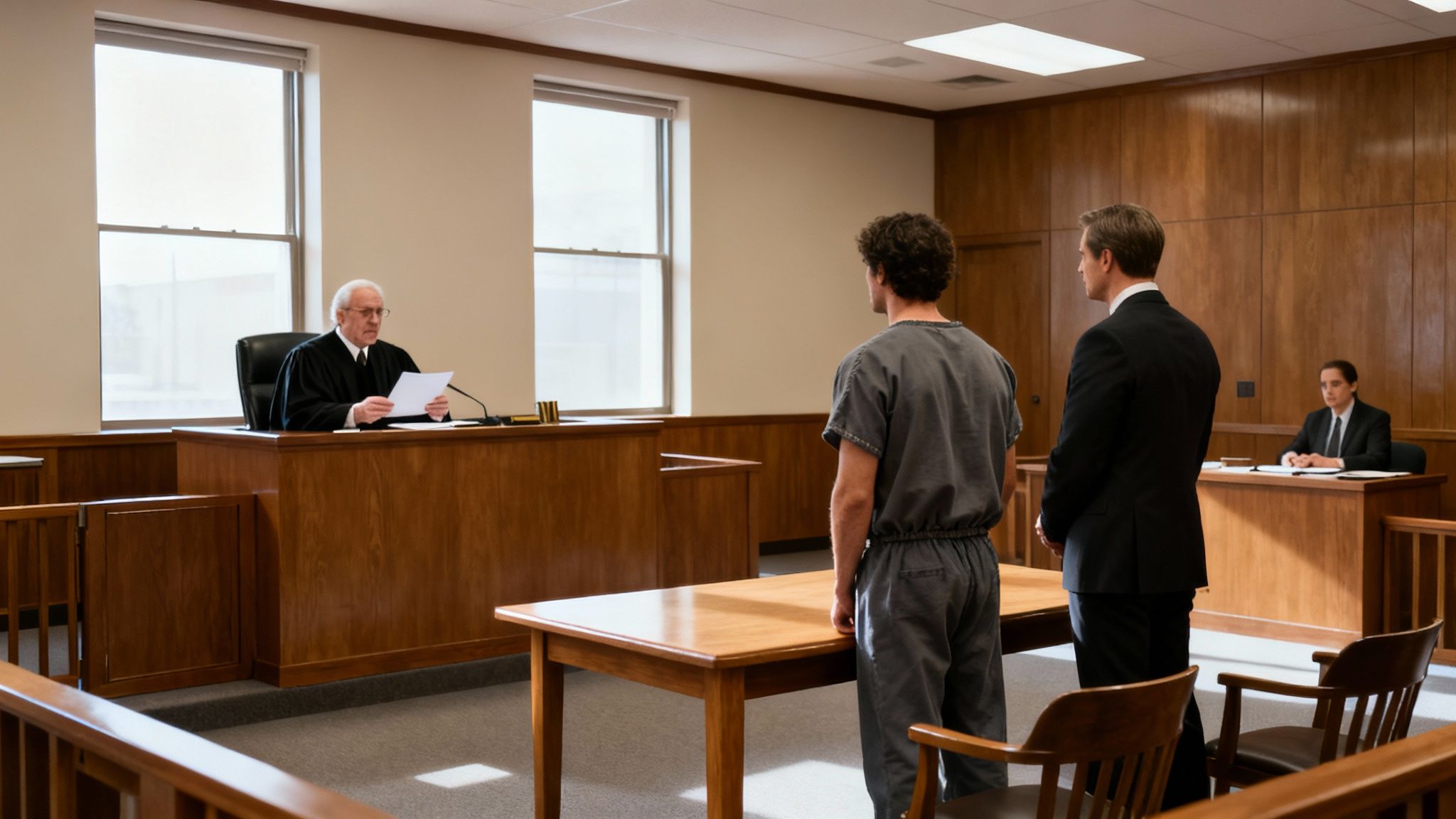
The justice system moves quickly after a DWI arrest. Your arraignment is typically scheduled within 24 to 48 hours. This speed is intentional—the Sixth Amendment guarantees your right to a speedy process, and this hearing is the first step toward resolving the charges.
During this hearing, a judge will formally read the DWI charges filed against you by the State of Texas. You'll receive a copy of the official charging document, and then you'll be asked to enter a plea. This is all done in open court to ensure transparency right from the start.
Who Is in the Courtroom?
Walking into a courtroom can be intimidating. Knowing who the key players are helps make the experience less overwhelming and allows you to focus on the process.
Here’s who you can expect to see:
- The Judge: The person in charge of the courtroom. They ensure all rules are followed, read the charges aloud, and make important decisions about your bail conditions.
- The Prosecutor: This attorney represents the State of Texas. Their job is to present the DWI charges and prosecute the case against you.
- Your Defense Attorney: Your advocate and guide. They speak on your behalf, protect your constitutional rights, and provide critical advice on how to plead and proceed.
Having an experienced Houston DWI lawyer by your side is essential. They will handle all communication with the judge and prosecutor, preventing you from accidentally saying something that could harm your case.
The Purpose of the Arraignment
The arraignment is more than a formality; it serves several critical functions that set the stage for your entire defense strategy.
The primary goal of an arraignment is to officially inform you of the charges, allow you to enter a plea, and address the conditions of your release while your case is pending. This is where your fight for a positive outcome officially begins.
At this stage, your attorney will almost always advise you to plead "Not Guilty." This is a crucial strategic move. Pleading not guilty doesn't mean you're denying every fact of the case; it simply preserves all of your legal rights and gives your defense team the time needed to investigate the state's evidence. It keeps every single one of your options on the table, allowing you to fight the DWI Texas charges effectively.
To give you a clearer picture of what to expect, here's a rundown of the main events during a typical Texas DWI arraignment.
Key Events During Your Texas DWI Arraignment
| Event | What It Means For You |
|---|---|
| Formal Reading of Charges | The judge reads the official DWI charge aloud, ensuring there's no confusion about the accusation. |
| Entering a Plea | You will be asked to plead "Guilty," "Not Guilty," or "No Contest." Your attorney will advise pleading "Not Guilty." |
| Setting Bail/Bond | The judge sets or reviews the conditions for your release from custody while the case is ongoing. |
| Scheduling Future Dates | The court will set dates for future hearings, like pre-trial conferences, where your case will be discussed further. |
Each of these steps is a building block for your defense. Getting them right from the very beginning is essential to protecting your future.
The arraignment is the first formal step in a much larger legal journey. To see how this hearing fits into the complete timeline, you can check out our detailed guide on the steps after a DUI arrest. With the right legal advocate by your side, you can navigate this initial hearing confidently, knowing your future is being protected.
The Three Pivotal Moments of a DWI Arraignment

While an arraignment has several official steps, the entire hearing revolves around three critical moments that set the stage for your entire DWI case. Understanding them helps demystify the process and restores a sense of control during a stressful time.
These three events are the formal reading of the charges, entering your plea, and the judge's decision on your bail conditions. With an experienced Texas DUI attorney by your side, these are not just boxes to check—they are the first building blocks of a strong defense.
Moment 1: Hearing the Formal Charges
The first thing that happens is the judge formally reads the DWI complaint filed against you by the prosecutor. This isn't a dramatic TV reveal; it’s the court's official way of making sure you know exactly what you are being accused of. The judge or clerk will state the specific law you’ve allegedly broken, such as driving while intoxicated under the Texas Penal Code.
This step upholds your constitutional right to be informed of the charges you're facing. It creates a clear, official record of what the State of Texas must now prove beyond a reasonable doubt. Your attorney will be listening carefully, analyzing the specific language of the charge for any immediate weaknesses or procedural errors.
Moment 2: Entering Your Plea
After the charges are read, the judge will ask how you plead. You have three choices: “Guilty,” “Not Guilty,” or “No Contest.” In nearly every DWI case, the only correct and strategic plea to enter at this first hearing is “Not Guilty.”
Think of this as a procedural move, not a statement about the facts. Pleading "Not Guilty" is your way of telling the court, "I am exercising my right to see every piece of evidence the state has against me before making any decisions."
Here’s why this is so critical:
- It Preserves All Your Rights: A "Not Guilty" plea keeps every constitutional protection intact, including the right to a trial and the right to challenge evidence.
- It Gives Your Attorney Time to Work: This plea allows your legal team to formally request and analyze all evidence—police reports, breathalyzer maintenance logs, body camera video, and more.
- It Makes the State Prove Its Case: By pleading not guilty, you legally require the prosecutor to prove every element of the DWI charge. The burden of proof is on them, not you.
Pleading guilty at your arraignment is like folding your hand in poker before looking at your cards. It closes the door on your defense before it even begins. Your attorney will always advise you to plead "Not Guilty" to keep every defensive option on the table.
Moment 3: Determining Bail and Bond Conditions
The final major event of your arraignment is the judge's decision on bail. Bail is the money the court requires to ensure you appear for future court dates. This decision has an immediate impact on your freedom while the case is ongoing.
Judges in Texas consider several factors when setting bail:
- The seriousness of the charge (a first DWI in Texas is treated differently than a felony DWI).
- Your criminal history, if any.
- Your ties to the community, such as your job and family.
- Whether the judge believes you are a flight risk.
Your Houston DWI lawyer’s job is to argue for the most favorable outcome. This could mean a Personal Recognizance (PR) bond, where you are released on your written promise to appear without posting money. If the judge requires a cash bond, your lawyer will advocate for the lowest amount possible.
The judge can also set non-financial conditions for your release. A common condition in Texas DWI cases is requiring you to install an ignition interlock device (IID) on your vehicle. This is a breathalyzer connected to your car's ignition that prevents it from starting if it detects alcohol. Your attorney will argue to ensure any conditions are reasonable and fair for your specific case.
The Critical Role of Your DWI Attorney at Arraignment

Facing your DWI arraignment without an experienced attorney is a significant risk. While the hearing may seem brief, the decisions made here can have a lasting impact on the rest of your case.
This isn't the time to go it alone. Having a skilled Houston DWI lawyer by your side isn’t a luxury—it’s a strategic necessity from the very first minute.
Your attorney acts as your advocate, advisor, and shield the moment you enter the courtroom. They handle all communication with the judge and prosecutor, which is crucial. This simple act prevents you from saying something that could be misinterpreted and used against you later. When you walk in with a dedicated legal professional, it sends a clear message to the court: you are taking these charges seriously and are prepared to defend your rights.
Protecting Your Rights and Freedom
One of your attorney’s most important jobs at the arraignment is to argue for your release under the best possible conditions. The goal is to get you back home to your life and job while the case proceeds.
This involves making a persuasive argument to the judge for one of two things:
- A Personal Recognizance (PR) Bond, which means you’re released on your word without having to post any money.
- The lowest possible cash bail amount, saving you and your family from a significant financial burden.
This isn’t just about money; it’s about your future. National court data from the Bureau of Justice Statistics shows that pretrial release dramatically impacts case outcomes. Individuals who remain in jail before trial often face higher conviction rates and more severe sentences. An attorney fighting for your release is fighting for a better result for your entire case.
A skilled DWI attorney doesn’t just show up—they show up prepared. They anticipate the prosecutor's arguments and present a compelling case for your release, highlighting your ties to the community and your reliability.
Investing in a qualified lawyer is a critical step toward protecting your freedom, your job, and your future.
Building Your Defense from Day One
Your attorney’s work at the arraignment goes far beyond speaking for you. They are already starting to build your defense strategy. They obtain the official charging documents and begin their initial analysis of the state's case against you.
They listen intently to how the charges are read, looking for any procedural errors or weaknesses that can be challenged later. This first hearing gives your attorney a valuable opportunity to assess the prosecutor and the judge, gathering insights that will shape the defense strategy moving forward.
A strong defense doesn’t start weeks down the road—it starts the moment you are charged. By having an attorney at your arraignment, you ensure that no opportunity is missed and no unforced errors are made. It's the first and most important step you can take toward a successful outcome. To learn more, read our guide on the role of a DUI attorney and when to hire one.
Understanding the Two Battles You Must Fight
After a Texas DWI arrest, you are facing two completely separate legal battles at the same time. This is a critical point that many people overlook. They focus all their energy on the criminal court case that starts with the arraignment, not realizing there’s a second, equally urgent fight happening: the battle to save your driver's license.
These two processes run on parallel tracks in different legal systems, and the outcome of one does not automatically determine the other. It’s possible to win your criminal DWI case but still lose your license, or vice versa. Your defense strategy must account for both. A skilled Texas DUI attorney is essential to manage both proceedings and ensure a misstep in one doesn’t jeopardize your chances in the other.
The Criminal Case: Your Arraignment Kicks It Off
The first battle is the criminal charge of Driving While Intoxicated, brought against you by the State of Texas. Your arraignment is the official starting point for this process.
Here's what that fight involves:
- The Goal: The prosecutor must prove you are guilty of DWI "beyond a reasonable doubt." A conviction can lead to jail time, steep fines, and a permanent criminal record.
- The Arena: This takes place in a criminal court, governed by the Texas Code of Criminal Procedure.
- The Stakes: Your freedom, your reputation, and your future are on the line.
Everything discussed so far—the arraignment, entering a plea, and setting bail—is part of this criminal battle. It is often a lengthy process that can take months to resolve.
The Civil Case: The ALR Hearing for Your License
The second battle is an administrative case against the Texas Department of Public Safety (DPS). This is the Administrative License Revocation (ALR) process, and it moves extremely fast. Its sole purpose is to determine whether the DPS has the legal right to suspend your driver’s license due to your DWI arrest. This is also known as a DWI license suspension.
From the moment of your arrest, you have only 15 days to request an ALR hearing. If you miss this strict deadline, your license will be automatically suspended, regardless of what happens in your criminal case.
Here’s how the ALR process is different:
- The Goal: The DPS only needs to show it has grounds to suspend your license, which usually means proving you either refused a breath or blood test (violating "implied consent" laws) or provided a sample with a Blood Alcohol Concentration (BAC) of 0.08% or higher.
- The Arena: This hearing is held in an administrative setting before an administrative law judge, not in a criminal court.
- The Stakes: Your ability to drive legally is at risk.
The ALR hearing is more than just a fight for your license; it's a critical strategic opportunity. It’s often your attorney’s first chance to question the arresting officer under oath and lock them into their testimony. The evidence and testimony gathered from this hearing can be invaluable for finding weaknesses in the state’s criminal case, helping you fight DWI Texas charges more effectively.
Mapping The Road Ahead After Your Arraignment
Your arraignment is the starting line of a marathon, not a sprint. A Texas DWI case unfolds through several distinct stages, each presenting an opportunity for your attorney to challenge the state's evidence and build a powerful defense on your behalf.
Understanding this roadmap can reduce anxiety by showing you that the process is structured and manageable. This isn’t about one single court date; it’s about a strategic legal process designed to protect your rights at every turn.
The Discovery Phase: Uncovering The Evidence
Immediately after you enter a "Not Guilty" plea at your arraignment, your case moves into the discovery phase. Think of this as your attorney’s investigation period. The law requires the prosecutor to turn over all evidence they have against you.
Your DWI lawyer will formally request and meticulously analyze every piece of evidence, including:
- The arresting officer's official police report
- Dashcam and body camera video footage
- Results and maintenance logs for breath or blood tests
- Statements from any witnesses
- The officer's training records and any disciplinary history
This is where the state's case is deconstructed. Your attorney isn't just reading reports; they are actively hunting for inconsistencies, procedural errors, and constitutional violations that can be used to weaken the prosecution's argument.
Pre-Trial Motions: Your Attorney’s Strongest Tools
After reviewing the evidence, your attorney will develop a strategy that often involves filing pre-trial motions. These are formal legal arguments asking the judge to make specific rulings before a trial begins. They are some of the most powerful tools in a defense attorney's arsenal.
A well-argued motion can be a game-changer. It can get key evidence excluded, sometimes forcing the prosecutor to dismiss the case entirely because they no longer have enough evidence to proceed.
Common pre-trial motions in a Texas DWI case include:
- Motion to Suppress Evidence: This motion argues that evidence was obtained illegally and should be excluded from your case. For example, if the officer pulled you over without a valid reason (reasonable suspicion), everything that happened afterward—like the field sobriety tests or breath test—could be deemed inadmissible.
- Motion to Exclude Breath or Blood Test Results: Your attorney might challenge the scientific reliability of a chemical test if the machine wasn't calibrated properly, the test was administered incorrectly, or the chain of custody for a blood sample was broken.
This infographic helps visualize how the criminal case and the separate fight for your driver's license run on parallel timelines.
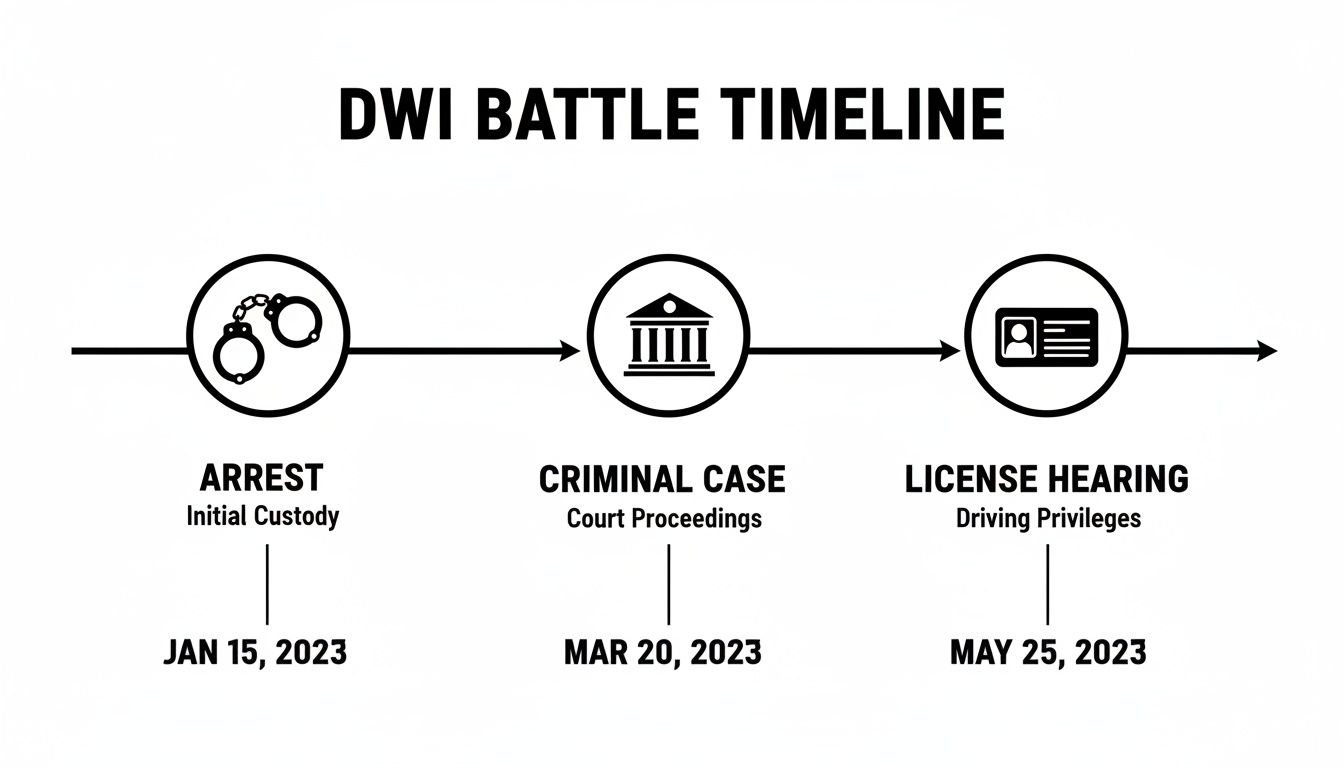
As you can see, while your criminal case moves through discovery and motions, you must also address the separate and extremely time-sensitive administrative license hearing.
Plea Negotiations and Preparing For Trial
While your attorney challenges the evidence, they are also communicating with the prosecutor. This can lead to plea negotiations, where the prosecutor might offer to reduce the charge to a lesser offense. A skilled attorney will only consider offers that are genuinely in your best interest and will advise you accordingly.
If a favorable agreement cannot be reached, your case will be set for trial. This is your constitutional right, where the state must prove every element of the DWI charge to a jury beyond a reasonable doubt. Your attorney will prepare to tell your side of the story, cross-examine the state's witnesses, and present a compelling case for your acquittal.
Both the criminal case and the administrative hearing have unique procedures. You can learn more about the rules governing your license suspension case by exploring our guide on the State Office of Administrative Hearings in Texas.
Common Questions About DWI Arraignment in Texas
Walking into a courtroom after a DWI arrest can be confusing and stressful. You are not the first person to have questions about what to expect. Getting clear, simple answers is the first step toward regaining control of your situation.
Let’s tackle some of the most common questions people have about their DWI arraignment in Texas to help you walk in with more confidence.
Will I Have to Speak at My Arraignment?
This is a major source of anxiety for most people, but the answer should be reassuring. In most cases, you will say very little, if anything. Your attorney's job is to be your voice and shield in the courtroom. They will handle nearly all communication with the judge and prosecutor.
The judge may ask you to state and spell your name for the record. They might ask if you understand the charges, to which you can give a simple “yes.” When asked how you plead, you will follow your lawyer’s advice and state, “Not Guilty.” That’s it.
Letting your lawyer do the talking is a key part of your defense strategy. It prevents you from accidentally saying something that could be misinterpreted or used against you. Your attorney is there to protect you, and that starts with managing all communication in court.
What Is Appropriate to Wear to a DWI Arraignment?
Your appearance sends a powerful message to the judge about how seriously you are taking the proceedings. The best rule is to dress as you would for an important job interview. It shows respect for the court and the legal process.
Here are a few simple guidelines:
- For Men: Business casual is a safe choice. Think slacks and a collared shirt. A suit jacket or tie shows an extra level of respect.
- For Women: A conservative dress, skirt, or a professional pantsuit is appropriate. The key is to keep it modest and professional.
- What to Avoid: Do not wear jeans, shorts, graphic t-shirts, tank tops, sandals, or hats. Casual attire can be seen as disrespectful and may subconsciously influence the judge’s perception of you.
Dressing professionally reinforces the message your attorney is sending: that you are a responsible person treating this matter with the seriousness it deserves.
Can a DWI Case Be Dismissed at the Arraignment?
While it's a common question, it is extremely rare for a DWI case to be dismissed at the arraignment. This initial hearing is not for arguing the facts or proving innocence. Its purpose is administrative—to officially start the legal process, read the charges, take your plea, and set release conditions.
A dismissal typically happens much later in the process, as a direct result of your attorney's work during the discovery and pre-trial phases. After the arraignment, your Houston DWI lawyer will file motions to obtain all evidence from the prosecutor. They will then meticulously review everything—the police report, bodycam footage, and breathalyzer maintenance logs. If they find a fatal flaw in the state's case, like an illegal traffic stop or improperly administered field sobriety test, that’s when they file a motion to suppress evidence, which can lead to a dismissal.
What if I Cannot Afford the Bail Set by the Judge?
This is a practical concern for many people. If the judge sets a cash bail that you cannot afford, you have options, and your attorney is there to help you navigate them.
First, your lawyer will fight for the best possible conditions from the start. They can ask the judge to lower the amount or, ideally, release you on a personal recognizance (PR) bond. A PR bond is the best-case scenario, as it allows for your release on a written promise to appear for future court dates without requiring money upfront.
If a cash bond is unavoidable and you cannot pay it yourself, the next step is typically to work with a bail bondsman:
- Contact a Bail Bonds Company: Your lawyer can often recommend a reputable local bondsman.
- Pay a Fee: You will pay the bondsman a non-refundable fee, usually about 10% of the total bail amount.
- Secure Your Release: The bondsman then posts the full bail amount with the court on your behalf, and you are released from custody.
Facing an arraignment is a major step, but remember, it’s just the beginning. Having a strategic, confident legal partner by your side makes all the difference.
A DWI charge can feel like the weight of the world is on your shoulders, but you don’t have to face the complexities of the Texas court system alone. At The Law Office of Bryan Fagan, PLLC, our experienced DWI defense attorneys are here to protect your rights, answer your questions, and build the strongest possible defense for your case. We invite you to request a free and confidential consultation to discuss your situation. Let us help you take the first step toward protecting your future. Contact us today at https://texasduilawfirm.com.