 Skip to content
A DWI arrest can be overwhelming — but you don’t have to face it alone. Receiving notice of a grand jury indictment for a DWI is a serious, often frightening moment. It's the point where your case officially shifts from a misdemeanor to a felony prosecution, and that word—felony—can feel overwhelming. But it's crucial to understand this: an indictment is not a conviction. It’s simply the formal start of the court process, a starting line where you have every right to build a powerful defense.
Your Guide to the Texas DWI Process After an Indictment
A felony DWI charge can be life-altering, but you don’t have to face this difficult process alone. An indictment simply means a group of citizens, the grand jury, heard the prosecutor's initial evidence and decided there was enough probable cause to move forward. This is a very low legal standard, and in most cases, they only hear one side of the story—the prosecutor's.
The good news is that this next phase is where your defense attorney can finally get in the game and actively fight for you in court. Knowing what happens after a grand jury indictment is the first step toward taking back control of your situation and protecting your future.
The Immediate First Steps
Once an indictment is returned, a specific sequence of events kicks off. The first thing that usually happens is the court will issue an arrest warrant if you aren't already out on bond. Now, this doesn't have to mean a surprise arrest at home or work. A skilled Houston DWI lawyer can often arrange a voluntary "walk-through" surrender, which minimizes your time in custody and shows the court you're taking this seriously.
The key priorities right after an indictment are to deal with the warrant and get ready for your first official court appearance. This is a critical time to have legal counsel guiding you. Your attorney will handle all communications with the court and the prosecutor, making sure your rights are protected from the very beginning.
This flowchart shows how the process generally unfolds right after the indictment.
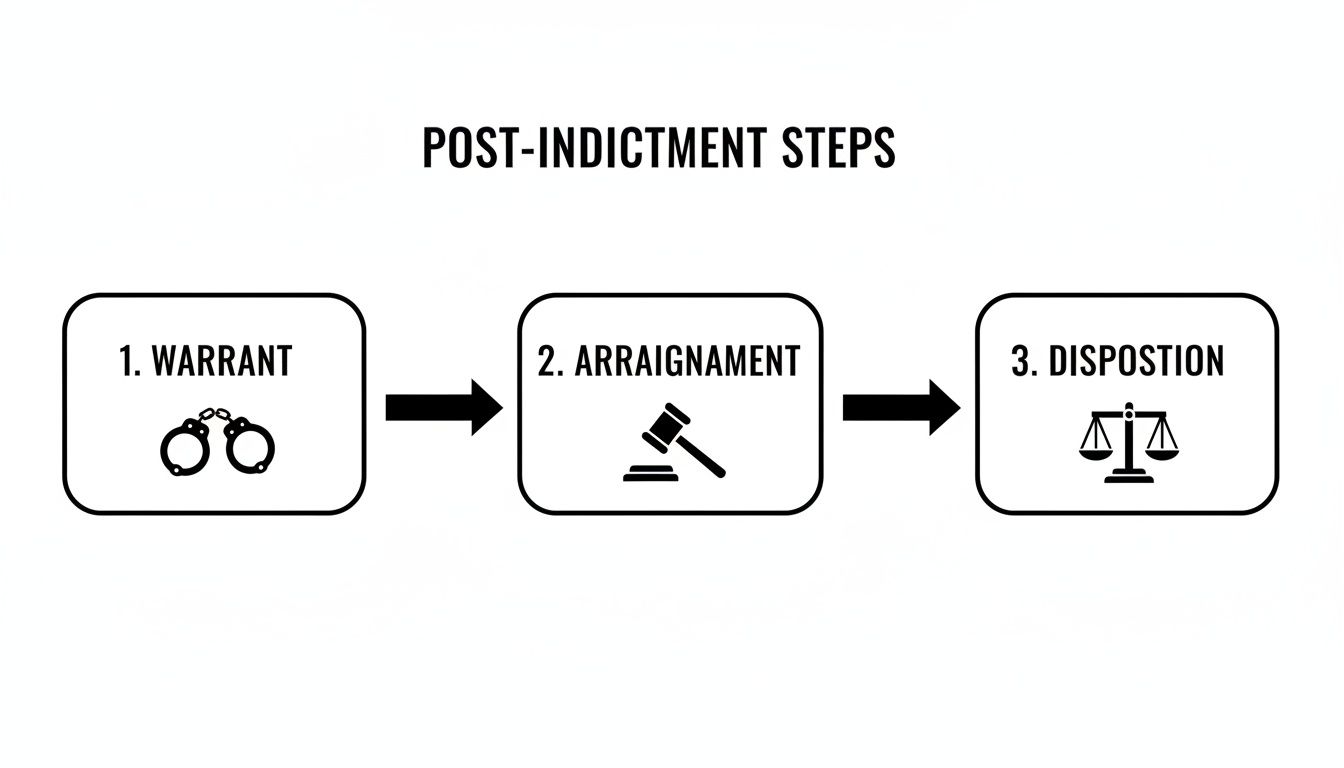
As you can see, the indictment triggers the warrant, which leads directly to your arraignment—your first formal appearance in the district court where the felony case will be heard.
To give you a clearer picture, here’s a quick-reference table outlining the immediate steps you'll face.
Immediate Steps After a DWI Grand Jury Indictment
| Event | What It Means for You | Your Immediate Priority |
|---|---|---|
| Indictment Returned | The grand jury found probable cause for a felony charge. Your case moves to District Court. | Contacting your DWI attorney immediately. |
| Warrant Issued | The court issues a warrant for your arrest if you are not currently on bond. | Coordinating a "walk-through" surrender with your lawyer to avoid a surprise arrest. |
| Arraignment Scheduled | This is your first mandatory court appearance for the felony charge. | Preparing with your attorney to enter a plea and address your bond conditions. |
This sequence is the standard playbook for Texas courts, and being prepared for each step is the best way to reduce anxiety and start building a strong defense.
Your First Court Appearance: The Arraignment
Your first time in court after the indictment is called an arraignment. It’s usually a brief, formal hearing where the judge will:
- Formally read the felony DWI charges against you.
- Ask you to enter a plea (which will almost always be "not guilty").
- Set or review your bond amount and any release conditions.
Pleading "not guilty" is a standard and absolutely crucial step. It preserves all of your legal rights and gives your attorney the time needed to dig into the evidence and build your defense strategy. Think of it not as a denial of facts, but as a formal demand that the State prove its case beyond a reasonable doubt.
Understanding this process is vital. Rather than feeling like you're just along for the ride, you can feel prepared for what’s to come. With a strategic Texas DUI attorney by your side, each step becomes an opportunity to challenge the State's case and work toward the best possible outcome for you. At The Law Office of Bryan Fagan, PLLC, our goal is to provide that strategic guidance from day one. Request a free consultation to discuss your case today.
Navigating Your First Court Appearance and Bond

The time right after a grand jury indictment can feel like a confusing storm of legal paperwork and court dates. The first formal court appearance you'll have in this new, more serious phase is the arraignment. This is a pivotal hearing where the court officially puts you on notice of the felony charges and sets the stage for how your case will proceed.
At the arraignment, the judge will read the specific DWI charge from the indictment out loud. Then, you'll be asked how you plead. You’ll hear options like "guilty" or "no contest," but the standard, strategic response at this stage is to plead "not guilty." This is more than just a formality; it's a critical move.
Pleading "not guilty" isn't you claiming you’re innocent or that nothing happened. It’s you formally exercising your constitutional right to make the State prove its case against you. That simple plea keeps all your legal options on the table and gives your attorney the time needed to get and scrutinize all the evidence, a process called discovery.
Understanding Your Plea
Entering a "not guilty" plea is like turning the key that unlocks your entire defense. It tells the court and the prosecutor that you’re not just going to roll over—you intend to challenge the allegations. It gives your legal team the green light to start the hard work of picking apart the State’s case, from police reports to breathalyzer logs, searching for the procedural mistakes or constitutional violations that can win a case.
If you want to dig deeper into what this first hearing looks like, you can learn more about what happens during an arraignment in our detailed guide.
This initial appearance is really about setting up the legal battlefield for the months ahead. It’s far less about deciding guilt and much more about establishing the rules of engagement for the pretrial process. With a seasoned attorney by your side, this hearing can be handled efficiently to protect your rights from day one.
Key Takeaway: Pleading "not guilty" is not a lie; it is a legal strategy. It forces the prosecution to meet its burden of proving guilt beyond a reasonable doubt and gives your defense team the time and opportunity to fight for you.
Addressing Bail and Bond Conditions
A huge part of the arraignment is setting or re-evaluating your bail or bond conditions. The bond is simply the financial guarantee you give the court, promising you'll show up for all your future court dates. If you were already out on bond from the initial DWI arrest, the judge will now review those terms, since the charge has been elevated to a felony.
The judge has a lot of power here. They'll look at several factors when deciding the bond amount and what strings are attached:
- The seriousness of the new felony charge.
- Your criminal history, if you have one.
- Your connections to the community, like your job, family, and how long you've lived here.
- Whether the court sees you as a risk to flee or a danger to the public.
These conditions can dramatically change your day-to-day life. A judge might order travel restrictions, weekly check-ins with a probation officer, or substance abuse monitoring. For a felony DWI, one of the most common conditions is the mandatory installation of an ignition interlock device (IID) on any vehicle you drive. This device is a small breathalyzer that won't let your car start until you provide an alcohol-free breath sample.
This is where having an experienced Texas DUI attorney to argue for you becomes vital. We can make strong arguments for the most reasonable and least disruptive bond conditions, helping you keep your life as normal as possible while the case is ongoing. Our priority is making sure you can keep working, taking care of your family, and living your life with minimal interference.
The Discovery Process: How We Uncover the Facts
Once you enter a “not guilty” plea at your arraignment, the fight truly begins. This is where we shift from defense to offense. The next phase, called discovery, is easily one of the most critical parts of your entire DWI case. It’s where we stop reacting to the State’s accusations and start building our own strategy to take their case apart, piece by piece.
Think of it like this: the prosecution has a playbook with every piece of evidence they plan to use against you. The discovery process is how we demand—and get—a copy of that very playbook. This isn’t a polite ask; it’s a legal and constitutional right.
This evidence is the foundation of your defense. It gives us a behind-the-scenes look at the prosecutor's game plan, and more importantly, it's where we start finding the cracks in their story.
What We Look for in the Evidence
When the discovery files arrive, it’s like getting a massive box of puzzle pieces. Our job isn't just to see the picture the prosecutor wants the judge and jury to see. It’s to find the pieces that are missing, don't fit, or were gathered illegally in the first place. A powerful defense strategy is born from this deep-dive investigation.
Here are the key items we demand and exactly what we’re looking for:
Police Reports: We tear apart the officer’s written narrative, searching for inconsistencies, sloppy police work, and claims that just don’t line up with the video evidence. Did the officer even follow their own department’s procedures during the stop and arrest?
Dashcam and Bodycam Videos: This is often the most powerful evidence in the entire case—for either side. We scrutinize the footage to see if the officer had a valid reason to pull you over, how they administered the field sobriety tests, and whether they violated your rights at any point.
Breath and Blood Test Results: We never, ever take the state's BAC (Blood Alcohol Concentration) number at face value. We dig into the breathalyzer's maintenance logs, the lab technician's credentials, and the chain of custody for the blood sample. In fact, our team has a detailed process for how to obtain and analyze DWI breathalyzer records specifically to challenge their accuracy.
Witness Statements: We meticulously compare statements from every witness. We’re looking for contradictions, biases, or credibility issues that can completely neutralize their testimony in court.
This is how we often uncover the critical weaknesses that the State was hoping we’d miss.
A DWI arrest can feel like you’re lost in the dark—but you don’t have to go through it alone. The discovery phase is where our experience shines, turning the State's own evidence into a clear roadmap for your defense.
Finding the Cracks in the Prosecution’s Case
The whole point of this exhaustive investigation is to find those "cracks" in the prosecution's foundation. These aren’t just minor details. They are often major legal mistakes that can get key evidence thrown out, force a charge reduction, or even lead to a full dismissal.
For example, we might find that the initial traffic stop was completely illegal. If an officer pulls you over without a legitimate, provable reason (known as reasonable suspicion), then all the evidence collected after that moment—including the breath test—could be suppressed. This is what lawyers call the "fruit of the poisonous tree."
We also put the so-called "science" under a microscope. Breathalyzer machines need constant, precise calibration and maintenance. If we discover the machine used in your case had a shoddy service history or was used incorrectly by the officer, we can mount a powerful challenge to the reliability of its results.
This is the nitty-gritty investigative work that answers the questions that can make or break your case. It’s the cornerstone of any effective strategy to fight DWI Texas charges. Once we have the full story, we can prepare to challenge the State with pretrial motions, negotiate from a true position of strength, or build a winning narrative for a jury.
Challenging the State's Case with Pretrial Motions

Once we’ve dug through all the evidence the prosecutor has handed over, the real fight often begins. This is where an experienced attorney moves from defense to offense using one of the most powerful tools in our arsenal: the pretrial motion. These are formal legal challenges we file with the judge, asking them to make crucial decisions before a trial ever starts.
Think of it like setting the rules of the game in your favor before the opening kickoff. Instead of just reacting to the State’s playbook at trial, we get to challenge the legality of their evidence, how they got it, and whether a jury should ever be allowed to see it.
This is the bedrock of an aggressive DWI defense. We don't wait to see what happens. We create opportunities by forcing the State to prove that every step they took was by the book. The single most important weapon in this phase is the Motion to Suppress Evidence.
The Motion to Suppress Evidence
The Motion to Suppress is exactly what it sounds like: a formal request for the judge to throw out—or “suppress”—evidence the State wants to use against you. The legal basis is simple but powerful: the police violated your constitutional rights when they gathered that evidence.
Imagine a referee calling back a touchdown because of a flag on the play. The points come off the board. A Motion to Suppress does the same thing in court. If the police broke the rules to get the evidence, that evidence can’t be used.
A successful Motion to Suppress doesn't just chip away at the prosecutor's case—it can cause it to completely collapse. Removing a key piece of evidence, like a blood test result, can leave the state with no path to a conviction.
For example, let’s say an officer pulled you over but can’t give a valid, legal reason for the stop—a standard called reasonable suspicion. Any evidence they collected after that illegal stop can be thrown out. This is known as the "fruit of the poisonous tree" doctrine. The bad stop poisons everything that came from it, including:
- Any statements you made to the officer.
- The results of so-called field sobriety tests.
- The BAC number from a breathalyzer or blood draw.
Your attorney files the motion, which triggers a special hearing. At this hearing, we put the arresting officer on the stand, cross-examine them about their actions, and make our legal arguments to the judge, pointing out exactly where your rights were violated. You can read more about what a Motion to Suppress evidence is and see just how effective this strategy can be.
How Suppressing Evidence Wins Cases
Getting a key piece of evidence thrown out can completely change the game. If a judge agrees to suppress the breath or blood test, the prosecutor loses their main scientific proof of intoxication. Without that magic number, proving a DWI beyond a reasonable doubt suddenly becomes much, much harder.
This puts the prosecutor in a tough spot. With their best evidence gone, they are usually left with two choices:
- Dismiss the Charges: They might recognize they no longer have a case they can win at trial and drop the charges completely.
- Offer a Better Plea Deal: To avoid the risk of losing in court, the prosecutor will often offer a significantly reduced charge, like a non-DWI traffic offense or a lower-level misdemeanor.
What happens after a grand jury indictment is never a sure thing. Filing aggressive, well-researched pretrial motions is how we fight DWI Texas charges head-on. It sends a clear message that you won’t just roll over and accept the State's version of events. We force them to justify every action they took, and we are there to hold them accountable.
Weighing Your Options Between Plea Bargaining and Trial
After we’ve dug through the evidence from discovery and started filing powerful pretrial motions, your DWI case will head down two paths at the same time. On one path, we’re building an aggressive, persuasive story for a jury trial. On the other, we’re strategically opening up plea negotiations with the prosecutor. This isn’t about giving up; it’s about exploring every single option to get you the best result possible.
This is what happens after a grand jury indictment—it becomes a careful balancing act. The work we put into preparing for trial, like the motions we file and the holes we poke in the state's case, becomes our biggest bargaining chip. The stronger our trial case looks, the more a prosecutor is willing to offer a good deal to avoid losing in court. This two-track approach means we’re always negotiating from a position of strength, not weakness.
But make no mistake: you are always in the driver's seat. We will never accept a plea agreement without you fully understanding it and giving your informed consent. Our job is to lay out the options, explain the risks and benefits of each, and give you our professional advice so you can make a clear-headed decision about your future.
What Does a Plea Offer Look Like?
A plea bargain is essentially an agreement where you plead guilty or “no contest” to a charge in exchange for a specific, pre-determined outcome. The whole point is to minimize the damage and get rid of the "what if" of a jury trial. When you're facing a felony DWI indictment, a good plea offer can be a total game-changer.
Potential offers we fight to get on the table include:
- Reduction to a Misdemeanor: One of our top priorities is always to get the prosecutor to knock that felony DWI charge back down to a misdemeanor. This alone can save you from the life-altering consequences of a felony conviction, like losing your right to vote or own a firearm.
- Preventing a Final Conviction: We often push for what’s called deferred adjudication. With this outcome, you plead guilty, but the judge holds off on finding you guilty and puts you on community supervision (probation) instead. If you successfully complete probation, the case gets dismissed, and you are never actually convicted of the crime.
- Agreed-upon Sentencing: If a conviction seems unavoidable, we can still negotiate a predictable and manageable sentence. This could mean probation instead of jail time, or maybe a shorter probation term with fewer hoops to jump through. It takes away the risk of a judge or jury handing down a much harsher sentence after a trial.
This negotiation is where having an experienced Houston DWI lawyer really pays off. We know the local courts, we know the prosecutors, and we know exactly how to use the weaknesses in their case to get them to make a serious offer.
A strong defense isn't just about winning a not-guilty verdict at trial. It's about creating chances for a better outcome at every single stage. Plea negotiations are a powerful tool for controlling the damage and protecting your future.
Building a Defense for Both Paths
So, how do we prepare for a trial and a plea deal at the same time? Think of it like a football team getting ready for the Super Bowl. The offense practices their plays to score a touchdown and win the game (that’s our trial strategy). At the same time, the defense is studying the other team’s film to shut them down (that’s our negotiation strategy). Both parts of the team are working together for the same goal: a win.
In your case, every piece of evidence we uncover that hurts the state’s case—like a faulty breathalyzer test or an illegal traffic stop—is a weapon we can use on both paths. In front of a jury, it creates reasonable doubt. In front of a prosecutor, it creates leverage.
Preparing for both scenarios at once ensures that no matter which way your case turns, you are ready. You can face what's next with confidence, knowing every option was explored and every angle was fought for by an advocate in your corner. This approach is the heart of how we fight DWI Texas charges and protect our clients' futures.
How Your DWI Case Can Be Resolved
After a grand jury indictment, the road ahead can feel long and uncertain. This is often where the real stress kicks in. You’re probably wondering, "What happens now? How does this all end?" It’s a completely normal question, and knowing the possible outcomes can give you back a sense of control.
Even with a serious charge like a felony DWI, your case doesn’t have to end in disaster. A good defense attorney isn’t just planning for a trial; we’re actively working from day one to create opportunities for a better resolution, no matter what stage the case is in.
The Best-Case Scenarios
Let's start with the outcomes we fight for from the very beginning: making the charges disappear. This isn’t just wishful thinking; it’s the result of aggressive, detail-oriented legal work.
Dismissal of Charges: This is the home run. A dismissal means the State's case against you is over. We can achieve this by filing a powerful pretrial motion—like a motion to suppress illegally obtained evidence. If we get the breath test, blood test, or even the entire stop thrown out, the prosecutor might not have enough evidence left to proceed. Other times, our own investigation uncovers a fatal flaw in their case, forcing them to drop the charges.
"Not Guilty" Verdict: If your case goes to trial, the best possible result is a jury finding you "not guilty." This means we successfully created enough reasonable doubt in the minds of the jurors. A not-guilty verdict is final. The case is over, and you walk out of the courtroom with your name cleared.
These are the goals we aim for in every single case. They don't happen by accident—they are earned through relentless preparation and strategy.
Other Favorable Resolutions
Sometimes, the facts of a case make a full dismissal or a not-guilty verdict an uphill battle. But that doesn't mean we're out of options. There are still very positive outcomes that can protect your record and keep you out of jail. Two of the most important are deferred adjudication and probation.
Deferred Adjudication is a critical tool, especially when fighting a first DWI in Texas, even one enhanced to a felony. In this scenario, you enter a plea of "guilty," but the judge puts off making an official finding of guilt. Instead, you're placed on community supervision (probation) for a specific period.
If you complete all the terms of your deferred adjudication—like classes, community service, and staying out of trouble—the case is formally dismissed. You are never actually convicted of the crime. This is a massive win for your future, protecting your career and reputation.
Straight Probation, on the other hand, does start with a conviction. After a plea or a finding of guilt at trial, a judge might sentence you to community supervision instead of time behind bars. While it does result in a conviction on your permanent record, it allows you to serve your sentence while maintaining your job, living at home, and supporting your family.
Life After the Verdict
Even if a case ends with a conviction, our job isn't done. We’re always looking down the road, thinking about how to protect your long-term future. There are important post-conviction steps that can offer a fresh start.
One path is to appeal the conviction. If we believe significant legal errors were made during your trial—like a judge wrongly admitting evidence—we can ask a higher court to review the case. A successful appeal could lead to the verdict being overturned or a new trial being granted.
More importantly, Texas law offers ways to clean up your criminal history. If your case was dismissed or you were found not guilty, you are likely eligible for an expunction. This legal process completely destroys all records of the arrest, as if it never happened. If you successfully completed deferred adjudication, you may be able to get an order of nondisclosure, which seals the record from the public's view.
Understanding the end game is a crucial part of your defense. From a complete dismissal to clearing your record years later, a smart strategy is about securing the best possible result not just for today, but for the rest of your life.
Frequently Asked Questions About Texas DWI Indictments

Hearing the words "grand jury indictment" is a gut-punch. Your mind is likely racing with a thousand questions about what comes next. To give you some immediate clarity, we've put together answers to the most common questions our clients ask when they find themselves in this exact spot.
Does a Grand Jury Indictment Mean I Am Guilty?
Absolutely not. This is probably the biggest misconception we see, and it's crucial to understand the difference. An indictment is not a verdict of guilt.
All it means is that the grand jury believes there is enough probable cause—a relatively low legal standard—to formally charge you with a felony and move the case forward. The prosecutor still carries the heavy burden of proving your guilt beyond a reasonable doubt in court. You have every right to fight back.
Think of an indictment as the starting bell for the real fight, not the final round. It's the moment your attorney can finally start punching holes in the state's case.
How Long Does the Court Process Take After an Indictment?
There’s no one-size-fits-all answer here. A felony DWI case in Texas can wrap up in a few months or stretch out for more than a year. The timeline really depends on the unique facts of your case.
Several things can affect the duration, like:
- The complexity of the evidence in your case
- The judge’s calendar and the court’s existing backlog
- The specific defense strategy we build, especially if we file pretrial motions to challenge evidence
An experienced Texas DUI attorney can give you a much better estimate after reviewing your situation and learning which court and prosecutor you're up against.
Key Insight: Don't assume a longer case is a bad thing. It often means your attorney is doing their job—digging deep into the evidence, finding weaknesses, and building a strategic defense designed to force the best possible outcome.
Can My Felony DWI Charge Be Reduced to a Misdemeanor?
Yes, it's possible, and it’s often one of our primary goals. Getting a felony DWI knocked down to a misdemeanor is one of the most powerful ways to fight DWI Texas charges and protect your future.
A reduction like this doesn't happen by just asking nicely. It’s achieved by methodically finding significant flaws in the prosecution's case. When we can show the state their evidence is weak, it gives us powerful leverage to negotiate a better deal for you.
A DWI indictment feels overwhelming, but you don’t have to go through it alone. The legal team at The Law Office of Bryan Fagan, PLLC is here to defend your rights and guide you through every single step. Request a free consultation to discuss the specifics of your case and start building your defense today.

