
A DWI arrest can be overwhelming, but you don’t have to face it alone. It's easy to feel like your options are limited, but it's critical to know that strategic legal paths exist that can protect your future. You might hear the term "deferred disposition," which is a legal route allowing certain offenses to be dismissed after you successfully complete a probationary period.
While deferred disposition is common for minor traffic tickets, there’s a much more powerful and relevant option for a first-time DWI called 'deferred adjudication.' This guide will break down what deferred adjudication really means and how it could be the key to keeping your record clean.
Understanding Your Path to a DWI Dismissal
A DWI charge in Texas can leave you feeling stressed and overwhelmed, but you don't have to navigate this alone. The legal system has specific routes that can lead to a full dismissal, preventing a permanent conviction from haunting your record. Understanding these options is the first step toward building a defense that gives you back control over your life.
The term "deferred disposition" often gets thrown around in legal circles, but it's almost exclusively used for minor, fine-only offenses known as Class C misdemeanors (think speeding tickets or similar citations). For a more serious charge like a first-time DWI in Texas—which is a Class B misdemeanor—the correct legal path is actually deferred adjudication.

Though the names sound alike, they are fundamentally different. They operate in different courts, apply to different levels of offenses, and come with their own unique eligibility rules.
Why This Difference Matters So Much
Grasping this distinction is vital for your defense strategy. Put simply: deferred disposition is for a simple traffic ticket handled in a municipal or JP court. Deferred adjudication is the powerful tool a skilled Houston DWI lawyer uses in a county court to fight for a dismissal of your DWI charge.
Here’s what successfully navigating this path means for you:
- You Avoid a Final Conviction: When you complete deferred adjudication, the judge dismisses your case entirely. This means you are never formally convicted of the DWI.
- You Protect Your Public Record: A dismissal keeps a damaging DWI conviction off your public criminal record, which is crucial for protecting your reputation and future job opportunities.
- You Get a Second Chance: This path gives you a critical opportunity to move on from a mistake without the lifelong baggage of a DWI conviction, as long as you meet all the court's requirements.
Our goal at The Law Office of Bryan Fagan, PLLC is to cut through the confusion and provide you with a clear, strategic plan. We're here to ensure you understand every option available and to fight for the best possible outcome for your case.
Deferred Disposition vs. Deferred Adjudication Explained
When you start researching your defense options for a first DWI in Texas, you’ll quickly run into two terms that sound almost identical: deferred disposition and deferred adjudication. It’s easy to get them mixed up, but knowing the difference is critical. While both can lead to a case dismissal, they exist in completely different legal worlds and apply to vastly different charges.
Think of it this way: deferred disposition is for minor traffic tickets—the kind of thing you handle in a local Justice of the Peace (JP) or municipal court. These are Class C misdemeanors. On the other hand, deferred adjudication is the more powerful option available for serious charges like a first-time DWI, which is a Class B misdemeanor handled in a County Court at Law.
For a DWI charge, your attorney isn't fighting for deferred disposition. The real prize is deferred adjudication.
The Key Differences in Texas Courts
The biggest distinction comes down to the seriousness of the charge and the court that handles it. Deferred disposition is a simple arrangement you might make with a prosecutor to keep a speeding ticket off your driving record. It's a common, straightforward process for low-level violations.
Deferred adjudication, however, is a much more formal and significant legal negotiation. It’s a powerful tool your Texas DUI attorney uses in a higher-level criminal court for a serious offense. Successfully completing deferred adjudication for a DWI means you walk away without a criminal conviction, which is a massive win that protects your career, housing, and reputation for life.
Securing deferred adjudication isn't a given; it demands strategic negotiation. Your lawyer has to convince the prosecutor that you are a good candidate for this second chance, which is why having an experienced attorney in your corner is non-negotiable.
Why Deferred Adjudication Is the Goal for a First-Time DWI
Let’s be crystal clear: deferred disposition is not on the table for a DWI charge. It’s simply not an option. Your entire focus, and ours, will be on securing deferred adjudication. This is the second chance the Texas legal system offers to first-time offenders, allowing them to avoid a permanent conviction by completing a period of probation-like supervision. We fight for this outcome because it is often the best path to protect your future.
Under Texas law, a judge has the power to put off a finding of guilt if the case facts allow for it. You then enter a period of "community supervision," which can last anywhere from 180 days to two years. The terms usually include completing 20-40 hours of community service, attending an alcohol education program, paying fines, and staying away from alcohol. You can learn more about how Texas law structures these agreements and what is required to successfully complete the program.
How the DWI Deferred Adjudication Process Works
If you’re eligible for deferred adjudication, the process can feel like a maze of legal steps and strict requirements. But once you understand the journey from start to finish, it becomes far more manageable. Think of it as a structured path designed to give you a second chance—a path that begins with your attorney’s skill in negotiation.
The first step is for your Houston DWI lawyer to convince the prosecutor, and then the judge, that you are the right candidate for this opportunity. This isn't just about paperwork; it's about presenting you as a responsible person who made a one-time mistake and is committed to making things right. Your attorney will highlight factors like a clean record and your commitment to following the court's rules to argue for this favorable outcome.
This simple chart shows the legal path from the initial offense to a successful dismissal.
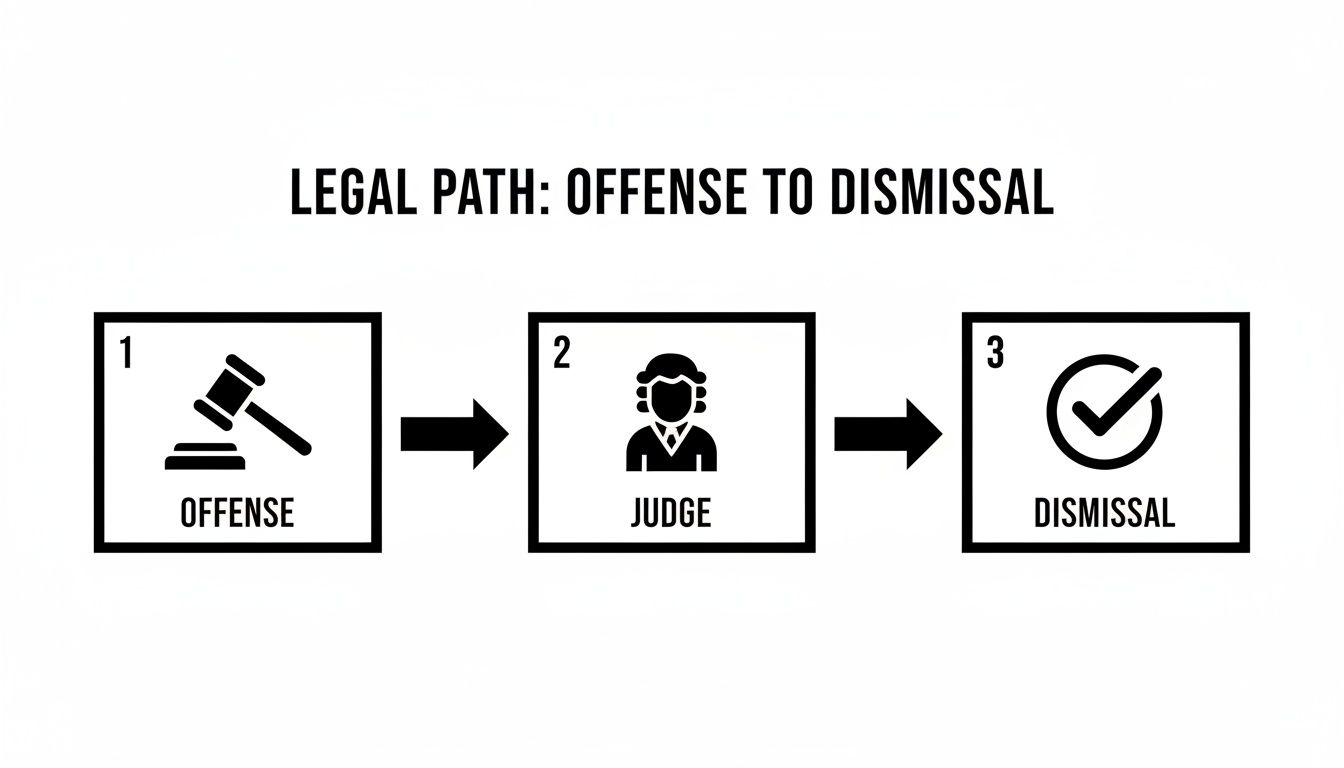
As you can see, even a serious offense can be steered toward a positive resolution where a conviction is completely avoided. It all comes down to having the right legal guidance.
What to Expect During the Probation Period
Once a judge grants deferred adjudication, you aren't actually found guilty. Instead, you enter a period of “community supervision,” which is the legal term for probation. This period usually lasts somewhere between one and two years.
During this time, you must follow a set of court-ordered conditions precisely. While the exact terms can vary depending on your specific case, you can almost always expect to see these requirements:
- Regular Reporting: You’ll have to check in with a probation officer on a set schedule.
- Fines and Court Costs: All financial penalties associated with the case must be paid.
- Mandatory Education: Completing a state-approved DWI education course is a standard requirement.
- Community Service: You will likely be ordered to complete a certain number of community service hours.
- Ignition Interlock Device (IID): It's highly probable the court will require you to install an IID in your vehicle. This device prevents your car from starting if it detects alcohol on your breath.
It’s crucial to understand every detail of a deferred adjudication for a DWI in Texas, because each requirement is a non-negotiable part of the agreement.
The Two Possible Outcomes
The deferred adjudication process really only has two endings, and which one you get is entirely in your hands. Your success hinges on your commitment to following every single rule.
- Successful Completion: If you meet every requirement of your probation without a single slip-up, the judge will dismiss the DWI charge against you. This is the goal. It means you walk away without a final conviction, and the case is officially closed.
- Violation of Terms: If you fail to meet even one condition—maybe you miss a meeting with your probation officer, fail an alcohol test, or get arrested for something else—the consequences are immediate and severe. The prosecutor can file a "motion to adjudicate." If that happens, the judge can find you guilty of the original DWI and sentence you to the full range of punishment, which can include jail time.
Successfully navigating this process is the best shot you have at protecting your record and putting a DWI charge behind you for good.
Figuring Out if You're Eligible for Deferred Adjudication
While deferred adjudication is a strategic path for a first-time DWI, Texas law is incredibly specific about who gets this opportunity. It's not available to everyone. Figuring out if you meet the strict eligibility requirements is the first step in deciding if this is a realistic defense strategy for your case. The goal is always to avoid a permanent conviction, but you have to qualify first.
A DWI arrest is overwhelming, and it's easy to feel lost. You don't have to face it alone. We're here to help you understand your options and fight for the best possible outcome for your case.
Who Is Automatically Disqualified from DWI Deferred Adjudication?
Texas law draws a hard line and automatically disqualifies certain individuals from receiving a deferred adjudication offer for a DWI charge. You are generally not eligible if any of these apply to your case:
- You held a Commercial Driver’s License (CDL): If you had a CDL when you were arrested—even if you were in your personal vehicle—you cannot get deferred adjudication for a DWI.
- Your BAC was 0.15 or higher: If a breath or blood test showed your Blood Alcohol Concentration (BAC) was 0.15 or higher, the law automatically disqualifies you.
- You have a prior DWI conviction: Deferred adjudication is strictly for first offenders. Any previous DWI conviction or even a prior deferred sentence makes you ineligible.
- An accident involved serious injury or death: Cases that rise to the level of intoxication assault or intoxication manslaughter are not eligible for this type of resolution.
Even if you clear these hurdles, an offer isn't guaranteed. It still takes skillful negotiation with the prosecutor. This is where having an experienced Houston DWI lawyer becomes your biggest advantage, as they can advocate for why you are a strong candidate for this second chance. We also have a comprehensive guide that explores various ways a DWI case can be dismissed in Texas.
The Legal Landscape and Your Second Chance
Across the country, there's a growing understanding that second-chance programs like deferred adjudication have real value. A 2020 survey showed that 18 states expanded their deferred disposition laws, leading to a 15-20% increase in their use for some first-time offenses. Here in Texas, our firm's track record highlights just how powerful these programs can be. We've won 92% of the Administrative License Revocation (ALR) hearings connected to our deferred cases, helping clients get their driver's licenses back after they've proven their commitment to the program.
How a Dismissal Impacts Your Criminal Record and License
Getting your DWI case dismissed after successfully completing deferred adjudication is a massive win. It’s the kind of outcome that protects your career, your reputation, and your future. But a common misconception is that a dismissal automatically wipes the incident from your past. It doesn’t.
While you avoid a conviction—and that’s a significant victory—the arrest itself remains on your record, visible to the public.
This is a critical point to understand. A dismissal closes the court case and prevents a guilty verdict from ever being entered. But it doesn't scrub the slate clean on its own. The record of your arrest—fingerprints, mugshots, police reports—still exists. It can still appear on background checks for jobs, housing, or loans. That means there’s one more vital step you need to take to truly put this behind you.

Sealing Your Record with an Order of Non-Disclosure
To regain your privacy, Texas law offers a powerful tool called an Order of Non-Disclosure. This is a court order that seals your DWI arrest record from public view. Once a judge signs off on it, private entities like employers, landlords, and background check companies can no longer see it.
However, you can’t file for it the day your probation ends. The law requires a mandatory waiting period after you’ve completed deferred adjudication:
- You must wait two years from the date your probation ends for a standard first-time DWI.
- That waiting period extends to five years if your case involved an accident, even if no one was hurt.
Filing for non-disclosure is a completely separate legal process that requires careful attention to detail. An experienced Houston DWI attorney can ensure your petition is filed correctly and on time, giving you the best chance at sealing the record for good. It's crucial to grasp the difference between a dismissal and a sealed record; you can read more about whether deferred adjudication is a conviction in our detailed guide.
The Separate Battle for Your Driver’s License
It’s essential to remember that a DWI arrest kicks off two legal battles at the same time. While your Texas DUI attorney handles your criminal case in court, the Texas Department of Public Safety (DPS) starts its own process to suspend your license through an Administrative License Revocation (ALR). This is a civil proceeding related to the state's implied consent law, which says that by driving on Texas roads, you agree to submit to a breath or blood test if lawfully arrested for DWI.
Crucial Point: Winning deferred adjudication in your criminal case does not automatically save your driver’s license. The DWI license suspension process is entirely separate and moves much faster.
You only have 15 days from the date of your arrest to request an ALR hearing and challenge the suspension. If you miss this deadline, your license will be suspended automatically, no matter what happens in your criminal case. This is why you must fight both battles simultaneously with a dedicated Texas DWI attorney who knows how to navigate both systems.
Deferred disposition models across the U.S. have given us valuable insights into Texas DWI strategies. In Texas, finishing deferred adjudication for a first-time DWI often makes you eligible to seal your record. According to 2023 DPS data, approximately 28,000 DWI cases were resolved through deferrals. Of those, about 80% successfully completed probation and became eligible for non-disclosure. You can discover more insights about these reform models and how they impact legal outcomes.
Your Next Move Matters Most
Facing a DWI charge feels like a massive weight, but it doesn't have to crush your future. Securing a dismissal through a path like deferred adjudication isn't just a legal outcome—it's a lifeline. It protects your job, your good name, and all the opportunities you've worked so hard to create. It's a second chance to move forward without the shadow of a permanent DWI conviction following you.
But this isn't a journey you should ever attempt on your own. The legal system is a maze, and when your future is on the line, the stakes are too high to go it alone. The single most important decision you can make right now is to secure an experienced legal professional to fight for you.
A seasoned Houston DWI lawyer will analyze every detail of your case, determine if you're eligible for deferred adjudication, and build a defense strategy designed to get you there. Your rights are worth fighting for. Your future is worth defending.
Taking action is the first step toward regaining control. A strategic defense can make all the difference between a temporary mistake and a permanent conviction.
Here at The Law Office of Bryan Fagan, PLLC, we are committed to defending Texans facing DWI charges. We invite you to contact us for a free, confidential consultation to discuss your case and learn how we can help protect your rights and your future.
Frequently Asked Questions About Deferred Adjudication
Navigating the legal maze after a DWI arrest in Texas naturally brings up a lot of questions. This section provides clear, straightforward answers about deferred adjudication and what it really means for your case.
Can I get deferred adjudication for a second DWI in Texas?
No. Texas law is very clear on this. Deferred adjudication is a one-time opportunity reserved almost exclusively for individuals facing their first-time DWI offense.
If you already have a DWI conviction on your record, you will not be eligible for this specific path. This raises the stakes significantly, making it critical to build an aggressive defense with an experienced Houston DWI lawyer to fight DWI Texas charges.
What happens if I violate the terms of my deferred adjudication?
Violating the conditions of your community supervision (probation) is a serious misstep. If that happens, the prosecutor can file a "motion to adjudicate guilt," and you'll be brought back before the judge.
At that point, the judge can find you guilty of the original DWI charge and sentence you to any punishment within the full legal range for that offense. This can include jail time, and the second chance you were given is replaced by a permanent conviction on your criminal record.
How long does deferred adjudication last for a DWI?
The community supervision period for a DWI handled with deferred adjudication typically lasts anywhere from one to two years.
The exact timeline depends on the specifics of your case, the county where the charge was filed, and the terms your attorney negotiates with the prosecutor on your behalf. Successfully completing this period without any violations is the key to getting your case dismissed.
Is deferred adjudication the same as getting my case expunged?
This is a common point of confusion, but the answer is a firm no. These are two completely different legal processes with very different results.
- Deferred Adjudication: This path leads to a dismissal of your DWI charge once you complete probation. It's an excellent outcome, but the record of your arrest still exists and remains publicly visible.
- Expunction: This is a separate legal action that completely destroys all records of the arrest, essentially making it as if it never happened.
Here's the critical takeaway: a DWI case that ends in deferred adjudication is not eligible for expunction. However, it may qualify for an Order of Non-Disclosure, which seals the record from public view. While not a total erasure like an expunction, it provides a crucial layer of privacy that can make a huge difference in your life.
At The Law Office of Bryan Fagan, PLLC, we know you need answers and a solid plan, not more legal jargon. If you have more questions or you're ready to fight your DWI charge, our team is here to stand with you. Request a free, confidential case evaluation today and let's start protecting your future.