
When a Texas police officer asks you to perform the walk and turn test on the side of the road, it can feel like everything is on the line. A DWI arrest can be overwhelming—but you don’t have to face it alone. The officer presents the test as a simple measure of balance, but it's a tool designed to gather evidence to justify a DWI arrest. By splitting your attention between following complex instructions and performing awkward physical movements, it's a deeply flawed and often unreliable way to measure intoxication.
Facing a DWI After the Walk and Turn Test? You're Not Alone.
Being arrested for DWI is a disorienting and stressful experience. If the officer’s case seems to depend entirely on how you walked a line, you might feel as though you've already been proven guilty. But a so-called "failed" test is a long way from a conviction. The reality is, countless sober people perform poorly on this test for reasons that have nothing to do with alcohol.
Here at The Law Office of Bryan Fagan, PLLC, we want to make one thing clear: you have rights, and you have powerful defense options. We’ve seen firsthand how subjective the walk and turn test is, how often officers make procedural mistakes, and how easily external factors can skew the results. Our job is to shift your perspective from feeling cornered to feeling empowered. You don't have to go through this by yourself.
This Test Isn't as Simple as It Looks
The walk and turn test forces you to perform a series of unnatural, rigid movements under the worst possible conditions. An officer is trained to watch for tiny, specific missteps and count them as "clues" that you're impaired. What they frequently ignore, however, are the many legitimate reasons a perfectly sober person might struggle:
- Bad Roadside Conditions: Was the test given on a gravelly shoulder, a sloped road, or in the dark with flashing police lights in your eyes? Perfect balance is next to impossible in those situations.
- Medical Problems: Pre-existing issues with your back, legs, knees, or even your inner ear can make walking a perfectly straight line or turning as instructed incredibly difficult.
- Confusing Instructions: Officers often rush through or muddle the instructions, essentially setting you up to fail before you even take your first step.
- Nerves and Anxiety: Let's be honest—the sheer stress of a police stop is enough to make anyone's balance feel off, regardless of sobriety.
An officer’s personal opinion about your balance during a roadside test is not automatic proof of intoxication. Our job is to dig into the process, expose every flaw, and protect your rights from the very beginning.
A sharp Houston DWI lawyer knows exactly where the weaknesses in these tests lie and how to leverage them for your defense. At The Law Office of Bryan Fagan, PLLC, we leave no stone unturned. We scrutinize every detail, from the officer’s training history to the dashcam and bodycam footage of the stop. We build a defense strategy designed to dismantle the credibility of the walk and turn test and fight the charges against you.
This guide will break down the test, its many hidden flaws, and show you how we can help protect your future.
What Is The Standardized Walk and Turn Test in Texas?
When a Texas police officer pulls you over on suspicion of DWI, the walk and turn test is one of the primary tools they use to build a case and justify an arrest. It’s not just a matter of walking a straight line. It's a specific, two-part procedure that must be administered exactly according to protocol. If the officer deviates, the results become unreliable and can be challenged in court.
This test is what’s known as a divided attention task. This means it is designed to split your focus between listening to a long list of complicated instructions and performing unnatural physical movements. The theory is that a sober person can handle both, while someone who is impaired will struggle, showing "clues" that the officer is trained to look for.
The Two Phases of the Test: How It's Supposed to Work
The entire test is broken down into two distinct stages: the Instructional Stage and the Walking Stage. If an officer makes a mistake during either phase, it can become the cornerstone of a strong DWI defense strategy.
- The Instructional Stage: Before you take a single step, the officer must give you a precise set of instructions. You’re told to stand in an awkward heel-to-toe position, keep your arms at your sides, and not move until instructed. The test has already begun at this point. The officer is scoring you, watching to see if you break your stance or start walking too soon.
- The Walking Stage: Next, the officer should demonstrate the test and then instruct you to take nine heel-to-toe steps down a real or imaginary straight line. While walking, you must count your steps out loud, keep your arms at your sides, and look at your feet. After the ninth step, you must perform a specific turn—a series of small pivots on one foot—and then take another nine heel-to-toe steps back.
This process may sound simple, but it’s incredibly difficult to perform perfectly, especially for a sober person on the side of a busy road with flashing lights in their eyes. For a deeper dive into what officers are supposed to do during these stops, you can check out our comprehensive Texas driver's guide to DUI and sobriety testing.
The journey from feeling overwhelmed by this test to feeling empowered by questioning its flaws is a critical part of any DWI defense.
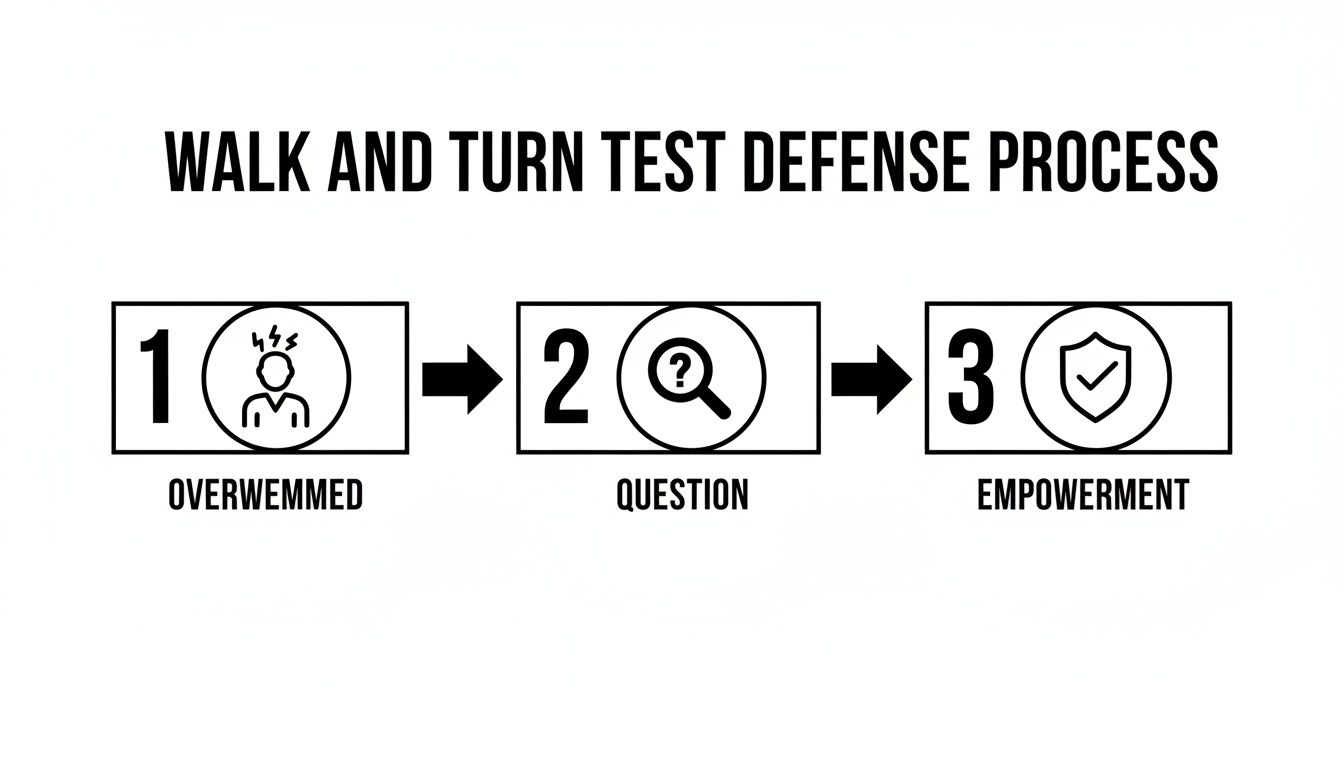
By digging into the details and learning how the test is supposed to be administered, you can shift from a position of uncertainty to one of strength.
Where Does This Test Come From?
The Walk and Turn test isn't something police officers invented. It was developed during a federal research program that began in the mid-1970s. For over 40 years, officers across Texas have been trained to use this exact nine-steps-out, nine-steps-back procedure to decide whether to arrest a driver for DWI.
This long, documented history is an advantage for your defense. It means the rules are set in stone, giving an experienced DWI attorney a clear checklist to determine if the arresting officer followed them correctly.
The 8 Standardized Clues of Impairment on the Walk and Turn Test
Officers are trained to look for eight specific mistakes, or "clues," during the test. These standards come directly from the National Highway Traffic Safety Administration (NHTSA), the agency that developed the test. According to their research, if an officer observes just two of these clues, they are trained to believe you have a blood alcohol concentration (BAC) over the legal limit.
Here is the exact list of what they are looking for:
| Clue Number | Clue Description | When It Is Observed |
|---|---|---|
| Clue 1 | Cannot keep balance while listening to instructions. | During the Instructional Stage |
| Clue 2 | Starts before the instructions are finished. | During the Instructional Stage |
| Clue 3 | Stops while walking to regain balance. | During the Walking Stage |
| Clue 4 | Fails to touch heel-to-toe (misses by more than 1/2 inch). | During the Walking Stage |
| Clue 5 | Steps off the line. | During the Walking Stage |
| Clue 6 | Uses arms for balance (raises them more than 6 inches). | During the Walking Stage |
| Clue 7 | Makes an improper turn (loses balance or doesn't follow instructions). | During the Walking Stage |
| Clue 8 | Takes an incorrect number of steps. | During the Walking Stage |
Understanding exactly what the officer was scoring you on is the first step toward dismantling their case. It allows us to move beyond the officer's subjective opinion and focus on the hard facts of whether the test was administered—and graded—correctly.
How External Factors and Medical Conditions Invalidate Test Results
A police officer might describe the walk-and-turn test as an objective measure of your sobriety. But that idea falls apart under the real-world conditions of a typical Texas traffic stop. The test’s official validity depends on having a perfectly flat, dry, well-lit surface with no distractions—a scenario that almost never exists on the shoulder of a busy highway.
When those ideal conditions aren’t met, the results become unreliable. A skilled Texas DUI attorney knows how to show that you were set up to fail for reasons that have nothing to do with alcohol.
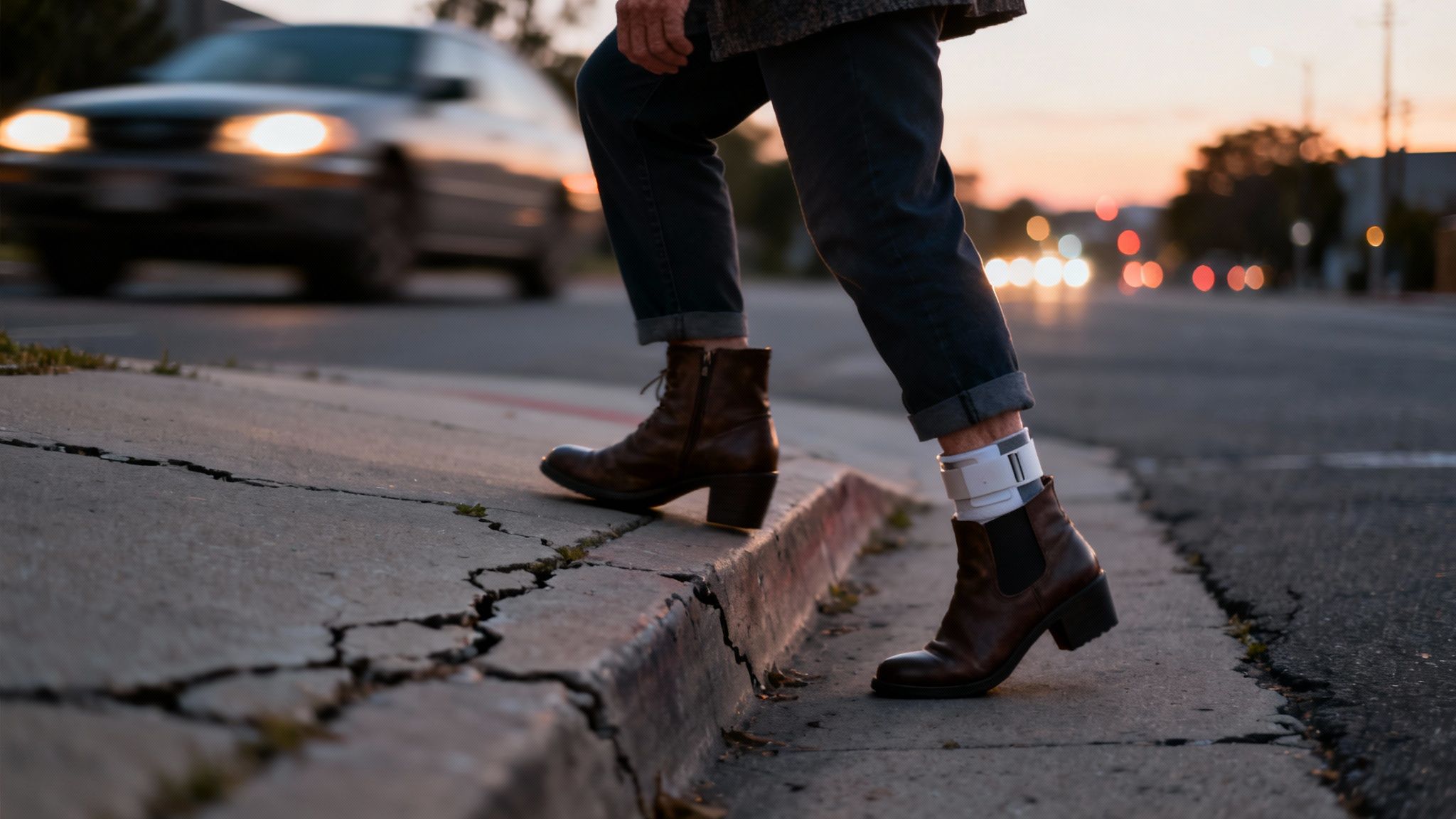
Many sober drivers "fail" this test not because they're impaired, but because the environment itself makes success nearly impossible. A sharp lawyer will immediately investigate the scene of your arrest to pinpoint these kinds of compromising factors.
Environmental and Situational Roadblocks
Where the test was administered is a critical piece of evidence. The officer is supposed to find a safe and appropriate place, but on the side of a highway at night, that’s a tall order. Any deviation from a perfect testing environment is a weak spot that can be used to challenge the test's validity.
Ask yourself if any of these conditions were present during your stop:
- Uneven or Unstable Surfaces: Was the test done on a soft grass shoulder, loose gravel, or a cracked and uneven patch of pavement? Any surface that isn't perfectly hard, level, and smooth can easily make a sober person stumble.
- Sloped Ground: Many Texas roads are built with a slight slope for water drainage. Trying to walk heel-to-toe on even a minor incline forces an unnatural adjustment and can easily be mistaken for an impairment clue.
- Poor Lighting: The test gets significantly harder in the dark or with the blinding glare of headlights and flashing police lights. If you can't see the line you're supposed to walk, how can you perform perfectly?
- Distracting Conditions: The roar of passing cars and 18-wheelers, and the sheer stress of a traffic stop create a chaotic environment. These distractions are designed to divide your attention—the very thing this test is supposed to measure.
The standardized instructions for the walk-and-turn test were developed in a controlled, clinical setting—not on the shoulder of I-45 in Houston with semi-trucks flying by. Your performance must be judged in the context of the real-world environment where the test was actually given.
How Personal Health and Physical Traits Affect Performance
Beyond the external environment, your own physical condition plays a huge role in your ability to perform the walk-and-turn test. In fact, NHTSA’s own training materials admit that certain people will have difficulty with the test regardless of sobriety. An officer who doesn't ask about these factors isn't conducting a fair evaluation.
These personal factors can completely invalidate the test's results:
- Age and Weight: Individuals over the age of 65 or who are 50 pounds or more overweight may naturally struggle with the delicate balance and coordination this test demands.
- Medical Conditions: Pre-existing injuries or chronic conditions can make passing the test impossible. This includes any issues with your back, legs, ankles, or knees, as well as neurological conditions or inner-ear problems that affect your equilibrium.
- Inappropriate Footwear: The test becomes exponentially harder if you're wearing high heels (over 2 inches), sandals, steel-toed boots, or flip-flops. The officer is supposed to give you the option to remove your shoes, but they often fail to do so.
If any of these environmental or personal factors were at play during your traffic stop, the officer's conclusion that you were impaired is built on a shaky foundation. An experienced Houston DWI lawyer at The Law Office of Bryan Fagan, PLLC, will meticulously dig into the details of your case, including any dashcam or bodycam video, to expose these flaws and build a defense designed to protect your rights.
The Questionable Science Behind The Walk and Turn Test
Law enforcement and prosecutors want juries to see the walk-and-turn test as a reliable, scientific tool for detecting impaired drivers. They will frame your performance as clear-cut evidence of intoxication. But when you examine the actual data—published by the same government agency that created the test—a very different picture emerges.
The truth is, the walk-and-turn test is far from a foolproof measure of sobriety. Its scientific foundation has significant cracks, its accuracy is questionable, and a skilled DWI attorney knows exactly how to expose those flaws.
Unpacking the Real Accuracy Rate
The National Highway Traffic Safety Administration (NHTSA) is the agency behind all standardized field sobriety tests (SFSTs). While they promote these tests as effective, their own studies reveal startling limitations.
According to NHTSA-sponsored research, the walk-and-turn test, when used alone, correctly identified drivers with a Blood Alcohol Concentration (BAC) of 0.10 or higher only about 68% of the time. This was under controlled, ideal laboratory conditions—not on the shoulder of a dark, uneven Texas road with flashing lights blinding the driver.
Think about that for a second. Even in a perfect setting, the test is wrong nearly one-third of the time. For every three people who "fail" this test, one of them might have been misjudged. That's a massive margin for error when your life and livelihood are hanging in the balance.
A statistic like that can create powerful reasonable doubt. It reframes the test from a definitive measure of guilt into what it actually is: a subjective physical challenge with a high rate of failure, even for sober people. You can learn more about the science of DWI testing and see how we challenge it in court.
Flawed Research Skews the Results
The problems with the walk-and-turn test's validity don't stop with its low accuracy rate. The original studies used to standardize the test were flawed, leaving out huge segments of the population.
For instance, the research acknowledged that people over the age of 65 or those with back, leg, or inner-ear issues would struggle with this test. Yet, in the foundational data set used to establish the test's "accuracy," less than 1.5% of the subjects were over 65 years old. How can a test be considered valid for a demographic that was barely included in the original study?
NHTSA even warns that drivers wearing heels over two inches high should be given the chance to remove them because footwear alone can drastically affect performance. These official warnings highlight just how sensitive the test is to outside factors that have nothing to do with alcohol.
An experienced Houston DWI lawyer at The Law Office of Bryan Fagan, PLLC knows how to use this questionable science to your advantage. We will argue that your performance wasn't a sign of intoxication, but the predictable outcome of a flawed, unfairly administered test designed for failure.
Common Police Mistakes That Can Get Your Case Dismissed
The entire value of the walk-and-turn test depends on the officer’s ability to administer it exactly according to standardized protocol. This isn't a flexible exercise where "close enough" counts. It's a rigid procedure, and any mistake can make the results unreliable and inadmissible in court.
A skilled Houston DWI lawyer knows that police officers are human. They get tired, rushed, and make errors under pressure. Those errors can become the key to dismantling the prosecution's case against you. At The Law Office of Bryan Fagan, PLLC, one of the first things we do is obtain any dashcam or bodycam footage of your arrest. We scrutinize every second for the common but critical mistakes officers often make when giving the walk-and-turn test.

Procedural Violations During Administration
The most frequent and damaging errors happen when an officer fails to follow the strict NHTSA guidelines. These aren't minor technicalities; they are procedural failures that can invalidate the test results. When we review your case, we are on the hunt for these specific violations.
- Giving Incorrect or Confusing Instructions: The officer is supposed to recite the instructions verbatim. If they rush through them, muddle the steps, or fail to clearly explain the turn, they are setting you up to fail.
- Failing to Demonstrate the Test Properly: An officer is required to physically demonstrate the heel-to-toe steps and the turn. A sloppy demonstration—or skipping it entirely—is a major procedural error.
- Ignoring Unsafe Conditions: As covered, the test demands a hard, dry, level surface. Forcing you to perform it on a gravelly shoulder, a sloped road, or in dim lighting violates protocol and makes the test fundamentally unfair.
- Failing to Ask About Medical Issues: The officer must ask if you have any physical conditions that would prevent you from completing the test. Forgetting this crucial step means they might misinterpret a medical symptom as a sign of intoxication.
These procedural mistakes are not just poor police work—they are legitimate grounds to challenge the admissibility of the test. If the test wasn't performed by the book, the "clues" the officer claims to have seen are meaningless.
Subjective Scoring and Interpretation Errors
Even if an officer administers the test perfectly, their scoring is often highly subjective and prone to bias. They are looking for eight specific clues, and it's shockingly common for them to misinterpret or exaggerate your movements. This is where video evidence becomes your best friend.
For instance, an officer might mark down "uses arms for balance" when you only slightly raised your arm for a split second. They may count a minor wobble as "stepping off the line." We have seen cases where officers score clues that simply did not happen, a fact that becomes obvious when a defense attorney compares the police report to the video footage.
A police officer’s opinion is not fact. When an officer’s written report claims you showed multiple signs of impairment, but the video shows something entirely different, their credibility is severely damaged. This discrepancy is a powerful tool to fight DWI Texas charges.
At The Law Office of Bryan Fagan, PLLC, our attorneys are trained to spot these inconsistencies because we know the NHTSA manual inside and out. We use that knowledge to hold the arresting officer accountable for every procedural shortcut and scoring error. These mistakes can be pivotal in getting the walk-and-turn test evidence thrown out, which can ultimately lead to a reduction of charges or a full dismissal of your DWI case.
How A Houston DWI Lawyer Uses Test Flaws to Protect You
Knowing the walk-and-turn test is flawed is one thing; using those flaws to build a strong defense is another. At The Law Office of Bryan Fagan, PLLC, our job is to methodically dismantle the state’s case against you. We never take a police report at face value—instead, we treat it as the starting point for a deep, critical investigation.
Our first move is to obtain all the evidence, especially the dashcam and bodycam footage from your arrest. This video is often the most powerful tool in your defense because it shows what really happened, not just the officer’s biased summary. We review this footage frame-by-frame, comparing the officer's actions against the strict NHTSA protocol.
Exposing Errors Through Scrutiny
We hunt for specific, procedural mistakes that make the test results unreliable. Did the officer speak too fast while giving instructions? Did they fail to properly demonstrate the turn? Were you asked to perform this balancing act on a sloped, gravelly roadside?
These details are everything. Each deviation from standardized procedure is a crack in the prosecution's case. Our attorneys know the NHTSA manual thoroughly, which allows us to spot the subtle but critical errors that others might miss.
Taking Legal Action with Motions to Suppress
When we find significant procedural flaws, we take proactive legal action by filing a Motion to Suppress Evidence. This is a formal request asking the judge to exclude the walk-and-turn test results entirely because the officer failed to follow the rules.
If the judge grants our Motion to Suppress, the jury may never even hear that a walk-and-turn test was performed. Removing this evidence can cripple the prosecutor's ability to prove their case beyond a reasonable doubt.
This is a strategic strike designed to weaken the case against you. A successful motion often leads to a better plea offer, a reduction in charges, or even a complete dismissal of your DWI case.
Creating Reasonable Doubt in Court
If your case moves forward to a hearing or trial, our preparation becomes your shield. This applies to both your Administrative License Revocation (ALR) hearing, where we fight a potential DWI license suspension, and your criminal court case.
During cross-examination, we use the officer’s own mistakes against them to challenge their credibility. We ask pointed questions about their training, the poor testing conditions, and every procedural corner they cut.
- Highlighting Contradictions: We show the jury the stark differences between the police report and what the video evidence clearly shows.
- Challenging Subjective Scoring: We force the officer to admit that scoring a "clue" is subjective and that a minor wobble could have been caused by nerves or uneven ground—not alcohol.
- Establishing Alternative Causes: We introduce other logical explanations for poor balance, like your medical conditions, footwear, or the terrible testing environment.
This methodical deconstruction is designed to create reasonable doubt. We show the judge or jury that this wasn't a fair or reliable scientific test. It was a flawed procedure, set up for you to fail. Instead of seeing a "failed test," they see a failed process. To get a clearer picture of our defense strategies, review our comprehensive Houston DWI defense guide.
Your future shouldn't hang in the balance because of a subjective, error-prone roadside game. Contact The Law Office of Bryan Fagan, PLLC, for a free consultation. Let us show you how we fight back to protect your rights.
Common Questions We Hear About the Walk-and-Turn Test
After the stress of a DWI stop, you probably have many questions. The walk-and-turn test, in particular, often leaves people confused. Getting clear, direct answers is the first step toward building your defense. Here are answers to some common questions we hear from clients.
Can I Refuse to Do the Walk-and-Turn Test in Texas?
Yes. You have the absolute right to refuse any and all field sobriety tests in Texas, including the walk-and-turn. These tests are voluntary. Unlike the breath or blood test, where refusal has automatic administrative license suspension penalties under Texas's implied consent law, there is no direct legal penalty for politely declining a field sobriety test. Doing so simply gives the officer less subjective evidence to use against you.
If the Officer Said I "Failed" the Test, Does That Mean I'll Be Convicted of DWI?
Absolutely not. A so-called "failure" on the walk-and-turn test is a long way from a DWI conviction. It is just one piece of evidence, and it is often the easiest to challenge.
As we've laid out, the test is riddled with problems. It is subjective, officers often administer it incorrectly, and a dozen other factors can make a sober person appear "impaired." A sharp Houston DWI lawyer will dismantle the test's credibility by highlighting the officer's errors, the poor roadside conditions, or explaining how your medical history made it impossible to perform perfectly.
A "failed" test isn't the end of your case—it's often the beginning of a powerful defense strategy. Our job is to show that the test didn't measure intoxication; it measured your ability to perform a bizarre, stressful physical stunt on the side of a dark road.
What if There Wasn't Even a Line for Me to Walk On?
This happens far more often than you would think and is a major procedural error. The official NHTSA training manual is clear: the test requires a "designated straight line" on a surface that’s reasonably dry, hard, level, and not slippery.
If there’s no painted line, the officer must instruct you to imagine one. When they fail to give you a clear reference point—either real or imaginary—it's a significant mistake. A skilled DWI defense attorney will use that failure to argue that the test results are completely unreliable and should be thrown out of court.
A DWI arrest can be overwhelming, but you don’t have to face it alone. At The Law Office of Bryan Fagan, PLLC, our experienced Houston DWI lawyers dig into every detail of your arrest to build a strategic defense. We are here to protect your rights, your license, and your future.
Let us help you understand your options. Contact us today for a free, confidential case evaluation and take the first step toward getting your life back on track. https://texasduilawfirm.com