
A DWI arrest can be overwhelming—but you don’t have to face it alone. When you hear the term “third-degree DWI” in Texas, you need to understand one thing above all else: you’re no longer facing a simple misdemeanor. This is a felony charge, and the stakes are exponentially higher. For most people, this charge comes after a third DWI arrest, but other circumstances can trigger it, too.
A felony conviction isn’t just about bigger fines or a longer license suspension. It means potential state prison time, a permanent criminal record that follows you everywhere, and the loss of fundamental civil rights. This guide will help you understand the charges you face and how a skilled Houston DWI lawyer can help protect your future.
What Exactly Is a Third-Degree DWI?
Getting arrested for DWI can be confusing and frightening. If you’re facing a third-degree charge, understanding the specifics is the first step toward building a strong defense. In Texas, the law escalates penalties for repeat offenses. A third DWI crosses the line from a misdemeanor—which is handled in county court—to a serious felony.
This isn’t just a label change. It's a complete shift in how the state will prosecute your case and the life-altering penalties on the table. Why the harsh jump? The state sees a third offense not as another mistake, but as a pattern of behavior it wants to stop.
Statistics often back up this aggressive stance. Studies have shown that drivers with a BAC of 0.08 or higher who are involved in fatal crashes are six times more likely to have prior DWI convictions than sober drivers. You can explore the research on this topic to see why prosecutors take these cases so seriously.
The Jump from Misdemeanor to Felony
That leap from a misdemeanor to a felony is a game-changer. Here’s a practical breakdown of what that really means for your case:
- A Different Courthouse: Your case will be heard in District Court, a venue reserved for serious felony crimes, not the local county court.
- A Tougher Prosecutor: The District Attorney's office will handle the prosecution, and they often assign experienced lawyers with more resources to secure felony convictions.
- Serious Penalties: Forget county jail time. You’re now looking at 2 to 10 years in state prison and a fine of up to $10,000.
- Lifelong Consequences: A felony conviction strips you of certain rights forever. You may lose the right to own a firearm and the right to vote while incarcerated or on parole.
An arrest is not a conviction. The prosecution still carries the burden of proving every single element of their case beyond a reasonable doubt, regardless of your history. A sharp Houston DWI lawyer can dismantle their evidence piece by piece.
Facing a third-degree DWI can feel like you're staring up at a mountain. But it’s a fight that can be won. Every case has potential weaknesses—an illegal traffic stop, sloppy field sobriety tests, or a faulty breathalyzer machine. Your future is on the line. The single most important thing you can do right now is get an experienced legal expert in your corner to protect your rights.
Texas DWI Penalties Explained
To build a powerful defense, you first have to understand exactly what you're up against. A third-degree DWI charge in Texas isn't just another legal hurdle; it's a completely different ballgame with consequences far beyond what you might face with a misdemeanor. Let's break down what's at stake in clear, straightforward terms.
The penalties for a felony are designed to be severe. This isn’t about scaring you—it's about being prepared. A conviction means you're looking at significant time in state prison, crushing fines, and mandatory court-ordered programs that can impact your life for years.
This infographic shows that critical jump from a misdemeanor to a felony, putting the legal severity into perspective.
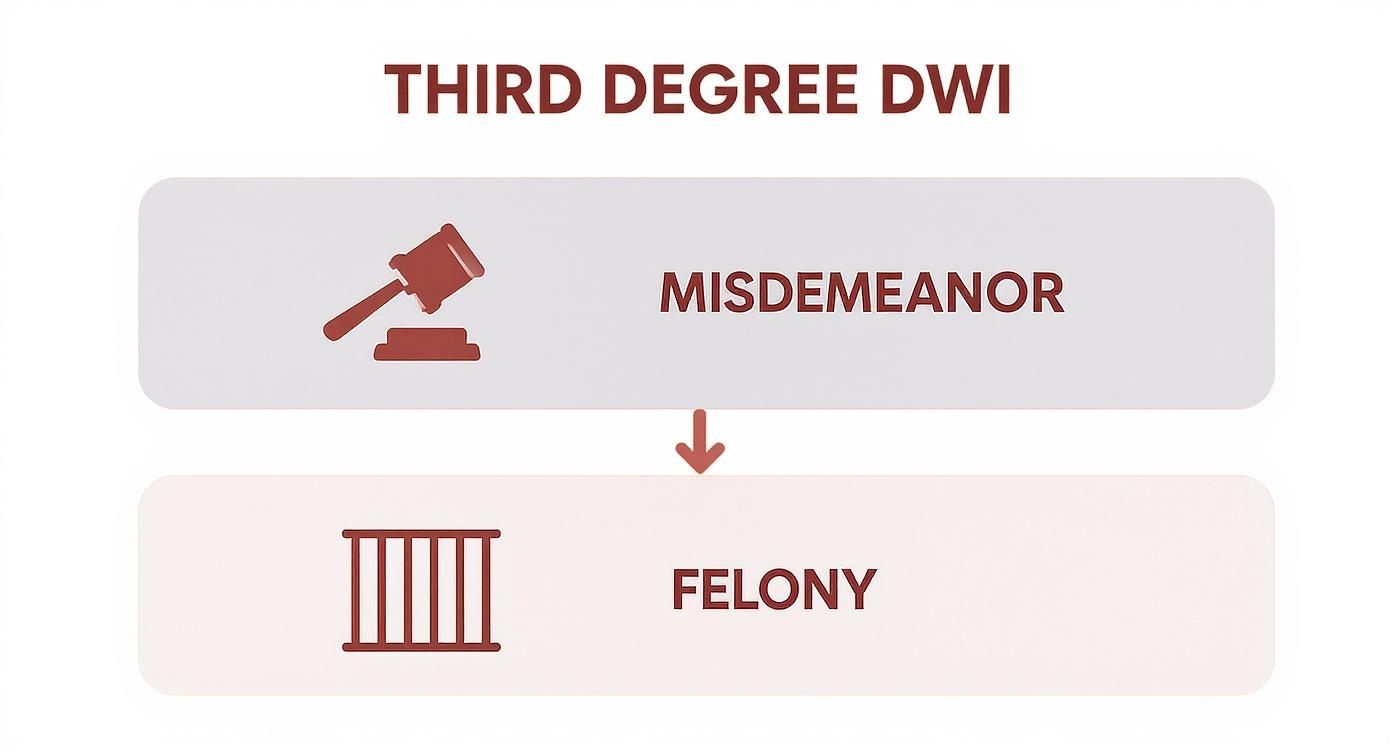
As the graphic highlights, the defining difference is the threat of state prison—a consequence reserved for the most serious crimes in Texas.
Comparing Misdemeanor and Felony Consequences
The clearest way to grasp the seriousness of a third-degree DWI is to see how its penalties stack up against a first DWI in Texas. From the legal system's point of view, a third offense shows a pattern of behavior, and the punishments are scaled up accordingly.
To put it in perspective, here’s a quick side-by-side look at how the potential penalties escalate with each offense.
Texas DWI Penalties at a Glance
| Penalty Type | First DWI (Class B Misdemeanor) | Second DWI (Class A Misdemeanor) | Third DWI (Third Degree Felony) |
|---|---|---|---|
| Jail/Prison Time | 3 to 180 days in county jail | 30 days to 2 years in county jail | 2 to 10 years in state prison |
| Maximum Fine | Up to $2,000 | Up to $4,000 | Up to $10,000 |
| License Suspension | Up to 1 year | Up to 2 years | Up to 2 years |
As you can see, the jump is huge. The biggest shift is from serving time in a local county jail to being incarcerated in the Texas state prison system. That distinction alone changes everything.
Mandatory Minimums and Other Strings Attached
One of the toughest parts of a third-degree DWI charge is the reality of mandatory sentences. While a skilled Houston DWI lawyer can fight to keep you from the maximum penalties, certain minimums are incredibly difficult to dodge without a rock-solid defense.
Here are some of the other penalties that almost always come with a felony conviction:
- Mandatory Jail Time: Even if you get probation (what Texas calls "community supervision"), a judge will almost certainly require you to serve an initial stint in jail—often 30 to 180 days—as a condition of that probation.
- Ignition Interlock Device (IID): A conviction means you'll be required to install an IID on any vehicle you drive. This device is a small breathalyzer that stops your car from starting if it detects any alcohol.
- Lengthy Probation: If you're fortunate enough to receive probation instead of a long prison sentence, the term can last for up to 10 years. This period comes with strict rules, like regular check-ins, random testing, and completing substance abuse programs.
- Community Service: Courts often tack on hundreds of hours of community service, anywhere from 160 to 600 hours.
A third-degree DWI conviction doesn’t just impact your freedom; it follows you. The financial burden, loss of rights, and the stigma of being a convicted felon can last a lifetime. This is why a proactive, strategic defense is not a luxury—it's a necessity.
These penalties aren't set in stone the moment you're arrested. They represent what the prosecution will be aiming for. An experienced Texas DUI attorney can challenge the evidence, negotiate with prosecutors, and fight to protect your freedom and your future at every turn. You have options, but the clock is ticking.
Your First Steps After a Felony DWI Arrest
Getting arrested for a felony DWI feels like the world is crashing down. It's disorienting, frightening, and easy to panic. But the next few hours and days are absolutely critical. This isn't the time to freeze—it's the time to get strategic and start building your defense.
By taking the right steps, you can regain some control and put yourself in the best possible position to protect your future.

The moments after an arrest are a blur of booking, processing, and trying to figure out bond. While every step matters, there's one deadline that towers above all the rest. If you miss it, you've already lost your first battle.
The 15-Day ALR Hearing Deadline
Your number one priority is the Administrative License Revocation (ALR) hearing. You have a razor-thin window—just 15 days from the date of your arrest—to formally request this hearing. If you fail to meet this deadline, the Texas Department of Public Safety (DPS) will automatically suspend your driver's license. This is known as administrative license suspension.
This hearing is a separate civil process, completely independent of your criminal case, that decides the fate of your driving privileges. But it’s much more than that. The ALR hearing is often the first real chance your lawyer gets to go on the offensive. It’s where we can:
- Subpoena the arresting officer and question them under oath.
- Get an early look at police reports and other key evidence.
- Identify weaknesses in the state’s case before it even gets off the ground.
Winning the hearing means you can avoid a DWI license suspension. But even if you don't, the testimony and evidence uncovered can become the foundation of a powerful criminal defense strategy. We can help you learn more about how to navigate the State Office of Administrative Hearings in Texas and keep you on the road.
Get Out of Jail, Then Stay Quiet
Once you're booked, the next immediate goal is to secure your release from jail. A judge will set a bond amount based on your past record and the details of your third degree DWI charge. A skilled attorney can often make a strong case for a lower, more reasonable bond and help you navigate the process.
After you're released, your most important job is to exercise your right to remain silent. Do not talk about your case with anyone—not your friends, not your family, and definitely not the police—unless your lawyer is right there with you. Every word you say is a potential weapon that a prosecutor can and will use to try and secure a felony conviction.
The moments after an arrest are when people make the most mistakes. Your only job is to be polite, provide basic identification, and state clearly, "I want to speak with my attorney." This simple act is your most powerful defense.
Contact an Experienced Houston DWI Lawyer Immediately
You wouldn't ask a general family doctor to perform heart surgery, and you shouldn't trust a general practice lawyer with a felony DWI charge. The stakes are simply too high. You need a specialist who lives and breathes Texas DWI law.
Prosecutors are incredibly aggressive in these cases. Statistics from the FBI have shown around 1 million DWI arrests per year in the U.S. during certain periods. In 2018 alone, there were 10,511 deaths in alcohol-related crashes, which is a big reason why the state throws everything it has at these charges. You can read the full analysis on alcohol-impaired driving statistics to see the data for yourself.
This is why you need an expert in your corner from day one. An experienced Texas DUI attorney will immediately file the ALR request, start preserving crucial evidence, and begin building a defense tailored to protect your freedom and your future.
Building a Strategic DWI Defense
An arrest for a third-degree DWI is a challenging moment, but it’s just the beginning of the fight—it is absolutely not a conviction. The prosecution carries the entire weight of proving your guilt, and their standard is incredibly high: beyond a reasonable doubt. A seasoned DWI attorney doesn't just wait to see what the state comes up with. We start taking their case apart, piece by piece, from the second you were pulled over.
Every DWI charge is built on a stack of evidence. If we can knock out a foundational piece, the whole case can become unstable. Our job is to find the cracks, the procedural missteps, and the violations of your rights. This means a painstaking review of every single report, video, and lab result.

This isn't about looking for one magical loophole. It's a systematic process of challenging every decision the officer made and every piece of so-called evidence they collected.
Questioning the Initial Traffic Stop
The entire case depends on one simple question: did the officer have a legal reason to pull you over in the first place? If they didn't, any evidence they gathered afterward—the field sobriety test results, the breath or blood sample—can be thrown out of court.
To pull you over, an officer needs reasonable suspicion that you've broken a law. This can't just be a hunch; it has to be based on specific facts they can articulate. We pull the dashcam and bodycam footage to see what really happened, not just what the officer wrote in their report.
We often find grounds to challenge stops based on things like:
- Minor traffic violations: Did you really fail to signal for 100 feet, or was it closer to 50? We check the video against the law.
- Weaving within a single lane: You don't have to drive perfectly. Simple weaving inside your lane, without crossing any lines, is often not enough to legally justify a traffic stop.
- Anonymous tips: A random 911 call isn't a free pass for police to pull anyone over. They need to observe their own evidence to back up the tip.
If we can show the stop was unconstitutional, the case is often over before it even begins. This is frequently the strongest and first line of defense when you need to fight DWI Texas charges.
Scrutinizing Field Sobriety and Chemical Tests
After the stop, you were likely asked to perform a Standardized Field Sobriety Test (SFST). Let's be clear: these aren't simple pass/fail tests. They are divided-attention exercises designed to be confusing and difficult for almost anyone, sober or not, especially under pressure.
An experienced Houston DWI lawyer knows how to pick these tests apart in court. We look at several factors that can make the results completely unreliable:
- Improper Instructions: Officers are trained to give instructions exactly as laid out by the National Highway Traffic Safety Administration (NHTSA). If they deviate from the script, the test is invalid.
- Environmental Conditions: Was it dark? Was the ground uneven? Were you standing on a busy roadside with cars flying past? All of these things can affect your performance.
- Physical Limitations: Your age, weight, past injuries, or medical conditions can make it physically impossible to "pass" these tests, no matter how sober you are.
The same goes for breath and blood tests—they are far from perfect. Under Texas's implied consent law, you are required to submit to a chemical test if lawfully arrested. However, the equipment and procedures are not infallible. Breathalyzer machines must be calibrated and maintained on a strict schedule. We subpoena the logs to find errors or a history of faulty readings. Blood vials can be contaminated, stored improperly, or mixed up in the lab. We attack the chain of custody, which is the paper trail documenting every person who handled your blood sample.
A prosecutor's case is only as strong as its weakest link. Our job is to find every procedural error, every equipment malfunction, and every violation of your rights to dismantle their argument and protect your freedom.
By attacking the very foundation of the state's case, we create the reasonable doubt needed to win. An arrest doesn't have to define your future. With an aggressive, strategic defense, you can fight back.
The Hidden Consequences of a Felony Conviction
The courtroom penalties for a third-degree DWI—prison time and massive fines—are daunting enough. But the impact of a felony conviction doesn’t stop when your sentence is complete. It follows you.
A felony conviction creates a ripple effect, touching nearly every part of your life for years, sometimes forever. These are the hidden consequences, the ones that can be just as devastating as the criminal penalties themselves. A felony is a permanent red flag on your record, one that follows you into job interviews, housing applications, and loan offices. That's why a strategic defense isn't just about fighting the immediate charge; it's about protecting your entire future.

Your Career and Professional Life at Risk
For countless Texans, a career is built on a foundation of trust and a clean record. A felony DWI conviction can shatter that foundation in an instant.
Many professions that require state licensing—think nursing, aviation, real estate, or law—have strict character and fitness requirements that can be impossible to meet with a felony. A conviction can quickly lead to:
- Denial of a new professional license.
- Suspension or outright revocation of an existing license.
- Struggles finding employment in any field that requires a background check.
Even if your job doesn’t require a specific license, many employers are simply unwilling to hire someone with a felony record. This can severely limit your career opportunities and your ability to provide for your family.
Broad Impacts on Your Personal Freedoms
Beyond your career, a felony conviction strips away fundamental rights and throws up roadblocks in your daily life. The consequences are far-reaching and often permanent, affecting everything from your family to your financial stability.
A felony record doesn't just close doors; it can lock them permanently. This is why a proactive, aggressive defense is critical. We fight to prevent a conviction that could impact your right to vote, own a firearm, or even secure a safe place to live.
This isn’t just a Texas issue; impaired driving has global consequences. Alcohol is a factor in approximately 21.8% of all road traffic fatalities worldwide—a staggering number that fuels the aggressive prosecution of repeat DWI offenders here and everywhere else. You can discover more insights about these global DWI statistics on sandlawnd.com.
Other Lasting Collateral Consequences
Here are just a few of the other ways a third-degree DWI conviction can alter your future:
- Loss of Firearm Rights: Under both Texas and federal law, convicted felons are prohibited from owning or possessing firearms for life.
- Housing Difficulties: Many landlords and apartment complexes run background checks and will deny applications from anyone with a felony conviction.
- Child Custody Issues: A felony DWI can be used against you in family court, potentially affecting your custody arrangements or visitation rights.
- Immigration Status: For non-citizens, a felony conviction can lead to deportation, denial of naturalization, or being barred from re-entering the United States.
- Financial Hurdles: Securing financing for a car, home, or education becomes incredibly difficult with a felony on your record.
While the path is tough, it's important to know that in some very specific circumstances, options may exist down the road. You can learn more by reading about expunging a DWI in Texas to see what may be possible long-term.
How We Defend Your Rights and Future
You don't have to face this overwhelming challenge on your own. A third-degree DWI charge is one of the most serious situations anyone can go through, but it’s critical to remember that a proactive, strategic defense can completely change the outcome. An arrest is just the beginning of a legal process, not the end. Our entire focus is on protecting your rights at every single turn.
At The Law Office of Bryan Fagan, we have deep experience fighting and winning felony DWI cases for clients in Houston and across Texas. We understand what’s at stake—your freedom, your career, and your future. Our approach is professional, reassuring, and built on a foundation of proven legal strategies that work.
A Defense Built for Your Case
No two DWI cases are ever the same. The specific details matter. The reason for the traffic stop, how the field sobriety tests were given, and the way chemical evidence was handled are all unique to your situation. We meticulously pick apart every piece of the prosecution's case to find the weaknesses and build a defense tailored to the facts.
Our defense process involves:
- Challenging the Traffic Stop: We dig into the officer's reason for pulling you over in the first place. If the stop was illegal, the evidence that follows could be thrown out.
- Deconstructing the Evidence: We investigate everything from the administration of field sobriety tests to the calibration and maintenance records of the breathalyzer or blood testing equipment. Mistakes here are more common than you'd think.
- Negotiating from a Position of Strength: By finding the flaws in the state’s case, we create the leverage needed to fight for dismissals, get charges reduced, or secure alternative sentencing that keeps you out of jail.
A strong legal defense isn’t just about reacting to what the prosecutor does; it’s about taking control of the narrative. We force the state to prove every single allegation beyond a reasonable doubt, holding them to the highest legal standard.
Taking that first step to get proven legal help is the most important one you can make right now. We invite you to schedule a free, confidential consultation to talk about your case. Let us show you how we can fight to protect your future.
Common Questions About Third Degree DWI Charges
When you're facing a felony charge as serious as a third-degree DWI, your mind is probably racing with urgent questions. The uncertainty can be overwhelming, but getting clear, straight answers is the first step toward regaining control of your situation.
Here, we'll address some of the most common concerns we hear from clients in your exact situation. No legal jargon, just direct, practical information to help you understand what you're up against.
Can a Third DWI in Texas Be Reduced to a Misdemeanor?
It's exceptionally difficult, but not always impossible. When you're facing a felony DWI, prosecutors are far less willing to negotiate than they might be for a first or second offense. However, a skilled Houston DWI lawyer can create leverage by relentlessly attacking every piece of the state's evidence.
Success often comes down to finding critical, case-breaking flaws, such as:
- An unconstitutional traffic stop.
- Improperly administered field sobriety tests.
- Major errors in the breath or blood testing procedures.
If we can expose significant weaknesses in their case, we can sometimes negotiate for a reduction to a lesser charge, like reckless driving. But make no mistake, for a felony DWI, this is a hard-won victory that requires a strong defense.
Is Prison Time Mandatory for a Third DWI Conviction?
Yes, if you are convicted of a third-degree felony DWI in Texas, the law mandates a prison sentence of 2 to 10 years. But a conviction is never a given. An effective defense is designed to prevent that outcome entirely, whether that means getting the case dismissed or hearing the words "not guilty" from a jury.
In some situations where a conviction can't be avoided, we may be able to secure probation, which is called "community supervision" in Texas. Even then, a judge will almost certainly require a stretch of jail time upfront—often 30 to 180 days—as a condition of that probation.
Being charged with a felony does not mean you are going to prison. Your defense starts now, and every action we take from this point forward is aimed at protecting your freedom and avoiding that outcome.
Can a Felony DWI Ever Be Removed from My Record?
In Texas, a DWI conviction is for life. It cannot be expunged from your criminal record. If you are convicted of a third degree DWI, it will follow you forever.
However, if your case is dismissed or you are found not guilty at trial, you may be eligible to have the arrest record expunged. This is another massive reason why fighting the charge is so critical—it's your only shot at keeping your record completely clean.
At The Law Office of Bryan Fagan, PLLC, we understand the immense pressure you're under. A felony charge threatens everything you've worked for, but a powerful, strategic defense can change the entire equation. Don't wait to get the answers and the help you deserve. Contact us today for a free, confidential case evaluation to discuss your rights and start building your defense. Learn more at https://texasduilawfirm.com.