
A DWI arrest can be overwhelming, but it doesn't have to define your future. In Texas, a Texas record expungement is a powerful legal process that literally destroys all records of an arrest, allowing you to legally deny it ever happened. It's the first step toward a truly clean slate, and you don’t have to face it alone.
Your Path to a Clean Slate After an Arrest

Facing the aftermath of an arrest is overwhelming. The shadow of a criminal record can creep into every corner of your life, complicating job applications, housing opportunities, and your general peace of mind. But Texas law offers a clear path forward for those who qualify.
Two primary tools exist to help you move forward: expungement (also called expunction) and an order of nondisclosure. Each serves a different purpose, but both are designed to help you reclaim your life after a difficult time. Understanding your options is the critical first step in this journey, and we're here to help you take that step.
Understanding Your Legal Options
Think of an expungement as hitting the "delete" button on your arrest record—permanently. Once a judge grants an expungement, every agency involved, from the arresting police department to the court itself, must destroy every file related to the incident. Legally, it's as if it never happened.
An order of nondisclosure, on the other hand, is more like putting the record in a locked vault. It seals the record from public view, making it inaccessible to most employers, landlords, and the general public.
Which strategy is right for you depends entirely on the outcome of your specific case. For many Texans, these legal remedies aren't just a long shot; they are frequently used paths to a second chance.
Data shows that from late 2018 through early 2025, Texas courts processed 9,555 expungements, hitting a significant peak in 2021. This shows a real and ongoing demand for record relief across the state.
These numbers highlight a crucial reality: thousands of people just like you are successfully clearing their records every year. This isn't some obscure legal loophole but a well-established procedure. You can dig into these trends by reviewing the expungement totals provided by Texas courts.
At The Law Office of Bryan Fagan, PLLC, our job is to turn this complex legal challenge into a manageable, successful process. We’re here to give you the strategic guidance needed to navigate the system with confidence and finally achieve the clean slate you deserve.
Expungement vs. Nondisclosure Explained
When you're looking to clear your record in Texas, you'll encounter two key legal tools: expungement and nondisclosure. While they sound similar and both aim to give you a fresh start, they are fundamentally different. Choosing the right path for your situation is the most critical decision in the entire process.
Think of it this way. A Texas record expungement (also called an expunction) is like having a document professionally shredded, incinerated, and its digital files permanently wiped from every server. Once a judge grants an expungement, every single record of your arrest is physically destroyed. It’s gone for good, allowing you to legally and truthfully deny the arrest ever happened.
An order of nondisclosure, on the other hand, is like taking that same document and sealing it away in a high-security bank vault. The record still exists, but it’s completely hidden from the public. That means the vast majority of people—like potential employers, landlords, and curious neighbors—will never see it.
What This Means For You
The real-world difference comes down to who can still peek inside that vault. With an expungement, the vault is empty; virtually no one can see a record that no longer exists. With a nondisclosure, the record is locked away from the public but remains accessible to law enforcement and certain state agencies for very specific purposes, like government licensing or sensitive security clearances.
Because an expungement is so final and powerful, the eligibility rules are much stricter. It's generally reserved for cases where you were never actually found guilty of a crime. You might qualify if:
- The prosecutor dismissed your case entirely.
- A jury found you "not guilty" at trial.
- You successfully finished a pretrial diversion program.
An order of nondisclosure is the go-to remedy for people who successfully completed a deferred adjudication probation. It isn't a total erasure, but it's an incredibly effective solution that keeps your past from defining your future. For a much deeper look at the specifics, check out our guide on getting an order of nondisclosure in Texas.
Comparing Your Options Side-by-Side
To make the right choice, you need a clear, side-by-side comparison. The path you take will depend entirely on how your criminal case ended and what you need to accomplish for your future.
The table below breaks down the key distinctions between these two powerful legal remedies.
Expungement vs. Nondisclosure at a Glance
This table compares the key features of Texas Expungement and Orders of Nondisclosure to help you understand which legal remedy may be right for you.
| Feature | Expungement (Expunction) | Order of Nondisclosure |
|---|---|---|
| Legal Effect | All records of the arrest are physically destroyed. | Records of the arrest are sealed from public view. |
| Your Legal Right | You can legally deny the arrest ever happened. | You can deny the arrest in most situations (e.g., jobs). |
| Who Can See It | Virtually no one. The record is gone. | Law enforcement, government agencies, some licensing boards. |
| Common Eligibility | Case dismissed, found not guilty, pretrial diversion. | Successfully completed deferred adjudication probation. |
Both options are designed to give you a vital second chance, and neither should be underestimated.
An expungement offers a completely clean slate, which is the ideal outcome. However, an order of nondisclosure is an incredibly powerful tool that effectively removes a past mistake from public scrutiny, allowing you to pursue your personal and professional goals without hindrance.
Trying to figure this out on your own can be challenging. A simple mistake in filing could mean losing your one shot at clearing your name. That's where an experienced attorney comes in. We can analyze the unique facts of your case, help you choose the right strategy with confidence, and make sure it’s executed perfectly.
Qualifying for a Texas Record Expungement
Eligibility is the first—and most important—hurdle when you're seeking to clear your record. Fortunately, the path to a Texas record expungement is clear-cut. It’s designed for situations where the legal system ultimately did not find you guilty, offering you a genuine fresh start.
Think of it this way: an expungement is for people whose cases ended favorably. It's not available for every situation, but if your case was dismissed or you were found not guilty, you're likely on the right track. Understanding exactly what that means is the first step to seeing if this powerful legal tool is available to you.
Who Is Eligible for an Expungement
In Texas, you generally have the right to an expungement if you were arrested for a misdemeanor or felony but were never actually convicted. The final outcome of your case has to meet some very specific standards.
The most common scenarios where an expungement is an option include:
- You Were Acquitted: A judge or jury found you "not guilty" at trial. This is the most straightforward path to an expungement.
- Your Case Was Dismissed: The prosecutor decided to drop the charges against you, and the clock has run out for them to refile.
- You Received a Pardon: You were officially pardoned by the Governor of Texas or the President of the United States.
- You Completed a Pretrial Diversion Program: You successfully finished a formal program that led to your charges being dismissed.
It's critical to know that a dismissal after completing most types of deferred adjudication does not qualify for an expungement. While that's still a great outcome, it usually makes you eligible for an order of nondisclosure instead. You can get the full story by checking out our guide on what deferred adjudication means for your case.
This decision tree helps visualize the two main paths for clearing an arrest record here in Texas.
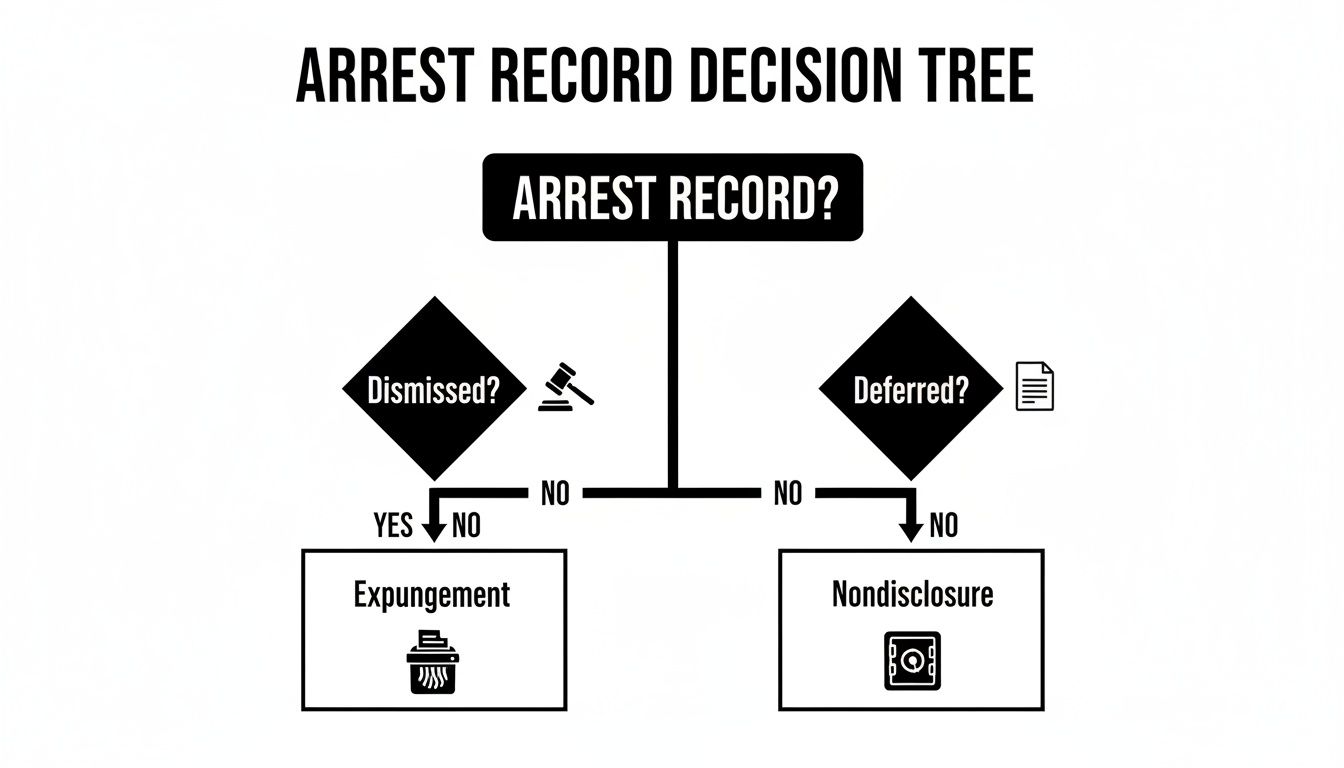
As you can see, a true dismissal usually points toward expungement (record destruction), whereas finishing deferred adjudication points toward nondisclosure (record sealing).
Mandatory Waiting Periods Before Filing
Even with a dismissal, you can't just walk into the courthouse the next day and file for an expungement. Texas law requires a waiting period for the statute of limitations on the alleged offense to expire. This waiting period acts as a safeguard, ensuring the prosecutor can't turn around and refile the charges against you.
How long you have to wait depends entirely on the severity of the offense you were arrested for:
- Class C Misdemeanors: 180 days from the date of arrest.
- Class A & B Misdemeanors: One year from the date of arrest.
- Felonies: Three years from the date of arrest.
These timelines have become much more consistent thanks to recent changes in the law. Reforms have made the waiting periods and eligibility rules far more predictable for people whose arrests didn't lead to a conviction, helping thousands get the clarity they need.
How DWI Arrests Affect Expungement Eligibility
So, where does a DWI arrest fit into all of this? This is a question our Houston DWI lawyers get all the time, and the answer comes down to a crucial difference between a DWI arrest and a DWI conviction.
Let’s be clear: a final conviction for a DWI in Texas can almost never be expunged. The law is incredibly strict on this. However, if you were arrested for DWI but the case ended in your favor, you absolutely may be eligible for an expungement.
For example, let's say your DWI lawyer successfully got the evidence suppressed, and the prosecutor had no choice but to dismiss your case. After the one-year waiting period for misdemeanors, you could qualify for an expungement. The same goes if you took your case to trial and a jury found you not guilty.
The key takeaway is that an expungement targets the arrest record, not a conviction. If your DWI arrest did not lead to a final conviction, you have a strong chance of being able to permanently destroy the record of that event.
Figuring out these eligibility rules can feel overwhelming, especially when you're already dealing with the stress of a DWI charge. You don’t have to go it alone. An experienced Texas DUI attorney can dig into the specifics of your case, confirm whether you qualify, and manage the entire process to secure the clean slate you deserve.
How the Texas Expungement Process Works

The legal journey to a Texas record expungement can feel complex, but it's a structured, manageable process when you know the steps. You don’t have to navigate this path alone; think of it as a methodical roadmap to your clean slate, where an experienced attorney handles the heavy lifting while you focus on moving forward.
We've designed this guide to cut through the legal jargon and show you exactly what to expect from start to finish. From gathering the initial paperwork to receiving the final court order, each stage has one goal: destroying your arrest record for good.
Step 1: Gathering Your Case Information
First, we need to collect all the necessary information about your arrest and the court case that followed. Precision here is everything—any error or missing detail can cause frustrating delays. Your attorney will need the official records to draft a flawless petition.
This includes key details like:
- Arrest Details: The exact date of the arrest, the specific offense you were charged with, and the name of the arresting police department.
- Case Identifiers: The case or cause number the court assigned to your charge, along with the court that handled it (e.g., County Criminal Court at Law No. 5 of Harris County).
- Disposition Information: The final outcome. Was it dismissed? Were you acquitted? Did you complete a pretrial diversion program?
Your attorney will work with you to pull these documents together, making sure every detail is accurate before taking the next step. This foundational work sets the stage for a smooth process.
Step 2: Drafting and Filing the Petition for Expunction
Once all the information is verified, your lawyer gets to work drafting the formal Petition for Expunction. This isn't just a simple form; it's the official legal document that formally requests the court to order the destruction of your records. It must be meticulously prepared, listing every single government agency that holds a record of your arrest.
This petition is then filed in the district court of the county where the arrest happened. The moment it’s filed, the legal clock starts ticking.
Step 3: Notifying All Relevant Agencies
After filing the petition, the law requires every agency holding records of your arrest to be formally notified. This isn’t a casual email. It’s a legal process called "service," where each entity receives an official copy of your petition.
The list of agencies that must be notified includes:
- The arresting police department or sheriff’s office
- The District Attorney’s or County Attorney’s Office
- The District and County Clerks
- The Texas Department of Public Safety (DPS)
This step ensures every agency has a chance to contest the expungement. However, objections are rare in cases where eligibility is clear-cut.
Step 4: The Court Hearing and Final Order
With all agencies notified, the court will schedule a hearing. For most people who clearly qualify and face no objections, this hearing is a straightforward formality. You probably won't even need to show up, as your attorney can appear on your behalf.
The judge will review the petition to confirm you meet all the legal requirements. If everything is in order, the judge signs the Final Order of Expunction. This is the legally binding document that commands every agency to destroy your records. It's the moment you've been waiting for.
The signed Final Order of Expunction is the ultimate victory in this process. It is the legal tool that transforms your request into a mandatory action, officially granting you the clean slate you've worked for.
Once the order is signed, the final step is ensuring it gets to every agency listed in the petition. Your attorney’s office handles this, sending certified copies of the order to each entity. By law, these agencies must then begin destroying all physical and digital files related to your arrest. The entire process, from the day we file to the final destruction of records, typically takes about three to six months.
Using Nondisclosure After a DWI Case
While a full Texas record expungement is the ultimate goal for clearing your name, it just isn't an option in every case. This is especially true if your DWI case ended with you completing deferred adjudication.
But don’t lose hope. Just because expungement is off the table doesn't mean your path to a clean slate is closed. In fact, it opens the door to another powerful legal tool: an order of nondisclosure.
An order of nondisclosure lets you seal your record from the public eye. Think of it as a strategic victory that gives you a vital second chance, protecting your future opportunities and reputation without requiring the complete destruction of the record. For many who successfully get through a DWI case, this is the most realistic and effective path forward.
Nondisclosure After Deferred Adjudication
If you successfully finished deferred adjudication for a first-time DWI, there's a very good chance you're eligible to petition the court to seal your record. Deferred adjudication is a special kind of probation where a judge holds off on finding you guilty. Once you complete all the terms of your community supervision, the case is officially dismissed.
That dismissal is a huge win, but the arrest record still hangs around for anyone to see—unless you take action. An order of nondisclosure is that action. It stops most employers, landlords, and the general public from ever seeing the arrest, giving you a clean background check for most practical purposes.
Key Requirements for DWI Nondisclosure
The rules for sealing a DWI record are much stricter than for other types of offenses. Texas law is very clear that certain conditions must have been met during your probation period for you to qualify.
These are not suggestions; they're mandatory requirements:
- Successful Completion of Probation: You had to finish the entire term of your deferred adjudication without any major violations that got it revoked.
- No Other Convictions: You can't have been convicted of or placed on deferred adjudication for another crime (other than a minor traffic ticket) while you were on probation.
- Mandatory Ignition Interlock Device: This is the big one for DWI cases. As part of your probation, you must have had an ignition interlock device (IID) installed in your vehicle for at least six months.
Missing even one of these conditions could make you ineligible. It’s always a good idea to have an attorney review your case files to confirm you check every single box before you spend time and money on a petition.
Understanding the Waiting Period
Even after you successfully complete your DWI deferred adjudication, you can't just run down to the courthouse and file for nondisclosure. Texas law makes you wait. There's a mandatory waiting period designed to make sure you stay on the right side of the law.
For a first-time DWI that resulted in deferred adjudication, you must wait two years from the date your probation was successfully discharged and the case was dismissed.
This two-year clock is non-negotiable. During this time, it's absolutely critical to avoid any more legal trouble, because a new arrest or conviction could completely derail your eligibility. Once that waiting period is over, you're free to file the petition and start the process of sealing your record for good.
While nondisclosure doesn't destroy the record like an expungement does, its impact is life-changing. It allows you to confidently apply for jobs, seek housing, and pursue educational goals without the shadow of a past mistake holding you back. For those who earned a second chance with deferred adjudication, it is the final step in truly putting the incident behind them. Navigating these specific rules requires precision, and our team is here to ensure your petition is filed correctly and at the right time.
Why an Experienced Attorney Is Essential

It’s tempting to think you can handle a Texas record expungement or nondisclosure on your own. You might see it as just another form to fill out. But trying to go it alone is a huge risk. The laws that govern clearing your record are a minefield of strict deadlines, hyper-specific formatting, and complex court rules. One wrong move can have serious consequences.
A simple mistake on the petition—like forgetting to list a single agency that has your records or miscalculating a waiting period—can get your case thrown out by the court. Worse yet, in some situations, a denial can lock you out from refiling for years, slamming the door on your second chance. Your future is far too important to leave to chance.
The Strategic Advantage of Legal Representation
Bringing an experienced criminal defense attorney from The Law Office of Bryan Fagan, PLLC, onto your team turns this process from a risky gamble into a strategic move. We eliminate the guesswork and manage every single detail with the precision your case demands.
Our job is to protect your interests at every turn. Here’s how we do it:
- Ensuring Flawless Paperwork: We meticulously draft and double-check your petition to make sure it’s accurate, complete, and filed in the right court without any errors.
- Managing Deadlines and Notifications: Our team is on top of every critical deadline. We also ensure all required state and local agencies are properly served notice, which prevents the procedural slip-ups that could sink your case.
- Providing Confident Courtroom Advocacy: We’ll be the ones standing beside you at the court hearing, confidently arguing your case and professionally handling any questions from the prosecutor or the judge.
With an attorney managing the entire process, you get peace of mind knowing that every legal box is being ticked. Our experience becomes your biggest asset in securing the clean slate you deserve.
We know the ins and outs of Texas expunction law. This lets us spot potential problems before they ever come up and build a strong, persuasive case from the very beginning.
Protecting Your Future Is Our Priority
A DWI arrest is overwhelming enough. The path to clearing your name shouldn't add to that stress. Our goal is to make this process as smooth and successful as it can be. We’ve walked countless Texans through these exact steps, helping them finally put a difficult chapter behind them for good. You can read more about why it's so important to hire a lawyer for a DUI expungement to see the full scope of benefits.
Don't let a technicality cost you everything. The stakes are simply too high. Let our experience and strategic approach work for you. We are committed to defending your rights and helping you achieve the best possible outcome.
Your journey to a clean slate starts with one conversation. We invite you to contact The Law Office of Bryan Fagan, PLLC, for a free, confidential case evaluation. Let us review your case, explain your options in plain English, and show you how our expertise can make all the difference.
Common Questions About Clearing Your Record in Texas
When you're trying to navigate the legal system to clear your name, a lot of questions come up. And when it's something as important as a Texas record expungement or nondisclosure, getting clear answers is everything.
Here are some of the most common questions we hear, with straightforward answers designed to help you figure out your next steps.
How Long Does the Texas Record Expungement Process Take?
This is probably the number one question people ask, and the honest answer is: it depends. While the exact timeline can shift based on the county and the unique details of your case, the process typically takes anywhere from three to six months.
That clock starts the day we file the Petition for Expunction. It ends when a judge signs the final order telling all the different government agencies to physically destroy the records of your arrest. Having an experienced attorney in your corner helps avoid the common hang-ups that can drag the process out.
Can a Felony Conviction Be Expunged in Texas?
In nearly every situation, a final felony conviction in Texas is permanent and cannot be expunged. The only real exception is if you receive a full pardon from the governor, which is incredibly rare.
But here’s the critical distinction: an arrest is not a conviction. If you were arrested for a felony but the charge was later dismissed, a grand jury "no-billed" it, you were acquitted at trial, or you finished a pretrial diversion program, you are very likely eligible for an expungement. You'll just need to wait out the mandatory three-year waiting period first.
The legal difference between an arrest and a conviction is the single most important factor in figuring out if you're eligible for an expungement. An arrest that didn't lead to a conviction can often be cleared, but a final conviction usually can't.
What Is the Difference Between Deferred Adjudication and a Conviction?
This is a big one, and it causes a lot of confusion. A conviction is exactly what it sounds like—a formal, final judgment of guilt that goes on your permanent record.
On the other hand, deferred adjudication is a special kind of community supervision (probation) where you plead "guilty" or "no contest," but the judge holds off on actually finding you guilty. If you successfully complete all the terms of your probation, the judge dismisses the case, and you are never formally convicted. This outcome is crucial because it keeps a conviction off your record and often makes you eligible for an Order of Nondisclosure.
How Much Does It Cost to Get a Record Expunged?
The total cost is a combination of a few different things: court filing fees, the cost to formally serve notice to each government agency holding your records, and attorney fees.
These costs can vary quite a bit depending on which county you were arrested in and how complex your case is. We believe you should know exactly what to expect from the very beginning, so we're always transparent about the investment required.
At The Law Office of Bryan Fagan, PLLC, we offer a free, no-strings-attached consultation to look over your case, confirm whether you're eligible, and give you a clear, itemized breakdown of all the costs involved. Don't let uncertainty stop you from getting the clean slate you deserve.
Take the first step today by contacting us at https://texasduilawfirm.com.