
A DWI arrest can be overwhelming — but you don’t have to face it alone. If you've just been arrested for Driving While Intoxicated in Texas, your head is probably spinning. The flashing lights, the handcuffs, the confusing questions—it’s an intimidating experience. But this is the most critical time to understand what you're up against, because an arrest is just the start of the legal process, not the end of your story.
Let's cut through the jargon. In Texas, a DWI means the state believes you were operating a motor vehicle in a public place while intoxicated. That sounds simple, but the definition of "intoxicated" is where things get complicated.
The prosecution has three ways to prove it:
- Loss of Mental Faculties: You no longer had the normal use of your mental abilities.
- Loss of Physical Faculties: You no longer had the normal use of your physical abilities.
- Per Se Intoxication: You had a Blood Alcohol Concentration (BAC) of 0.08% or higher.
An officer might use subjective observations from the traffic stop—like your speech or balance—to argue the first two points. The third relies on chemical tests like a breathalyzer or blood draw, but these machines are far from perfect.
DWI vs. DUI: What's the Difference in Texas?
People often use DWI and DUI interchangeably, but in Texas law, they are two very different charges.
A DWI is the charge for adults aged 21 and over who meet one of the three intoxication definitions. A DUI, or Driving Under the Influence, is a specific charge for minors under 21 who are caught driving with any detectable amount of alcohol in their system. It's Texas's version of a "zero tolerance" law.
Knowing which charge you’re facing is absolutely crucial. The penalties, court processes, and defense strategies are entirely different for a DWI versus a DUI. A knowledgeable Houston DWI lawyer can build a case that's tailored to your exact situation from day one.
Your First Steps After a Texas DWI Arrest
Being arrested for a DWI can feel like the world is crashing down around you. You have rights, but in the heat of the moment, it's easy to forget them. The legal system is complex, and navigating it alone is a significant risk.
By bringing in an experienced Texas DUI attorney right away, you immediately level the playing field. Your lawyer will scrutinize every piece of evidence, challenge procedural mistakes made by law enforcement, and ensure your rights are protected from the very beginning. To get a handle on the legal landscape you've just entered, it helps to understand the key terms you'll hear right away.
Key DWI Terms Explained
This table breaks down the essential legal vocabulary you'll encounter immediately after a DWI arrest.
| Term | What It Means for You | Why It Matters to Your Case |
|---|---|---|
| BAC | Blood Alcohol Concentration—the percentage of alcohol in your bloodstream. 0.08% is the legal limit for adults. | This is the state's scientific evidence. A skilled attorney can challenge the accuracy of the test results. |
| Administrative License Suspension | A civil process separate from your criminal case that seeks to suspend your driver's license. Also known as Administrative License Revocation (ALR). | You have only 15 days from your arrest to request a hearing to fight this DWI license suspension. If you miss this deadline, your license is automatically suspended. |
| Field Sobriety Test | Physical and mental exercises an officer asks you to perform, like the walk-and-turn or one-leg stand. | These tests are highly subjective and often administered incorrectly. They are designed to be difficult, and you have the right to refuse them. |
| Implied Consent | The law stating that by driving in Texas, you have automatically agreed to provide a breath or blood sample if lawfully arrested for DWI. | Refusing the test has consequences, like a longer license suspension, but it also denies the prosecution key evidence. |
Getting familiar with these terms is your first step toward taking back control. The actions you take in the first few hours and days can make all the difference.
Texas DWI Penalties Explained
If you’re facing a DWI charge in Texas, your first question is probably, "What am I up against?" The potential penalties can touch every part of your life—your freedom, your finances, and your future. Understanding what’s on the line is the first step in building a strong defense to protect yourself.
These consequences aren't random; they’re spelled out in Texas law and get progressively tougher depending on whether this is your first, second, or third offense.
And make no mistake, Texas takes DWI charges incredibly seriously. A recent Forbes Advisor report ranked Texas as the third-worst state for drunk driving in the nation. This is a big reason why prosecutors pursue these cases so aggressively. You need someone in your corner who understands how to fight DWI Texas charges.
First DWI in Texas
For most people, a first DWI in Texas is a Class B Misdemeanor, assuming there are no "enhancing" factors. While that's the lowest-level DWI charge, the penalties are designed to be significant.
A conviction for a first DWI typically includes:
- Jail Time: You're looking at a mandatory minimum of 72 hours behind bars, with a maximum of 180 days.
- Fines: The court can impose a fine of up to $2,000.
- License Suspension: Your driver's license can be suspended for anywhere from 90 days to a full year.
On top of this, you’ll likely face court-ordered DWI education classes, community service hours, and the installation of an ignition interlock device (IID) on your vehicle, which you'll have to pay for.
Second DWI Offense
If you have a prior DWI conviction on your record, a second charge gets bumped up to a Class A Misdemeanor. The penalties get a lot more severe because the court now sees a pattern of behavior.
For a second DWI conviction, the stakes are raised significantly:
- Jail Time: The potential jail sentence jumps to a minimum of 30 days and a maximum of one year.
- Fines: The maximum fine doubles to $4,000.
- License Suspension: You’re facing a much longer suspension, from 180 days up to two years.
Third DWI or More: The Felony Line
A third DWI charge is where everything changes. It’s no longer a misdemeanor; it’s a Third-Degree Felony. Crossing this line brings life-altering consequences that extend far beyond jail and fines. A felony conviction means losing your right to own a firearm and facing massive challenges finding a job or even a place to live.
The penalties for a felony DWI are severe:
- Prison Time: We're not talking about county jail anymore. You face two to 10 years in a Texas state prison.
- Fines: The maximum fine skyrockets to $10,000.
- License Suspension: Your license can be suspended for up to two years.
To give you a clearer picture, here’s a side-by-side comparison of how the penalties stack up for each offense level.
Texas DWI Penalties by Offense Level
| Offense Level | Jail Time | Maximum Fine | License Suspension Period |
|---|---|---|---|
| First DWI (Class B Misdemeanor) | 72 hours to 180 days | Up to $2,000 | 90 days to 1 year |
| Second DWI (Class A Misdemeanor) | 30 days to 1 year | Up to $4,000 | 180 days to 2 years |
| Third DWI (Third-Degree Felony) | 2 years to 10 years in prison | Up to $10,000 | Up to 2 years |
As you can see, the jump between each level is substantial. The state's goal is to make the consequences so severe that repeat offenses become unthinkable. This framework is what a skilled DWI attorney works within to protect your rights and future.
When Penalties Get "Enhanced"
It's important to know that certain factors can "enhance" a DWI charge, making the penalties much harsher even on a first offense. Think of these as red flags that tell the court the situation was especially dangerous.
Key Takeaway: An enhancement can turn a standard misdemeanor DWI into a much more serious charge. For instance, a first-time DWI with a high BAC gets treated with penalties similar to a Class A Misdemeanor.
Here are the most common enhancements:
- High BAC: If your Blood Alcohol Concentration (BAC) was 0.15% or higher, a first-offense DWI is automatically upgraded from a Class B to a Class A Misdemeanor.
- Child Passenger: Driving with a passenger under the age of 15 is a game-changer. This immediately elevates the charge to a State Jail Felony, even for a first offense. The penalty is 180 days to two years in a state jail and a fine of up to $10,000.
Seeing these penalties laid out can be intimidating, but it’s not meant to scare you. It’s about arming you with knowledge. A good Houston DWI lawyer knows how to dissect every piece of evidence, challenge the state’s case, and fight for a reduction or dismissal to shield you from the worst of these outcomes.
The Two Battles You Face After a DWI Arrest
Getting arrested for DWI in Texas isn't just one legal problem—it's two. The moment of your arrest, two separate legal processes begin. Understanding that you're fighting on two fronts is the first, most critical step in protecting your freedom and your right to drive.
The first fight is the criminal case. This is what everyone pictures: a courtroom, a prosecutor, and the threat of jail time, steep fines, and a permanent criminal record. This case moves through the classic stages of the justice system—bond, arraignment, pretrial hearings, and either a plea bargain or a jury trial. Our goal here is simple: beat the criminal charge and avoid a conviction.
But at the exact same time, there's a second, faster-moving battle: the Administrative License Revocation (ALR) process. This is a civil case brought by the Texas Department of Public Safety (DPS), and it has only one purpose: to suspend your driver's license. This process runs on a completely different timeline from your criminal case and has its own non-negotiable deadlines.
The 15-Day Deadline That Can Make or Break Your Case
After a DWI arrest, the single most important deadline you face is the one for your license. You have exactly 15 days—and not a minute more—to formally request an ALR hearing.
If you miss this window, your license suspension is automatic. No second chances. No extensions.
Requesting this hearing immediately puts the suspension on hold. It forces the DPS to prove they have the grounds to take your license away. This isn't just a procedural step; it's a powerful strategic opportunity. You can learn more about how we leverage this in our guide to the Texas ALR hearing process.
Think of the ALR hearing as the first round of the fight. It’s our chance to get the arresting officer under oath, ask tough questions, and find weaknesses in the state’s case—weaknesses we can then use to our advantage in your criminal case.
This chart shows just how quickly the penalties stack up, turning what starts as a misdemeanor into a life-altering felony.
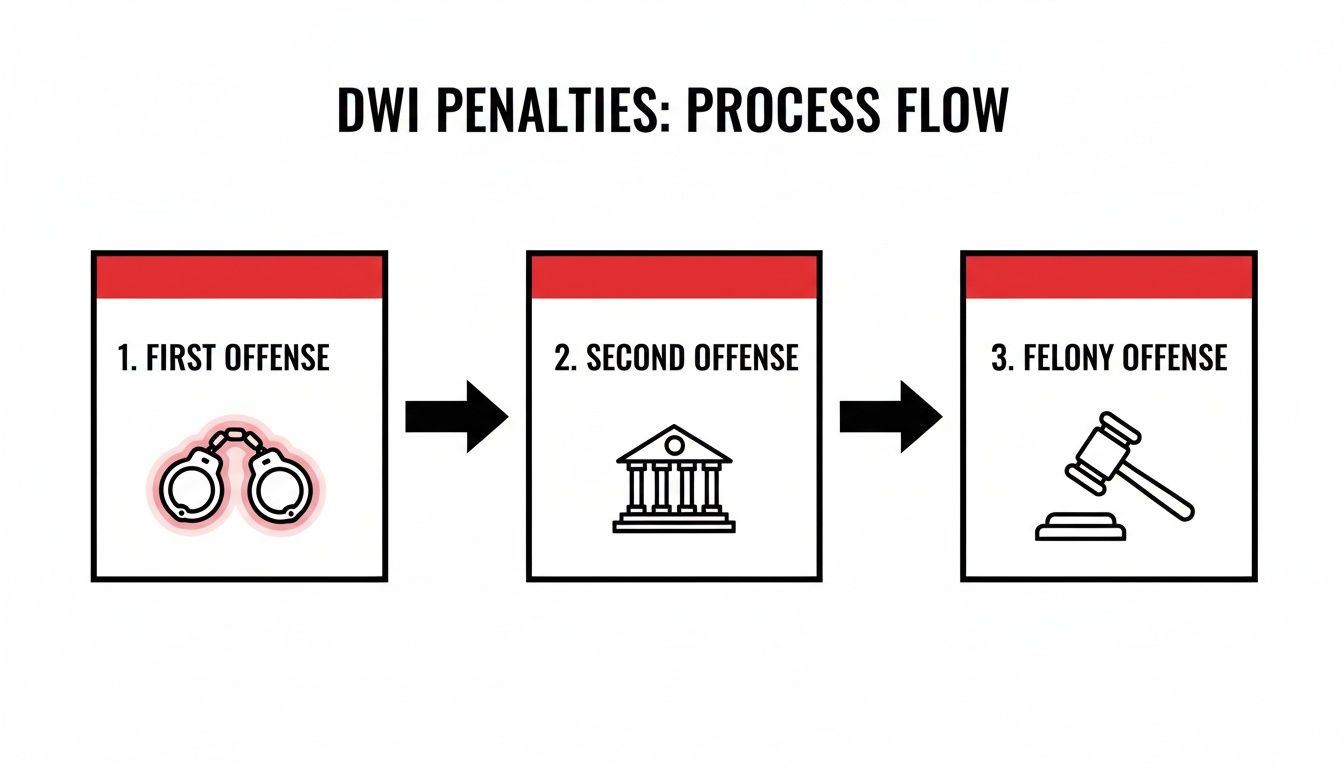
As you can see, a third offense pushes you over the line into felony territory, where the stakes—prison time, fines, and lifelong consequences—skyrocket. This is why a strong, immediate defense is non-negotiable.
"Implied Consent": The Law Behind the ALR Process
So, why does the state get to have this separate process to take your license? It all comes down to a legal concept called implied consent. In Texas, the law says that by getting a driver's license and using public roads, you have automatically—or implicitly—agreed to provide a breath or blood sample if you are lawfully arrested for DWI.
But implied consent is not the same as forced consent. You still have the right to refuse a chemical test.
Deciding whether to take a breath or blood test is one of the toughest choices you'll ever have to make, usually under incredible stress on the side of the road. There’s no perfect answer, only trade-offs.
- Refusing the Test: If you refuse, you deny the prosecution a key piece of evidence—your alleged Blood Alcohol Concentration (BAC). The downside? Your license gets suspended automatically (often for longer) through the ALR process, and the refusal itself can be used against you in court.
- Taking the Test: If you agree to a test and the result is 0.08% BAC or higher, you've just handed the prosecutor their strongest piece of evidence. Your license is still going to be suspended, although typically for a shorter period than if you had refused.
There's a lot of strategy involved in that decision, and the right choice depends on the specific facts of your situation. No matter what you chose to do during your arrest, your fight isn't over. It's just beginning.
How to Fight a Breath Test Result and Other Evidence
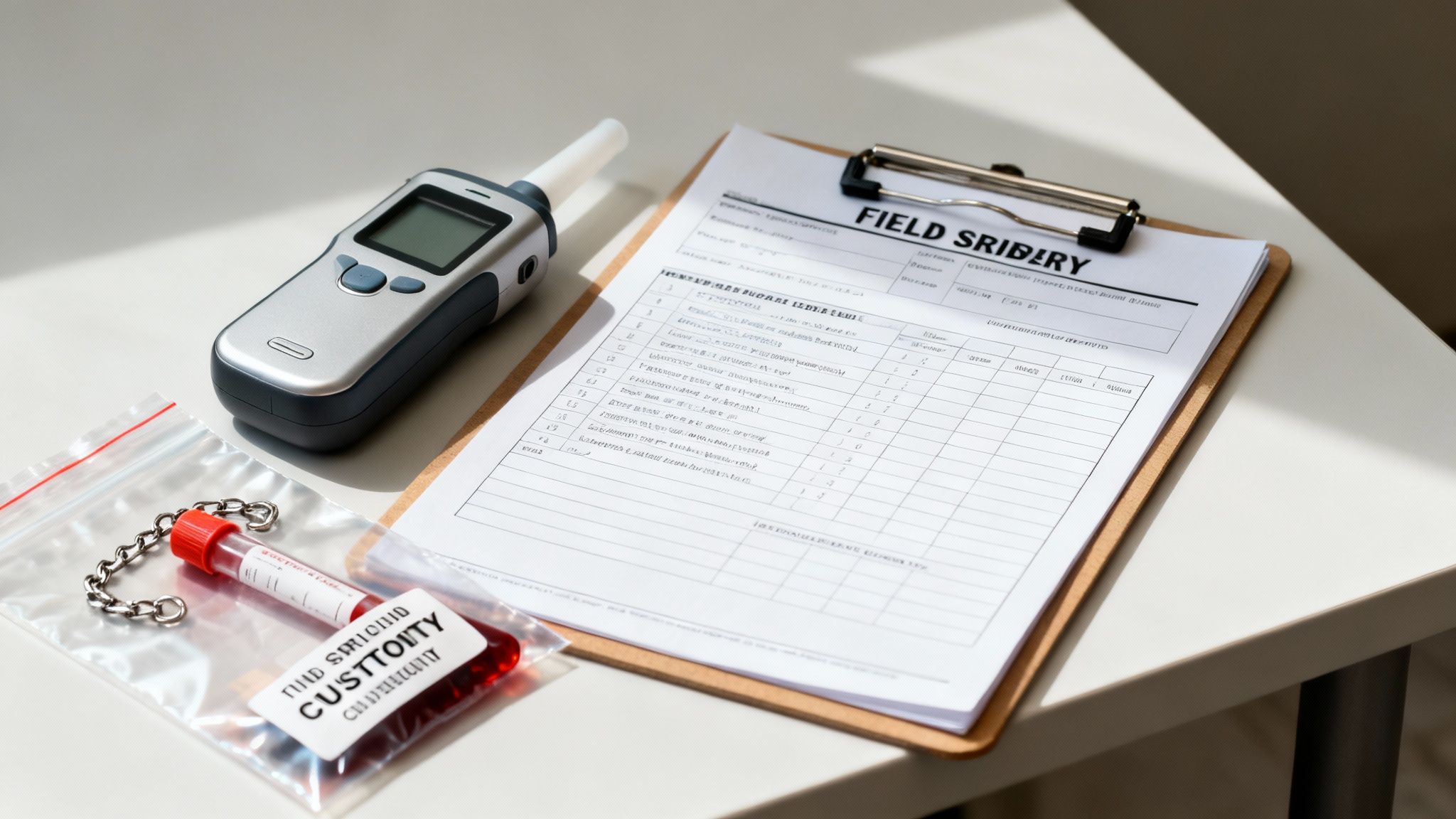
When the prosecution lays out its case in a DWI, the evidence can feel overwhelming. Breathalyzer printouts, blood test results, and an officer's testimony about field sobriety tests all seem like indisputable facts. But here’s the truth: this "scientific" evidence is often far more fragile than it appears.
A smart DWI defense isn't about making excuses. It's about pulling back the curtain to scrutinize how that evidence was collected and exposing the mistakes that were made along the way. These tests are not foolproof, and challenging them is a cornerstone of any effective defense strategy in Texas.
The Problem with Field Sobriety Tests
Before making an arrest, an officer will almost certainly ask you to perform a series of Standardized Field Sobriety Tests (SFSTs). They are subjective evaluations of your balance, coordination, and ability to follow complex instructions under the immense pressure of a roadside stop.
In Texas, law enforcement relies on three main tests:
- Horizontal Gaze Nystagmus (HGN): The officer moves a pen or finger in front of your face and looks for an involuntary jerking in your eyes. This test is notoriously difficult to administer correctly. Dozens of factors unrelated to alcohol—from certain medical conditions to the flashing lights of the patrol car—can cause the exact same eye movements.
- Walk-and-Turn: You're told to take nine heel-to-toe steps down a real or imaginary line, turn in a specific way, and walk back. The officer is looking for "clues" of impairment, but something as simple as uneven pavement, bad footwear, or just plain nervousness can cause a misstep.
- One-Leg Stand: Here, you have to stand on one foot and hold the other foot up for 30 seconds. It’s a test of balance that can be easily thrown off by your age, physical condition, or the environment.
The most important thing to understand is that these tests are designed to be difficult, even for a completely sober person. The scoring is entirely subjective, and officers are often looking for reasons to confirm a decision they've already made: to arrest you. Your performance is not definitive proof of anything.
Uncovering Flaws in Chemical Testing
Chemical tests—breath and blood samples—give the prosecution their magic number: your Blood Alcohol Concentration (BAC). While a number seems concrete, its accuracy is completely dependent on rigid scientific and legal protocols being followed perfectly at every single stage.
A skilled DWI lawyer will dig into every detail of the chemical testing process, because that's where critical, case-winning errors are often found.
Common Breathalyzer Test Errors
Breath testing machines, like the Intoxilyzer 9000 used across Texas, are complicated instruments that need precise calibration and handling. A single mistake can throw the whole result into question. Some of the most common issues include:
- Improper Calibration: These machines must be regularly serviced and calibrated. If maintenance logs are missing or show failures, the results are unreliable.
- Operator Error: The officer giving the test must be certified and follow a strict procedural checklist. If they failed to observe you for the required 15-minute period before the test, for example, the result could be invalid.
- External Factors: Things like acid reflux (GERD), burping, or even using mouthwash can trap alcohol in your mouth, leading to a falsely high reading that doesn't reflect your true BAC.
Issues with Blood Test Evidence
A blood test is often called the "gold standard" of BAC testing, but it is just as vulnerable to human and procedural error that can lead to a wrongful conviction. A strong defense scrutinizes the entire timeline, from the moment the needle goes in to the final analysis at the lab.
Key areas to challenge include:
- Improper Blood Draw: Was the sample drawn by a qualified professional? Was the site cleaned with a non-alcohol swab? A mistake here can contaminate the sample.
- Contamination and Storage: If the vial isn't properly sealed, stored at the right temperature, or is contaminated at the lab, the results can be completely skewed.
- Chain of Custody: The prosecution must be able to prove who had the blood sample and where it was at every single moment. Any gap or break in this chain of custody can make the evidence inadmissible in court.
A DWI arrest can make you feel like you've already been found guilty. Nothing could be further from the truth. The state's evidence is rarely perfect, and a deep investigation into how these tests were performed can uncover the reasonable doubt needed to protect your future.
Building a Strategic DWI Defense for Your Case
A winning DWI defense isn't about getting lucky—it’s about building a deliberate, methodical strategy from the ground up. While the laws and penalties can feel rigid, the facts of every arrest are unique. The key is to move from just understanding the law to taking decisive action, dissecting the prosecution's case piece by piece to protect your future.
Every DWI case starts with a traffic stop, and that’s exactly where a strong defense begins. An officer can’t just pull you over on a hunch; they must have reasonable suspicion. This means they need a specific, factual reason to believe you've violated a traffic law.
A skilled Houston DWI lawyer will immediately question the very foundation of that stop. Was it a legitimate violation, or was the officer just on a “fishing expedition”? If the stop was unlawful, any evidence collected afterward—including field sobriety tests, your statements, and the arrest itself—could be thrown right out of court.
Questioning the Path to Arrest
After pulling you over, the officer needs to develop probable cause to believe you were intoxicated before they can legally arrest you. This is a much higher legal standard than reasonable suspicion. It’s usually built on shaky ground: your performance on field sobriety tests and the officer's subjective observations.
This is a critical area to challenge. We meticulously analyze the officer's report and compare it against any dashcam or bodycam footage. It’s amazing how often the video tells a completely different story than the written report.
For example, did the officer claim you were swaying and slurring your words, but the video shows you speaking clearly and standing perfectly steady? Exposing these contradictions can completely dismantle the probable cause for your arrest.
Looking Beyond a Conviction
Too many people facing a DWI charge think their only options are to plead guilty or go to trial. That's not true. A proactive defense explores every possible path to secure a better outcome and protect your record.
Some of these defense strategies include:
- Pretrial Diversion Programs: Many Texas counties offer programs for first-time offenders. If you successfully complete the requirements, like classes and community service, your charges can be dismissed entirely.
- Negotiating for a Reduced Charge: It’s often possible to negotiate a plea to a lesser, non-alcohol-related offense, like reckless driving. This helps you avoid the stigma and harsh consequences of a permanent DWI on your record.
- Motions to Suppress Evidence: If we find that evidence was obtained illegally—maybe from an invalid traffic stop or an improperly administered blood test—we will file a motion to suppress it. A successful motion can gut the prosecution's case, often forcing a dismissal.
Key Takeaway: A DWI arrest is not the end of the story. A proactive and strategic defense is all about creating opportunities—finding the procedural errors, the factual inconsistencies, and the alternative resolutions that the prosecution hopes you’ll never see.
For example, an officer pulls someone over for briefly touching the white line on the shoulder. During the stop, the driver admits to having two beers a few hours ago. The officer, now suspecting DWI, runs them through field sobriety tests and makes an arrest.
A strategic defense attorney would immediately argue that briefly touching the line doesn't give the officer reasonable suspicion for a stop in the first place. If a judge agrees the stop was invalid, the entire case could be dismissed before it ever sees a jury. This is how we fight for you—by challenging the state's actions at every single step. Your future is far too important to leave to chance.
Special DWI Rules for CDL Holders and Underage Drivers
While any DWI charge in Texas is a serious matter, the game changes dramatically for commercial drivers and anyone under 21. For these groups, the rules are tougher, and the consequences cut deeper. A single bad decision can destroy a career or put a young person's future in jeopardy.
It's critical to understand these unique situations to build a defense that truly protects what's important to you.
The High Stakes for Commercial Driver’s License (CDL) Holders
For a professional driver, a CDL isn't just a license—it's your livelihood. Texas law holds commercial drivers to a much higher standard, whether you're on the clock or not.
The legal BAC limit for a CDL holder operating their commercial vehicle is just 0.04%. That's half the limit for a standard driver.
A DWI conviction is often a career-ending event. The penalties are swift and severe:
- A one-year disqualification of your CDL for a first offense.
- A lifetime disqualification for a second offense.
These rules apply even if you were driving your personal car at the time of the arrest. The state doesn't care what you were driving; it cares that you hold a special license with public trust attached to it. For a CDL holder, a DWI defense isn't just about staying out of jail—it's about saving your entire career.
Texas’s Zero-Tolerance Stance on Underage Drivers
When it comes to drivers under the age of 21, Texas has a hard-and-fast Zero-Tolerance policy. This means a completely different charge comes into play: Driving Under the Influence (DUI). A minor can be charged with a DUI for having any detectable amount of alcohol in their system. The BAC limit is effectively 0.00%.
A first-offense DUI is a Class C Misdemeanor and usually doesn't involve jail time. But don't mistake that for a slap on the wrist. The penalties are designed to make an impact, often including license suspension, hefty fines, mandatory alcohol awareness courses, and community service. These consequences create a permanent record that can affect college applications and job opportunities for years.
Answering Your Urgent Texas DWI Questions
When you're facing a DWI arrest, the questions and anxiety can feel overwhelming. Getting straight, clear answers is the first step toward taking back some control. Below, we tackle some of the most common questions we hear from people trying to make sense of their rights and options.
Should I Refuse a Breathalyzer Test in Texas?
This is one of the most critical decisions you'll make during a traffic stop. Under Texas’s implied consent law, you have the right to say no. But it's a trade-off.
By refusing a breath or blood test, you deny the prosecutor their single most powerful piece of evidence—that specific BAC number. On the other hand, a refusal automatically triggers an Administrative License Revocation (ALR), which often results in a longer initial license suspension than a test failure would. It's a complex choice, but keeping the state's strongest evidence out of their hands can give you a significant strategic advantage when it comes time to fight your DWI in Texas.
Can a DWI Charge Be Dismissed in Texas?
Yes, a dismissal is absolutely on the table. A DWI charge is not a conviction, and the prosecution's case is rarely as solid as they want you to believe. A skilled Houston DWI lawyer can get a case thrown out by:
- Challenging the Traffic Stop: If the officer didn't have a legitimate reason (reasonable suspicion) to pull you over, any evidence they gathered afterward can be suppressed.
- Finding Procedural Errors: If an officer administered the field sobriety tests incorrectly or failed to follow proper protocol for the chemical tests, the results can be deemed unreliable and inadmissible.
- Negotiating with the Prosecutor: A strong and well-prepared defense can convince the prosecutor that their case is too weak to win at trial, leading them to dismiss the charge or offer a reduction to a non-alcohol-related offense.
How Much Does a Houston DWI Lawyer Cost?
The investment in a solid legal defense depends on the complexity of your case. A straightforward first DWI in Texas will cost less than a felony DWI that demands extensive investigation, expert witnesses, and lengthy trial preparation.
But it’s important to frame it this way: the cost of not hiring an experienced attorney can be far greater. You could be facing fines, skyrocketing insurance, lost income, and permanent damage to your career. We believe everyone deserves to understand what's at stake, which is why we offer a free consultation to go over your case and give you a clear picture of the investment needed to protect your future.
A DWI conviction can follow you for life, but a dismissal or an expunction can give you a clean slate. Investing in a strategic defense is an investment in your future, your career, and your peace of mind.
Can I Get My DWI Record Sealed in Texas?
For many people, this is the ultimate goal—wiping the slate clean and moving on without this hanging over their head. In Texas, you may be eligible to have your DWI record sealed through an order of nondisclosure or even completely erased through an expunction.
An expunction is generally an option if your case was dismissed or if you were found not guilty at trial. Sealing the record (nondisclosure) is a possibility for certain first-time offenders who successfully complete their community supervision. These are powerful legal tools that offer real hope for a fresh start, and we can help you figure out if you qualify.
The legal road ahead can feel intimidating, but you don't have to walk it alone. At The Law Office of Bryan Fagan, PLLC, our team has the local experience and strategic knowledge to defend your rights and fight for the best possible outcome. A DWI arrest is serious, but it doesn't have to define your future. Contact us 24/7 to request a free, confidential case evaluation and learn how we can protect what matters most to you. Find out more about our approach at https://texasduilawfirm.com.