 Skip to content
A DWI arrest in Texas can be overwhelming, but you don’t have to face it alone. The potential penalties are serious, ranging from a Class B Misdemeanor for a first offense—carrying up to 180 days in jail and a $2,000 fine—to a third-degree felony for a third offense, which could mean up to 10 years in prison and a $10,000 fine.
These criminal consequences are only half the battle. You are also facing an immediate and separate administrative process to suspend your driver's license. Understanding how to protect your rights on both fronts is the first step toward a strong defense.
Your First Steps After a Texas DWI Arrest

The moments during and after a DWI arrest are disorienting. From the flashing lights and field sobriety tests to the ride to the station, the entire experience is designed to make you feel powerless. But taking strategic action right now is how you begin to regain control.
You are currently fighting two distinct legal battles, each with its own timeline, rules, and potential consequences.
The first is the criminal case. This is where a state prosecutor will try to prove you were operating a vehicle while intoxicated. This is the fight that involves potential jail time, significant fines, and a permanent mark on your criminal record.
The second is an administrative case with the Texas Department of Public Safety (DPS), which focuses entirely on your driver's license. The moment of your arrest, a clock started ticking on your right to drive.
Understanding the Two Fronts of a DWI Case
To successfully navigate what’s ahead, you need a two-pronged defense strategy. You must address both the criminal charges and the license suspension simultaneously, as one will not wait for the other.
-
The Criminal Case: This battle unfolds in the court system, where penalties become more severe with each prior conviction and can be enhanced by factors like a high Blood Alcohol Concentration (BAC). A skilled Houston DWI lawyer knows how to challenge the evidence against you, from questioning the reason for the traffic stop to disputing the accuracy of breath or blood tests.
-
The Administrative Case (ALR Hearing): Texas is an "implied consent" state. This means that by holding a Texas driver's license, you have already agreed to provide a breath or blood sample if lawfully requested by a police officer. If you refuse a chemical test or fail it (by having a BAC of 0.08% or higher), the DPS will immediately begin the process to suspend your license through an Administrative License Revocation.
You have only 15 days from the date of your arrest to request an Administrative License Revocation (ALR) hearing to fight this suspension. If you miss this critical deadline, your license will be suspended automatically.
Facing these parallel challenges can feel like an impossible climb, but you don't have to do it alone. The right legal strategy can make a significant difference in the outcome of both cases, protecting your freedom, your finances, and your future.
Texas DWI Penalties at a Glance
To give you a clearer picture, this table breaks down the standard criminal penalties for DWI offenses in Texas. It's a quick reference to help you understand what is at stake in your case.
| Offense Level | Classification | Potential Jail Time | Maximum Fine |
|---|---|---|---|
| First DWI | Class B Misdemeanor | Up to 180 days | $2,000 |
| Second DWI | Class A Misdemeanor | Up to 1 year | $4,000 |
| Third DWI | 3rd Degree Felony | 2 to 10 years in prison | $10,000 |
Remember, these are standard ranges. Factors like a high BAC, having an open container, or the presence of a child passenger can lead to enhanced penalties. We will explain those details later in this guide.
Navigating a First DWI Offense in Texas

For most people, a DWI arrest is their first jarring encounter with the criminal justice system. It is a confusing and stressful experience that leaves you wondering what comes next. If this is your situation, the most important thing to know is that a single mistake does not have to define your future.
In Texas, a first-time DWI is typically charged as a Class B Misdemeanor, provided there are no aggravating factors like an extremely high BAC or an accident causing injury. While it is the least severe DWI classification, the penalties are serious enough to disrupt your life. Understanding what's at stake and your opportunities to build a smart defense is key.
Criminal Penalties for a First DWI
A conviction for a standard Class B Misdemeanor DWI is more than a simple slap on the wrist. This charge carries significant penalties, including up to 180 days in county jail and a fine of up to $2,000. In addition, you face an automatic license suspension for up to one year. Even a minimum sentence requires at least three days behind bars.
You will almost certainly be ordered to install an Ignition Interlock Device (IID) on your vehicle, adding hundreds of dollars in monthly fees while you work to regain your driving privileges. According to the Texas DPS Crime Records Division, 83,088 Texans were charged with DWI in 2020 alone. Of those, only 3,275 were released without charges, showing how rarely these arrests simply go away on their own.
Alternatives to Jail Time
While the threat of jail is real, it is not the only possible outcome. An experienced DWI attorney can often negotiate alternatives that focus on rehabilitation rather than punishment, helping you stay out of jail and minimize long-term damage to your record.
Two of the most common alternatives are probation and deferred adjudication:
- Probation (Community Supervision): Instead of serving your sentence in jail, a judge might place you on probation. This means you must follow a strict set of rules for a specific period, typically one to two years.
- Deferred Adjudication: This is often the best-case scenario for a first offense. If you successfully complete the terms of your probation, the charge is dismissed, and you avoid a final conviction. This outcome may also make you eligible to have the arrest record sealed later on.
Successfully completing probation or deferred adjudication is critical. If you violate the terms, the judge can revoke the agreement and impose the original sentence, including jail time.
Common Requirements During Probation
Whether you receive standard probation or deferred adjudication, you will have to comply with a list of court-ordered conditions designed to ensure accountability.
You can almost always expect these requirements:
- DWI Education Course: A mandatory 12-hour class covering the dangers of impaired driving.
- Victim Impact Panel: A session where you listen to individuals share how their lives were impacted by a drunk driver.
- Community Service: You will likely be ordered to complete a set number of unpaid work hours for a nonprofit or government agency.
- Ignition Interlock Device (IID): A small breathalyzer wired into your car. You must provide a clean sample to start the engine and periodically while driving.
- Substance Abuse Evaluation: A professional assessment of your alcohol or drug use to determine if you require counseling or treatment.
Managing these requirements while balancing your job and family is a challenge. With a clear understanding of the road ahead and a strong legal advocate in your corner, you can work toward the best possible outcome for your case.
How Penalties Escalate for Repeat and Felony DWI Charges
A first DWI is a serious wake-up call, but in the eyes of Texas law, it's just the starting point. The legal landscape shifts dramatically once you face a second or third charge, transforming what was a misdemeanor into a felony that can permanently alter your life. The first offense is a warning; subsequent charges are treated as proof that the warning was not enough.
If you are arrested for a second DWI, the charge is elevated to a Class A Misdemeanor. This is a significant jump from a first offense, and the penalties increase accordingly.
A conviction for a second DWI can bring:
- Jail Time: A mandatory minimum of 30 days and up to one year in county jail.
- Fines: The maximum fine doubles to $4,000.
- License Suspension: Your driver's license can be suspended for up to two years.
These penalties represent serious disruptions to your job, family, and freedom. The courts view a second offense as a direct challenge and respond with harsher consequences.
The Leap to a Third-Degree Felony
The stakes skyrocket with a third DWI charge. In Texas, a third DWI is automatically a third-degree felony, regardless of how much time has passed since your last conviction. A felony conviction is a permanent brand that follows you long after you've served your sentence.
The penalties for a third DWI include:
- Prison Time: A conviction means two to 10 years in a Texas state prison, not county jail.
- Fines: The maximum fine balloons to $10,000.
- License Suspension: You will lose your license for up to two years.
The punishment doesn't end there. A felony conviction strips you of fundamental rights. You lose the right to vote (while in prison and on parole) and the right to own a firearm. It can also bar you from holding professional licenses, effectively ending certain careers.
A felony DWI conviction isn't just about serving time; it's about fundamentally changing your status as a citizen. The consequences impact your rights, reputation, and opportunities for the rest of your life.
When a First DWI Becomes a Felony
It's a dangerous myth that only repeat offenders face felony charges. Certain situations, known as "aggravating factors," can elevate even a first-time DWI into a felony from the start. These laws are designed to punish behavior that puts others at an even greater risk.
- DWI with a Child Passenger: If you are arrested for DWI with a child under 15 years old in the car, the charge is automatically elevated to a state jail felony. This means up to two years in a state jail facility and a fine of up to $10,000.
- Intoxication Assault: If your impaired driving causes an accident that results in serious bodily injury to someone else, you will be charged with Intoxication Assault. This is a third-degree felony, punishable by two to 10 years in prison.
- Intoxication Manslaughter: If your impaired driving leads to a fatal accident, you will face Intoxication Manslaughter charges. This is a second-degree felony, carrying a prison sentence of two to 20 years.
And Texas laws are only getting tougher. Effective September 1, 2025, Senate Bill 2320 will make a standard first-time DWI a Class A misdemeanor. More critically, it catapults cases with a BAC of 0.15% or higher to a state jail felony—a massive leap from its current misdemeanor status. As this guide to 2025 Texas criminal law changes explains, this means a felony record and state jail time for what was previously just a high-level misdemeanor.
The Two Fights: Criminal Court and Your Driver's License
A DWI arrest in Texas creates two legal problems, not just one. You are immediately pulled into two separate battles that unfold at the same time: the criminal case that everyone knows about, and an administrative fight to save your driver's license.
It is a common mistake to focus only on the criminal charges while letting the license issue slide. You must understand that these are two distinct fronts. What happens in criminal court can influence the license case and vice-versa, but winning one does not automatically mean you will win the other.
The Criminal Court Case: Your Freedom and Finances
The first battle is the one most people are familiar with: the criminal case. This is where the State of Texas, through a prosecutor, attempts to prove beyond a reasonable doubt that you were operating a motor vehicle in public while intoxicated. The stakes here are incredibly high, directly threatening your freedom and your financial stability.
The potential criminal penalties include:
- Jail or Prison Time: Depending on whether it’s a misdemeanor or felony charge, you could face anything from a few days in county jail to many years in state prison.
- Significant Fines: The court can impose fines that start in the thousands for a first offense and climb to $10,000 or more for a felony.
- A Permanent Criminal Record: A conviction creates a permanent record that can affect your ability to get a job, secure housing, or maintain a professional license.
This battle takes place in the county or district court system and involves arraignments, pretrial motions, and possibly a jury trial. Your attorney’s goal is to analyze the state's evidence to get the case dismissed, negotiate a reduction in charges, or win a "not guilty" verdict at trial.
This graphic illustrates how quickly the charges can escalate from a second offense to a life-altering felony.
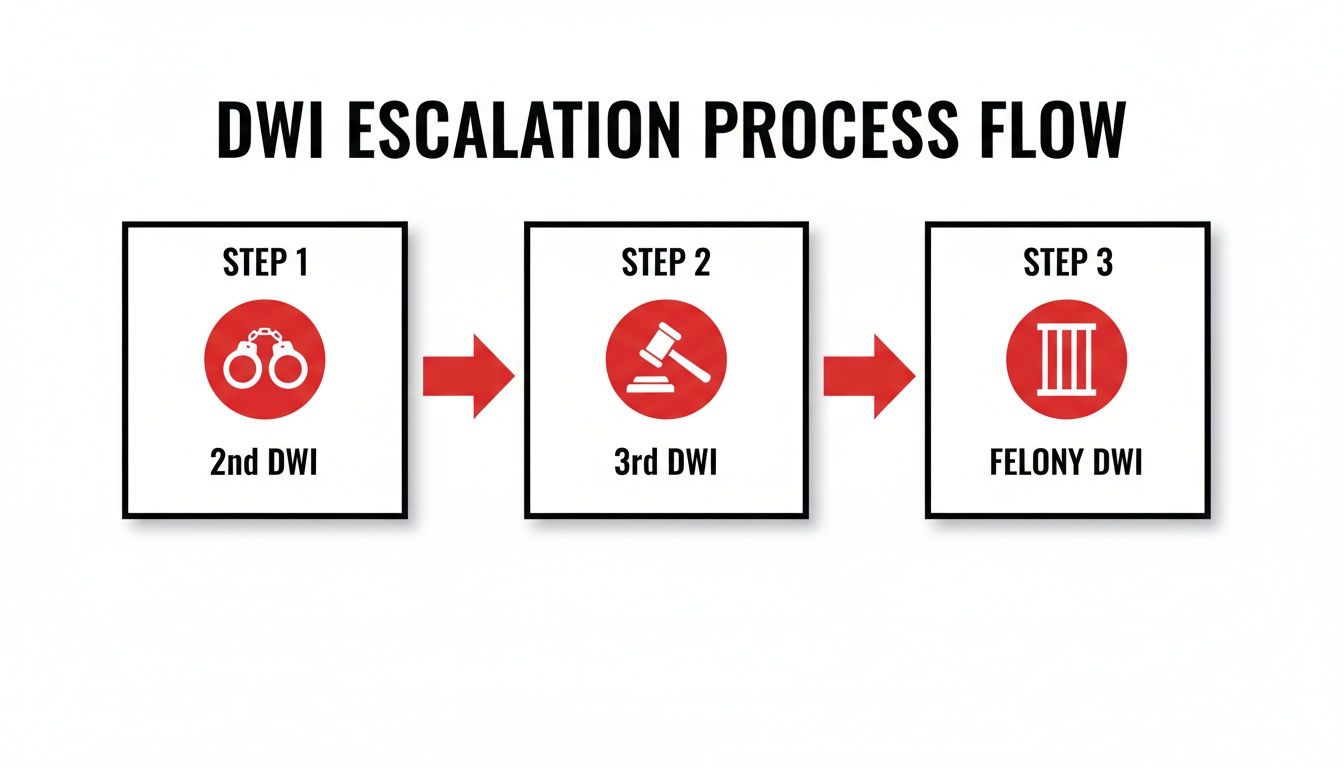
As you can see, each subsequent charge dramatically increases the severity, turning what was a misdemeanor with jail time into a felony with a potential prison sentence.
The Administrative Case: Your Right to Drive
The second fight begins the moment you are arrested. This battle is not fought in a criminal courtroom but in an administrative hearing with the Texas Department of Public Safety (DPS). The only thing at stake here is your privilege to drive.
This process is governed by Texas’s "implied consent" law. When you received your Texas driver’s license, you legally consented to provide a breath or blood sample if lawfully arrested for DWI.
If you refuse to take a chemical test, or if you take it and your Blood Alcohol Concentration (BAC) is 0.08% or higher, the DPS will automatically start the process to suspend your license.
This is known as an Administrative License Revocation (ALR). It is a civil proceeding, completely separate from your criminal case. You can lose your license through the ALR process even if your criminal charges are eventually dismissed.
You Only Have 15 Days to Save Your License
This is the most critical deadline you will face after a DWI arrest. From the day you receive notice of the suspension (usually the day of the arrest), you have exactly 15 days to request an ALR hearing.
- If you request the hearing: Your license remains valid until the hearing occurs. This gives your lawyer a crucial opportunity to challenge the suspension and question the arresting officer under oath—a "free look" at the evidence that can be invaluable for your criminal defense strategy.
- If you miss the deadline: Your license will be automatically suspended 40 days after your arrest. You will have waived your right to fight it, and there are no second chances.
The ALR hearing is a technical, rule-based proceeding held at an administrative courthouse before an administrative law judge. To better understand this process, you can find more detailed information on how to handle the State Office of Administrative Hearings in Texas.
Successfully fighting a DWI requires a strategic approach from an experienced lawyer who knows how to defend you on both fronts simultaneously.
The True Financial Cost of a DWI Is More Than Just the Fine

The fine listed in the Texas Penal Code is just the tip of the iceberg. A DWI conviction triggers a financial chain reaction of fees, surcharges, and other expenses that can easily add up to thousands of dollars. Understanding this full financial picture is critical, as these are not just one-time payments but a series of hurdles that can strain your budget for years.
The Official and Unofficial Costs
Beyond the maximum court fine of $2,000 for a first offense, a conviction opens the door to a host of other mandatory expenses. Each is a separate bill you will have to pay as you move through the justice system.
These costs almost always include:
- Court Costs and Fees: Administrative fees tacked onto every case, typically running several hundred dollars.
- Probation Supervision Fees: If you are placed on community supervision (probation), you will pay a monthly fee, usually between $60 and $100, for the entire term.
- DWI Education Classes: The state requires you to complete a DWI education program at your own expense. A repeat offense requires a more intensive and costly program.
- Ignition Interlock Device (IID): If the court orders an IID, you are responsible for all costs, including an installation fee (around $100-$200) and a monthly monitoring fee (often $80-$100).
The financial penalties are designed to be a significant burden. When you add up all the mandatory costs, the total out-of-pocket expense for a first-time DWI can easily reach $5,000 to $10,000 or more—and that’s before you factor in legal fees.
The Long-Term Financial Pain of SR-22 Insurance
One of the most painful and long-lasting financial hits is the SR-22 insurance requirement. An SR-22 is not an insurance policy but a certificate your insurance company files with the state to prove you have minimum liability coverage. This certificate officially labels you as a high-risk driver, causing your insurance premiums to skyrocket.
It is common for drivers to see their rates double or even triple, an expensive consequence that can last for several years. To see how severe this can be, you can learn more about how insurance premiums are affected after a DUI in Texas. This single requirement can cost you thousands of extra dollars over time.
The Hidden Costs to Your Career
The financial damage often extends into your professional life, and for people in certain careers, the consequences can be devastating.
Consider these potential career-related impacts:
- Lost Wages: Court dates, community service, and mandatory classes all mean time away from your job. If you must serve jail time, the lost income can be substantial.
- Professional Licenses: A DWI conviction can jeopardize professional licenses for nurses, pilots, real estate agents, and others held to a high ethical standard.
- Commercial Driver's License (CDL): For truck drivers and anyone who drives for a living, a DWI is often a career-ending event, leading to an immediate disqualification of their CDL.
When you look at the overwhelming financial and professional consequences, you can see why a strong legal defense is so important. A skilled DWI lawyer isn't just fighting for your freedom—they're working to protect your financial future.
How a Strategic Defense Can Reduce DWI Penalties
An arrest for a DWI in Texas can feel like the end of the road. But the truth is, an arrest is just the beginning of a legal process, not the final word. While the penalties are harsh, a proactive and strategic defense can completely change the outcome, potentially leading to reduced charges or even a full dismissal. The prosecution's case might look solid, but an experienced Texas DUI attorney knows where to find weaknesses.
Deconstructing the Prosecution's Case
Every DWI case begins with the initial police interaction, which is often the first place to find a crack in their case. If an officer makes a critical mistake at any point, the evidence they gathered can be jeopardized. A powerful defense involves digging into every detail.
Here’s where we start looking for crucial errors:
- Challenging the Traffic Stop: An officer cannot pull you over on a hunch. They need reasonable suspicion—a legitimate, specific reason like a traffic violation. If they cannot legally justify the stop, any evidence gathered after that point could be thrown out of court.
- Scrutinizing Field Sobriety Tests (FSTs): These roadside tests—like the walk-and-turn or one-leg stand—are notoriously subjective and difficult to perform perfectly even when sober. An attorney can challenge the results by showing the officer gave improper instructions, failed to account for your medical conditions, or conducted the tests on an unsafe surface like gravel or a sloped shoulder.
- Contesting Chemical Test Results: Breathalyzer and blood test results are far from infallible. These machines can be challenged based on improper calibration, procedural errors by the technician, or a broken chain of custody for a blood sample. Any procedural gap raises serious doubts about the accuracy of the results.
A top-tier Houston DWI lawyer knows how to dissect police reports and body camera footage to find the mistakes that can turn a case in your favor.
The Power of a Motion to Suppress
One of the most effective tools in a DWI defense is the Motion to Suppress. This is a formal legal request asking the judge to exclude any evidence that was obtained illegally. For example, if we prove the traffic stop was unlawful, all evidence that followed—the field sobriety tests, the breath test, and your statements—is considered "fruit of the poisonous tree."
If the judge grants our motion, the prosecutor could be left with no case. No evidence often means the charges must be dismissed.
A successful motion to suppress can be a complete game-changer. By getting the state's key evidence thrown out, we can often dismantle their entire case before a jury ever hears it.
This is why a meticulous case review is so critical. It’s not just about what happened; it’s about whether law enforcement followed the law at every step. Through sharp negotiation and a total readiness to fight for you in court, we can work to protect your rights and secure the best possible outcome. An arrest is just the start—let's build the right strategy for the finish.
Common Questions About Texas DWI Penalties
When you're facing a DWI charge, it's normal to have a million questions. Getting clear answers is the first step toward regaining control and planning your next steps. Let’s address some of the most common questions we hear every day.
Can I Get My DWI Charge Dismissed in Texas?
Yes, getting a DWI charge dismissed is possible, but it depends entirely on the specific facts of your case. An experienced lawyer can often find weak spots in the prosecution's case. Perhaps the initial traffic stop was not legally justified, or maybe the evidence was collected improperly. For instance, if a breathalyzer was not calibrated correctly or if the chain of custody for a blood sample was broken, that evidence can be challenged and potentially excluded. A skilled Houston DWI lawyer knows exactly where to look for these crucial opportunities to fight for a full dismissal.
How Long Will a DWI Stay on My Record in Texas?
A DWI conviction in Texas is permanent and stays on your criminal record forever unless you can get it sealed through an order of nondisclosure or, in rare cases, expunged.
Expunction completely destroys the record of the arrest but is only available in limited situations, such as if your case was dismissed or you were found not guilty at trial. Nondisclosure is more common and essentially hides the record from public view. This may be an option for some first-time offenders after completing probation and a waiting period. The rules are very strict, so speaking with a DWI attorney is the only way to know if you qualify to clear your record.
While a conviction is permanent, an arrest that doesn't lead to a conviction doesn't have to be. Taking proactive steps like seeking an expunction can protect your future opportunities.
What Happens If I Refuse a Breathalyzer Test in Texas?
Refusing a breath or blood test in Texas has immediate consequences. Under the state's "implied consent" law, your driver's license will be automatically suspended. For a first-time refusal, that suspension lasts for 180 days. This license suspension is an administrative penalty, completely separate from your criminal DWI case.
You have a very short, strict 15-day window from the date of your arrest to request an Administrative License Revocation (ALR) hearing to fight the DWI license suspension. If you miss this deadline, you lose your chance to challenge it. Acting fast is absolutely critical to protecting your ability to drive.
A DWI arrest is a serious and disorienting experience, but you do not have to navigate it alone. The legal team at the Law Office of Bryan Fagan, PLLC is here to defend your rights, challenge the evidence, and pursue the best possible outcome for your case. We understand what is at stake and are prepared to build a strategic defense tailored to you. Contact us today for a free, confidential case evaluation by visiting our DWI defense website.

