 Skip to content
A DWI arrest can be overwhelming—but you don’t have to face it alone. You’re suddenly dealing with two legal problems at once: a criminal charge that could lead to fines or jail time, and a separate, fast-moving civil process designed to take away your driver's license.
Understanding that you are fighting on two fronts is the first, most critical step to protecting yourself. This guide will explain Texas DWI laws in clear terms, outline your rights, and help you take the next step toward a strong legal defense.
What to Do Immediately After a Texas DWI Arrest

An arrest is chaotic and confusing, but what you do in the hours and days that follow can significantly impact your case. Your most urgent priority is not the criminal charge—it’s protecting your driver’s license.
You have just 15 days from the date of your arrest to request an Administrative License Revocation (ALR) hearing. This deadline is absolute, with no extensions.
If you miss this 15-day window, your license will be automatically suspended. It doesn’t matter if your criminal case is eventually dismissed. Requesting the ALR hearing is your only opportunity to fight the administrative suspension and protect your driving privileges.
Your Two Separate Legal Battles
It’s crucial to understand that you are fighting two distinct cases simultaneously. Each has its own rules, timeline, and consequences, which is why having an experienced DWI lawyer is so vital from the very beginning.
- The Criminal Case: This is the DWI charge prosecuted by the state. The goal of your defense is to prove you did not break the law. A conviction leads to penalties like steep fines, community service, probation, or jail time. This battle is fought in criminal court.
- The Civil (ALR) Case: This is a separate, administrative action handled by the Texas Department of Public Safety (DPS). Its sole purpose is to suspend your driver’s license, and it moves much faster than the criminal case.
A skilled Houston DWI lawyer will immediately engage in both fights on your behalf. They’ll file the ALR request to save your license while simultaneously launching an investigation to build your defense against the criminal charges. To get a clearer picture of this process, you can review the essential steps to take after a DWI arrest in our detailed guide.
The time after an arrest feels like a whirlwind, but you don’t have to go through it alone. Your first call should be to an attorney who can step in, preserve crucial evidence, meet every deadline, and start building the strongest defense possible for your case.
Decoding the Language of a DWI Charge
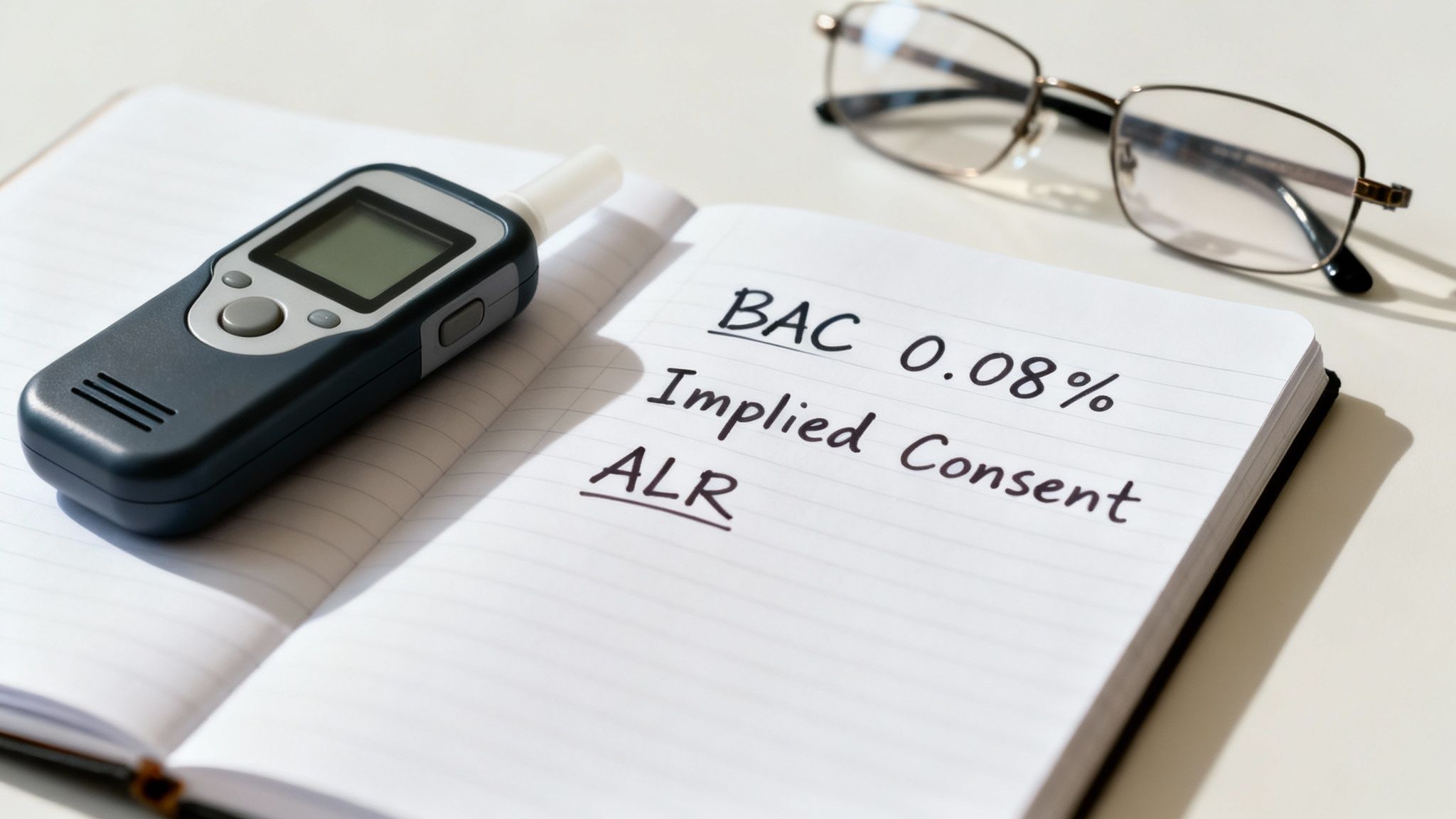
After an arrest, the legal system can feel like it's speaking a foreign language. When you're already stressed, terms like "ALR," "SFST," and "implied consent" only add to the confusion.
Understanding this terminology is your first step toward regaining control. Once you know what these key terms mean, you can have more productive conversations with your attorney and make informed decisions about your case. Let's define the most important DWI terms in plain English.
Blood Alcohol Concentration (BAC)
The most common term in a DWI case is Blood Alcohol Concentration, or BAC. This is a measurement of the amount of alcohol in your bloodstream, expressed as a percentage. Modern Texas DWI laws are built around this metric.
Years ago, laws were much vaguer, but today’s statutes are based on precise BAC numbers, reflecting a shift from subjective officer observations to scientific standards. Texas lowered its limit to the current 0.08% in the late 1990s, following a push from federal initiatives. You can read more about the evolution of drinking and driving laws on reolink.com.
The legal BAC limits in Texas are tiered, and it’s critical to know which one applies to you:
- 0.08% for most drivers who are 21 and older.
- 0.04% for anyone operating a commercial vehicle (CDL holders).
- Any detectable amount for drivers under 21, due to a strict zero-tolerance policy.
Implied Consent
When you obtain a Texas driver's license, you automatically agree to something called "implied consent." Think of it as a contract you sign in exchange for the privilege of driving. By accepting your license, you have already consented to provide a breath or blood sample if a police officer has probable cause to arrest you for DWI.
You still have the right to refuse the test. However, refusing is not a "get out of jail free" card. It triggers a separate legal process that immediately targets your driver's license, while forcing the state to prove its criminal case without that key piece of evidence.
Field Sobriety Tests
Before asking for a breath or blood sample, an officer will likely ask you to perform Standardized Field Sobriety Tests (SFSTs). These are a set of three physical and mental exercises designed to help the officer determine if they have enough reason (probable cause) to make a DWI arrest.
The three tests approved in Texas are:
- Horizontal Gaze Nystagmus (HGN): An eye test where the officer looks for involuntary jerking as your eyes follow a stimulus, like a pen.
- Walk-and-Turn: A "divided attention" test requiring you to walk heel-to-toe along a straight line, turn, and walk back.
- One-Leg Stand: Another divided attention test where you must stand on one foot for 30 seconds while counting aloud.
These tests are notoriously unreliable and highly subjective. Factors like fatigue, nerves, a medical condition, or even uneven pavement can cause a perfectly sober person to "fail." A good DWI attorney knows exactly how to challenge the administration and results of these tests in court.
Administrative License Revocation (ALR)
Finally, there's the Administrative License Revocation (ALR) process. This is the civil case we mentioned earlier that runs parallel to your criminal DWI charge. It’s handled by the Texas Department of Public Safety (DPS), not the criminal court, and it moves much faster.
The ALR process has one purpose: to decide whether your driver's license should be suspended. This case is automatically triggered if you refuse a chemical test or provide a sample that’s over the legal BAC limit.
Understanding these terms is crucial. It helps you know what's happening at every stage and empowers you to work more effectively with your legal team to fight the charges.
What Am I Really Facing? Texas DWI Penalties Explained
If you're reading this, you want to know what a DWI conviction could mean for your life. Understanding the stakes is essential for building a strong defense to avoid them.
A conviction can impact your freedom, your finances, and your future. But remember, these penalties are the worst-case scenario and are not automatic. They are the exact outcomes a skilled Texas DUI attorney works to prevent or dramatically reduce. This information is here to empower you, not to scare you.
Penalties for a First DWI in Texas
For most people, a first-time DWI without aggravating circumstances is a Class B misdemeanor. While it's the lowest-level DWI charge, the state of Texas still imposes serious penalties.
A conviction could mean:
- Jail Time: A mandatory minimum of 72 hours behind bars, with a maximum of up to 180 days.
- Fines: Up to $2,000 in criminal fines, not including court costs and other administrative fees.
- DWI License Suspension: You could lose your driving privileges for up to one year.
- Annual Surcharges: For three years, you may have to pay a hefty annual fee to the Texas DPS just to keep your license valid.
These are just the starting points. A good Houston DWI lawyer doesn't accept these consequences; they attack the evidence from day one, pushing for a dismissal or a reduction to keep a conviction off your record entirely.
Second DWI: The Stakes Get Higher
If you are arrested for a second DWI, the state views it as a pattern, and the penalties become significantly more severe. A second offense is typically charged as a Class A misdemeanor.
For a second DWI conviction, you could be facing:
- Jail Time: Anywhere from 30 days to one year in the county jail.
- Fines: The maximum fine doubles to $4,000.
- License Suspension: Your license could be suspended for up to two years.
- Ignition Interlock Device (IID): You will almost certainly be required to have an IID (a "blow-and-go" device) installed on your vehicle, often as a condition of your bond.
It's critical to know that Texas has a "lifetime lookback" period. A DWI from ten or fifteen years ago still counts and will be used to elevate a new charge, making a powerful legal defense more important than ever.
Texas DWI Penalties at a Glance
This table breaks down the potential criminal consequences for standard DWI offenses in Texas. The penalties escalate sharply with each subsequent offense, making it critical to fight DWI Texas charges aggressively from the very beginning.
| Offense | Classification | Potential Jail Time | Potential Fine | License Suspension |
|---|---|---|---|---|
| DWI 1st Offense | Class B Misdemeanor | 72 hours – 180 days | Up to $2,000 | 90 days – 1 year |
| DWI 2nd Offense | Class A Misdemeanor | 30 days – 1 year | Up to $4,000 | 180 days – 2 years |
| DWI 3rd or More | Third-Degree Felony | 2 – 10 years in prison | Up to $10,000 | 180 days – 2 years |
Remember, these are statutory maximums. The goal of a strong defense is to ensure you face the least severe outcome possible—or better yet, no conviction at all.
Third DWI or More: A Felony Charge
A third DWI arrest is a game-changer. It’s automatically charged as a third-degree felony, regardless of how much time has passed since your last conviction. This is a life-altering charge that moves your case to district court, where you face the real possibility of a prison sentence.
A conviction for a third DWI can lead to:
- Prison Time: Between 2 and 10 years in a Texas state prison (TDCJ).
- Fines: A fine up to a staggering $10,000.
- License Suspension: Losing your license for up to two years.
- Permanent Criminal Record: A felony conviction follows you forever. It can strip you of your right to vote, own a firearm, and make it incredibly difficult to find a job or housing.
When you're fighting a felony DWI, you are fighting for your freedom.
Aggravating Factors: When a Situation Gets Worse
Certain circumstances can immediately elevate the charges and penalties, even on a first DWI in Texas. Prosecutors view these "aggravating factors" as signs of a more serious case and will pursue it aggressively.
The legal framework in Texas is designed to punish repeat offenders or those in high-risk situations more severely. While a standard first-time DWI is a Class B misdemeanor, certain facts can elevate it to a higher category with years of potential jail time. You can learn more about the legal history behind these enhanced penalties by reading about the evolution of drunk driving laws in Texas on lgrlawfirm.com.
The most common aggravating factors include:
- High BAC (0.15% or higher): If your blood alcohol concentration was 0.15% or more, a first-time DWI is elevated to a Class A misdemeanor, carrying the same penalties as a second offense.
- DWI with a Child Passenger: If you're arrested for DWI with a child under 15 in the vehicle, you face a State Jail Felony, punishable by up to two years in a state jail facility and a fine of up to $10,000.
- Intoxication Assault: If a DWI-related accident causes "serious bodily injury" to another person, the charge becomes Intoxication Assault, a third-degree felony.
- Intoxication Manslaughter: If a DWI-related accident leads to someone's death, you will be charged with Intoxication Manslaughter, a second-degree felony punishable by 2 to 20 years in prison.
These penalties are incredibly serious, but an arrest is not a conviction. With an experienced attorney fighting for you, you can challenge the evidence and work toward the best possible outcome for your case.
How to Fight a Breath Test Result and Other DWI Evidence
A DWI arrest can feel like the end of the road, but it's critical to understand this: an arrest is not a conviction. The state’s case against you is often far from perfect, and a skilled DWI attorney knows exactly where to find the weaknesses in the prosecution's evidence. A successful defense starts by scrutinizing every detail—from the initial traffic stop to the final chemical test.
Challenging the Initial Traffic Stop
Every DWI case begins with a traffic stop, and this is often the first and best place to challenge the state's case. The Constitution protects you from unreasonable searches and seizures, which means a police officer cannot pull you over on a mere hunch.
To legally stop your vehicle, the officer must have reasonable suspicion that you have committed a traffic violation. This must be based on specific, observable facts.
Common reasons for a stop include:
- Speeding, weaving, or failing to maintain a single lane.
- Running a stop sign or red light.
- Driving with a broken taillight or other equipment violation.
If the officer cannot provide a legitimate, factual reason for the stop, then everything that followed—field sobriety tests, your statements, and chemical test results—could be thrown out of court. An illegal stop can dismantle the prosecution's case before it begins.
Contesting the Arrest and Probable Cause
Just as an officer needs a reason to pull you over, they need a stronger reason—probable cause—to legally arrest you for DWI. Probable cause means there is enough evidence to lead a reasonable person to believe you committed a crime. A sharp defense attorney will dissect whether the officer truly had solid grounds for the arrest.
This often involves challenging the officer's subjective observations. Things like "red, glassy eyes," "slurred speech," or "fumbling for a license" are not definitive proof of intoxication and can have innocent explanations—allergies, fatigue, or nervousness during a stressful police encounter.
Exposing Flaws in Field Sobriety and Chemical Tests
The core evidence in most DWI cases comes from Standardized Field Sobriety Tests (SFSTs) and chemical tests (breath or blood). This evidence is frequently flawed and highly contestable.
SFSTs are notoriously unreliable. They are difficult for a sober person to perform perfectly under ideal conditions, let alone on the side of a dark road. An experienced attorney knows how to expose their weaknesses by asking key questions:
- Improper Administration: Did the officer give the instructions exactly as required?
- Unsuitable Conditions: Were the tests done on an uneven surface or in poor lighting?
- Medical and Physical Factors: Do you have a condition or injury that made it impossible to perform the tests correctly?
Likewise, breath and blood test results are far from foolproof. Their accuracy depends on strict scientific and legal protocols. Any mistake can destroy the evidence's credibility.
A breathalyzer or blood test result might seem definitive, but it's only as reliable as the procedures used to obtain it. Errors in machine calibration, breaks in the chain of custody, or improper sample handling can make the results inadmissible in court.
Common challenges to chemical tests include:
- Machine Malfunction or Calibration Errors: Breathalyzers require constant maintenance. If records are incomplete, their readings are unreliable.
- Improper Police Procedure: The officer or technician must follow a strict set of rules when administering the test.
- Chain of Custody Issues: A blood sample must be tracked from the moment it’s drawn until it’s tested. Any gap can compromise the sample.
- Medical Conditions: Conditions like acid reflux (GERD) or diabetes are known to create false positive results on a breath test.
An arrest is just the beginning. By systematically challenging every piece of evidence, a knowledgeable Houston DWI lawyer can protect your rights and work toward the best possible resolution for your case.
Your Journey Through the Texas DWI Legal Process
A DWI arrest kicks off a confusing and often overwhelming legal journey. Knowing what to expect can make a huge difference, reducing stress and putting you back in control. Think of this as your roadmap through the Texas DWI system.
The process might seem tangled, but a good defense strategy begins untangling it from day one, starting with the traffic stop and questioning every piece of evidence to ensure your rights were protected.
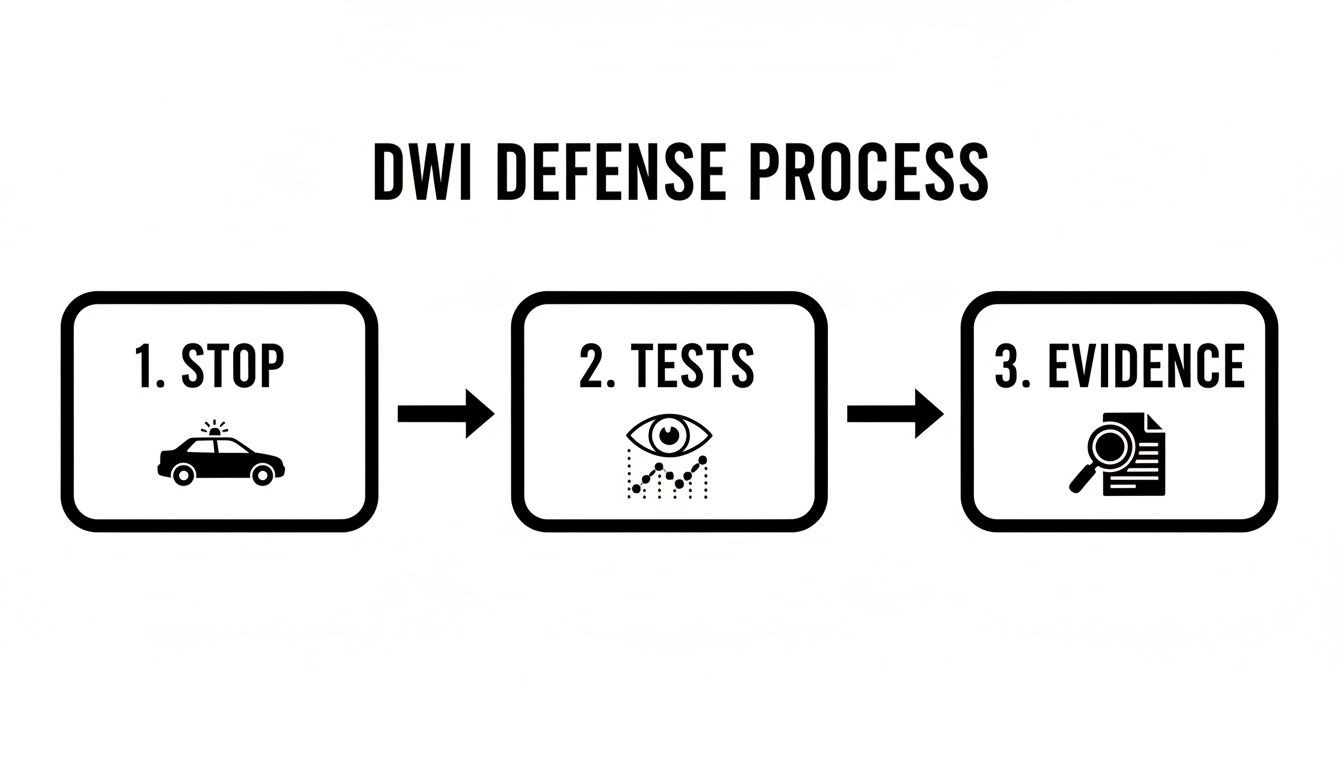
As you can see, every stage—from the flashing lights to the chemical test—is an opportunity to build a strong defense.
Stage 1: The Arrest, Booking, and Bond
It starts the moment you’re placed in handcuffs. You'll be taken to a police station or county jail for booking, where they’ll take your fingerprints, photo, and personal details.
Once booked, the immediate goal is getting released. A judge sets a bond amount—a financial promise you’ll appear for future court dates. You can pay the full amount or hire a bail bondsman. An experienced DWI lawyer can often help speed up this process.
Stage 2: The ALR Hearing and Your First Court Date
The moment you’re released, a critical clock starts ticking. You have only 15 days to request an Administrative License Revocation (ALR) hearing. This is your one and only chance to fight the automatic suspension of your driver’s license. Your attorney will handle this time-sensitive step immediately.
Soon after, you’ll receive a notice for your first court appearance, the arraignment. This is where the state formally reads the charges, and you’ll enter a plea of "not guilty." This hearing officially begins the criminal side of your case.
Stage 3: Pre-Trial Discovery and Negotiations
This is where the real work of building your defense happens. During the pre-trial phase, your attorney files for "discovery," a legal demand for all evidence the prosecutor has against you.
This evidence typically includes:
- The official police report and officer notes.
- Dashcam and bodycam video footage.
- Results of breath or blood tests, plus machine maintenance logs.
- The arresting officer’s training and certification records.
Your lawyer will comb through every document and video, looking for weaknesses, procedural mistakes, or rights violations. This investigation forms the basis for legal challenges, like a Motion to Suppress Evidence. This is also the stage where your attorney negotiates with the prosecutor, pushing for a dismissal or charge reduction. For a more detailed look, our firm has a comprehensive Texas DUI case timeline that breaks down each step.
Stage 4: Trial or Resolution
Most DWI cases are resolved during the pre-trial phase. But if the prosecutor refuses to make a fair offer, your case will head to trial, where you have a right to have your case decided by a jury.
At trial, the prosecutor must prove you are guilty "beyond a reasonable doubt"—the highest standard in our justice system. Your attorney's job is to dismantle their case, cross-examine their witnesses, and show the jury that the evidence isn’t strong enough for a conviction. Whether your case ends in a plea agreement or a not-guilty verdict, having a prepared and strategic lawyer is your greatest advantage.
Why a Houston DWI Lawyer Is Your Strongest Ally
When facing the full weight of the state's legal machine, going it alone is a risk you cannot afford. A DWI charge is a complex legal battle where your freedom, finances, and future are at stake.
An experienced DWI lawyer does more than just show up to court. They become your strategic partner, digging into every detail of your case to find weaknesses in the prosecution’s story, protect you from rights violations, and challenge the so-called "scientific" evidence from breath and blood tests.
Local Knowledge Is a Powerful Advantage
Hiring a lawyer deeply familiar with Houston’s legal community gives you an invaluable advantage. They know the local court system—the prosecutors, the judges, and the unwritten rules of the courthouse. This isn't just trivia; it's critical intelligence that can dramatically influence the outcome of your case.
This local experience transforms generic legal advice into a sharp, tailored defense strategy, giving you the best possible chance at a favorable result.
Your Advocate and Your Shield
Ultimately, your attorney is your champion, committed to minimizing the damage a DWI charge can cause. Texas DWI laws are constantly changing, often becoming stricter. You can learn more about the history of drunk driving laws at lowlawfirm.com.
An expert stays ahead of these changes, ensuring your defense is built on the most current legal ground. They are your shield, standing between you and the full force of the prosecution.
A DWI arrest can make you feel like your world is caving in, but it does not have to define your future. Getting a strategic, knowledgeable legal partner in your corner is the single most important step you can take to protect your rights and fight for the best possible outcome.
If you're facing charges, the time to act is now. A dedicated Houston DWI lawyer is ready to hear your side of the story, explain your options, and start building the powerful defense you need.
Contact The Law Office of Bryan Fagan, PLLC today for a free, confidential case evaluation. Let our experienced team show you how we fight for our clients.
Your Top Questions About Texas DWI Cases Answered
A DWI arrest brings a whirlwind of urgent questions and anxiety. Not knowing what comes next is often the most stressful part. Below, we provide clear, direct answers to the questions we hear most often.
Getting reliable information is the first step toward regaining control. When you understand your rights and the road ahead, you and your attorney can build a powerful defense.
Should I Refuse a Breathalyzer Test in Texas?
This is a high-stakes decision with no single "right" answer. Texas operates under an "implied consent" law, meaning you’ve already agreed to provide a breath or blood sample if lawfully arrested for DWI.
Refusing has an immediate consequence: a driver's license suspension, typically for 180 days on a first offense. However, providing a sample gives the prosecutor their most powerful piece of evidence—your BAC. A refusal forces them to prove intoxication using other, often weaker evidence like the officer's subjective observations.
While the license suspension is serious, a skilled DWI attorney will immediately request an ALR hearing to fight it. The best choice depends on the specific facts of your case.
Can a DWI Be Wiped From My Record in Texas?
Yes, it’s possible, but only in specific circumstances. If your DWI case is dismissed, you are found "not guilty" at trial, or you complete a pre-trial diversion program, you may be eligible for an expunction.
An expunction is a court order to destroy all records of your arrest. For all intents and purposes, it’s like it never happened.
Once you are convicted, an expunction is no longer an option. However, you might still qualify for an Order of Non-Disclosure, which seals the conviction from public view. While law enforcement can still see it, employers, landlords, and the public cannot. To be eligible, your BAC was likely below 0.15, and you must have completed all terms of your probation. An experienced lawyer can tell you if your case qualifies for one of these powerful remedies.
What Is the ALR Hearing, and Why Is It a Big Deal?
The Administrative License Revocation (ALR) hearing is a civil proceeding completely separate from your criminal DWI case. Its only purpose is to decide if the Texas Department of Public Safety (DPS) can suspend your driver's license.
You have just 15 days from your arrest to request this hearing. This deadline is absolute. If you miss it, your license will be suspended automatically.
The ALR hearing is also your lawyer's first opportunity to challenge the prosecution's case. It’s a chance to question the arresting officer under oath long before your criminal trial. The testimony from this hearing can uncover major weaknesses in the state’s case—weaknesses that can be used to get your criminal charges reduced or even dismissed. It is a vital strategic move.
The hours and days after a DWI arrest are crucial. You don’t have to face this complex legal maze alone. The experienced attorneys at The Law Office of Bryan Fagan, PLLC are ready to stand with you, defend your rights, and fight for the best possible outcome. For a free, confidential case evaluation to discuss your options, contact us today at https://texasduilawfirm.com.

