
A DWI arrest can be overwhelming—but you don’t have to face it alone. While a first-offense DWI in Texas is a serious Class B Misdemeanor, the criminal charge isn’t your most immediate problem. The real race against the clock is to save your driver's license.
You have just 15 days from the moment of your arrest to request an Administrative License Revocation (ALR) hearing. If you miss this critical deadline, the state can automatically suspend your license. This is, without a doubt, the most important deadline you will face in the entire process.
What Happens After a First DWI Arrest in Texas
Getting arrested for DWI is disorienting and stressful. Once you're released, it’s easy to feel overwhelmed and unsure what to do next. But the steps you take in the first 24 to 48 hours can significantly impact the outcome of your case. This isn't a time to wait and see what happens—it's a time for decisive action.
You are now fighting two separate legal battles: one in criminal court over the DWI charge and another with the Texas Department of Public Safety (DPS) over your license. The battle for your driving privileges starts immediately.
The path forward might seem confusing, but it follows a clear sequence. The infographic below simplifies the essential steps to take right after an arrest.
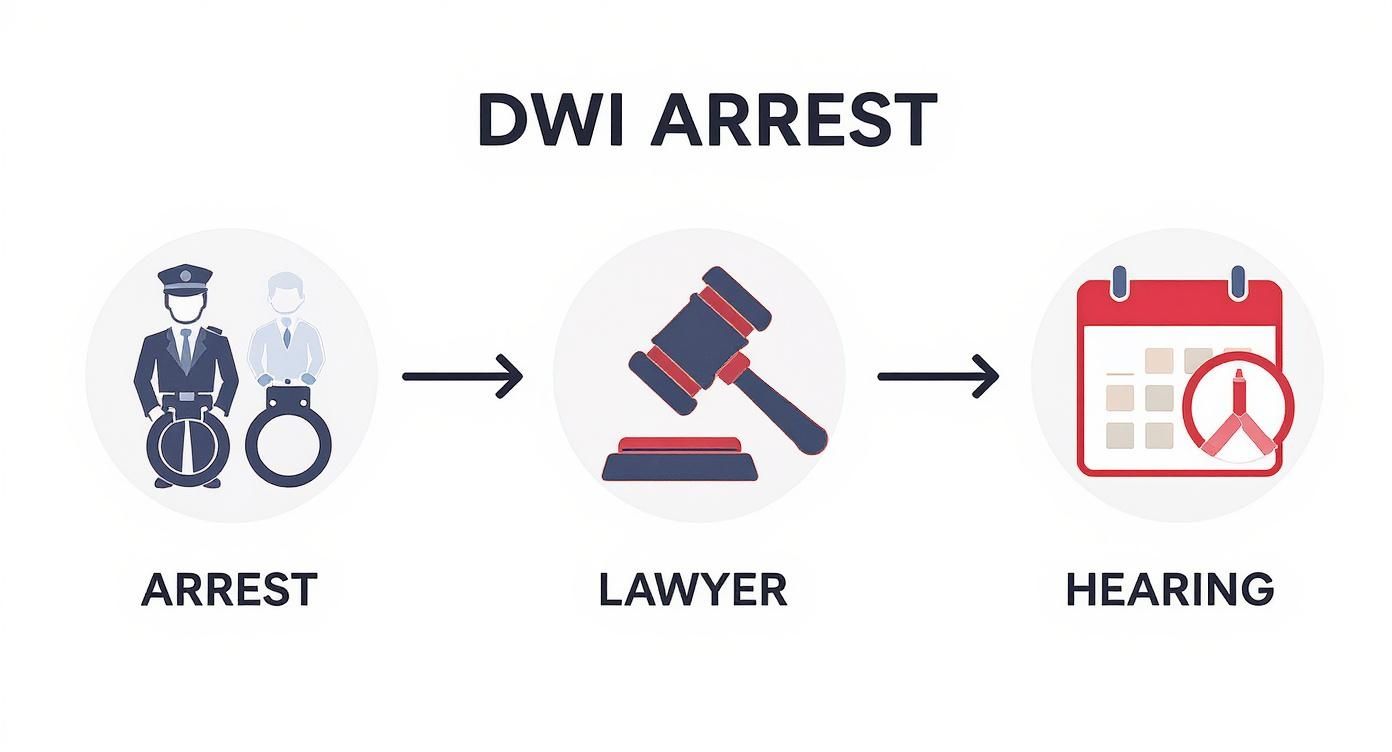
As you can see, hiring an experienced Houston DWI lawyer is the critical link between your arrest and building a strong, strategic defense. It’s not just about the criminal charge; it's about protecting your freedom to drive.
The Most Important Deadline You Face
Let's get back to that ticking clock. The most urgent threat after a first DWI in Texas is losing your license. This isn't decided by a criminal judge but through a separate civil, administrative process.
You have exactly 15 days from the date of your arrest to formally request an Administrative License Revocation (ALR) hearing. If you fail to file this request, your license will be automatically suspended.
Think of the ALR hearing as a mini-trial focused solely on your driving privileges. It runs on a completely different track from your criminal DWI case.
Winning the ALR hearing not only prevents the suspension but also gives your attorney an invaluable opportunity to review the state’s evidence against you—long before the criminal case moves forward. You can learn more in our detailed guide on the Texas ALR hearing process.
Taking immediate action is the cornerstone of a strategic defense. A proactive approach allows your attorney to preserve evidence, interview witnesses, and—most importantly—file the necessary paperwork to save your license before that 15-day window closes.
Texas DWI Penalties Explained
Many people mistakenly believe a first-time DWI is just a slap on the wrist. They assume it involves a fine, some classes, and then it’s over. But in Texas, the law treats a first DWI as a very serious offense. A conviction isn't just about paying a fine; it can lead to significant penalties that follow you for years.
Understanding what you're up against is the first step in building a solid defense strategy.
A standard texas dwi first offense is classified as a Class B Misdemeanor. While that is a serious charge on its own, it’s critical to understand that certain "aggravating factors" can increase the penalties substantially.

Standard vs. Enhanced DWI Penalties
The consequences for a first DWI in Texas are not one-size-fits-all. They can change dramatically based on the specifics of your arrest. The legal limit for Blood Alcohol Concentration (BAC) is 0.08%, but the penalties become much tougher if your BAC is significantly higher or if other circumstances were involved.
For a standard first offense (Class B Misdemeanor), the potential penalties include:
- Fines up to $3,000
- Jail time of 72 hours to 180 days
- Driver’s license suspension for up to one year
However, if your BAC is 0.15% or higher—nearly double the legal limit—the charge is enhanced to a Class A Misdemeanor. The potential fines increase to $6,000, and you could face up to a year in jail.
The stakes get even higher if a child under 15 is in the vehicle. That is a state jail felony, carrying fines up to $10,000 and a potential jail sentence of up to two years. For more details on these strict laws, you can learn more about Texas DWI penalties here.
This is why you need an experienced DWI lawyer to scrutinize every detail of your arrest.
To make these penalties easier to understand, here's a quick summary of what a first-time offender might face.
Texas First DWI Offense Penalties at a Glance
| Charge Level (BAC/Circumstance) | Classification | Potential Fines | Potential Jail Time | DWI License Suspension |
|---|---|---|---|---|
| Standard DWI (BAC under 0.15%) | Class B Misdemeanor | Up to $3,000 | 72 hours – 180 days | Up to 1 year |
| High BAC DWI (BAC 0.15% or higher) | Class A Misdemeanor | Up to $6,000 | 30 days – 1 year | Up to 2 years |
| DWI with Child Passenger (Under 15) | State Jail Felony | Up to $10,000 | 180 days – 2 years | Up to 2 years |
As you can see, the circumstances of your arrest play a massive role in the potential outcome.
Key Aggravating Factors in Texas
Certain situations will automatically escalate your DWI charge. Prosecutors look for these factors to seek the toughest penalties possible.
- High BAC: As mentioned, a BAC of 0.15% or higher upgrades the charge to a Class A Misdemeanor, doubling the potential fines and jail time.
- Child Passenger: Driving while intoxicated with a passenger under the age of 15 is a state jail felony, one of the most serious aggravating factors.
- Open Container: Having an open container of alcohol in your vehicle can add to the minimum jail time required if you are convicted.
A DWI charge isn't just a one-time event. A conviction stays on your record permanently, setting the stage for much harsher penalties if you ever face another charge down the road.
These potential outcomes are not meant to cause fear, but to provide a realistic picture of what's at stake. A strategic legal defense is a necessity to protect your freedom, your finances, and your future. An experienced Texas DUI attorney knows how to challenge the prosecution’s case and fight for the best possible outcome for a first DWI in Texas.
Navigating the Two Cases Against You
One of the biggest surprises for people arrested for DWI in Texas is discovering they are not just in one legal fight—they are in two. The state essentially pursues your case on two separate fronts at the same time: a criminal case that determines guilt and an administrative case designed to take away your driver’s license.
These two processes are completely separate. They have different rules, deadlines, and objectives. Facing a DWI without understanding this dual-track system is a significant disadvantage. An experienced Houston DWI lawyer knows how to manage both battles simultaneously, creating a defense strategy that protects both your freedom and your ability to drive.
The Administrative License Revocation (ALR) Case
First is the civil case against your driver’s license. This process is called the Administrative License Revocation (ALR), and it’s handled by the Texas Department of Public Safety (DPS), not the criminal courts. Its only goal is to determine whether the state can suspend your license.
This case is automatically triggered if you fail a chemical test (breath or blood) or refuse to take one. As we've mentioned, you have only 15 days from your arrest date to request an ALR hearing to fight this suspension. If you miss that deadline, your license will likely be suspended.
The ALR hearing is more than a fight for your license—it’s a powerful strategic advantage. It gives your attorney the first opportunity to question the arresting officer under oath and examine the evidence. This is often where we find weaknesses in the state's case, long before the criminal trial begins.
The Criminal DWI Case
The second battle is the criminal case. Here, the state prosecutor must prove beyond a reasonable doubt that you were operating a motor vehicle in a public place while intoxicated.
The criminal process for a Texas DWI first offense follows several key steps:
- Arraignment: This is your first official court date where the charges are read, and you enter a plea—almost always "not guilty."
- Pre-Trial Motions: Your attorney will file legal challenges. These motions can question everything from the reason for the traffic stop to the accuracy of the breathalyzer machine.
- Plea Bargaining: In many cases, your lawyer and the prosecutor will negotiate to see if a favorable agreement can be reached, potentially reducing the charge or sentence to avoid a trial.
- Trial: If a fair agreement cannot be reached, your case will proceed to trial, where a judge or jury will hear the evidence and decide your guilt or innocence.
To successfully fight DWI Texas charges, you need an attorney who can skillfully navigate both the ALR hearing and the criminal court system. A win in the ALR case not only saves your license but can provide a significant advantage in the criminal fight, putting you in the best position to protect your future.
How to Challenge the Prosecution's Evidence
An arrest for a Texas DWI first offense is not a conviction. The state has the entire burden of proving its case, and the evidence it relies on is often flawed. A strong defense begins by scrutinizing every action the officer took, from the initial traffic stop to the final chemical test.
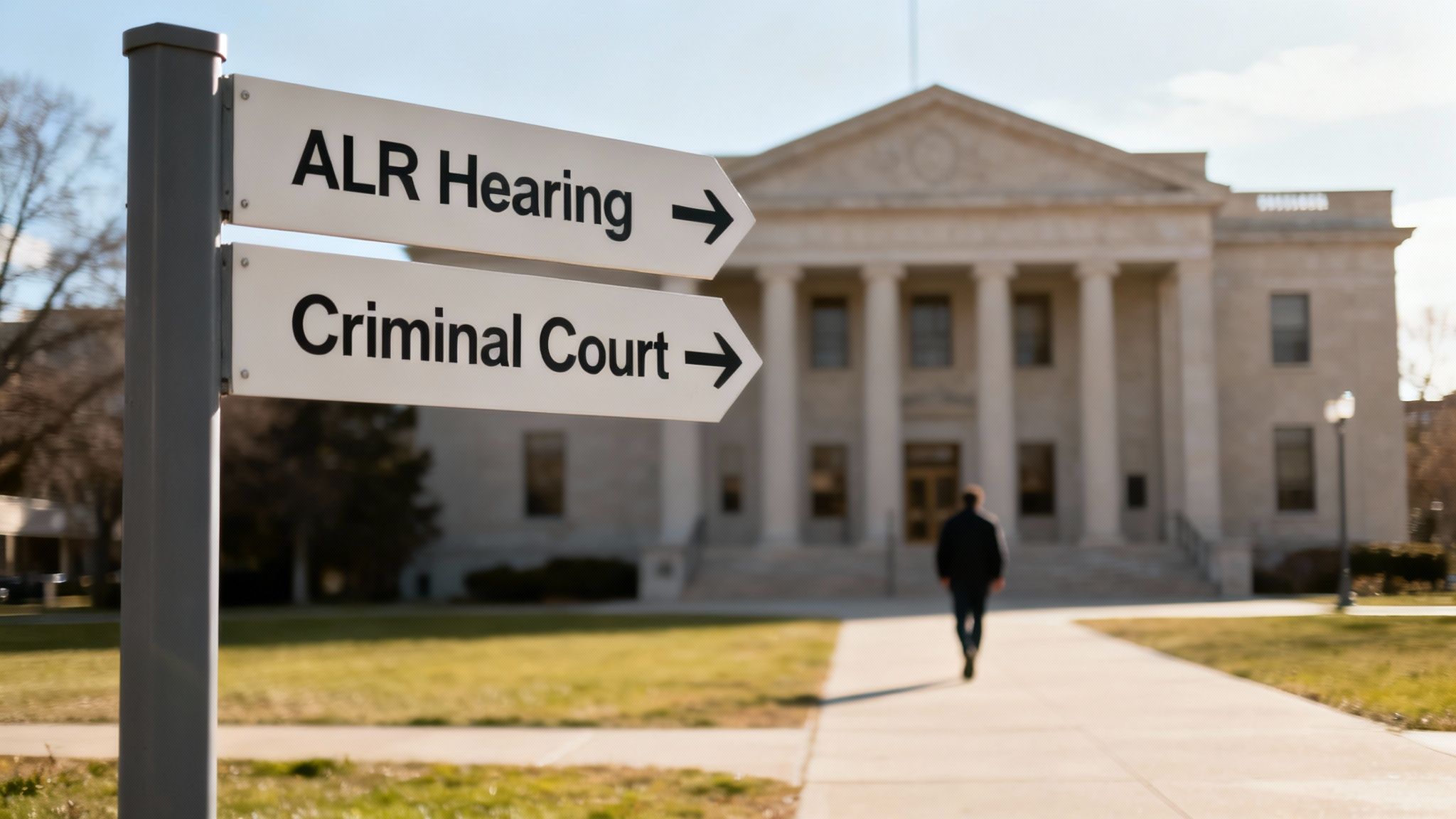
Think of the prosecution's case like a chain. If we can break just one link, the entire case can fall apart. We always start at the beginning: Did the officer have a legal reason—reasonable suspicion—to pull you over? If the stop was illegal, any evidence gathered afterward can often be excluded from court.
Deconstructing Field Sobriety Tests
Field sobriety tests are a cornerstone of DWI arrests but are notoriously unreliable. These are not simple pass/fail exercises; they are divided-attention tasks that many sober people would find difficult under ideal conditions.
We challenge the validity of these tests by digging into the details:
- Improper Instructions: Did the officer give you instructions exactly as their training manual requires? Any deviation can invalidate the results.
- Environmental Conditions: Were the tests performed on a flat, dry, well-lit surface? Uneven ground, poor lighting, or bad weather can make passing nearly impossible.
- Your Physical Condition: Do you have medical issues, injuries, or balance problems? Age and weight can also affect your ability to perform these physical maneuvers.
It's a common myth that "failing" a field sobriety test is solid proof of intoxication. In truth, these tests are highly subjective and provide a skilled Texas DUI attorney a valuable opportunity to question the officer's judgment.
Scrutinizing Breath and Blood Test Results
Chemical tests, like a breathalyzer or blood draw, may seem scientific and conclusive, but they are prone to significant errors. The machines require precise calibration, and samples must be handled according to strict legal protocols.
For breath tests, we investigate whether the machine was properly maintained and if the officer administering the test was certified. We also explore whether medical conditions like acid reflux or residual mouth alcohol could have inflated the BAC reading. Our guide on how to challenge breathalyzer results in Texas explores these defense strategies in more detail.
When it comes to blood tests, the chain of custody is critical. Was the sample drawn by a qualified professional? Was it stored and transported correctly to prevent contamination? Any mistake in this process can render the results inadmissible in court.
Successfully challenging the state's evidence is how we fight to get a DWI case dismissed or the charges reduced. An experienced DWI lawyer is essential for finding the weak spots in the state's case and pushing for a dismissal. Your case is unique, and it deserves a defense that questions everything.
The Long-Term Impact of a DWI Conviction
It’s tempting to view a first-offense DWI as a temporary problem, but a conviction casts a long and permanent shadow over your future. The consequences extend far beyond the courtroom, affecting your personal and professional life in unexpected ways.
This is why building a strong legal defense is not just about managing a single mistake—it's about protecting everything you've worked for.
A DWI on your permanent criminal record is a major red flag for potential employers. Most companies conduct background checks, and a conviction can disqualify you from jobs, especially those that involve driving, require a professional license, or place you in a position of trust.

How a Conviction Affects Daily Life
The ripple effects of a Texas DWI first offense conviction can impact nearly every area of your life. It's not just about your career; the consequences can be personal and financial.
Here are just a few of the lasting impacts you could face:
- Skyrocketing Insurance Rates: Your auto insurance premiums will likely increase significantly, often by thousands of dollars per year, for a long time.
- Professional Licensing Issues: If you hold a professional license as a nurse, pilot, real estate agent, or in another field, a DWI conviction could trigger disciplinary action from your licensing board, potentially leading to suspension or revocation.
- Housing and Education Hurdles: Landlords often run background checks, and a DWI could lead to a denied rental application. It can also affect your eligibility for student loans or acceptance into certain college programs.
- Community and Family Life: The stigma of a conviction can follow you. Opportunities like volunteering at your child's school may become impossible, as many organizations bar anyone with a criminal record from participating.
A first DWI conviction sets a dangerous legal precedent. If you are ever arrested for another DWI in the future, the penalties will be far more severe, with mandatory jail time and longer license suspensions.
The Hidden Risks of Impaired Driving
While the legal penalties are daunting, it is important to understand why the system takes these charges so seriously. Statistically, a first-time DWI arrest is rarely a person's first time driving while impaired—it’s usually just the first time they were caught.
Research suggests the average first-time offender has driven under the influence approximately 87 times before their first arrest. This statistic is a major public safety concern and a key reason why Texas law enforcement and prosecutors pursue these charges so aggressively. To learn more, you can review additional DWI facts and statistics.
Fighting the charge is about more than avoiding jail time or fines. It's about safeguarding your reputation and future from these long-term consequences. An experienced Houston DWI lawyer can work to prevent a single mistake from defining the rest of your life.
Your Future Is Worth Fighting For
Facing a Texas DWI first offense is a heavy burden, but the most important thing to remember is that you have options. An arrest is not a conviction. While the penalties are serious and the legal process is confusing, the state's case against you may have weaknesses. The key is to take swift, decisive action.
Don't let one mistake derail your future. There are strategic, proven ways to challenge the evidence, question procedures, and fight for a better outcome. An experienced DWI attorney can be the difference between a life-altering conviction and a more manageable result, such as a reduced charge or even a full dismissal.
Get the Legal Help You Deserve
The first step is the most critical. Before you speak further with law enforcement or make any decisions that could affect your case, you need to understand your rights and options. Our guide on how to find a local DWI lawyer is a great resource to help you find the right advocate for your situation.
Contact The Law Office of Bryan Fagan, PLLC for a free, confidential consultation. Let our experienced Houston DWI lawyers hear your side of the story, explain your rights in clear terms, and start building the powerful defense you need and deserve.
Common Questions About a First DWI in Texas
After a DWI arrest, your mind is likely racing with questions. It's a confusing and stressful experience, but getting accurate information is the first step toward regaining control.
Here are some of the most common questions we hear from people in your exact situation. Our goal is to provide clear, straightforward answers to help you understand the road ahead.
Can I Refuse a Breathalyzer Test in Texas?
Yes, you have the right to refuse a breath or blood test. However, this right comes with an immediate consequence under Texas's “implied consent” law. By driving on Texas roads, you have implicitly agreed to submit to a chemical test if lawfully arrested for DWI.
For a first-time refusal, you face an automatic 180-day driver's license suspension. This DWI license suspension is administrative and occurs regardless of whether you are ultimately convicted of DWI. While the prosecutor won't have a BAC number to use against you, they can tell the jury you refused the test and argue it shows you knew you were guilty.
Will I Go to Jail for a First DWI in Texas?
This is the question that causes the most anxiety. While jail time is possible for a first-offense DWI—up to 180 days for a Class B Misdemeanor—it is not guaranteed. In many cases, a skilled Texas DUI attorney can successfully negotiate alternatives that keep you out of jail.
These alternatives often include:
- Probation (also known as community supervision)
- Mandatory DWI education courses
- Entry into a pre-trial diversion program, which can lead to a full dismissal of the charges
The final outcome depends on the specific facts of your arrest, your background, and the strength of the legal defense built to protect you.
Many people assume jail is unavoidable for a first DWI in Texas. The truth is, skilled legal negotiation can often shift the focus from punishment to rehabilitation and education, protecting both your freedom and your future.
How Long Does a DWI Stay on Your Record in Texas?
A DWI conviction in Texas is permanent. It does not automatically disappear after a few years, which can create long-term challenges for employment, housing, and professional licensing.
However, there is hope. If your case is dismissed or you successfully complete deferred adjudication, you may be eligible to seal the record from public view through an order of non-disclosure. In the best-case scenarios—such as an acquittal at trial or an outright dismissal—you could even qualify for an expunction, which completely destroys the arrest record. An attorney can explain whether these powerful options might apply to your case.
A DWI arrest can feel like your world is falling apart, but you don't have to face it alone. The dedicated attorneys at The Law Office of Bryan Fagan, PLLC are here to protect your rights, challenge the evidence, and fight for the best possible outcome. We offer free, confidential case evaluations to help you understand your options and take the first step toward defending your future. Contact us today to build the strategic defense you deserve.