
A DWI arrest can be overwhelming, but you don't have to face it alone. If a crash involved a death, the stakes jump fast, and you may be left trying to understand two things at once: what happens in criminal court, and what happens to your driver's license. The fastest mistake is assuming the criminal case is the only case, because in Texas, the administrative license process can start moving while the felony investigation is still unfolding.
For someone facing Texas DWI fatality charges, the first question is usually simple, “Am I going to lose my license right away?” The better question is, “What can be challenged now, before the deadlines pass?” That matters because Texas has a separate license process, separate evidence rules, and a separate timeline from the criminal court case. A calm, early response can protect driving privileges, preserve evidence, and create better options for the defense.
What Happens After a Fatal DWI Arrest in Texas
The first hours after a fatal DWI arrest feel chaotic. Police may still be interviewing witnesses, the crash scene may still be under review, and your phone may already be filling with calls from family, an employer, or the jail. In that moment, you are dealing with two tracks that move on different timelines, the criminal case and the administrative license case.
On the criminal side, prosecutors may pursue intoxication manslaughter or intoxication assault if the facts support those charges. On the license side, the Texas Department of Public Safety can begin the ALR process, which runs separately from the court case. A person can be fighting for a bond, a hearing date, and a license deadline at the same time.
The first days matter more than many defendants realize
The early window is where key defense choices get made. Wait too long, and you can miss the chance to request an ALR hearing, lose negotiating power, or let evidence fade before your lawyer can secure it. That is why many people contact a Texas DUI attorney before the first court setting, not after.
Practical rule: treat the arrest like two overlapping cases. One case decides criminal exposure, the other decides whether you can keep driving while the criminal case is pending.
The criminal court case may take months, but the license process moves far faster. If you are a CDL holder, an out-of-state driver, or someone who needs to drive for work or family, the early steps matter even more. A Houston DWI lawyer or other local Texas defense lawyer can use the first few days to identify deadlines, preserve video, and start shaping the case theory before the evidence hardens.
If you are trying to sort out the moving parts, the roadmap is straightforward. Define the charge, understand the penalties, learn the court process, challenge the evidence, and act quickly on the license issue. For readers facing a crash case involving injury or death, Texas DWI involving an accident or injury in Texas is a helpful companion topic because it shows how an accident changes the legal exposure in a Texas DWI case.
The Core Texas DWI Fatality Offenses Explained
Texas charges a fatal crash case based on the harm the State believes it can prove, not just on the fact that a driver had alcohol in the system. The charge people hear most often is intoxication manslaughter, and the statute matters because it defines the elements the prosecution must prove. Under Texas Penal Code §49.08, the State has to show that a person operated a motor vehicle in a public place while intoxicated and, because of that intoxication, caused another person's death by accident or mistake. That causation issue is where many of these cases are fought, because the question is not just whether alcohol was present, but whether intoxication caused the fatal outcome. Texas Penal Code §49.08
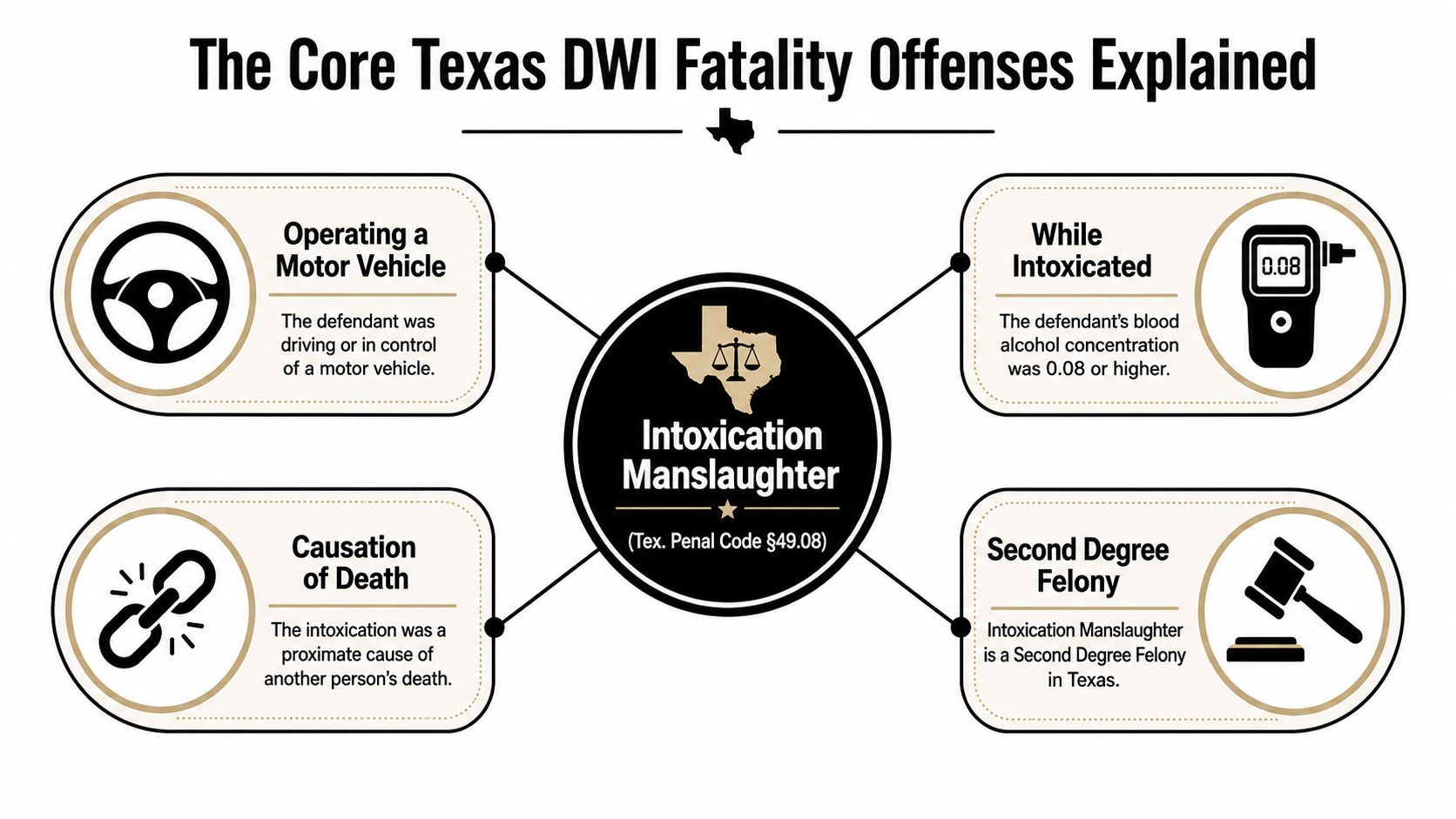
The terms you'll hear again and again
BAC means blood alcohol concentration. In Texas DWI cases, 0.08% is the legal intoxication threshold for most drivers, while a separate 0.04% limit applies to commercial drivers when operating a commercial vehicle. Intoxicated means more than just having consumed alcohol, because the State still has to prove impairment or the legal BAC level.
Implied consent is the rule that, by driving in Texas, a driver can face consequences for refusing a chemical specimen after arrest. Field sobriety tests are the roadside balance and coordination exercises officers use to look for signs of impairment, though those tests are often disputed because weather, injuries, fatigue, and nervousness can affect performance. Administrative license suspension is the separate license penalty that comes through the ALR process, not the criminal court.
Texas also treats certain aggravating facts as separate problems. A child passenger under 15 creates additional child-endangerment exposure, which can add penalties on top of the underlying DWI case. The legal issue is not just whether alcohol was involved, it is whether the State can prove the right charge, the right level of harm, and the right cause of that harm.
For readers comparing related charges, intoxication manslaughter charges in Texas explains the fatality offense itself, while DWI Involving an Accident or Injury in Texas addresses the broader accident-focused issues that can arise when a crash does not involve a death. Those topics overlap, but they are not the same thing.
Bottom line: a fatal crash does not automatically mean a conviction for intoxication manslaughter. The State still has to prove intoxication and causation, and those are the places where defense work matters most.
Penalties and Prison Exposure You Need to Understand
A fatal DWI case starts with one question that worries families right away, how much prison time is on the table. The answer only makes sense if you compare it with ordinary DWI exposure first. A first DWI in Texas is commonly punished by up to 180 days in jail and a fine of up to $2,000, while a third offense can carry up to 2 to 10 years in prison and a $10,000 fine. A crash causing serious injury or death can carry a 2 to 20 year prison sentence. Texas penalty summary
Why the fatality allegation changes everything
That range explains why a fatality allegation changes the whole case. A routine first DWI often stays in misdemeanor court, while a crash tied to intoxication and a death can move into felony territory with long-term incarceration risk. Texas intoxication manslaughter is a second-degree felony, and the punishment can include prison, a fine, and required community service. Texas practice materials describe community service requirements in these cases, and the amount depends on how the case is charged and resolved.
The same crash can also trigger consequences that do not fit neatly into the prison sentence. License losses, testing consequences, and probation terms can stack around the criminal case. If a child under 15 was in the vehicle, Texas treats that as a separate child-endangerment offense, adding up to 2 years in jail, an additional fine of up to $10,000, and a 180-day license loss on top of the DWI sanctions. Texas impaired driving laws
What a lawyer looks at when comparing exposure
The core comparison is not just misdemeanor versus felony. A defense lawyer looks at whether the State has evidence strong enough to support the charge, whether the facts support the level of causation the prosecutor is claiming, and whether the case can be negotiated down if the record is weaker than it first appears. That means studying the crash reconstruction, the test results, and the exact allegations before anyone talks seriously about plea posture.
If you want a closer look at felony exposure, Felony DWI in Texas gives the broader framework. The main point is simple, a fatality charge is a different universe, not just a harsher version of a routine DWI.
How a Texas DWI Fatality Case Moves Through Criminal Court
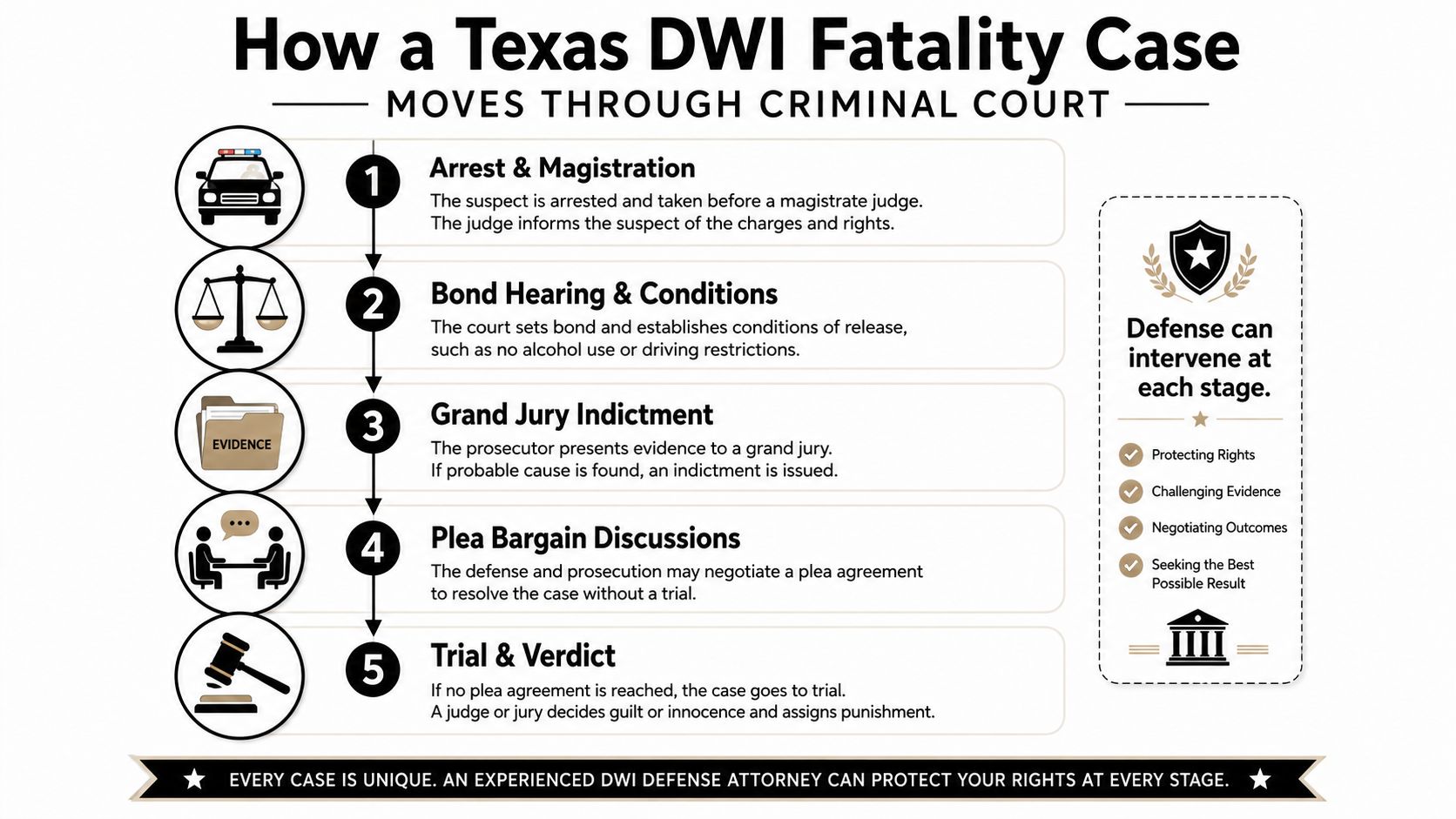
A fatal DWI case doesn't begin with a jury trial. It begins with paperwork, bond, evidence collection, and a long period where the defense can challenge what the State thinks it has. After arrest, the court will address magistration, bond, and conditions of release. In felony cases, formal charges usually move through grand jury review before the case is fully set for trial.
The stages that usually follow
Discovery comes next, and that's where the defense starts seeing the State's file. That file may include blood or breath results, police reports, dash-cam and body-cam footage, 911 audio, and crash reconstruction materials. A good lawyer studies what the officers wrote, what they recorded, and what the science does or doesn't support.
Then comes the legal challenge phase. Defense counsel may file motions to suppress evidence if the stop, arrest, search, or seizure violated constitutional rules. Plea negotiations often happen during this period, and in many Texas counties the practical outcome depends on how strong the causation evidence is and how the family, investigators, and prosecutors assess the full record.
Practical rule: the earlier your lawyer gets the file, the more likely it is that weak evidence can be challenged before the State builds its case around it.
Where defense counsel makes the biggest difference
A lawyer can intervene at nearly every step, but the most important moments are often the first ones. Bond conditions can affect work, travel, and family obligations. Discovery can expose gaps in the State's theory. Pretrial motions can narrow the evidence or even take critical pieces out of the case.
The timeline for a felony DWI case is not quick, and that's one reason panic helps no one. Some cases resolve through negotiation, some move toward trial, and some end with outcomes that are better than the family feared at the beginning. For a closer look at the criminal timeline, see Timeline of a DWI Case in Texas, From Arrest to Trial.
The ALR Hearing and Your Texas Driver's License
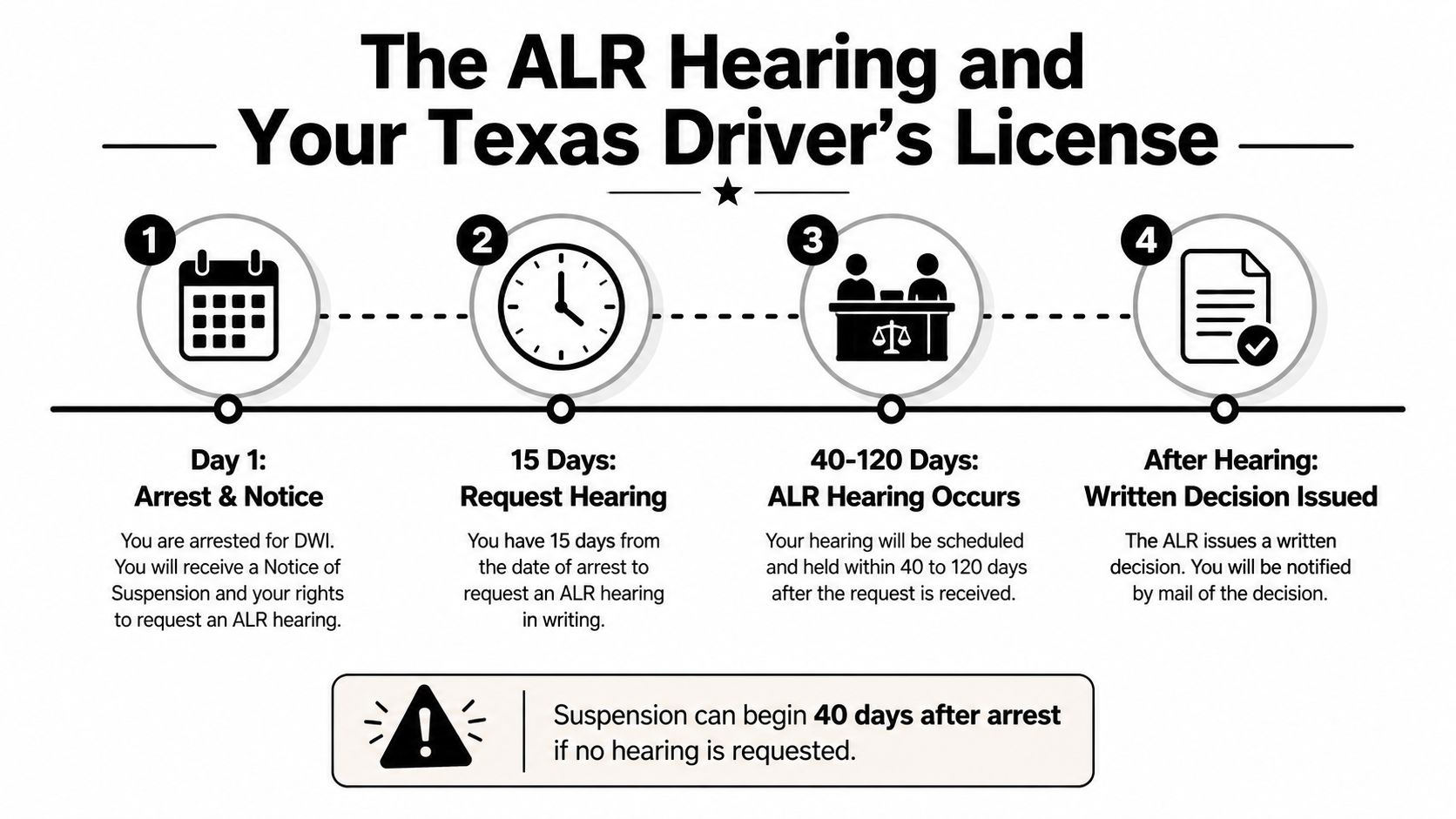
The criminal court case and the license case do not wait for each other. Texas uses implied consent rules and a separate administrative process called ALR, short for Administrative License Revocation, to decide whether your driving privilege should be suspended after a DWI or BWI arrest. That means a driver can be fighting a criminal case in one courthouse while also fighting to keep a license through a separate administrative track.
What refusal can trigger
A refusal to provide a specimen after arrest can trigger an ALR suspension of 180 days for a first refusal and 2 years if the driver was previously suspended for failing or refusing a specimen. That's a separate administrative consequence, and it starts before the criminal charge is resolved. Texas Impaired Driving Plan
That deadline matters because a driver usually has only a short window to request the hearing after receiving notice. If the hearing is not requested in time, the suspension can go into effect on its own timetable. An ALR loss does not decide guilt in the criminal case, but it can hurt your ability to work, care for your family, or keep a commercial license active while the case is pending.
Why the ALR case deserves its own strategy
The hearing is not a formality. The defense can challenge whether the stop was lawful, whether probable cause existed, whether the officer properly requested the specimen, and whether the paperwork was handled correctly. In some cases, winning the ALR hearing preserves an advantage in the criminal case even if it doesn't erase the arrest.
CDL holders face added risk because commercial driving standards are stricter, and out-of-state drivers can see Texas consequences follow them back home. The point is not that the license issue is more important than the criminal case, but that it is separate, urgent, and often overlooked. That's why a Texas DWI license suspension needs immediate attention, not after the court date.
Defenses That Actually Move Fatal DWI Cases
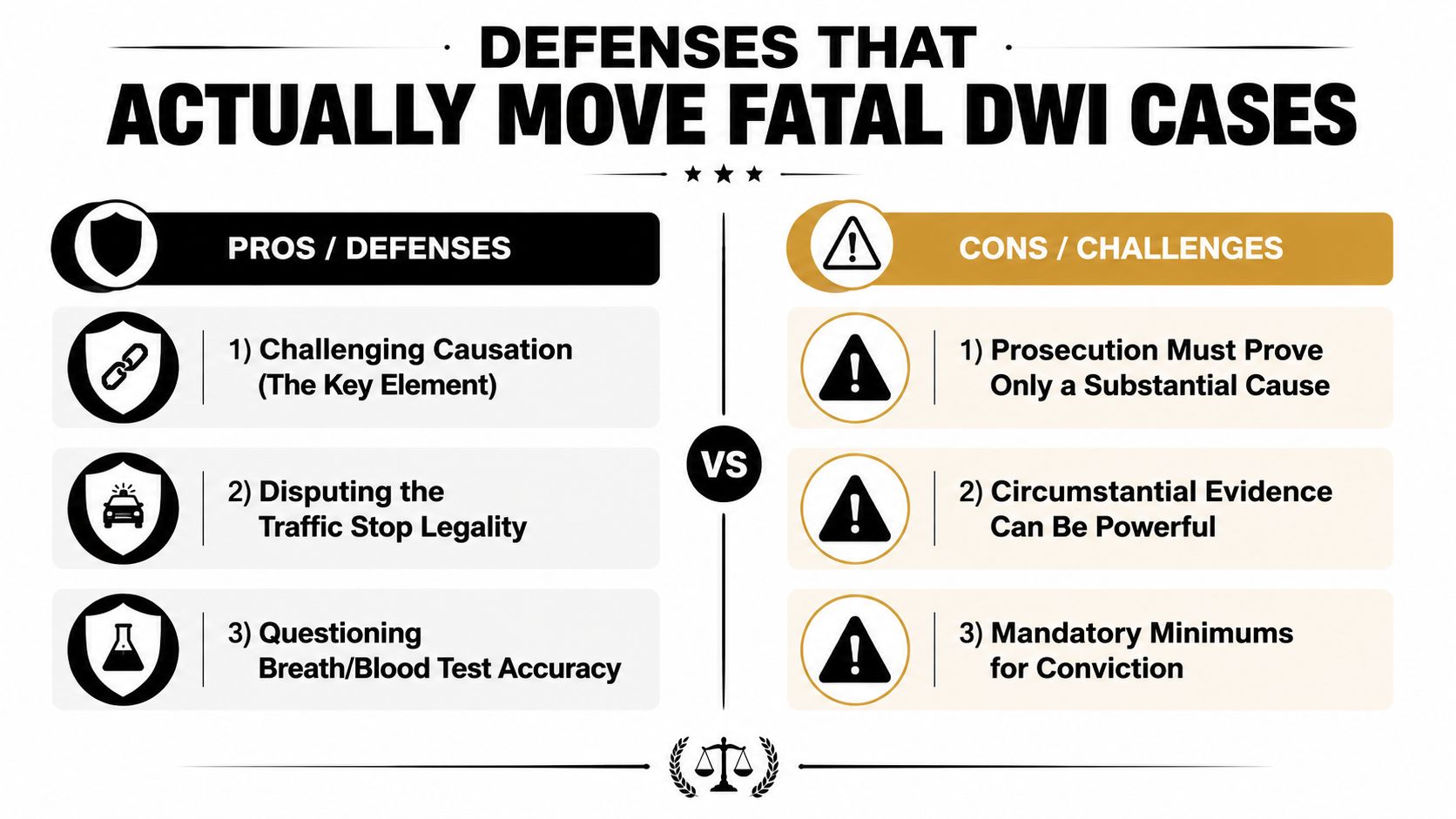
The hardest part of a fatality case is not always the intoxication allegation. It's the causation issue, because Texas intoxication manslaughter requires proof that the driver was intoxicated and, because of that intoxication, caused the death by accident or mistake. That means the fight is often about whether alcohol caused the crash, or whether something else did.
The evidence that gets tested first
A defense lawyer will usually start with the legality of the stop and arrest. If the officer lacked a lawful basis for the stop, key evidence may be challenged. Then the lawyer looks at the breath or blood evidence, including whether the machine was maintained correctly, whether the sample chain of custody is intact, and whether the laboratory results can be retested or explained differently.
Field sobriety tests matter too, but they are far from perfect. Roadside conditions, injury, shock, darkness, and fatigue can all distort what officers think they saw. Crash reconstruction can also change the story, because speed, impact point, visibility, and roadway conditions can show a sequence that doesn't match the simplest police theory.
Alternative causes can matter more than people think
Medical emergencies, mechanical defects, and the conduct of another driver can all affect causation. If the defense can show that intoxication wasn't the legal cause of the death, the State's best charge may weaken. That is why the charge does not turn on the fatality alone, it turns on proof that intoxication caused the death.
The prosecution can have a tragic crash and still have a legally weak case if the causal link is not proven.
Mitigation matters too. Cooperation with investigators, documented treatment, and a measured response to the victim-impact side of the case can influence negotiation posture in some counties. A case with serious exposure can still resolve in a way that avoids the worst possible outcome, but only if the defense is active early and focused on the evidence.
Your First 15 Days After a Texas DWI Fatality Arrest
The first 15 days are not a period to sit and wait. They are a period to act carefully. The criminal case and the license case begin to move on different tracks, and early choices can affect both of them. One track focuses on whether the State can prove intoxication manslaughter or another fatality charge. The other track focuses on whether you keep your driving privilege while the case is pending.
A lot of confusion starts here because people assume the arrest itself tells the whole story. It does not. A fatal crash gives the State a serious accusation, but the legal fight still turns on evidence, timing, and causation. That means your first job is to protect records and avoid mistakes that can harden the State's case.
Your immediate checklist
- Request the ALR hearing fast: the license case starts on its own schedule, and missing the deadline can cost you your driving privileges.
- Save crash-related evidence: photos of the scene, vehicle damage, skid marks, road conditions, and anything that shows what happened before officers changed the area.
- Collect medical records and witness names: if injury, shock, or another driver's conduct matters, those records and witnesses can become important.
- Stay off social media: posts, messages, and comments can be used against you later.
- Follow bond conditions exactly: missed check-ins or ignored restrictions can create a second problem while the first case is still pending.
If a child under 15 was in the vehicle, the exposure can increase quickly, so the details matter even more. Texas treats that situation as a separate child-endangerment offense with added jail, fine, and license consequences, which makes early legal review important.
Special issues for CDL holders and professionals
Commercial drivers need to think about employment consequences immediately, because a Texas case can affect a license beyond the courtroom. Licensed professionals should also think about reporting duties, because a board can open its own review even if the criminal case has not been resolved. Out-of-state drivers should assume their home state may learn about the Texas case through licensing systems and employer reporting.
A defense lawyer who handles felony DWI, ALR hearings, and fatal crash cases should be involved early. In some situations, the Law Office of Bryan Fagan, PLLC is one option for that kind of work because it handles Texas DWI defense at both the license and criminal levels. The important point is simple. Do not wait until the best chance to challenge the State's evidence has already passed.
Why Local Texas Experience Matters and How to Get Help Now
Texas DWI fatality charges are serious, but they are not automatic convictions. The lawyer who understands local courts, local prosecutors, and local ALR practice can spot issues faster and push the case in a better direction sooner. That matters whether your case is in Harris County, Dallas County, Tarrant County, Travis County, Bexar County, or a surrounding court where the docket moves quickly and the facts get evaluated closely.
Texas DWI Fatality Tracks at a Glance
| Track | Decision-Maker | Key Deadline | What Is at Stake |
|---|---|---|---|
| Criminal case | Judge, prosecutor, jury if trial happens | Depends on the court schedule | Felony conviction, prison exposure, probation, fines |
| ALR license case | Texas Department of Public Safety hearing system | Short request window after notice | Driver's license, work access, family transportation |
| Bond and release conditions | Criminal court | Immediate after arrest | Travel limits, check-ins, compliance, freedom while the case is pending |
A local defense team can also read the practical signals in a county's plea posture. Some offices are more willing than others to consider reductions when causation is weak, when lab evidence is shaky, or when a strong mitigation record exists. That's why experience in Texas courts can matter as much as legal knowledge on paper.
If you need help understanding fight DWI Texas strategy, the next step is simple, get a consultation before the evidence hardens. The firm can review the stop, the chemical test, the ALR deadline, and the fatality allegations together, instead of treating them like separate problems.
If you're facing a fatal DWI investigation or charge in Texas, the attorneys at the Law Office of Bryan Fagan, PLLC can review your arrest, protect your license options, and explain the defense path in plain English. Reach out for a free, confidential case evaluation, and get focused help from a Texas team that handles felony DWI, ALR hearings, and intoxication manslaughter defense every day.