 Skip to content
A DWI arrest can be overwhelming — but you don’t have to face it alone. The flashing lights, the confusion, and the fear for your future can make you feel powerless. This moment, as stressful as it is, does not have to define your life. This guide is your first step toward understanding the complex web of Texas alcohol laws driving and taking back control of your situation.
A DWI Arrest Is Overwhelming, But You Have Options

After a DWI arrest, your mind is likely racing with questions: What will happen to my driver's license? Am I facing jail time? How will this impact my job and my family? These are valid concerns, but you do not have to find the answers by yourself.
This guide is designed to provide clear, straightforward information so you can regain your footing. We will walk you through everything from the legal definition of intoxication and Blood Alcohol Concentration (BAC) to the critical process of fighting a license suspension. A strategic defense is possible, and it begins with understanding the law and your rights.
How Texas DWI Laws Became So Strict
The laws for driving while intoxicated have become significantly tougher over the decades. A look at the history of drunk driving laws in Texas shows a clear evolution from lenient rules to the strict standards we see today.
It wasn't until the late 20th century that Texas officially adopted the 0.08% BAC legal limit, aligning with a national movement to improve road safety. This change in 1999 marked a major turning point, establishing the clear, enforceable standard that is still in place across the state.
A DWI charge is far more than a traffic ticket; it is a serious legal challenge with consequences that can affect your personal and professional life for years. But remember: an arrest is not a conviction.
At The Law Office of Bryan Fagan, PLLC, our practice is dedicated to defending Texans facing these exact circumstances. We are here to translate complex legal jargon into plain English, protect your constitutional rights, and build a defense strategy aimed at minimizing the impact on your life. You have options, and our team is ready to help you explore them.
What Legally Constitutes Intoxication in Texas
To build a strong defense against a DWI charge, you must first understand what the State of Texas needs to prove. When most people think of DWI, they imagine a breathalyzer and a specific number. While that is a major component, Texas law provides prosecutors with a much broader definition of intoxication.
Under the Texas Penal Code, “intoxication” is not limited to your Blood Alcohol Concentration (BAC). The law gives the prosecution three distinct ways to argue that you were intoxicated while driving.
The Three Definitions of Intoxication
The state only needs to prove one of the following to secure a conviction:
- Per Se Intoxication: You had a BAC of 0.08% or higher. This is the most straightforward definition. If a valid chemical test shows your BAC was at or above this level, you are considered legally intoxicated, regardless of how sober you felt.
- Loss of Mental Faculties: You did not have the normal use of your mental faculties due to the introduction of alcohol, a controlled substance, a drug, or any combination of these into your body.
- Loss of Physical Faculties: For the same reasons, you did not have the normal use of your physical faculties. This can include your balance, coordination, and speech.
This legal framework is critical because it means you can be arrested and convicted of DWI even if your BAC is below the 0.08% legal limit. An officer’s subjective observations from a traffic stop—such as claiming you had slurred speech or performed poorly on field sobriety tests—can be used as evidence to argue you had lost the normal use of your faculties.
Understanding Blood Alcohol Concentration (BAC)
Your BAC is a measurement of the amount of alcohol in your bloodstream. While 0.08% is the well-known legal limit for drivers 21 and older, BAC is a complex biological reading influenced by many personal factors.
For example, two people could drink the exact same amount, but their BAC levels could be vastly different an hour later. Your BAC is affected by:
- Body Weight and Gender: Men and women metabolize alcohol differently, and body mass significantly impacts how quickly alcohol is absorbed.
- Food Consumption: Eating a meal before or while drinking can slow the rate at which alcohol enters your bloodstream.
- Metabolism and Tolerance: Your individual metabolic rate and your body’s acquired tolerance to alcohol also affect your BAC reading.
Because of these variables, trying to estimate your own BAC is unreliable and risky. This is why relying on generic charts or old "rules of thumb" is never a good idea. For a deeper look at the factors influencing test results, you can learn more about the legal alcohol limit in our guide.
A chemical test result is just one piece of evidence. It does not automatically mean you are guilty. An experienced Houston DWI lawyer knows how to analyze these results and challenge their validity.
Zero Tolerance for Younger Drivers
Texas DWI laws are particularly strict for anyone under the age of 21. The state enforces a zero-tolerance policy for underage drinking and driving. For a minor, this means that any detectable amount of alcohol in their system is enough to lead to a DUI (Driving Under the Influence) charge.
A BAC of just 0.01% can result in serious consequences, demonstrating the state's aggressive stance on preventing underage intoxicated driving. This strict approach also applies to other situations, such as having an open container of alcohol in a vehicle or driving while intoxicated with a child passenger under 15, which is a felony offense.
Navigating the Two Battles After a DWI Arrest
One of the most confusing aspects of a DWI arrest is realizing you are not fighting just one case—you are fighting two separate legal battles at the same time. This two-front war is a critical part of understanding Texas alcohol laws for driving and highlights why taking immediate, strategic action is so important.
On one front, you have the criminal case. This is the process that involves court appearances, a prosecutor, and potential penalties like fines, probation, or jail time. Here, the state must prove beyond a reasonable doubt that you were intoxicated.
Simultaneously, you are facing a second, faster-moving battle on the civil front: the Administrative License Revocation (ALR) process. This proceeding deals only with your privilege to drive in Texas.
The Criminal Case: Defending Your Freedom and Future
The criminal proceeding is the formal charge of Driving While Intoxicated. Its purpose is to determine your guilt and assign punishment. This process moves through the court system and can take months—or even more than a year—to resolve as your attorney gathers evidence, negotiates with the prosecutor, and prepares for a potential trial.
The stakes in your criminal case are high, with the potential to affect your permanent record, finances, and freedom. A conviction can follow you for life, creating challenges for employment, housing, and professional licensing. This is the battle where a skilled DWI lawyer will challenge every piece of evidence, from the legality of the traffic stop to the accuracy of chemical tests.
The Civil Case: Protecting Your Right to Drive
The ALR process is entirely separate from your criminal charge and is managed by the Texas Department of Public Safety (DPS). It is a swift administrative action triggered when you either fail a chemical test (with a 0.08 BAC or higher) or refuse to provide one. Its sole purpose is to determine whether your driver's license should be suspended.
This infographic breaks down the three ways Texas law defines intoxication, which is the foundation for both your criminal and ALR proceedings.
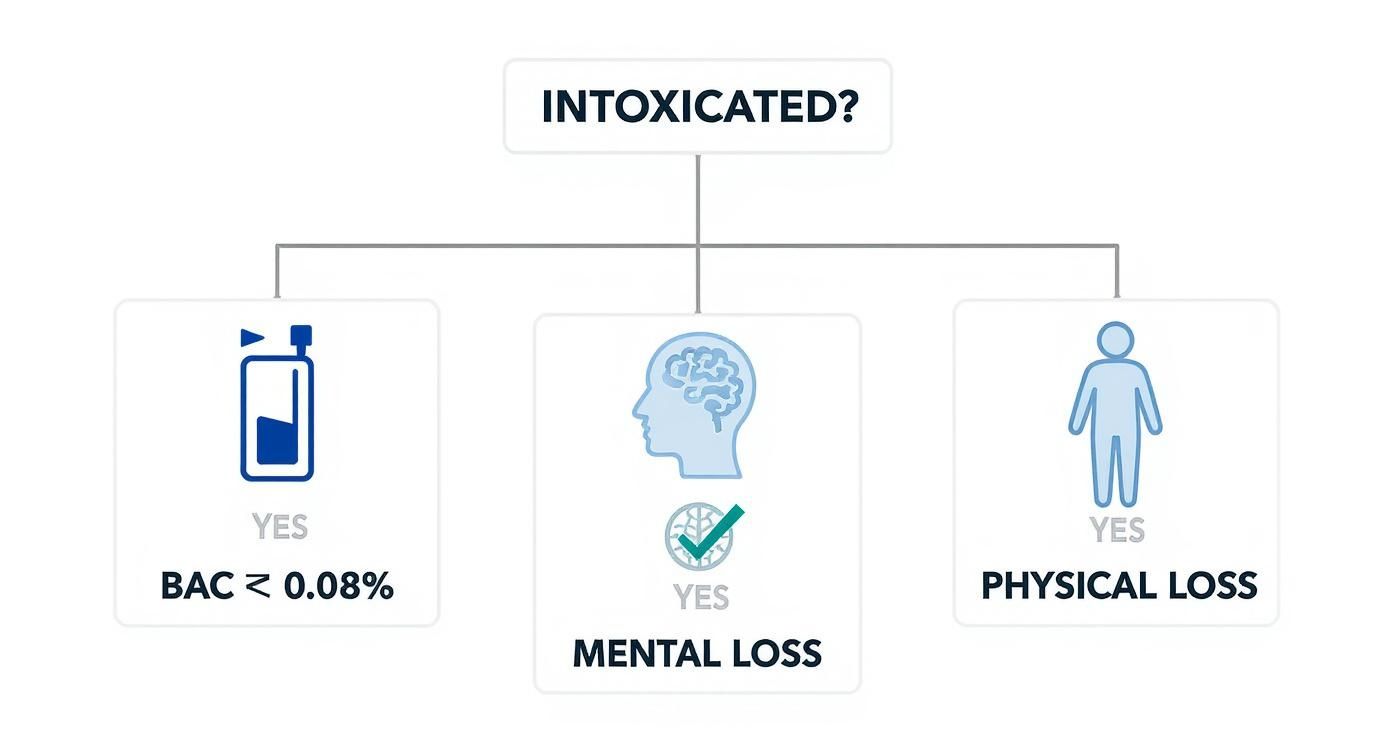
As you can see, a DWI charge can be based on more than just a breathalyzer result. That is why it is essential to fight both the criminal charges and the administrative license suspension from day one.
Crucially, you have only 15 days from the date of your arrest to request an ALR hearing. If you miss this deadline, your license will be automatically suspended.
Two Legal Battles After a Texas DWI Arrest
Comparing the two processes side-by-side helps clarify their differences. While the criminal case addresses guilt and punishment, the ALR hearing is exclusively about your driving privileges.
| Aspect | Criminal Case (DWI Charge) | Administrative License Revocation (ALR) |
|---|---|---|
| Purpose | To determine guilt or innocence and impose punishment. | To determine if your driver's license should be suspended. |
| Who's Involved | Prosecutor, defense attorney, judge, and possibly a jury. | Administrative Law Judge from the State Office of Hearings. |
| Timeline | Can take months or even over a year to resolve. | Extremely fast; you only have 15 days to request a hearing. |
| Burden of Proof | "Beyond a reasonable doubt"—a very high standard. | "Preponderance of the evidence"—a much lower standard. |
| Potential Penalties | Fines, jail time, probation, and a permanent record. | Driver's license suspension. |
| Outcome | Conviction or acquittal. | License suspended or not suspended. |
Winning your ALR hearing is a critical first step in your defense. Not only can it save your driving privileges, but it also gives your attorney a valuable opportunity to question the arresting officer under oath. This testimony can reveal weaknesses in the state's case that can be used to your advantage in the criminal proceedings.
To learn more about this strict deadline and what it takes to fight a suspension, read about the Administrative License Revocation process in Texas in our detailed guide. Do not let this critical deadline pass—protecting your ability to drive starts now.
Texas DWI Penalties Explained
If you are facing a DWI charge in Texas, it is important to understand what is at stake. The penalties are designed to be severe and can have a lasting impact on your life. Our goal is to provide a clear, honest picture of the challenges ahead so you can prepare to fight them effectively.
Texas law classifies DWI charges based on whether it is a first, second, or subsequent offense. As expected, the consequences become significantly harsher with each conviction. A first-time DWI is typically a misdemeanor, but a third offense is automatically a felony, carrying the possibility of years in prison.
Penalties for a First DWI in Texas
For most individuals, a first DWI in Texas is charged as a Class B Misdemeanor, provided there are no aggravating factors. Although it is the lowest-level DWI charge, the penalties can still be life-altering.
A conviction for a first DWI may include:
- Fines: Up to $2,000.
- Jail Time: A mandatory minimum of 72 hours, with a maximum sentence of 180 days in county jail.
- License Suspension: Your driver’s license could be suspended for up to one year.
These criminal penalties do not include thousands more in court costs, probation fees, and mandatory alcohol education classes that will also be required.
Escalating Consequences for a Second DWI
If you are facing a second DWI charge, the State of Texas considers you a repeat offender, and the stakes increase dramatically. A second DWI is a Class A Misdemeanor—the most serious misdemeanor classification in the state.
The potential penalties include:
- Fines: The maximum fine increases to $4,000.
- Jail Time: You face a minimum of 30 days and up to one year in jail.
- License Suspension: You could lose your license for up to two years.
In addition, a judge will almost certainly require you to install an ignition interlock device on your vehicle as a condition of bond or probation. This device requires you to provide a clean breath sample before your car will start.
A Third DWI: A Life-Changing Felony Offense
A third DWI conviction is where the Texas legal system draws a hard line. With two prior convictions, your next DWI charge is automatically filed as a third-degree felony. This elevates your case from a county court to a district court, where the penalties are much more severe.
A felony conviction brings consequences that extend far beyond prison and fines. It can result in the loss of your right to vote, your right to own a firearm, and create permanent barriers to obtaining professional licenses or securing quality employment.
The penalties for a third-degree felony DWI are severe:
- Fines: Up to $10,000.
- Prison Time: A sentence of 2 to 10 years in a Texas state prison.
- License Suspension: A suspension that can last for up to two years.
This is precisely why it is so critical to fight a DWI in Texas from the very beginning. An experienced Houston DWI lawyer can work to prevent a conviction that could be used to enhance a future charge into a felony.
Factors That Can Make DWI Penalties Even Worse
It’s not just the number of prior convictions that matters. Certain circumstances at the time of your arrest, known as "enhancements," can automatically increase the severity of the charge.
A common example is having an open container of alcohol in your vehicle, which adds a minimum jail sentence. A far more serious enhancement is having a BAC of 0.15 or higher. This alone elevates a first-time DWI from a Class B to a Class A Misdemeanor, placing you in the same penalty range as a second offense.
The most serious enhancement, however, involves the presence of a child. If you are arrested for DWI with a passenger under the age of 15, the charge is automatically a State Jail Felony—even for a first offense. This carries a potential sentence of up to two years in a state jail facility.
Texas DWI Penalties At A Glance
This table provides a quick summary of how these penalties increase with each offense level, helping you see the potential consequences clearly.
| Offense Level | Potential Fines | Potential Jail Time | License Suspension |
|---|---|---|---|
| First DWI | Up to $2,000 | 72 hours to 180 days | Up to 1 year |
| First DWI (BAC ≥ 0.15) | Up to $4,000 | Up to 1 year | Up to 2 years |
| Second DWI | Up to $4,000 | 30 days to 1 year | Up to 2 years |
| Third DWI (Felony) | Up to $10,000 | 2 to 10 years in prison | Up to 2 years |
Understanding these potential outcomes is not about accepting defeat—it is about recognizing the seriousness of your situation. A smart, strategic defense can challenge the state’s evidence, negotiate for reduced charges, and work to protect your future from these harsh consequences.
Your Rights During a DWI Traffic Stop
Seeing police lights in your rearview mirror is an unnerving experience for anyone. In those initial moments of stress and anxiety, what you say and do can significantly impact the outcome of your case. Knowing your rights is not about being confrontational—it is about protecting yourself from the very start.
https://www.youtube.com/embed/-2-IuA_kZMQ
While a traffic stop can be stressful, you have more control than you might realize. Staying calm and respectfully exercising your rights is the first and most important step in building a strong defense.
Texas Implied Consent Law Explained
One of the most misunderstood aspects of a DWI stop is the "Implied Consent" law. In Texas, the law states that by holding a driver's license and operating a vehicle on public roads, you have already consented to provide a breath or blood sample if you are lawfully arrested for DWI.
However, "implied consent" does not mean you can be physically forced to give a sample on the side of the road. You still have the right to refuse the test. That decision comes with immediate administrative consequences, namely an automatic license suspension. This puts you in a difficult position, and it is important to understand the trade-offs.
Refusing a breath or blood test triggers an automatic license suspension, but it also deprives the prosecution of its most powerful piece of evidence: your BAC number. This can sometimes make it much harder for them to prove intoxication in criminal court.
This is a strategic decision with no single right answer. An experienced Texas DUI attorney can help you manage the consequences of either choice, but understanding the law empowers you in that critical moment.
Your Right to Refuse Field Sobriety Tests
During the traffic stop, the officer will likely ask you to exit your vehicle to perform a series of roadside exercises. These are the Standardized Field Sobriety Tests (SFSTs), which include the Horizontal Gaze Nystagmus (eye test), the walk-and-turn, and the one-leg stand.
It is essential to remember this: These tests are 100% voluntary. You have the absolute right to politely decline.
Why is refusing often a wise choice?
- They are subjective. These are not scientific tests. They are tests of balance and coordination, and the outcome is based entirely on the officer's opinion of your performance.
- The conditions are poor. You are usually on an uneven roadside, late at night, with distracting police lights. Even a completely sober person could struggle under these conditions.
- They are designed for you to fail. The scoring is incredibly strict. Minor missteps—like raising your arms for balance or starting too soon—are recorded as "clues" of intoxication.
A simple, polite statement such as, "Officer, I respectfully decline any field sobriety tests," is one of the most effective ways to protect yourself.
Key Constitutional Rights During a Stop
Beyond sobriety tests, you have fundamental constitutional rights during any police interaction. Our guide on what happens during a DWI stop in Texas provides more detail, but here are the basics you must know.
You always have:
- The Right to Remain Silent. You are only legally required to provide your name, driver's license, and proof of insurance. You do not have to answer questions like, "Where are you coming from?" or "Have you had anything to drink tonight?" You can simply say, "I am exercising my right to remain silent."
- The Right to Refuse a Vehicle Search. An officer needs your consent, a warrant, or probable cause to search your car. If they ask for permission, you can and should clearly state, "Officer, I do not consent to a search of my vehicle."
Understanding these rights is the foundation of a solid DWI defense. A skilled attorney will ensure your rights were respected at every stage and will fight to have any illegally obtained evidence suppressed.
How a Houston DWI Lawyer Can Build Your Defense

An arrest is not a conviction. This is a crucial fact to remember, because the time immediately following a DWI charge can make you feel as if the fight is already lost. The reality is that the prosecution's case is just one side of the story. Our job as your defense team is to find every weakness in that story and challenge it at every opportunity.
Building a powerful DWI defense is like conducting our own investigation. We do not take any of the state's evidence at face value. Instead, we dissect every detail, starting from the moment you were pulled over.
Scrutinizing the Initial Traffic Stop
The entire case against you rests on a single question: did the officer have a legally valid reason to stop your vehicle? The Fourth Amendment protects you from unreasonable searches and seizures, which means an officer cannot pull you over on a hunch. They must have reasonable suspicion that you have violated a law.
We will carefully review the police report and any available dashcam or bodycam footage to find the answer. Was there a legitimate traffic violation, like speeding or failing to signal? Or was the justification weak, such as "weaving within the lane"? An unlawful stop can be the key to getting the entire case dismissed before it ever reaches a jury.
Challenging the Evidence Collected
From the start of a traffic stop, the officer is building a case. Our job is to systematically take it apart. A skilled Houston DWI lawyer will challenge every piece of evidence the prosecution intends to use against you.
This in-depth review includes:
- Field Sobriety Tests: These tests are notoriously subjective and often administered under poor conditions. We will scrutinize the officer’s instructions and scoring to demonstrate how easily a sober person could be judged as "impaired."
- Breath Test Results: A breathalyzer is a machine, and machines make mistakes. We will demand to see the device's maintenance logs, calibration records, and repair history to determine if it was functioning correctly on the day of your test.
- Blood Test Procedures: If a blood sample was taken, the process is even more complex and prone to error. We investigate the entire chain of custody—from the person who drew the blood to the lab that tested it—to find procedural mistakes or contamination that could render the results unreliable.
An arrest generates a mountain of paperwork, video, and data. To the prosecution, this is evidence of guilt. To a defense attorney, it is a field of opportunities to find the procedural errors that can win your case.
Ultimately, a strong defense is about more than just knowing the Texas alcohol laws driving statutes. It is about holding law enforcement and prosecutors to their high burden of proof. Every mistake they make, every protocol they skip, and every right of yours they violate becomes a powerful tool in your defense. We turn their errors into your advantage.
Common Questions About Texas DWI, Answered
When you're dealing with the stress of an arrest, you need clear, direct answers, not complex legal jargon. The laws surrounding driving and alcohol in Texas can be confusing, so let's address the questions we hear most often from our clients.
What’s the Real Difference Between DWI and DUI in Texas?
Many people use these terms interchangeably, but in Texas, they refer to different offenses that apply to different age groups. This is a critical legal distinction.
DWI (Driving While Intoxicated) is the charge that applies to an adult 21 or over. This is the standard offense for operating a motor vehicle while legally intoxicated, whether by alcohol, drugs, or a combination of both.
DUI (Driving Under the Influence), in contrast, is a charge reserved exclusively for minors under the age of 21. Because Texas has a strict zero-tolerance policy for underage drinking and driving, a minor can be charged with a DUI for having any detectable amount of alcohol in their system.
Can I Really Get a DWI for My Prescription Medication?
Yes, absolutely. This is a common point of confusion. A DWI charge is not limited to alcohol. The law is much broader.
The Texas Penal Code defines intoxication as losing the normal use of your mental or physical faculties due to the introduction of alcohol, a controlled substance, a dangerous drug, or a combination. This means a perfectly legal prescription from your doctor—or even certain over-the-counter medications—can lead to a DWI if it impairs your ability to drive safely.
Is Jail Time a Guarantee for a First DWI in Texas?
While jail time is a possible penalty for a first DWI in Texas, it is not guaranteed. The outcome of a first-time case depends heavily on the specific facts of the arrest and, most importantly, on the strength of your legal defense.
For many first-time offenses without aggravating factors like an accident or a very high BAC, the resolution often involves probation, fines, and community service. An experienced Texas DWI attorney knows how to fight for the best possible outcome, and that nearly always includes working to keep you out of jail.
How Do I Get My License Back After It’s Been Suspended?
Regaining your driving privileges after a DWI license suspension is a manageable process. Once your suspension period is complete, you will need to fulfill several requirements with the Texas Department of Public Safety (DPS) to be reinstated.
Typically, this involves:
- Paying all required reinstatement fees.
- Completing a mandatory alcohol education course.
- Obtaining and maintaining SR-22 insurance, which is a certificate that proves you have liability coverage.
While your license is suspended, a DWI license suspension attorney can often help you obtain an occupational driver's license. This special permit allows you to drive to and from essential locations like work, school, and medical appointments, ensuring your life is not put on hold.
A DWI arrest can feel like an impossible weight, but you do not have to carry it alone. The legal team at The Law Office of Bryan Fagan, PLLC is here to stand by your side, defend your rights, and build a strategic defense to protect your future. We offer free, confidential case evaluations to help you understand your options and see the path forward. Contact us today to start fighting back.

