 Skip to content
A DWI arrest can be overwhelming — but you don’t have to face it alone. Facing a DWI charge in Texas is a stressful and confusing experience, but an arrest is not a conviction. A crucial legal option known as a stay of adjudication can act as a "pause button" on a finding of guilt, offering a path to protect your future. This strategic legal pathway can prevent a DWI conviction from appearing on your permanent record.
A DWI Arrest Is Overwhelming, But You Have Options

The moments after a DWI arrest can leave you feeling powerless, facing a justice system filled with unfamiliar terms and procedures. It’s easy to assume the worst, but it's important to understand that you have rights and powerful defense options available. The legal language alone can feel like a maze, but you don’t have to navigate it by yourself.
An experienced Houston DWI lawyer doesn't just represent you in court; they serve as your strategic guide. One of the most important goals is to pursue outcomes that minimize long-term consequences. This is where a stay of adjudication becomes a critical tool in your defense.
Understanding Your Strategic Pathways
Think of this outcome as a crucial alternative to simply pleading guilty. Instead of a final conviction, the court agrees to withhold that judgment while you complete specific requirements. Successfully doing so often leads to the case being dismissed.
This approach has a long history in U.S. criminal law as a way to give defendants, especially those with a first DWI in Texas, a path to avoid a permanent record. Today, this history helps explain why Texas prosecutors are often open to negotiated resolutions short of a final conviction, particularly for those with no prior record who are willing to complete education or treatment programs. You can discover more about these justice system metrics and their background.
A DWI arrest is a serious event, but it is not the end of the story. With the right legal strategy, you can fight to protect your driver's license, your career, and your reputation.
This guide will explain how a stay of adjudication works and why securing experienced legal guidance is essential to fight DWI Texas charges and achieve the best possible result in your case.
What Is a Stay of Adjudication in Texas?
When you're facing a DWI charge in Texas, the legal jargon can feel overwhelming. Key terms get thrown around, and it's easy to get lost. But understanding your options is the first step toward building a strong defense. Let's break down one of those terms—stay of adjudication—in clear, simple terms.
Imagine the whole legal process is a train heading toward a final destination called "Conviction." A stay of adjudication is like a special switch on the tracks that can divert the train to a completely different station: "Dismissal." The court agrees to pause the journey just before a final judgment is made, giving you a chance to change the outcome of your case.
The Goal is Dismissal, Not Conviction
This "stay," or pause, isn't a free pass. It comes with a set of specific conditions you have to meet over a certain period. Think of it as a probationary period where your actions directly determine whether your case ends in a conviction or a dismissal.
The purpose of this legal tool is to give you a clear shot at showing you're responsible and avoiding the lifelong baggage of a DWI conviction. If you successfully complete every single thing the court asks of you, the case against you can be dismissed entirely. That's a powerful outcome because it means a DWI conviction never touches your permanent criminal record.
A stay of adjudication offers a path forward—one where a mistake does not have to define the rest of your life. It is a chance to prove that the incident was an exception, not a pattern.
How Does It Work in Practice?
So, how does this "pause button" actually work in a Texas courtroom? After your Houston DWI lawyer negotiates this specific outcome with the prosecutor, you'll enter a plea, usually "guilty" or "no contest." This can be a frightening step, but here’s the key difference: the judge doesn't formally accept your plea to find you guilty at that moment.
Instead, the finding of guilt is stayed, or put on hold. The judge then lays out the terms of your agreement. These conditions are tailored to your specific case, but they almost always include some combination of the following:
- Probation: A period of supervision where you must check in with an officer and, most importantly, stay out of trouble.
- DWI Education Classes: You'll need to complete state-approved courses that teach about the dangers of impaired driving.
- Fines and Court Costs: All required financial penalties must be paid on time.
- Ignition Interlock Device: You might be required to install a breath-monitoring device in your car. This device prevents your car from starting if it detects alcohol on your breath.
By fulfilling every single requirement without a slip-up, you hold up your end of the deal. In return, the court does its part and dismisses the charges. You can then move on without the stain of a DWI conviction following you. Having an experienced Texas DUI attorney is absolutely critical for negotiating the best possible terms and guiding you through the process to ensure you succeed.
Comparing Stay of Adjudication and Deferred Adjudication
When you’re fighting a DWI case in Texas, you'll probably hear two very similar-sounding terms: stay of adjudication and deferred adjudication. While both offer a way to sidestep a final conviction, they are not the same. Knowing the difference is critical to building a smart defense strategy for your case.
Think of it like this: both are paths that can lead to the same destination—a case dismissal. But the journey itself, the rules, and even who’s allowed to take each path are completely different. A stay of adjudication essentially hits the "pause" button on your case before a finding of guilt is ever made. Deferred adjudication, on the other hand, comes after you plead "guilty" or "no contest," but the judge agrees to put off a final judgment.
Key Differences at a Glance
The most important distinction comes down to the legal mechanics and eligibility. A stay of adjudication is often a more informal arrangement negotiated directly with the prosecutor's office before a formal plea is locked in with the court.
Deferred adjudication is a much more formal process, a specific type of community supervision (probation) laid out in Texas law. And because it's so formal, it comes with strict rules.
For instance, Texas law prohibits anyone with a Commercial Driver's License (CDL) from getting deferred adjudication for a DWI. No exceptions. This rule might not apply to a stay of adjudication, which could make it a viable option for a commercial driver trying to save their career. To learn more, you can explore what deferred adjudication is and how it works.
The flowchart below breaks down the simple three-step journey of a stay of adjudication. It’s a clean path from arrest to dismissal.
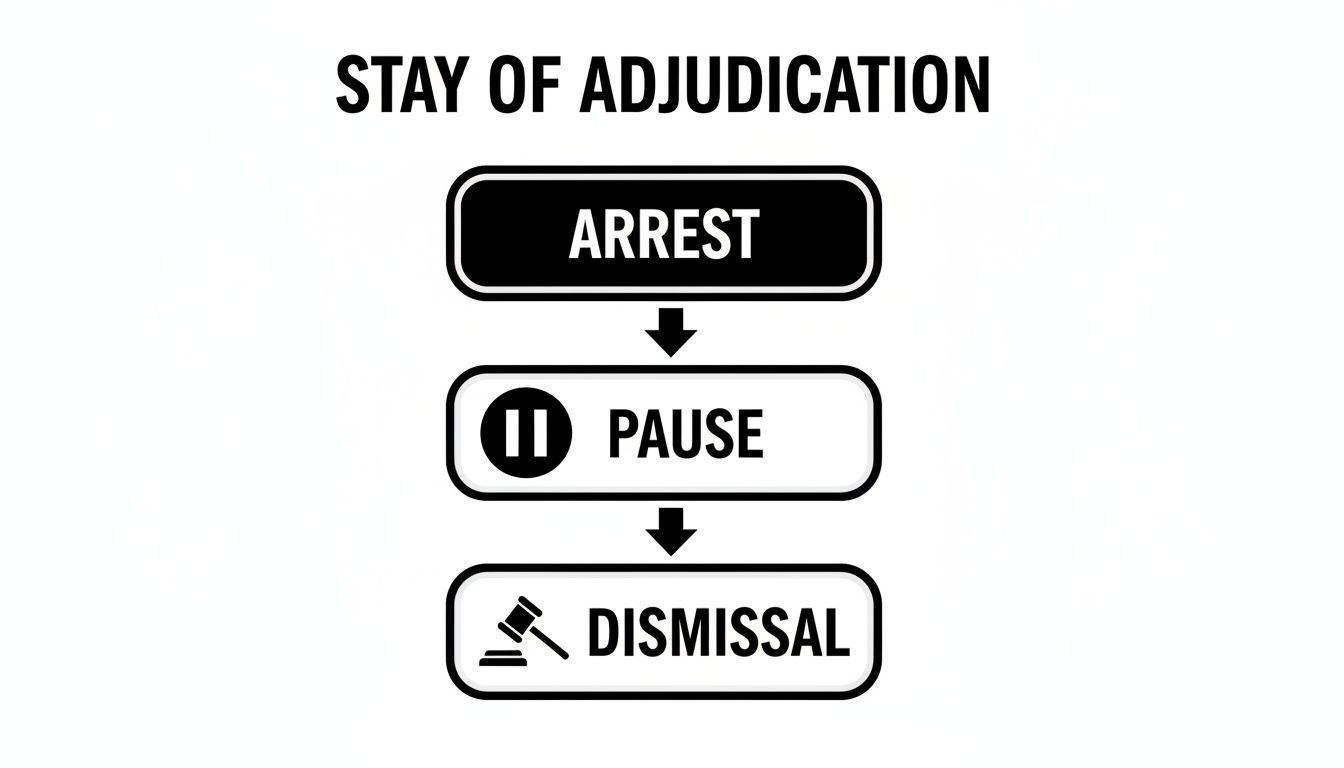
This visual gets to the heart of it: the entire legal process is put on hold, giving you a chance to meet certain conditions and walk away with a dismissal.
Side-by-Side Comparison
To make the differences even clearer, let's put these two outcomes head-to-head. Your eligibility for either one will depend heavily on the specific facts of your case, your criminal history, and the policies of the county where you were charged.
This is where a skilled Houston DWI lawyer becomes indispensable. They can analyze your situation and determine which path gives you the best chance at a favorable outcome.
Stay of Adjudication vs. Deferred Adjudication in Texas DWI Cases
This table breaks down the core differences between these two resolutions. While the end goal—a dismissal—is the same, how you get there matters.
| Feature | Stay of Adjudication | Deferred Adjudication |
|---|---|---|
| Legal Status | A pre-plea agreement where the finding of guilt is paused. | A form of community supervision after a guilty or no-contest plea. |
| Successful Outcome | The case is dismissed, and no conviction is ever entered. | The case is dismissed, and no final conviction is entered. |
| Consequence of Failure | The agreement is revoked, and the case proceeds toward conviction. | Probation is revoked, a finding of guilt is entered, and sentencing occurs. |
| Eligibility | Negotiated; potentially more flexible depending on the county. | Legally defined; unavailable for CDL holders in DWI cases. |
Ultimately, both options serve the same crucial purpose: keeping a DWI conviction off your permanent record. But the strategy needed to secure each one is vastly different. An experienced Texas DWI attorney will know how to assess your case and fight for the resolution that best protects your rights and your future.
How This Outcome Can Protect Your Future

Getting a stay of adjudication isn't just about closing out your current DWI case—it's about protecting the life you’ve worked so hard to build. This legal strategy is designed to shield your long-term opportunities by making sure a final, permanent DWI conviction never hits your record.
When you sidestep a conviction, you protect yourself from the collateral damage that follows people for years. Think about how many times you've had to check a box on an application asking about prior convictions. A stay of adjudication, once you complete it, lets you legally and honestly say "no."
Preserving Your Professional and Personal Life
The ripple effects of this outcome touch nearly every part of your life. For professionals in Texas, avoiding a DWI conviction is often the difference between a career hiccup and a career-ending event.
- Employment Opportunities: Many employers run background checks, and a DWI conviction can be an automatic disqualifier for jobs that involve driving, childcare, finance, or security clearances. A dismissal keeps those doors open.
- Professional Licenses: If you're a nurse, pilot, teacher, or another licensed professional, a conviction can trigger disciplinary action from your state licensing board, which could lead to suspension or revocation of your license.
- Housing and Loans: Landlords and mortgage lenders often see a criminal conviction as a sign of risk, which can make it tougher to get approved for an apartment or a home loan.
This legal path is about more than just a single court case. It's an investment in your future, ensuring that one mistake doesn't unfairly limit your personal and professional growth.
The Path to a Truly Clean Slate
Here’s the best part: successfully finishing the terms of a stay of adjudication doesn’t just get your case dismissed. It unlocks the door to clearing your record entirely. Once the dismissal is official, you may be eligible to have the arrest records sealed or even destroyed through expunction.
This final step is absolutely critical. While a stay of adjudication avoids a conviction, the initial arrest record still exists and can be found. Pursuing an expunction or an order of nondisclosure is the only way to permanently remove it from public view. You can get the full story on this vital process in our guide to expunging a DWI in Texas.
This type of forward-thinking resolution gives you a powerful opportunity to fight for a real second chance. With an experienced Houston DWI lawyer guiding you, a stay of adjudication can be the key that lets you move forward with confidence and a clean slate.
What to Expect When Pursuing This Legal Path

If a stay of adjudication sounds like the right move for your DWI case, you’re probably wondering what that process actually looks like. Knowing the steps can make the entire journey feel much more manageable. Your attorney is your guide through this process, handling the legal heavy lifting while you focus on moving forward.
Securing this outcome is a strategic play, built on careful preparation and skilled negotiation. It doesn't just happen automatically—it's an outcome earned through a solid legal defense.
The Initial Case Evaluation and Investigation
Everything starts with a deep dive into your case. Your attorney will meticulously review every piece of evidence—the police report, body camera footage, and the results from any breath or blood tests (your BAC, or Blood Alcohol Concentration). They will also analyze how field sobriety tests were administered. This isn't just about finding weaknesses; it's about building a complete picture of exactly what happened during your arrest.
This investigation allows your lawyer to find leverage points for discussions with the prosecutor. For example, was the initial traffic stop lawful? Were the field sobriety tests performed correctly? Any procedural misstep can become a powerful tool in your corner.
Negotiation and Reaching an Agreement
Armed with a strong understanding of your case's strengths, your attorney will then negotiate with the prosecutor to secure a stay of adjudication. This is where experience matters. Your lawyer presents your case in the most favorable light, making the argument that this resolution is both fair and just.
If the prosecutor agrees, a formal plea agreement is drafted. This document spells out every condition you’ll need to meet. Before you sign anything, your attorney will walk you through it line by line to ensure you understand and can realistically comply with all the terms.
The goal of any negotiation is to lock in a clear, manageable path to getting your case dismissed. A skilled attorney ensures the conditions are fair and achievable, setting you up for success from the start.
Common Conditions of the Agreement
While the exact terms can differ depending on the county and the specifics of your case, most agreements have a standard set of requirements. Fulfilling all of these conditions is your key to a dismissal.
Common conditions often include:
- Completing a DWI education program to learn about the risks of impaired driving.
- Performing a set number of community service hours at an approved organization.
- Installing an ignition interlock device (IID) in your vehicle for a specific time, which keeps the car from starting if it detects alcohol on your breath.
- Paying all required fines and court costs on schedule.
- Avoiding any new arrests while under supervision.
Remember, your DWI criminal case is separate from the administrative license suspension process. It’s critical to also fight the potential suspension of your driving privileges. You can learn more by checking out our detailed guide on the Texas ALR hearing process. An experienced attorney is essential for managing both the criminal and administrative sides of your case.
Take the First Step to Defend Your Record
This is a critical moment, but it's also a moment where you have the power to act. A DWI arrest is just the beginning of a legal process—it is not a final conviction. Powerful legal options like a stay of adjudication exist for a reason: to protect your future from the long-term damage of a criminal record.
Simply understanding that this strategic path is available is the first step toward taking back control of your future.
We understand the weight of what you're facing, and our firm is here to provide the strategic, confident defense you need and deserve. You don't have to navigate the Texas justice system alone or settle for an outcome that compromises everything you've worked for. Our experienced Houston DWI lawyers are ready to stand with you and fight for your rights.
The most important thing to remember is that you have options. Taking swift, informed action with a dedicated legal team in your corner can make all the difference.
We invite you to contact The Law Office of Bryan Fagan, PLLC, for a free and confidential consultation. Let us put our experience fighting DWI charges across Texas to work for you. Your future is too important to leave to chance—call us today and let's start building your defense.
Frequently Asked Questions About Texas DWIs
Getting a DWI charge opens the floodgates to dozens of questions and a great deal of uncertainty. Below are some straightforward answers to the most common concerns we hear from clients, especially those exploring strategic options like a stay of adjudication. Our goal here is to give you clarity and confidence as you face the road ahead.
Am I Eligible for a Stay of Adjudication for My First DWI?
That's an excellent question. Eligibility isn't guaranteed; it depends on the specific facts of your case and the policies of the county where you were charged.
Generally, the strongest candidates are people facing a first-time DWI in Texas with no "aggravating factors." This means no car accident, no children in the car, and no extremely high Blood Alcohol Concentration (BAC).
Ultimately, the power to offer this resolution rests with the prosecutor. An experienced Houston DWI lawyer can analyze your case, pinpoint its strengths, and build a compelling argument for why a stay of adjudication is the right and just outcome for you.
What Happens If I Violate the Conditions?
Failing to follow the court's rules is a serious issue with significant consequences. If you violate any part of the agreement—for example, you fail a drug test or get a new charge—the prosecutor can file a motion to revoke the stay.
If that happens, the judge is free to find you guilty based on the plea you originally entered. You would then be sentenced as if you were convicted from day one. That could mean jail time, higher fines, and a permanent DWI conviction on your criminal record. Following the rules precisely isn't just important—it's essential for your success.
Will a Stay of Adjudication Show Up on a Background Check?
This is a critical question, and the answer has two parts. Initially, yes, the arrest itself will still appear on your record even though the case did not result in a final conviction. Background checks often pull arrest records, not just convictions.
But the real benefit comes after you successfully complete all the court's requirements.
Once the judge formally dismisses your case, the door opens to clearing your record for good. An attorney can help you file for an expunction to completely erase the arrest or an order of nondisclosure to seal it from public view. That is how you achieve a truly clean slate.
Can a Commercial Driver Get This Outcome for a DWI?
For CDL holders, this is where things get complicated. A stay of adjudication might be a great result for the Texas criminal case, but federal regulations are a different matter. The Federal Motor Carrier Safety Administration (FMCSA) often treats any kind of deferred judgment for a DWI as a full conviction for licensing purposes.
This can trigger a mandatory one-year disqualification of your CDL, putting your entire livelihood at risk. It is absolutely essential for any commercial driver to work with a Texas DUI attorney who is an expert in both state and federal law to protect your career.
A DWI arrest can feel like a dead end, but a smart legal defense can pave a new path forward. At The Law Office of Bryan Fagan, PLLC, our team is here to protect your rights and fight for the best possible resolution for your case. Don't wait to get the answers and the help you need. Contact us today for a free, no-obligation case evaluation at https://texasduilawfirm.com.

