
A DWI arrest in Texas can be overwhelming, throwing you into two legal battles at once. The first is the criminal case dealing with the DWI charge itself. The second is an administrative case, and this one is all about the future of your driver’s license. This second, crucial fight happens at a place called the State Office of Administrative Hearings (SOAH) in Texas — and you don’t have to face it alone.
Understanding the State Office of Administrative Hearings Texas
A DWI arrest can make you feel powerless, especially when the threat of losing your license hangs over your head. But you have the right to fight the automatic suspension. That fight takes place at the State Office of Administrative Hearings, or SOAH. Think of SOAH as a specialized, independent court system designed to handle disputes between Texans and state agencies like the Department of Public Safety (DPS).
Its main purpose is to ensure fairness. Before SOAH was created, the same agency accusing you of a violation was also the one deciding your fate. Now, a neutral Administrative Law Judge (ALJ) hears your case, making sure the state must prove its claims based on the law.
Why Your SOAH Hearing Matters
This hearing at SOAH is officially called an Administrative License Revocation (ALR) hearing. It is your first—and often best—opportunity to keep your driver's license. This is a civil case, completely separate from your criminal DWI proceedings, but the outcome has a huge impact on your ability to work, care for your family, and live your life.
A strategic Houston DWI lawyer uses the ALR hearing as a powerful tool to:
- Challenge the legality of the initial traffic stop.
- Question the administration and validity of field sobriety tests.
- Scrutinize the evidence the DPS is trying to use against you.
- Cross-examine the arresting officer under oath.
This hearing is more than a formality; it’s a critical opportunity to gather evidence and test the strength of the state's case. The information we uncover here can be invaluable when we build the strategy to fight your criminal DWI charges in court.
Winning at SOAH requires a deep understanding of administrative law and procedure. At The Law Office of Bryan Fagan, PLLC, we handle every step, from filing the hearing request within the strict 15-day deadline to arguing on your behalf before the judge. You don't have to face this alone—let us help you take the first step in protecting your license and your future.
Understanding SOAH's Role and History in Texas Law
The State Office of Administrative Hearings (SOAH) hasn't been around forever, and understanding why it was created is key to seeing just how important it is for protecting your rights after a DWI arrest.
Before SOAH, if a state agency wanted to take action against you—like the Department of Public Safety (DPS) trying to suspend your license—that very same agency would also be the one to hear your appeal. You can probably see the problem with that.
It created a massive conflict of interest. Imagine the agency trying to penalize you also getting to act as the judge and jury in your case. Recognizing how fundamentally unfair this system was, the Texas Legislature decided to make a change.
A Shift Toward Impartial Justice
In 1991, lawmakers stepped in and established SOAH to act as a neutral, independent courthouse for disputes between regular Texans and state agencies. The goal was simple but incredibly powerful: make sure every single person had access to an impartial decision-maker.
Now, when DPS moves to suspend your license through an Administrative License Revocation (ALR) hearing, your case isn't heard by a DPS employee. Instead, it goes before a neutral Administrative Law Judge (ALJ) at SOAH.
This structure guarantees that the final decision is based on the facts and the law, not on the agency's internal goals. The ALJ is a licensed Texas attorney who operates independently, creating a level playing field where your side of the story can actually be heard fairly.
A perfect example of this reform in action happened with tax disputes. Before 2007, the Texas Comptroller's Office handled its own contested tax hearings, which obviously raised concerns about fairness. To fix it, the entire hearings function was moved over to SOAH. This was a clear signal that Texas was serious about due process. By late 2020, SOAH's Tax Division had handled nearly 3,000 cases, solidifying its role as a crucial check on agency power. You can learn more about this from the TTARA Research Foundation's report on SOAH's impact.
Why This Matters for Your DWI Case
For someone facing a DWI, this history lesson isn't just trivia—it provides real context and, frankly, reassurance. The creation of SOAH means your ALR hearing isn't some meaningless formality; it's a genuine opportunity to defend your driving privileges in front of an unbiased judge.
The existence of the State Office of Administrative Hearings in Texas is a direct result of the state's commitment to fairness. It ensures your ALR hearing is not a "rubber stamp" for the DPS but a real chance to challenge the evidence and protect your license.
Our job as your attorney is to use this impartial setting to your advantage. By knowing the procedural rules inside and out and presenting a strategic defense, we can effectively challenge the state’s attempt to take away your license. This history isn’t just a legal footnote—it’s the entire foundation of your right to a fair fight.
How SOAH Is Structured and What Cases It Hears
Think of the State Office of Administrative Hearings (SOAH) as a neutral court system built specifically to handle fights between you and a Texas state agency. The entire system is designed to be a fair, impartial battleground—which is exactly what you need when you're going up against a powerful agency like the Department of Public Safety (DPS).
The key players here are the Administrative Law Judges (ALJs). These aren't just employees of the agency you're fighting; they are independent, licensed Texas attorneys. Their job is to hear the facts and make a ruling based only on the evidence and the law. This independence is the whole point of SOAH. It guarantees the person deciding your case is a neutral referee, not someone rooting for the other team.
A Wide Range of Jurisdictions
While you're probably here because of an Administrative License Revocation (ALR) hearing after a DWI arrest, SOAH’s reach extends far beyond that. Its authority covers disputed cases from dozens of state agencies across Texas.
This means the ALJs at SOAH are constantly presiding over a huge variety of cases, including things like:
- Professional Licensing Disputes: Cases against doctors, nurses, real estate agents, and other professionals fighting to keep their licenses.
- Environmental Regulation Cases: Complex disputes involving the Texas Commission on Environmental Quality (TCEQ).
- State Tax Appeals: Fights brought against the Texas Comptroller of Public Accounts over tax issues.
- DWI License Suspensions: The ALR hearings that will decide whether you get to keep your driver's license after a DWI charge.
The image below, taken from the official SOAH website, gives you a peek at their public portal where cases are filed and tracked.
This centralized setup is meant to keep things efficient and transparent for everyone involved. And make no mistake, SOAH is a busy place. It handles a massive volume of hearings every single year, covering everything from simple mediations to formal trials across countless industries. The agency's caseload is so significant that the Texas Legislature has to set its hearing capacity each year based on how many cases they expect—a clear sign of its critical role in how the state operates. If you want to get a better sense of their scope, you can explore the detailed reports and publications available on the SOAH website.
So what does this all mean for you? It’s actually good news. It means the judge hearing your case is experienced in administrative law and is legally required to give you a fair shot. For a skilled DWI attorney, that's the opening we need to challenge the state's case on its merits.
The SOAH Hearing Process From Start to Finish
Stepping into a legal hearing can feel incredibly intimidating, especially when your driving privileges are on the line. After a DWI arrest, the clock starts ticking on a legal process that can feel confusing and overwhelming. But understanding what happens at the State Office of Administrative Hearings (SOAH) is your first real chance to fight back.
This hearing isn’t about guilt or innocence on the criminal DWI charge. It is a separate, civil battle purely focused on your driver's license. Let's walk through the entire process, from the moment you request a hearing to the final word from the judge. Knowing the roadmap will replace that uncertainty with confidence.
This infographic gives you a bird's-eye view of how cases, including DWI license hearings, move through the SOAH system.
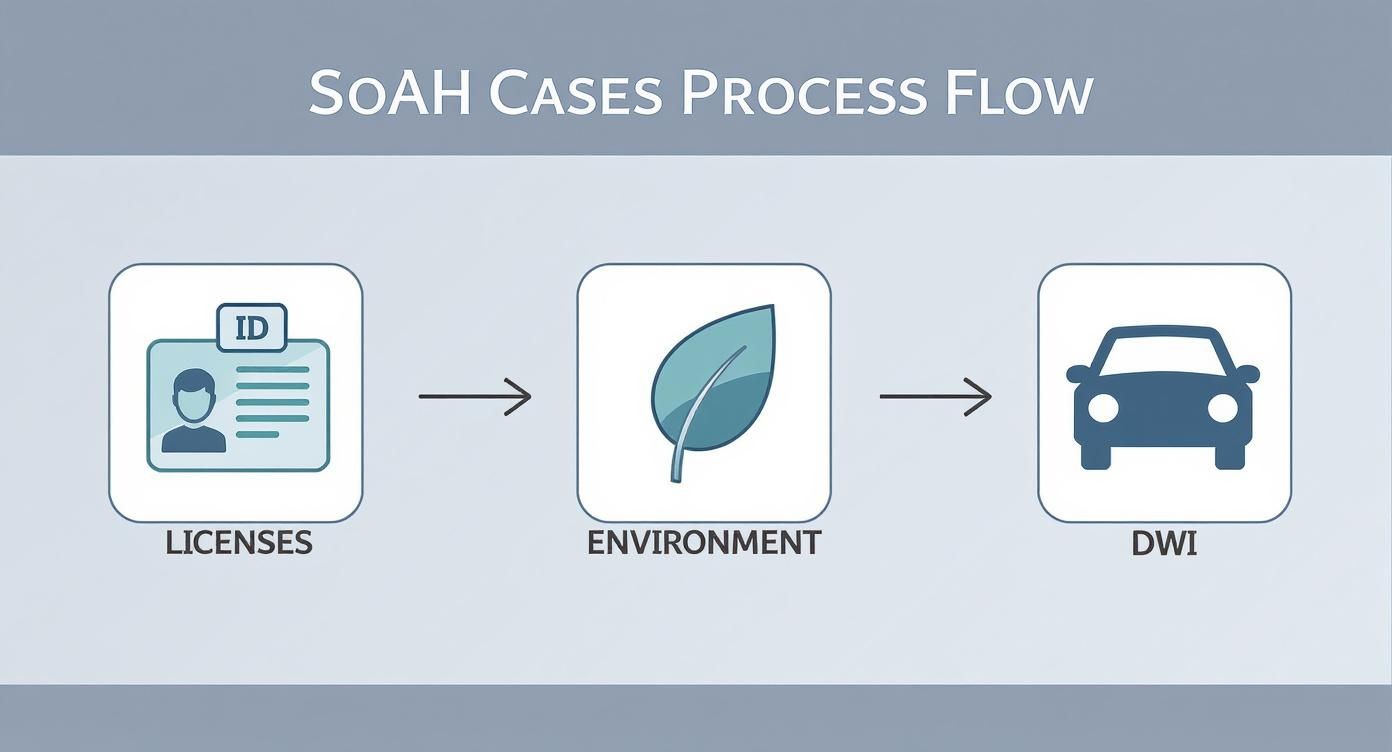
As you can see, these license suspension cases are just one piece of the puzzle for this independent state agency, but for you, it's the most important piece.
Stage 1: Requesting Your ALR Hearing
The moment you're arrested for DWI, a countdown begins. In Texas, you have just 15 days from the arrest date to officially request an Administrative License Revocation (ALR) hearing. Miss that deadline, and your license is automatically suspended. No questions asked.
This is, without a doubt, the most critical first step you can take. A seasoned Houston DWI lawyer can file this request for you, making sure it’s done correctly and on time. This single action freezes the suspension, keeping you legally on the road until your hearing at the State Office of Administrative Hearings Texas.
Stage 2: The Pre-Hearing and Discovery Phase
Once we've requested the hearing, your case gets an official spot on the SOAH docket, and an Administrative Law Judge (ALJ) is assigned. This kicks off the pre-hearing phase, which is a lot like the prep work before a major court trial.
This period is called discovery, and it’s where your attorney and the lawyer for the Texas Department of Public Safety (DPS) trade information and evidence. For us, this is prime time to start building your defense.
During discovery, we're busy with things like:
- Requesting Police Reports: We get our hands on everything—the official arrest report, dashcam and bodycam videos, and every note the officer jotted down.
- Subpoenaing Records: This isn't just about the arrest. We might pull maintenance logs for the breathalyzer or dig into the arresting officer's training history.
- Filing Pre-Hearing Motions: We can file motions challenging whether certain evidence should even be allowed in the hearing or questioning if the initial traffic stop was legal in the first place.
This is where we start poking holes in the state’s case against your license. Every document and video clip helps us craft a strategy aimed at one thing: protecting your ability to drive.
Stage 3: The Formal SOAH Hearing
The SOAH hearing itself is a formal legal proceeding. Think of it as a mini-trial, but with one key difference: there’s no jury. The Administrative Law Judge is the only one making the decision.
Here’s how the hearing usually unfolds:
- Opening Statements: Both your lawyer and the DPS attorney will lay out a quick summary of their case.
- The State's Case: The DPS attorney goes first, presenting their evidence and almost always calling the arresting officer to testify. This is our chance to cross-examine the officer, asking pointed questions about the stop, the field sobriety tests, and the arrest itself.
- Your Defense: Now it's our turn. We'll present the evidence we gathered during discovery and challenge the state’s case on legal and procedural grounds.
- Closing Arguments: Finally, both sides wrap up by summarizing their arguments for the judge.
The most important thing to remember is this hearing is not about determining if you're guilty of DWI. The only issue on the table is whether DPS has enough evidence to legally suspend your driver's license. The bar is much lower for the state here, which makes having a skilled attorney absolutely crucial.
Timeline of a Typical SOAH ALR Hearing
To give you a clearer picture, this table breaks down the key stages from the moment of arrest to the final decision on your license.
| Stage | Actions Required | Typical Deadline |
|---|---|---|
| DWI Arrest | The clock starts. You are given a Notice of Suspension. | Day 0 |
| Request ALR Hearing | You or your attorney must file a formal hearing request with DPS. | Within 15 days of arrest |
| Case Docketed at SOAH | DPS transmits your request to SOAH, and a case is opened. | 2-4 weeks after request |
| Discovery Period | Attorneys exchange evidence (police reports, videos, etc.). | Lasts until the hearing date |
| SOAH Hearing Date | Both sides present evidence and arguments before an ALJ. | Usually scheduled 60-120 days after the hearing request |
| Judge's Decision | The ALJ issues a written "Proposal for Decision." | Typically within 2-4 weeks after the hearing |
This timeline shows just how quickly things move and why immediate action is so vital to protecting your rights.
Stage 4: The Judge's Decision and Next Steps
Once the hearing is over, the ALJ takes all the evidence and testimony and makes a ruling. A few weeks later, they will issue a formal written decision, known as a "Proposal for Decision."
If the judge rules for you, the license suspension is thrown out. It's a win, and you can keep driving without any restrictions.
If the judge rules against you, the suspension will go into effect. But even then, it's not the end of the road. We can immediately start the process of applying for an occupational driver's license, which allows you to drive for work, school, and essential household needs.
How to Prepare a Winning Case for Your SOAH Hearing
Walking into a State Office of Administrative Hearings (SOAH) hearing unprepared is a recipe for disaster. The good news? You don't have to. Building a winning case is all about strategy and meticulous preparation, turning what feels like a mountain of anxiety into a manageable, step-by-step plan.
It all begins the moment you request your hearing. From gathering the right evidence to avoiding simple procedural trip-ups that could cost you your license, every move matters. Let's break down how to put the pieces together for the strongest possible defense.
Gathering Essential Evidence
Think of evidence as the foundation of your case. Without it, everything else crumbles. The moment you decide to fight your suspension, the hunt for documents should begin.
Key items that can make or break your case include:
- Police reports, especially the officer's field sobriety notes
- Dashcam and bodycam footage of the entire stop and arrest
- Calibration and maintenance logs for the breathalyzer or blood testing equipment
- Official lab reports and chemical test results
This isn't just about collecting papers; it's about finding the cracks in the DPS's case. A sloppy report, a missing maintenance record for the breath test machine, or video that contradicts the officer's story—these are the details that win hearings.
Preparing Witnesses and Testimony
A witness can provide crucial context that documents alone can't. Perhaps someone was with you before the traffic stop, or maybe you have a medical condition that could explain your performance on a field sobriety test.
Effective witnesses can speak to:
- Your behavior and condition leading up to the traffic stop
- Any medical issues that might have mimicked signs of intoxication
- The arresting officer's conduct and how the tests were administered
It’s not enough to just have them show up. A good lawyer will prepare your witnesses, running through potential questions so they know what to expect and can deliver their testimony clearly and confidently. For more on this, check out our ALR hearing evidence guide.
Avoiding Common Pitfalls
The SOAH process is full of procedural traps that can sink your case before it even starts. Many people lose their licenses not on the facts, but because they missed a deadline or filed paperwork incorrectly.
Be incredibly careful to avoid these common mistakes:
- Missing the 15-day deadline to request your ALR hearing.
- Failing to properly serve motions according to the Texas Rules of Civil Procedure.
- Overlooking pre-hearing deadlines for disclosing evidence and witnesses.
- Relying on your memory alone instead of documented proof.
| Common Error | Impact |
|---|---|
| Late filing | Automatic license suspension |
| Incomplete disclosures | Key evidence can be excluded |
| Weak witness prep | Testimony that hurts your case |
Staying organized and on top of these details is non-negotiable.
Strategic Mock Hearing
There’s no substitute for a dress rehearsal. A mock hearing is a practice run where your attorney simulates the real thing, playing the part of both the Administrative Law Judge (ALJ) and the DPS attorney.
This practice session is designed to:
- Pressure-test your arguments and evidence
- Refine your testimony and witness questioning
- Pinpoint weaknesses in your case so they can be fixed
By the time your actual hearing date arrives, the environment will feel familiar, and your nerves will be settled. You'll be ready.
Best Practices for Oral Arguments
When it’s your turn to speak, less is often more. The ALJ has likely already reviewed the evidence, so your job is to connect the dots clearly and persuasively.
Follow these tips for a powerful presentation:
- Open with a brief, powerful summary of your strongest points.
- Address any procedural issues or objections right away.
- Zero in on inconsistencies or legal errors in the state's case.
- Keep your questions to the officer direct and focused.
Don't rush. A calm, methodical pace shows confidence and makes your arguments easier to follow.
Next Steps After Hearing
Once the hearing is over, the waiting begins. The ALJ typically issues a "Proposal for Decision" within about 30 days. If the decision is in your favor, your license is safe. If not, you still have options, including applying for an occupational driver's license to get to work or school.
But the fight isn't necessarily over. Under Texas law, you have 20 days from receiving the ALJ's decision to file "exceptions." This is a formal legal argument explaining why the judge's ruling was wrong. An experienced attorney at our firm can draft these exceptions, ensuring you meet the tight deadline and give you the best possible shot at getting the decision overturned.
Don't navigate the SOAH hearing process alone. Contact The Law Office of Bryan Fagan, PLLC to schedule your free consultation. Our team knows how to build a winning strategy to protect your driving privileges. Let us help you fight back.
Your Rights And Why Legal Representation Matters
Walking into a SOAH hearing can feel like entering uncharted territory. You’re up against rules you’ve never seen and an opponent armed with experience. Yet, you’re far from powerless. Texas law hands you essential tools—due process and the right to an attorney—to protect your freedom to drive.
Due process isn’t just a fancy phrase. It means you can:
- Review every piece of evidence the DPS plans to use against you
- Challenge questionable breath tests or arrest procedures
- Call your own witnesses and present facts in your favor
At the end of the day, the administrative law judge (ALJ) must base a decision on true facts and legal standards, not on wild guesses.
The Power Of Professional Legal Counsel
Yes, you can represent yourself. But picture this: you’re the lone boxer stepping into the ring while the DPS attorney is a seasoned heavyweight champion. They know every procedural rule and evidence standard inside out.
Going solo is like attempting a heart surgery after watching a tutorial—you simply don’t want to take that risk. An experienced lawyer from The Law Office of Bryan Fagan, PLLC, evens the odds right away.
We handle every critical piece of your hearing:
- Challenging Evidence: We spot and object to improperly obtained test results.
- Cross-Examining the Officer: We press for clear answers under oath, exposing any inconsistencies.
- Navigating Deadlines: We track every filing date so you never miss a crucial step.
Building A Strategic And Proactive Defense
Legal guidance isn’t an on-off switch—it’s a continuous strategy. From day one, we dig into every report: the traffic stop details, the field tests, the lab work. Our goal is to find gaps in the state’s case before the hearing even begins.
You can learn more about safeguarding your driving privileges in our detailed guide on DWI License Defense in Texas.
An ALR hearing is not just a last-ditch defense—it’s your best chance to turn the tables and challenge the state’s story.
Your SOAH hearing outcome can influence your life for years. Don’t leave it to chance. The Law Office of Bryan Fagan, PLLC, stands ready to defend your rights and keep you on the road. Let’s put our experience to work for you.
A Few Common Questions About SOAH Hearings
When you're dealing with a DWI arrest, the legal system can feel like a maze of unfamiliar terms and procedures. Here are some straightforward answers to the questions we hear most often about the State Office of Administrative Hearings.
What Else Does SOAH Do Besides DWI License Hearings?
Think of SOAH as the state's central courthouse for disputes between citizens and Texas agencies. It’s a busy place. While we focus on their role in DWI license suspensions, SOAH administrative law judges handle a huge range of other cases.
They might hear a case from a doctor fighting to keep their medical license, a realtor facing disciplinary action, or a business challenging an enforcement action from an environmental agency. SOAH’s entire mission is to give Texans a neutral, independent forum to challenge a state agency's decision.
Can I Just Represent Myself at the Hearing?
You absolutely have the legal right to represent yourself, and some people do. But it's important to understand what you're walking into. The Texas Department of Public Safety (DPS) will have its own attorney there—someone who does these hearings day in and day out. They know the procedural rules, the evidence code, and exactly what they need to prove to win.
Going in alone means you're up against a seasoned professional. Having an experienced DWI lawyer who specializes in these hearings levels the playingfield. We know how to spot the weaknesses in the state's case that a non-lawyer would almost certainly miss, which can make all the difference.
What if I Lose My ALR Hearing at SOAH?
If the judge rules against you, a driver's license suspension will follow. The length of that suspension varies depending on the facts of your case—for example, it’s 90 days for a first-time breath test failure.
But that’s not the end of the story. Your attorney can immediately get to work applying for an occupational driver's license for you. This special license allows you to keep driving to essential places like work, school, and your kids' activities, so you can keep your life moving forward.
How Is the SOAH Hearing Connected to My Criminal DWI Case?
It’s not. This is one of the most important things to understand: the SOAH hearing and your criminal DWI case are two completely separate legal battles, handled in two different courts.
The SOAH hearing is a civil, administrative proceeding. Its only purpose is to decide whether or not your driver's license gets suspended. Your criminal DWI case, on the other hand, is where the prosecutor tries to prove you committed a crime.
A win at your SOAH hearing is a powerful first victory. While it doesn't get your criminal case dismissed automatically, it's a critical part of a strong, comprehensive defense strategy.
A DWI charge puts your freedom, your license, and your future on the line, but you don’t have to go through it alone. The attorneys at the Law Office of Bryan Fagan, PLLC are here to build a strategic defense designed to protect your rights. Contact us today for a free, confidential case evaluation to explore your options and take the first step toward getting your life back.