
A DWI arrest can be overwhelming—but you don’t have to face it alone. If you're facing a DWI in Texas, you've probably heard the term "surcharges" and felt a wave of confusion. For years, these were massive annual fees slapped on top of all other court fines under the old Texas Driver Responsibility Program (DRP).
While the program itself is gone, understanding its history is absolutely critical. Why? Because the fines that replaced it are just as severe, making a smart legal defense more important now than ever before. An experienced Houston DWI lawyer can help you understand the penalties and build a strategic defense.
What Happened to the Old Texas DWI Surcharges?
A DWI arrest is overwhelming enough on its own. For a long time, the financial fallout was made worse by the Texas Driver Responsibility Program (DRP). This system added a separate layer of financial punishment for anyone convicted of certain driving offenses, with DWI at the top of the list.

This wasn't just another court fine. It was an administrative penalty you had to pay directly to the state, every year, for three years straight. These state of texas surcharge payments were owed in addition to criminal fines, court costs, and any probation fees the judge ordered. The idea was to deter risky driving, but the reality was often a nightmare for those caught in the system.
A Look Back at the Driver Responsibility Program
The DRP was set up to assign points to your driving record for moving violations and to hit you with surcharges for major offenses like DWI. A conviction automatically triggered these fees, no matter the specifics of your case.
For a first-time DWI, you were looking at an annual surcharge of $1,000 for three years.
But the costs could skyrocket from there:
- A second DWI conviction meant paying $1,500 per year for three years.
- If your DWI involved a Blood Alcohol Concentration (BAC) of .16 or higher, the surcharge jumped to a staggering $2,000 per year for three years.
This created a brutal cycle. If you couldn't make your surcharge payments, your driver's license was automatically suspended. Of course, without a license, it's nearly impossible to get to work to earn the money to pay the surcharges. It was a debt trap that ensnared hundreds of thousands of Texans.
The Driver Responsibility Program wasn't just about punishment; it was a major revenue generator for the state. It had life-altering consequences for countless individuals trying to move past a mistake.
The Repeal of the DRP and What Came Next
The program was repealed in 2019, bringing massive relief to over a million Texans. However, that's not where the story ends. The state still needed the money the DRP generated, so it immediately rolled out new fines and civil penalties to fill the gap.
Before the repeal, the DRP was collecting millions. A huge chunk of that—around $70 million annually—was used to fund Texas's trauma care centers. While funding trauma care is a worthy cause, it was being done on the backs of people already struggling to put their lives back together after a DWI charge.
Here’s a quick breakdown of how things changed.
Impact Of The Driver Responsibility Program Repeal
This table breaks down the key changes that occurred when the Texas Driver Responsibility Program (DRP) was repealed, helping you understand what changed and what obligations remain.
| Aspect | Before Repeal (Under DRP) | After Repeal (Current System) |
|---|---|---|
| Penalty Type | Annual administrative surcharges paid to the DPS for three years. | A one-time civil penalty included in the criminal court fines at the time of conviction. |
| Collection Agency | Texas Department of Public Safety (DPS) managed and collected fees. | The criminal court system collects the penalty as part of the overall fine. |
| License Suspension | Automatic license suspension for non-payment of surcharges. | License suspension is tied to the criminal conviction itself, not a separate administrative fee. |
| Financial Structure | Recurring debt that could follow a person for years, causing a cycle of debt. | A single, upfront fine. While large, it doesn't create a recurring payment obligation to a separate agency. |
Ultimately, while the mechanism for collecting these massive fees has changed, the financial sting of a DWI conviction is just as powerful today. Understanding this history is the first step in building a strong defense against the modern penalties you're now facing.
The End Of The Driver Responsibility Program And What It Means For You
On September 1, 2019, Texas drivers finally got some good news. The state officially pulled the plug on the deeply unpopular Driver Responsibility Program (DRP), a system that had trapped over a million people in a cycle of debt and license suspensions.
If you were one of the many caught in that web, the repeal was a massive weight off your shoulders. So, what did the end of the DRP really mean for you and your DWI case?
The biggest, most immediate change was that all outstanding DRP surcharges were forgiven. Poof. Gone. The moment the law took effect, any debt you owed under that specific program was completely wiped from the books. No more surcharge bills, and no new ones would ever be issued.
But it's critical to understand this wasn't a total "get-out-of-jail-free" card. Killing the DRP didn't magically erase the original DWI conviction or make other financial penalties disappear.
What The Repeal Did Not Change
While the surcharges vanished, plenty of other consequences stuck around. It's a common—and costly—misconception that the repeal wiped your entire slate clean.
You are still on the hook for:
- Court-Ordered Fines: Any fines handed down by the judge during your sentencing are still very much due.
- Administrative Fees: This includes things like the license reinstatement fee you owe the Texas Department of Public Safety (DPS).
- Active License Suspensions: If your license was suspended for another reason—like an ALR hearing or the conviction itself—that suspension didn't go away.
The bottom line is that while existing surcharges were waived, you were still responsible for every other fine, fee, or suspension on your driving record.
How To Confirm Your License Status
After a DWI arrest, it’s easy to feel lost about where your driving privileges stand. With the old surcharge system gone, you might be wondering if there are still holds on your license. Don't guess.
The most reliable way to get answers is to use the official Texas DPS Online License Eligibility system. You’ll just need your driver's license number, date of birth, and the last four digits of your Social Security number.
This portal gives you the official, complete picture of your driving record. It will tell you:
- If your license is currently valid, suspended, or revoked.
- A clear list of any outstanding issues or "holds."
- The exact fees you need to pay to get your license reinstated.
- Any documents you have to submit, like an SR-22 insurance certificate.
Taking a few minutes to check your eligibility online is the first real step toward legally getting back on the road. It cuts through the confusion and gives you a clear checklist of what needs to be fixed.
Where Did The Money Go?
The state legislature didn't just forgive billions in debt without a plan to replace that revenue. To fill the budget hole left by the DRP's repeal, lawmakers rolled out a new system of fines and penalties.
This shift is crucial because it directly impacts the financial hit of a DWI conviction today.
Instead of a separate, confusing administrative program, the penalties were baked directly into the criminal justice system. State traffic fines were hiked across the board, and a brand-new set of heavy civil penalties were created just for DWI convictions. These new fines are often just as financially crippling as the old surcharges, which makes fighting the underlying DWI charge itself more important than ever.
To get the full story, you can read our guide on how Texas DWI surcharges ended and what replaced them. This will give you a better sense of the modern financial landscape you’re now facing.
How The Current System Of Fines Replaced Surcharges
When Texas officially killed the Driver Responsibility Program, a lot of people breathed a sigh of relief. But the idea that a DWI conviction is now cheaper is a dangerous misunderstanding.
The state didn't get rid of the financial pain; it just moved it. Instead of sending you a separate bill for those hated administrative surcharges, the massive financial penalties are now built directly into the criminal court system.
When the legislature repealed the DRP, it left a massive hole in the state's budget. To fill it, lawmakers simply increased other fines. They bumped general state traffic fines from $30 to $50 and, more importantly, created a whole new set of brutal penalties aimed squarely at DWI offenses. You can explore a deeper analysis of how Texas replaced this revenue source and what it means for drivers today.
What does this mean for you? It means the financial fight now happens entirely inside the courtroom. This makes having a strategic, aggressive legal defense more critical than ever to fight DWI Texas charges.
Texas DWI Penalties Explained: The New Civil Fines
At the heart of this new system is a set of mandatory civil penalties that are automatically tacked onto a final DWI conviction. Think of these as the new surcharges, but now they're handed down by the judge at sentencing.
If you're convicted, these annual fees are on top of any criminal fines the judge imposes.
- First DWI Conviction: An annual fee of $3,000 for three years, totaling $9,000.
- Second DWI Conviction: An annual fee of $4,500 for three years, totaling $13,500.
- DWI with a BAC of .15 or Higher: An annual fee of $6,000 for three years, totaling $18,000.
These numbers are fixed by state law. The only way to avoid these massive penalties is to avoid the DWI conviction in the first place.
The Full Financial Picture Of A DWI Charge
These new civil penalties are just one piece of a very expensive puzzle. A DWI conviction kicks off a domino effect of other costs that can quickly become overwhelming for you and your family.
A good legal strategy isn't just about keeping you out of jail. It's about protecting you from these crushing financial blows that can haunt you for years.
"Many people focus on the potential jail time or license suspension, but the total financial cost of a DWI conviction in Texas can easily exceed $20,000 when you account for all the fines, fees, and related expenses. This is why fighting the charge from day one is so essential."
On top of the civil penalties, you’ll almost certainly be paying for:
- Court Costs and Fees: Every court has its own administrative costs, which can add hundreds or even thousands of dollars to your final bill.
- Mandatory Alcohol Education Classes: If you're convicted, the court will order you to complete a DWI education program, and you'll be the one footing the bill.
- Ignition Interlock Device (IID) Installation: For many people, an IID is a required condition just to get out of jail on bond. You have to pay for the installation, the monthly calibrations, and the removal. These costs alone can easily top $1,000 over a year.
- SR-22 Insurance: A DWI conviction forces you to get an SR-22 certificate from your insurance company, which causes your premiums to skyrocket for several years.
When you lay out all the costs, it becomes crystal clear: the smartest financial move you can make is to invest in a powerful legal defense. An experienced Houston DWI lawyer can attack the evidence, negotiate for a lesser charge, or fight for a complete dismissal—any of which could save you from the severe financial penalties that replaced the old state of texas surcharge payments.
Navigating License Suspension And Reinstatement After A DWI
When you’re arrested for a DWI, you’re suddenly fighting on two fronts, and both can cost you your driver's license. The heavy fines that took the place of the old state of texas surcharge payments are bad enough, but the most immediate threat is often the DWI license suspension.
This isn’t just one problem—it’s two separate battles unfolding at the same time.
The first fight is the administrative one with the Texas Department of Public Safety (DPS). This process, known as the Administrative License Revocation (ALR), is completely separate from your criminal case, and it moves much, much faster.
The second battle is the criminal case itself. A conviction in court will also trigger a license suspension, often for a much longer period. A skilled Texas DUI attorney can manage both processes simultaneously to protect your right to drive.
The Critical Administrative License Revocation (ALR) Hearing
The moment you are arrested, a clock starts ticking. You have exactly 15 days to request an Administrative License Revocation (ALR) hearing. If you miss this deadline, your license gets suspended automatically.
This automatic suspension kicks in if you either:
- Refused to give a breath or blood sample (implied consent law).
- Provided a sample showing a Blood Alcohol Concentration (BAC) of .08 or higher.
The ALR hearing is your first—and often best—chance to stop the administrative license suspension. It’s a civil hearing where your attorney can challenge everything from the reason the officer pulled you over to the procedures used during your arrest. Winning this hearing not only prevents the initial suspension but also provides valuable information for your criminal defense.
An ALR hearing is far more than a procedural step. It's a strategic opportunity to get the arresting officer under oath, on the record, long before a criminal trial. This early testimony can expose critical weaknesses in the state's case that we can leverage later.
Reinstating Your Driving Privileges
If your license does get suspended, getting it back isn't as simple as waiting for the suspension period to end. You have to actively complete a series of steps to prove to the DPS that you’re eligible to be on the road again.
This infographic clearly illustrates the steep civil penalties that replaced the old surcharges. These fines are directly tied to a DWI conviction and almost always go hand-in-hand with a license suspension.
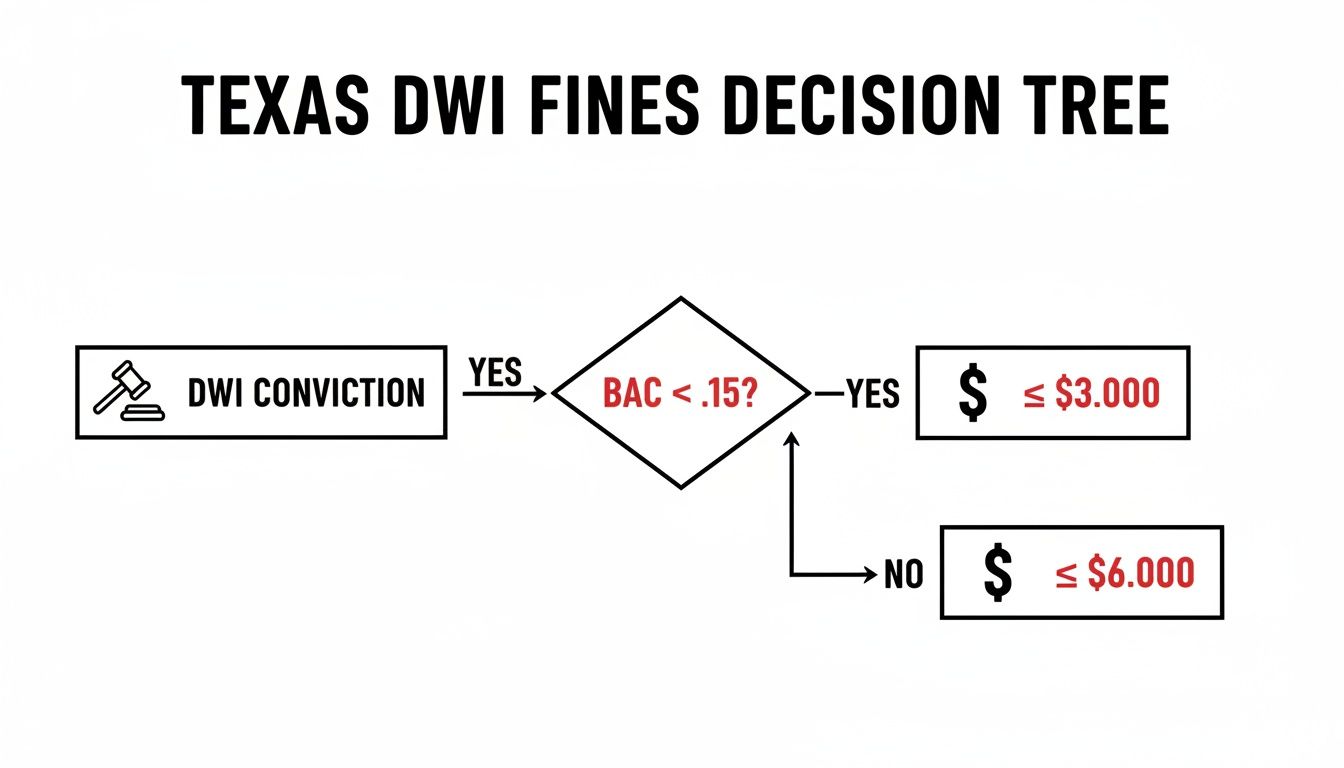
As you can see, a conviction leads directly to thousands of dollars in annual penalties. Notice how much higher that amount gets for a BAC at or above .15. It really underscores the severe financial hit you have to overcome on top of just getting your license back.
To get your license reinstated, the checklist generally looks like this:
- Pay All Reinstatement Fees: You’ll have fees owed directly to the DPS. These are completely separate from court fines or other civil penalties.
- Obtain SR-22 Insurance: You have to file an SR-22 certificate with the DPS, which is a special insurance policy proving you carry the state-mandated liability coverage.
- Complete Required Programs: The court will likely order you to complete a DWI education program or, for repeat offenses, a more intensive DWI intervention program. You’ll need to show proof of completion.
Navigating this maze of requirements can be a headache. You can find more information in our comprehensive guide to Texas driver's license reinstatement.
A DWI charge can make it feel like your life has been put on hold. Protecting your ability to drive is almost always the top priority so you can keep your job and take care of your family. A smart defense tackles both the administrative and criminal challenges head-on to keep you on the road and minimize the long-term damage to your future.
Why You Still Need An Experienced DWI Attorney In Texas
Don't let the end of the Driver Responsibility Program fool you. While those specific annual surcharges are gone, a DWI charge in Texas is still a formidable, life-altering event. The penalties that took their place are just as severe, and a conviction can derail your career, finances, and future.
This is exactly why having a strategic, experienced legal advocate in your corner isn't a luxury—it's your most valuable asset.

A DWI arrest is overwhelming. It feels like the walls are closing in. But you don’t have to face it alone. The time to start building your defense is right now, and taking a proactive approach is the single best way to protect your rights.
How to Fight a Breath Test Result and Other Evidence
From the second an officer flashes their lights, they have to follow strict legal procedures. Any mistake can be grounds for challenging the evidence. An experienced Texas DUI attorney knows exactly what to look for, meticulously dissecting every detail of your arrest.
We don't just take the police report at face value. We launch our own investigation to find the cracks in the prosecutor's case.
This analysis means asking tough questions:
- Was the initial traffic stop legal? The officer needed a legitimate, articulable reason—reasonable suspicion—to pull you over. A vague excuse like "driving late at night" doesn't cut it.
- Were the field sobriety tests done by the book? These tests are notoriously subjective and are only valid if administered under very specific guidelines. We review video footage, looking for errors in how the officer gave instructions or demonstrated the tests.
- Was the breathalyzer machine working correctly? Breath testing devices need regular maintenance and calibration to be accurate. We subpoena service records to see if the machine was in proper working order when you gave your sample.
Finding an issue with any one of these things could get critical evidence suppressed—meaning the prosecutor can't use it against you in court. This is often the first step toward getting a DWI case dismissed entirely.
Negotiating From A Position Of Strength
Not every DWI case ends in a jury trial. Often, the best outcome is achieved through skillful negotiation with the prosecutor. Prosecutors are far more likely to offer a favorable plea deal when they know they're facing a prepared, aggressive defense attorney who isn't afraid to take a case to trial.
A common goal is to get the DWI charge reduced to a lesser offense like Obstruction of a Highway, a Class B Misdemeanor that doesn't carry the same devastating, long-term consequences as a DWI conviction.
An Obstruction of a Highway plea allows you to avoid the automatic license suspension and the massive civil penalties that come with a DWI. It can be a game-changing result that saves you thousands of dollars and protects your driving record from that DWI stain.
Achieving this kind of outcome requires building a defense so strong that the prosecutor sees the real risk of losing at trial and decides a lesser plea is their best option.
Crafting A Powerful Defense For Trial
If a fair plea agreement can't be reached, your case will head to trial. An effective DWI trial defense is about more than just facts; it's about telling a persuasive story to the jury, exposing weaknesses in the state's evidence, and creating reasonable doubt.
A solid trial strategy might involve:
- Challenging the BAC results: We can bring in expert witnesses to explain issues like rising BAC levels or how certain medical conditions can affect a breath or blood test.
- Cross-examining the arresting officer: We skillfully question the officer on the stand, highlighting inconsistencies between their report, their testimony, and the video evidence.
- Presenting alternative explanations: We can offer evidence that provides another reason for your behavior—things like fatigue, allergies, or even a physical injury—that an officer may have mistaken for signs of intoxication.
The new system of hefty fines that replaced the old state of texas surcharge payments is tied directly to getting a conviction. The only way to completely avoid those crushing penalties is to win your case. An experienced DWI lawyer knows how to build that winning strategy from the ground up, giving you the best possible shot at hearing the words "not guilty."
Common Questions About DWI Penalties In Texas
When you're dealing with the fallout from a DWI arrest, the questions come fast and furious, especially about the money. Here are some straightforward answers to the questions we hear most often.
I Had A DWI Before 2019 And Owed Surcharges. Do I Still Have To Pay Them?
No, you don't. The old Driver Responsibility Program was completely repealed on September 1, 2019. Any outstanding surcharges you owed under that system were forgiven and waived. You are no longer on the hook for those specific DRP fees.
However, this forgiveness only applies to the surcharges. You are still responsible for any separate court fines, license reinstatement fees, or other penalties that were part of your original DWI conviction.
If Surcharges Are Gone, What Are The Main Financial Penalties For A First DWI Now?
Don't mistake the end of surcharges for a lighter penalty. The financial hit for a first DWI in Texas (a Class B Misdemeanor) is still incredibly steep. A conviction can bring a criminal fine of up to $2,000. On top of that, the state created a new civil penalty to replace the old surcharge system.
This new penalty is an annual fee of $3,000 for three years. And that's just the start. You're also looking at court costs, probation fees, expensive SR-22 insurance, and the cost of mandatory alcohol education classes. This is why a skilled DWI attorney's first goal is to fight the conviction that opens the floodgates to all these costs.
The new penalties can easily stack up to over $10,000, not even factoring in how much your insurance rates will skyrocket. The single most effective way to protect your finances is to challenge the underlying DWI charge from day one.
How Can I Check Why My Driver's License Is Suspended?
Stop guessing and get a definitive answer. The most reliable way to find out what's going on with your license is to go directly to the source: the Texas Department of Public Safety (DPS) online License Eligibility portal. You'll need your driver's license number, date of birth, and the last four digits of your SSN to log in.
Once you're in, the system gives you a complete breakdown of your eligibility status. It will list every single compliance issue and fee you need to take care of to get reinstated. This will show you if the hold is from an Administrative License Revocation (ALR) or a court-ordered suspension.
Can A Houston DWI Lawyer Help Reduce The New Fines That Replaced The Surcharges?
Absolutely. While the dollar amounts for the new civil penalties are set by law, a good Houston DWI lawyer doesn't just accept them—they attack the root of the problem: the DWI charge itself. By challenging the evidence, negotiating with the prosecutor, or taking your case to trial and winning, your attorney works to prevent the conviction that triggers those fees in the first place.
A strong defense can minimize the financial damage in a few key ways:
- Negotiating for a lesser charge. Getting a DWI reduced to an offense like Obstruction of a Highway means you avoid the automatic civil penalties that come with a DWI conviction.
- Winning a dismissal. If the evidence against you is weak or was obtained illegally, a dismissal means you walk away without a criminal conviction or the associated civil fines.
- Securing a "not guilty" verdict at trial. A win in court means you are not subject to any of the conviction-based penalties, period.
The fines and penalties for a lesser charge are a world away from what a DWI conviction will cost you. A powerful defense is your best financial shield. The penalties that replaced the old state of texas surcharge payments are harsh, but a conviction is never guaranteed.
A DWI charge threatens your finances, your freedom, and your future. You don’t have to go through this alone. The experienced Houston DWI attorneys at the Law Office of Bryan Fagan, PLLC are here to build the strategic defense you need to protect your rights. For a free, confidential consultation to go over your case, contact us today.